REEVES (Jesse Siddall).Livre Rare Book

1 123 résultats
244609Baltimore, The Johns Hopkins Press, september-october 1905, in-8, 134 pp. et XII pp. de catalogue d'éditeurs, demi-chagrin brun, dos lisse orné d'un N couronné, tête dorée (reliure de l'époque). Dos passé, manque à la coiffe supérieure, mors supérieur frotté. Ex-libris Charles Evan Fowler.
539 pages including index and notes. Ten thousand pages of formerly top secret U.S. Army and C.I.A. documents prove that for twenty-five years United States government agencies undertook the most extensive mind-manipulation program in the history of the world. Every conceivable method for molding the mind was explored and refined, many of them tested on unwitting American citizens. Psychologists, psychiatrists, physicians, prison officials, scientists, lawyers and politicians have, for decades, been involved in mind-control research in hospitals, laboritories, universities, mental institutions, medical offices, prisons and schools. Dramatically portrays how originally harmless medical research can become wedded to politics to create the most powerful and formidable weapons a government might use on its own citizens. Treats in detail the methods of: "brainwashing"; drugs; lobotomy; psychosurgery; castration; behavior modification; aversion therapy; electroconvulsive shock treatment; direct brain stimulation; and many more. Thoroughly documented. Authors possess extensive academic credentials. Book clean and unmarked with very light wear. Possibly unread. Light foxing to each edge of textblock. Eerily illustrated dust jacket bears light edgewear and no tears. Errata slip laid in. Please note: the U.S. and Canadian version has ISBN 0-448-22977-3. Excellent copy. Book
pp. (1), xvi, 495, 32 [Publisher's catalogue] + Engraved Portrait Frontis and two folding charts on crime and prisons. Penciled ownership of Huntington Williams, M.D. Offsetting from engraved frontis on title page. Tall 8vo. Original cloth spine over paper covered boards, worn. Original spine paper label, worn with some loss. Hardbound. John Howard (1726?-1790) was remarkable as a philanthropist, prison and civil health reformer, and traveler. Check the fine article in the Dictionary of National Biography. ENGLAND BOX 1
1334087296.Gpaperback. Good. Access codes and supplements are not guaranteed with used items. May be an ex-library book. paperback
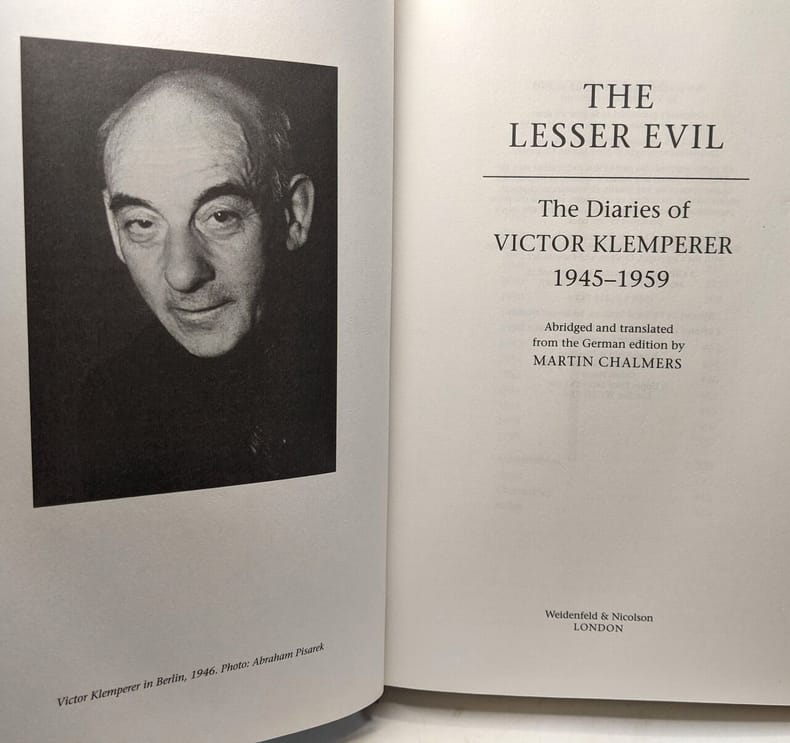
2004100126997Weidenfeld & Nicolson History 2004 500 pages 16 76x5 59x23 62cm. 2004. Cartonné jaquette. 500 pages.
1875ZB588970Philadelphia: J. B. Chandler 1875. #14 complete in original paper wrappers 159 pp. very good. - If you are reading this this item is actually physically in our stock and ready for shipment once ordered. We are not bookjackers. Buyer is responsible for any additional duties taxes or fees required by recipient's country. Philadelphia: J. B. Chandler unknown
1023516160.Ghardcover. Good. Access codes and supplements are not guaranteed with used items. May be an ex-library book. hardcover
184127566Boston: n.p. 1841. First edition. Removed. A very good copy browning along extremities. 9 pp. 8vo. The committee reported that prisons were overcrowded the legislature did not reduce the harshness of sentences so prisoners could not be release early to alleviate overcrowding and the mentally ill should be prodided different treatment. Nothing has changed in 160 years. n.p. unknown books
175 pages. Author relates his father's capture by the Japanese in the fetid jungles of New Guinea, the annihilation of his entire squad and how he, the lone survivor, was shipped to live with Australian and British POWs in a squalid, degrading camp in the Philippines that came to be known as The Hotel Tacloban. Usual library markings. Above-average wear. Binding intact. Spine leaning. Decent reading copy. Book
1978GITj030L'Age d'Homme 1978. In-8 broché couverture illustrée d'un autoportrait de l'auteur 277pp. Bel exemplaire frais et complet. Première version intégrale de ce témoignage capital sur l'histoire de la 2e Guerre Mondiale en Pologne. Né à Prague en 1896, décédé à Maison Laffitte en 1993, cet écrivain, peintre et critique d'art, offre ici, également, l'un des premiers témoignages sur l'horreur des goulags. (4737)
1334578508.Gpaperback. Good. Access codes and supplements are not guaranteed with used items. May be an ex-library book. paperback
0265159393.Ghardcover. Good. Access codes and supplements are not guaranteed with used items. May be an ex-library book. hardcover
195025986Milwaukee WI: Tee-Pee-Gee Company n.d. but ca.1950. Board game consisting of one 1 game board 21.5" x 22" set of two 2 red acrylic dice 41 round and square painted wood pieces in black white green red yellow blue and brown one black piece replaced 17 game cards 2.25" x 3.75" printed on rectos only and original instruction manual 6" x 4". Dice game pieces and cards housed in the original manufacturers two-piece box. Game board is hinged with linen lightly worn at extremities with some occasional board exposure; instruction manual is browned overall folded in half with some splitting along spine fold and holographic notes to front and rear wrappers. Box for entire game not present though it is unclear whether or not one was issued. Presumed complete. "The fascination of this game lies in the variety of ways chances and combinations in which it can be played. For instance - a player may decide to play all the men on the straight and narrow path to freedom by being pardoned or take a shorter but more risky method as a fugitive. The trials of fate and temptation may enter at any time and upset all plans. This novel game which may be played by two to six players illustrates the separation of prisoners from the outside world and their discipline and reformation. It is a game of chance and skill and the possibility of your opponents' chance to win depends upon where and how you make your moves. It will hold you spellbound from beginning to end" - opening statement from instruction booklet.<br/><br/>A prison-themed board game with a phantom manufacturer; our research has failed to reveal much information about either one though in theory and objective it bears remarkable similarities to the much later ca.1990's board game The Slammer produced by Ruppert Games. Tee-Pee-Gee can be played by up to six players and while it appears fairly easy at first glance the dynamics are quite complicated with game pieces representing inmates messengers guards and visitors. The possibility for numerous moves exists dictated by the roll of the dice cards chosen and each players respective positioning on the board. Prisoners can be released or can choose to escape with or without the help of visitors. The winner of the game is the player with all their prisoners outside the walls either as "pardoned" or "fugitives" and their visitors "in good standing" with the prison officials. Rare; we find no example for sale at the time of this writing March 2021 and no record in OCLC. Tee-Pee-Gee Company unknown books
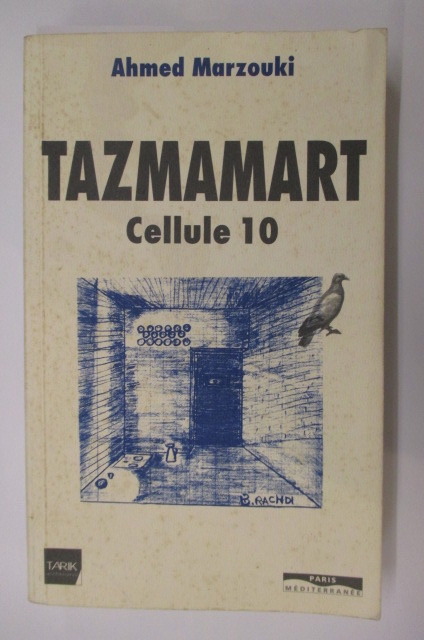
LIT707M2001 / 333 pages. Broché. Editions Tarik
193146420New York: Macmillan Company 1931. First Edition. Octavo 22cm.; publisher's maroon gilt-lettered buckram blue-green printed dust jacket; vii7318pp.; photographic frontispiece eleven leaves of photographs printed on rectos and versos. A hint of shelf wear to cloth extremities endpapers toned bottom corner of upper jacket flap clipped though upper corner retaining original price of $3.50 shallow chips along jacket extremities most notably at spine ends spine additionally a bit toned with brief soil spot at foot not affecting cloth binding else Near Fine in a Very Good copy of the scarce dust jacket. This work the result of a year-long study of penological practices across the globe from the criminal tribes in India Japanese penal institutions and the Parchman prison farm in Mississippi. John L. Gillin 1871-1958 was president of the American Sociological Association and showed little qualms at Parchman Farm's use of the strap as a disciplinary practice. Macmillan Company unknown books
ORD-8323et sous celui des satelites (sic), qui après sa mort ont propagé son systême, pour faire suite au tableau des prisons de Paris, contenant jour après jour les événemens remarquables arrivés dans ces prisons, le nom des victimes immolées à la fureur du tyran, celui des assassins qui les ont égorgés, le nombre des prisonniers et leurs différentes anecdotes par le Citoyen PESCAYRE, détenu. Toulouse. Lalanne. An III (1794-1795). In-12 (105 x 173mm) dos lisse basane brune entièrement orné or, VIII, 502 pages. En fin de volume on trouvera les noms des Citoyens détenus à la Visitation de Toulouse. Reliure de l'époque, un peu frottée mais solide, taches d'humidité sur le titre, papier lgt bruni, menus défauts mais plutôt bon exemplaire de cet ouvrage rare.
207723Paris, Michel, s. d. (1794-1795) 2 vol. in-16, 198 pp.. et 179 pp., frontispice à chaque volume bradel demi-maroquin poli bordeaux (reliure fin XIXe). Petites usures des coiffes. Ex-libris.
8693P., Michel, sans date (circa 1795).. In 18 broché, couverture muette de l’époque, 198 pp. avec un frontispice gravé.
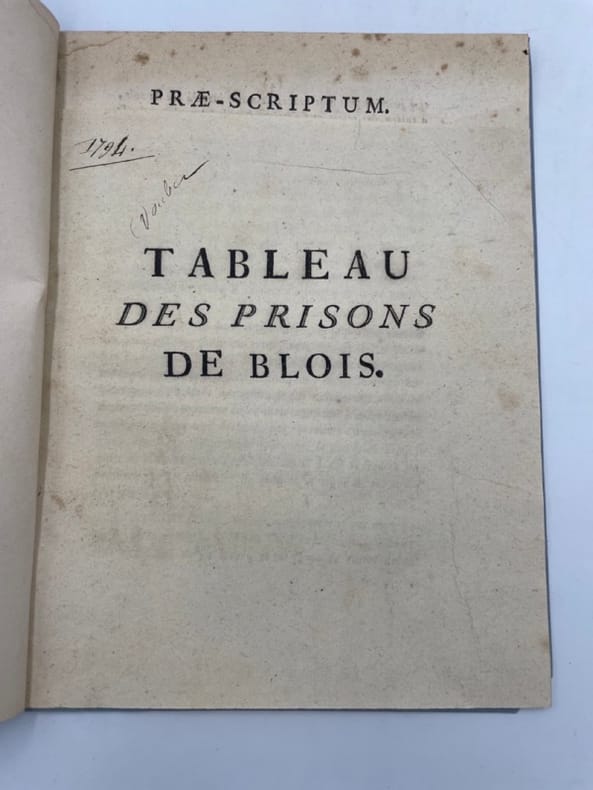
236070Blois, Imprimerie de l'auteur, an III (1794) in-4, 35 pp., broché sous couverture moderne de papier bleu imprimé. Envoi découpé au faux-titre.
189559Paris, Baudouin, 1824 in-8, 276 pp., frontispice, demi-basane noire, dos lisse orné (rel. de l'époque). Rousseurs.Coiffes usées, papier des plats usé.
1887716831887 Paris, Imprimerie et Librairie Centrales des Chemins de Fer, Imprimerie Chaix/ Marchal et Billard, Librairies (pour la deuxième partie), 1887/ 1897, 1 volume in-8 de xi-176 pages, (1) f., viii-155 pages, demi-basane taupe et cartonnage marbré, dos à 4 nerfs portant titres et date dorés, gardes marbrées.
[4]-XV-543 pages, 10 planches en lithographie Cartonnage moderne à la bradel, couvertures imprimées conservées 1853, 1853, in-4, [4]-XV-543 pages, 10 planches en lithographie, Cartonnage moderne à la bradel, couvertures imprimées conservées, Édition originale rare de cet ouvrage du docteur Almire Lepelletier (1790-1880), paru avant le célèbre Système pénitentiaire complet (1857). Il a été publié sous deux titres différents : sous celui-ci et sous Voyage en Bretagne, illustré de vues prises sur les lieux : avec (...) une histoire générale des bagnes et l'iconographie des principaux types de forçats étudiés à la chiourme de Brest. L'auteur offre ici, outre quelques considérations sur la Bretagne, un historique très complet sur l'histoire de bagnes, des réflexions sur le bagne idéal, ainsi que la description étonnante de 4 types de forçats, accompagnée de 4 portraits-types : La première catégorie "referme ces natures fortes, puissantes et riches, auxquelles une bonne direction seule a manqué pour effectuer des actions utiles, grandes, admirables" ; ce sont des hommes "à la physionomie martiale, au regard fier et dédaigneux", pour lesquels l'auteur éprouve des "regrets profonds, en voyant la nature humaine abandonnée" ; leur archétype est Pierre Cognard, le prétendu Pontis, comte de Sainte-Hélène. Le deuxième type correspond à des "natures souples, chatoyantes, suivant presque toujours, sans résistance et sans opposition, les impulsions qui leur sont imprimées vers le mal comme vers le bien". Ils rappellent "tantôt l'aspect de la fouine, du renard, tantôt celui du chat domestique" ; ce sont les incendiaires, les escrocs, les voleurs ; ce serait le type criminel d'Anthelme Collet. Le troisième type "nous offre ces natures profondément perverses qui semblent engendrées par l'enfer lui-même", commet des crimes "plutôt par goût (...) que par nécessité". Le quatrième type, enfin, "appartient aux natures grossières et stupides qui commettent le crime presque sans discernement et conscience, comme la hyène et le chacal se livrent à leurs instincts meurtriers par l'amour du sang et du carnage". Almire Lepelletier (1790-1880), membre de l'Académie de médecine, partageait, avec d'autres confrères du monde des sciences et des lettres du milieu du XIXe siècle, la foi scientiste qui consistait à distinguer des "types humains" dans une même société d'individus, théorie à laquelle il consacrera un Traité de physiognomonie en 1864. Dans le Système pénitentiaire complet, il donne en tout huit "types pénitentiaires". Réformateurs, néanmoins, il s'éleva contre les mutilations légales. Bon exemplaire, en dépit de petites rousseurs au titre et d'une fine galerie intérieure, avec très légère atteinte au texte
203223Paris, Guillaumin et Cie, 1857 fort vol. in-8, [4]-864 pp., demi-chagrin noir, dos à nerfs orné de doubles caissons à froid, double filet à froid sur les plats de toile chagrinée, tranches mouchetées (reliure de l'époque). Dos un peu frotté, mais bon exemplaire.
207473Paris, Guillaumin et Cie, 1857 fort vol. in-8, [4]-864 pp., broché. Manques de papier à la couverture.
18574040Paris, Librairie de Guillaumin et Cie, 1857. Fort vol. in-8 de 864 pp., tables, demi-chagrin noir, dos à nerfs (reliure de l'époque).