Livre Rare Book
323 résultats
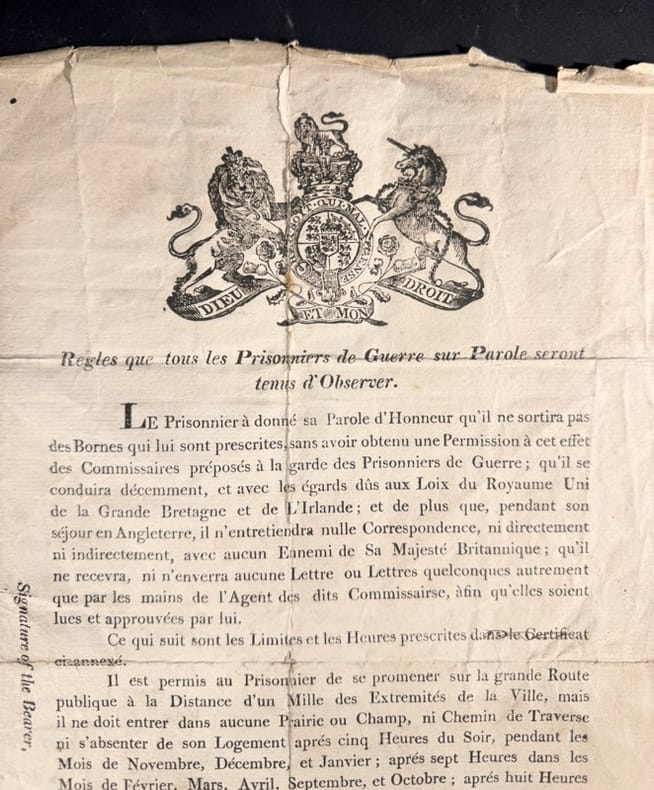
181232591812 Durant les guerres napoléoniennes, des prisonniers français étaient détenus en Angleterre et étaient prisonniers sur l’honneur.« Le prisonnier a donné sa parole d’honneur qui ne sortira pas des bornes qui lui sont prescrites (…) Il est permis au prisonnier de se promener dans la grande route public à la distance d’un mille des extrémités de la ville (…) mais il ne doit s’absenter de son logement après 5 h du soir mais il ne doit en aucun tems sortir de son logement avant 6 heures du matin. » Les officiers français juraient sur l’honneur de ne pas tenter de s’évader, ce qui pour tout homme d’honneur était une caution suffisante permettant de jouir d’une semi-liberté . Jean Gabriel Advil, lieutenant d’artillerie de Marine (1780 Dieppe, 1871 Angers) devint membre de l’académie des sciences et des belles lettres et bibliothécaire de la ville d’Angers, il a écrit plusieurs livres et fut en charge de la première école laïque de la ville. École gratuite pour 300 garçons ouverte en 1817.
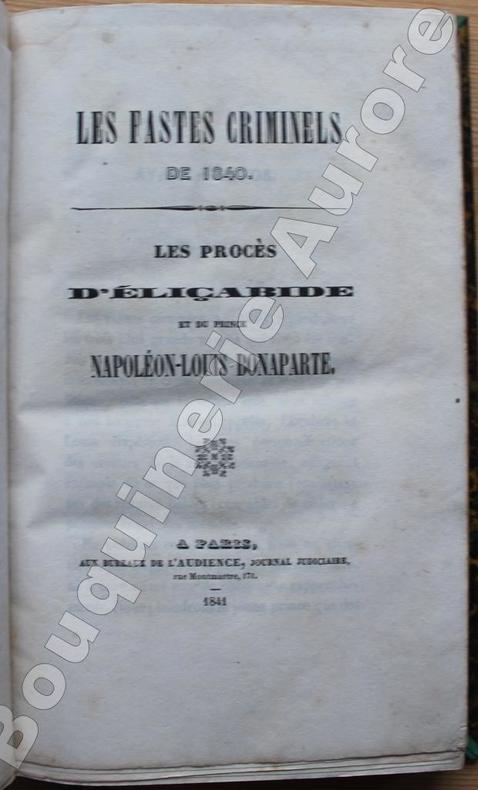
1841120941841 P., aux Bureaux de l'Audience, Journal Judiciaire, 1841, 1 vol. in-8° (230 x 140) relié 1/2 chagrin vert, dos à 5 nerfs, plats de papier marbré, de (4) ff. (faux-titre, titre et avant-propos signé de P. Millaud, directeur du journal) - 395 pp.Rares rousseurs et petite mouillure pâle angulaire, très bel exemplaire bien relié par ailleurs.
1816102195P., H. Nicolle, 1816, in-8°, [4]-lvj-444 pp, reliure demi-veau moucheté, dos lisse à doubles filets dorés, pièce de titre basane vermillon (rel. de l'époque), bon exemplaire
1877GIT0097cParis Durand et Pédone-Lauriel 1877. 3vol in-8 X 576 622 586pp. Demi chagrin acajou, dos à 5 nerfs orné de fleurons dorés, rel époque. Orné d'un croquis de bâtiment, 8 fac-similés d'autographes hors texte (affaire La Roncière). Manque 2 feuillets à la fin du Tome III (oraison funèbre). Bel exp bien relié.
18901089041890 Saint-Brieuc - Imprimerie-Librairie-Lithographie René Prud'homme - 1890 - In-12, broché, couverture rempliée - 212 p. - Quelques bandeaux en tête de chapitre
1863GITe137Paris Dentu 1863. In-8 IV 142pp. Demi basane havane, dos à faux nerfs orné de filets noirs et dorés, reliure de l'époque. Quelques pâles rousseurs, exemplaire bien complet.
1885GITj568Paris Aux Bureaux du Progrès Médical, Delahaye et Lecrosnier 1885. 2 volumes fort in-8 brochés LVIII 1 feuillet non chiffré errata et VI 605pp. Sans le 2e plat de la couverture du Tome I; pâles rousseurs sur les couverture, intérieur frais, complet, non coupé. Réimpression soignée de l'édition de 1579, tirée à 500 exemplaires, celui-ci 1 des 350 sur papier parchemin, non justifié.
1874TH155London: Ward Lock & Tyler 1874. 1st Edition . Soft cover. Vg. large 8vo. 302pp ii pub. ads UNCUT TOP EDGE. Near fine with the bold paper wrappers of the Verbatim Report. A rare original copy of the famous Tichborne Trials summing up by The Lord Chief Justice of England together with the Addresses of the Judges The Verdict and the Sentence; The Whole Accompanied by A History of the Case and Coious Alphabetical Index. Arthur Orton 1834-1898 called himself Sir Roger Charles Doughty-Tichborne to claim an estate after the real Sir Roger disappeared. A notorious Victorian trail that enthralled the nation. <br/> <br/> Ward, Lock & Tyler paperback
184335501444Angoulême, Chasseignac, 1843-1893 ; in-8 br. 4o vol Les délibérations du conseil général. Diverses Sessions de 1843 à 1893. Nombreux tableaux
1824BB056Murder Trial<br /><br />Account of the Murder of the late Mr William Weare . the coroner's inquest the trials of the prisoners and the execution. By George Henry Jones.<br /><br />London 1824.<br /><br />With 3 landscapes 2 folding plates finely lithographed by C J Hullmandel.<br /><br />8vo iv344pp; half-leather marbled boards spine label "Thurtell's Trial" lightly scuffed very solid and clean throughout.<br /><br />First edition.<br /><br />William Weare was a solicitor of Lyon's Inn and a gambler. His killer was John Thurtell 1794–1824 a sports promoter amateur boxer a former Royal Marine officer and a son of the Mayor of Norwich. Thurtell owed Weare a gambling debt of £300 an immense sum at the time equivalent to £24500 in 20151. Thurtell believed Weare had cheated him of the money. Whatever the truth when Weare demanded payment Thurtell murdered him rather than pay up. He invited Weare to join him and his friends – Joseph Hunt a tavern landlord and William Probert a former convict and alcohol merchant – for a weekend of gambling at Probert's cottage at the site of Oaks Close off Gills Hill Lane subsequently popularly known as Murder Lane23 Radlett. On 24 October 1823 they journeyed from London in Thurtell's horse-drawn gig but Weare was killed in a dark lane just short of their destination. The gruesome and callous events created such public sensation that it attracted numerous ballads and theatre shows at the time along with comment by the essayist Babington Macaulay and the crime used variously in the work of Sir Walter Scott William Hazllitt and Robert Louis Stevenson. After the trial one of the accused was hanged and another Joseph Hunt was transported to Botany Bay Australia.<br /><br />Charles Joseph Hullmandel 1789–1850 studied art and printmaking and is considered amongst the most important figures in the development of British lithography. He developed a method for reproducing gradations in tones and for creating the effect of soft color washes which enabled the reproduction of Romantic landscape paintings of the type made popular by J. M. W. Turner. Hullmandel's essay <i>The Art of Drawing on Stone</i> 1824 was an important handbook of lithography issued the same year as this account of the trial.<br />
1824BB056Murder Trial<br /><br />Account of the Murder of the late Mr William Weare . the coroner's inquest the trials of the prisoners and the execution. By George Henry Jones.<br /><br />London 1824.<br /><br />With 3 landscapes 2 folding plates finely lithographed by C J Hullmandel.<br /><br />8vo iv344pp; half-leather marbled boards spine label "Thurtell's Trial" lightly scuffed very solid and clean throughout.<br /><br />First edition.<br /><br />William Weare was a solicitor of Lyon's Inn and a gambler. His killer was John Thurtell 1794–1824 a sports promoter amateur boxer a former Royal Marine officer and a son of the Mayor of Norwich. Thurtell owed Weare a gambling debt of £300 an immense sum at the time equivalent to £24500 in 20151. Thurtell believed Weare had cheated him of the money. Whatever the truth when Weare demanded payment Thurtell murdered him rather than pay up. He invited Weare to join him and his friends – Joseph Hunt a tavern landlord and William Probert a former convict and alcohol merchant – for a weekend of gambling at Probert's cottage at the site of Oaks Close off Gills Hill Lane subsequently popularly known as Murder Lane23 Radlett. On 24 October 1823 they journeyed from London in Thurtell's horse-drawn gig but Weare was killed in a dark lane just short of their destination. The gruesome and callous events created such public sensation that it attracted numerous ballads and theatre shows at the time along with comment by the essayist Babington Macaulay and the crime used variously in the work of Sir Walter Scott William Hazllitt and Robert Louis Stevenson. After the trial one of the accused was hanged and another Joseph Hunt was transported to Botany Bay Australia.<br /><br />Charles Joseph Hullmandel 1789–1850 studied art and printmaking and is considered amongst the most important figures in the development of British lithography. He developed a method for reproducing gradations in tones and for creating the effect of soft color washes which enabled the reproduction of Romantic landscape paintings of the type made popular by J. M. W. Turner. Hullmandel's essay <i>The Art of Drawing on Stone</i> 1824 was an important handbook of lithography issued the same year as this account of the trial.<br /> books
183635501445Poitiers, Oudin, 1836-1882 ; in-8 br. 50 Vol +13 plaq. Les délibérations du conseil général. Diverses Sessions de 1843 à 1893. Nombreuses tables
186225537Paris Imprimerie Impériale 1862 Fort Petit in-4° toutes tranches dorées et petit endroit décoloré sur un plat, LXIV-863 pp
188712379Lyon, Imprimerie Pitrat Ainé, 1887 ; in-8, demi-chagrin maroquiné vert sapin, dos à nerfs soulignés de filets à froid, fleurons décoratifs dorés, titre doré, tête mouchetée (reliure de l’époque) ; (4), XLVI, 346 pp., 3 planches hors-texte dépliantes, nombreuses illustrations in-texte, certaines dépliantes.
1817634690Zürich, Orell, Füßli und Compagnie, 1817. XXIV, 351 S. Marmorierter Pappband d. Zt. (bestoßen, Rückenschild teilw. abgeplatzt). [2 Warenabbildungen]
1833632164Rostock, Adler, 1833. XII, 271 S. Pappband d. Zeit (angestaubt, Rücken gebräunt). [2 Warenabbildungen]
1874144831London: Ward Lock and Tyler 1874. First Edition. Paperback. Very Good. London Ward Lock and Tyler 1874. Octavo xvi 302 2 publisher's advertisements pages albeit the half-title is pasted to the front free endpaper. Early green cloth lettered in gilt on the spine and ruled and decorated in blind on the sides; cloth slightly rubbed and bumped at the extremities and a little sunned on the spine; ink ownership stamp to two early pages; some scattered foxing generally light; a few creases marks and short tears to a few margins; overall a very good copy bound without the original wrappers. Lord Chief Justice Cockburn's twenty-day summing-up in the sensational perjury trial of the claimant to the Tichborne baronetcy Arthur Orton a butcher from Wagga Wagga also known as Thomas Castro. The last few pages record the jury's speedy verdict of guilty. The 'History' of the case is taken from the 'Daily News' 2 March 1874. <p>Provenance: F. Frank Hobill Cole 1863-1934 Melbourne paediatrician and collector with his name-plate on the front pastedown. Ward, Lock, and Tyler paperback
18328608London Printed for the Proprietors and sold by W. Nute 1832. 1832 366 2 p. 5 plates one damaged. List of books recently published by Thomas Kelly. Contemporary half calf spine gilt and marbled boards. The front endpaper has been removed and p.171/172 partly in facsimile. A little rubbed on the edges and corners but still an attractive copy. London Printed for the Proprietors, and sold by W. Nute, hardcover
185777451857 plaquette (booklet) in-octavo, dos et couverture muets (spine and cover without title), gouttière long papier (fore-edge - great paper), tirage limité à 400 exemplaires - 1 des 370 exemplaires sur papier vergé (limited edition - 400 copies were printed), illustrations : 1 portrait en frontispice et orné de bandeaux - lettrines et de culs-de-lampe (frontispiece portrait and illuminated of headpieces and dropped initials and of tailpieces), 144 pages, 1857 à Paris Chez Auguste Aubry l'un des Libraires de la Société des Bibliophiles François,
1879GITf514Paris Marpon et Flammarion 1879 / paris librairie Générale 1871 / paris Librairie des Bibliophiles 1872 / Paris Dentu 1871. 5 ouvrages en 1 volume in-12 105pp 1 feuillet non chiffré table, 138pp 1 feuillet non chiffré table, 68pp, 70pp, VI 66pp 3 feuillets non chiffrés. Demi chagrin rouge, dos à nerfs orné de fleurons finement dorés, reliure de l'époque. Rousseurs par endroits, principalement sur les 2 premiers ouvrages. Bel exemplaire, textes bien complets, reliure de qualité, décorative, en très bon état.
1865212845Erlangen, Enke, 1865. VIII, 786 S. Modernes Leinen.
1868GITe195Paris Baillière 1868. In-8 2 feuillets non chiffrés VI-VIII 2-342pp. Demi basane blonde marbrée, dos lisse orné de chaînettes dorées, pièce de titre noire, tranches mouchetées, reliure de l'époque. Orné de 3 planches en couleurs en fin d'ouvrage, regroupant 14 figures. Bel exemplaire sans aucune rousseur, bien complet du texte et des 3 planches, dans une reliure décorative.
18142306Lerouge 14,5 x 21,5 Paris 1814 Volume in-8, reliure pleine toile bordeaux début XXe, pièce de titre de cuir rouge, titre et fleuron dorés, viii-255 p. Par un ami du Trône. Pierre Turbat (1773-1845) est l'auteur de ces Tableaux. Il avait fait paraître en 1798 le "Procès des Bourbons". Il explique dans son introduction qu'en 1798 "malgré notre courage, nous ne pouvions encore tout dire, ni tout divulguer : des hommes coupables étaient encore en place; mais aujourd'hui que nos princes légitimes sont remontés sur le trône de leurs aïeux, nous croyons qu'il est de notre devoir de mettre au jour la vérité toute entière". Pierre TURBAT du Mans (1773-1845) a été employé à la municipalité de Paris, impliqué dans la conspiration des bazinistes (au Mans), avoué, avocat, puis procureur du roi après la révolution de 1830, il est nommé juge à Alençon vers 1832.TOURNEUX, I, 3588 a. Notre exemplaire est bien complet in fine de la Liste alphabétique des Commissaires nommés dans la nuit du 9 au 10 août 1792, par les quarante-huit sections de Paris... et du Tableau des membres composant le Tribunal Révolutionnaire à l'époque du jugement de la Reine. Mouillures sur les premières et dernières pages, rousseurs, mais l'ensemble forme un bon exemplaire. Rare. (B33) PHOTOS NUMERIQUES DISPONIBLES PAR EMAIL SUR SIMPLE DEMANDE-DIGITAL PHOTOGRAPS MAY BE AVAILABLE ON REQUEST. Livre
18142306Lerouge 14,5 x 21,5 Paris 1814 Volume in-8, reliure pleine toile bordeaux début XXe, pièce de titre de cuir rouge, titre et fleuron dorés, viii-255 p. Par un ami du Trône. Pierre Turbat (1773-1845) est l'auteur de ces Tableaux. Il avait fait paraître en 1798 le "Procès des Bourbons". Il explique dans son introduction qu'en 1798 "malgré notre courage, nous ne pouvions encore tout dire, ni tout divulguer : des hommes coupables étaient encore en place; mais aujourd'hui que nos princes légitimes sont remontés sur le trône de leurs aïeux, nous croyons qu'il est de notre devoir de mettre au jour la vérité toute entière". Pierre TURBAT du Mans (1773-1845) a été employé à la municipalité de Paris, impliqué dans la conspiration des bazinistes (au Mans), avoué, avocat, puis procureur du roi après la révolution de 1830, il est nommé juge à Alençon vers 1832.TOURNEUX, I, 3588 a. Notre exemplaire est bien complet in fine de la Liste alphabétique des Commissaires nommés dans la nuit du 9 au 10 août 1792, par les quarante-huit sections de Paris... et du Tableau des membres composant le Tribunal Révolutionnaire à l'époque du jugement de la Reine. Mouillures sur les premières et dernières pages, rousseurs, mais l'ensemble forme un bon exemplaire. Rare. (B33) PHOTOS NUMERIQUES DISPONIBLES PAR EMAIL SUR SIMPLE DEMANDE-DIGITAL PHOTOGRAPS MAY BE AVAILABLE ON REQUEST. Livre
1803708901803. New York: Printed by George F. Hopkins 1803. New York: Printed by George F. Hopkins 1803. Lord Admiral Nelson Testified as a Character Witness Trial. Despard Edward Marcus 1751-1803 Primary Defendant. The Trial of Colonel Despard and His Associates For High Treason And a Conspiracy &c. &c. Before Lord Chief Justice Ellenborough and the Other Commissioners At the New Sessions-House In the County of Surry sic Great Britain 1803. Published from the London Morning Chronicle. New York: Printed by George F. Hopkins at Washington's-Head no. 118 Pearl-Street 1803. 56 pp. Octavo 9-1/4" x 5-1/2". Stab-stitched pamphlet in self-wrappers untrimmed edges. Light browning title page detached lightly soiled and moderately edgeworn with loss to corners early owner signature to head moderate edgewear and light soiling to final leaf light foxing to a few leaves. $250. Only American edition. After a brilliant military career in the West Indies where his achievements impressed Lieutenant later Lord Admiral Nelson Colonel Despard was recalled from his command and dismissed on frivolous charges. He tried to clear his name and seek compensation but his complaints led to imprisonment without trial for two years. Financially ruined and bitter he came to resent the establishment. He joined the radical London Corresponding Society and revolutionary United Irishman and took part in a plot to organize uprisings in London and Ireland the latter with support from French revolutionaries. After the plot was foiled Despard and six others were convicted of treason. A highlight during the trial was Lord Admiral Nelson's testimony as a character witness on Despard's behalf. Despard and his co-conspirators share the dubious distinction of being the last men in Great Britain sentenced to be hanged drawn and quartered. However the king commuted their sentences to death by hanging followed by decapitation. Cohen Bibliography of Early American Law 14127. unknown books