601 résultats
2000631142Köln, Heymanns, 2000. XIX, 316 S. OLwd (mit OUmschlag).
1980153819Bonn: Selbstverlag 1980. XXXIX, (1), 120 Seiten. Als Typoskript gedruckt. 8° (17,5-22,5 cm). Orig.-Broschur mit leinenverstärktem Rücken. [Softcover / Paperback].
1965142126Rouff Paris, Rouff, 1965. In-12 broché de 188 pages. Photos hors-Texte. Bon état
1973611407Freiburg im Breisgau, 1973. XXIII, 128 S. Kart.
19882091202132800374Ongaku no Tomosha 1988. Soft Cover. Fine. Number of books: 1 Ongaku no Tomosha paperback
1934521901934 Editions Emile-Paul Frères, collection "Le Crime dans l'Histoire et la Vie" N° 7 - 1934 - In-8, broché - 127 pages.
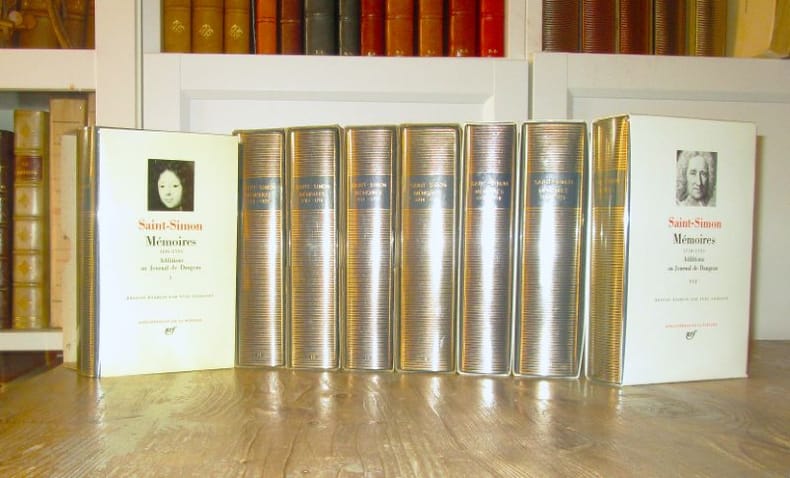
197633804Gallimard NRF "Bibliothèque De La Pléiade", 1982-1988. 8 volumes in-12 reliés (17,5 x 11 cm), reliure éditeur plein cuir vert, dos lisse orné de filets dorés, rhodoïd, jaquette imprimée et étui gris, puis étui blanc imprimé de l'éditeur, 1776-1728-1664- 1568-1744- 1504- 1648 et 1904 pages - Edition établie par Yves Coirault.. Ces volumes contiennent : Tome I : Mémoires (1691-1701) Appendice Relation du procès intenté pour la préséance par M. le Maréchal-Duc de Luxembourg... - tome II : Mémoires (1702-1708) Appendice Mémoire sur l'«étrange conduite» de Madame de Lussan (1707) - Tome III : Mémoires 1707-1710) Appendice Le Mariage du prince de Léon - Tome IV : Mémoires (1711-1714) - Tome V : Mémoires (1714-1716) Appendices Projets de protestation contre l'abaissement de la dignité de duc et pair Lettre du duc d'Orléans au chancelier Pontchartrain - Tome VI : Mémoires (1716-1718) Appendices Requêtes de Messieurs les ducs et pairs Mémoire en faveur de la liberté du commerce Extrait sur le pays de l'Alleu - Tome VII : Mémoires (1718-1721) - Tome VIII : Mémoires (1721-1723) Appendices Reliquat des additions au Journal de Dangeau Le Bonheur des Neufville-Villeroi. Très bon état et complet des 8 volumes pour ce qui concerne les Mémoires de saint-Simon.
1999703161999 Editions de Vecchi, 1999, 1 volume in-8 de 143 pages, broché.
19621141881962 A Paris, Au Cercle du livre Précieux - 1962 - Édition limitée à 2000 exemplaires, sur vélin pur fil du Marais, n° 268 - 15 volumes in-8, plein chagrin rouge; tranches de tête dorées; décor à froid et en doré sur les plats et le dos, nom de l'auteur, titre et tomaison en doré au dos - 657 p. + 694 p. + 556 p. + 378 p. + 446 p. + 476 p. + 462 p. + 576 p. + 602 p. + 522 p. + 430 p. + 650 p. + 438 p. + 472 p. + 534 p. - Iconographie hors texte en N&B - PREVOIR UNE AUGMENTATION DE FRAIS DE PORT EN CAS D'ENVOI POSTAL
19472110502150412837Hiroshima Map Co. Ltd. Hiroshima City 1947. Soft Cover. Fine. Volume: 1 Hiroshima Map Co., Ltd. (Hiroshima City) paperback
1967100150550LA GUILDE DU LIVRE 1967 in8. 1967. Cartonné. Ce livre compile les différents chefs d'accusation portés contre Marie-Antoinette ainsi que les nombreux témoignages de l'époque. Il s'agit d'une biographie construite à partir de témoignages qui présente le destin de la reine dans sa "malheureuse inéluctabilité" éclairant notamment l'influence du double jeu de Marie-Thérèse et Joseph II
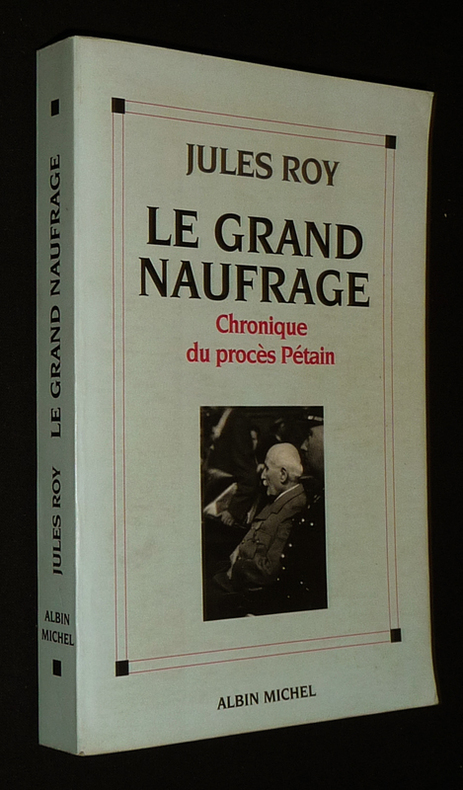
1995vk982Albin Michel Dos carré collé 1995 In-8 (13,1 x 20,1 cm), dos carré collé, 315 pages ; traces sur les plats et les tranches, par ailleurs assez bon état. Livraison a domicile (La Poste) ou en Mondial Relay sur simple demande.
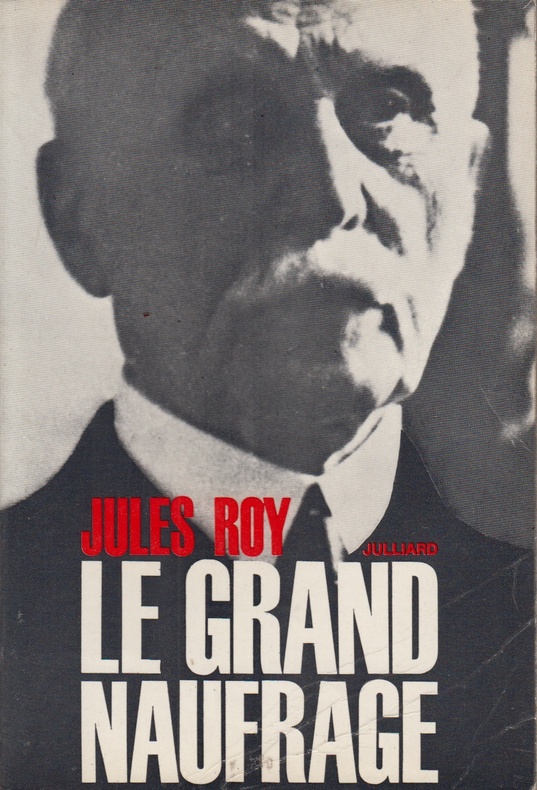
19666109Julliard, 1966, in-8°, 317 pp, broché, couv. illustrée, bon état
1990997961990 Ramsay - 1990 - In-8 broché - 254 pages - un cahier de reproductions photographiques en fin d'ouvrages
1930GITaz248Paris Librairie Artistique sd (1930). In-12 broché couverture illustrée 251pp. Orné d'illustrations hors texte.
19511903891951. The failed appeal against the "trial of the century" One of very few copies of Emanuel Bloch's appeal seeking to overturn the prosecution of the Rosenbergs at their infamous trial signed by Bloch for submission to the Court of Appeals on the final page. Bloch 1901-1954 an attorney who focused on civil rights was known for defending clients associated with left-wing and communist causes. The Rosenbergs communists accused of sending atomic secrets to the Soviets chose Bloch to lead their defence. The court found the Rosenbergs guilty of espionage in March 1951 and sentenced them to death in April following a trial widely criticized as prejudiced and motivated by Cold War hysteria. J. Edgar Hoover dubbed the case which attracted worldwide attention "the trial of the century". The Rosenbergs were granted time to prepare the appeal which Bloch submitted to the Circuit Court on 5 November 1951. Comprising 143 pages of argument extensively referenced against other legal cases and with an index Bloch sets forth his legal case. It rests on three grounds: the government had not established definite guilt the Rosenbergs had not been granted a fair trial and the "cruel and unusual punishment" violated the eighth amendment. Besides the constitutional grounding Bloch emphasizes the "frantic atmosphere" in which the Rosenbergs were arrested placing the trial within the context of the panic caused by the Soviet Union's acquisition of the atomic bomb. The appeal was denied by the three judges on the court on 25 February 1952. They reported they had carefully examined the trial record against Bloch's appeal and had found the death sentence was constitutional and would stand. Following the defeat Bloch filed a further appeal with the Supreme Court which declined to review the case. A stay on execution was granted to appeal to President Eisenhower who denied the petition. Various other legal challenges the last of which reached the Supreme Court also failed. Despite an international campaign for clemency backed by the Pope and Albert Einstein the Rosenbergs were executed on 19 June 1953. Despite the failure of Bloch's appeal his brief greatly impressed the Rosenbergs. Julius wrote to Ethel on 4 November 1951 "I read the brief and I wrote Manny Bloch telling him what a stupendous job he did and how everlastingly grateful we are for his tireless efforts for us. Darling the brief is a legal masterpiece and in addition is a literary gem. Although I don't have the background to really pass on the legal fine points I can attest to its excellent organization its meticulousness in presenting in a fair light our case the devastating logic of his points and the tremendous assiduous effort Manny exerted in preparing this document. Believe me it's a priceless piece of work from a great man. How proud we are to be considered his friends. I intend to reread it a number of times so I'll be able to better understand some of the legal points raised" The Rosenberg Letters 2013 pp. 253-4. Bloch is often seen as a lawyer unsuited to the case more suited to civil rights work than a major criminal trial. His failure to interrogate properly the government's key witness Harry Gold has been much criticized. This appeal shifted more to Bloch's speciality of constitutional and civil rights probably constitutes a stronger legal case than that which he presented in the original trial. Nonetheless the Rosenbergs were very confident in him and he became a close friend. Bloch delivered the eulogy at their funeral and took guardianship of their sons though he died soon afterwards of a heart attack. This copy of the brief is evidently one of a small number produced for official use alongside the copies which each Rosenberg received. This copy was deposited in the Civil Rights Division of the American Jewish Committee - it is marked as their file copy and subsequently "withdrawn". It is unknown how they acquired the brief - the American Jewish Committee pointedly distanced themselves from the case likely to avoid the association of Jews with communism and treachery which the case did much to encourage among the public. An inscription on the first page reads "Return to Ted Leskes" - Theodore Leskes 1908-1964 was director of the legal division of the American Jewish Committee focusing on civil rights and discrimination. We trace only one other example of the brief at the University of Kansas and no other copy in commerce. Quarto 285 x 217 mm. Containing 154 mimeographed leaves printed recto only paginated comprising i-xi index 143 pages of contents firmly staple-bound in "Accopress binder" an early likely original binding printed title page mounted to front of binder. Housed in a black cloth flat-back box by the Chelsea Bindery. Stamps of American Jewish Committee to front cover and p. i verso. Chipping around title on front cover reinforced with tape at extremities slight wear to binder extremities contents a little toned else clean. A good copy. hardcover
1993378103Lübeck, Schmidt-Römhild, 1993. XXXIV, 293 S. OKart.
1991207744Couverture souple. Broché. 171 pages. Légèrement défraîchi.
1992100150518Académie Européenne du Livre 1992 in8. 1992. Broché. Récit autobiographique de Roger Rabartin relatant son expérience personnelle d'un procès qu'il qualifie de "bidon". L'ouvrage critique le système judiciaire français à travers le prisme de son propre vécu évoquant le passage de la "justicratie" à la "justicrassie"
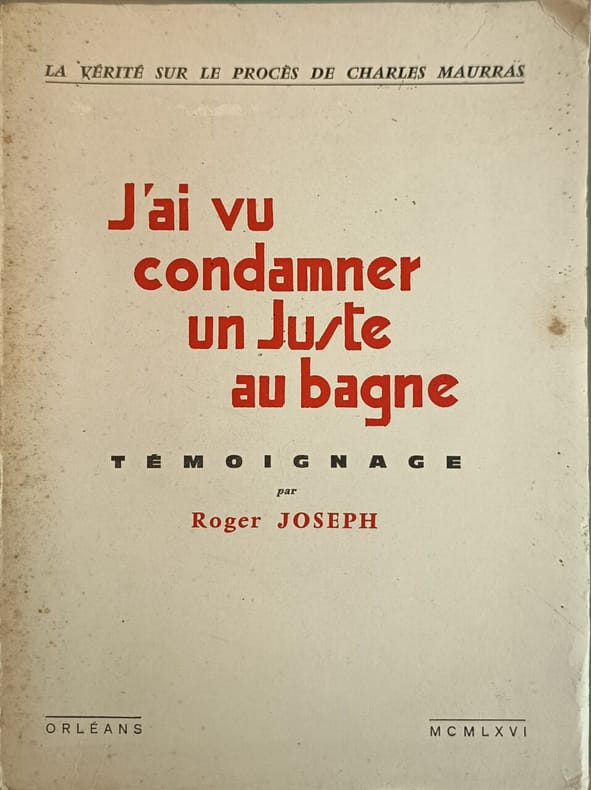
19666474Orléans 1966 137 pages in8. 1966. broché. 137 pages.
1914659851914. New York 1912-1914. Image in 30-1/2" x 24" frame. New York 1912-1914. Image in 30-1/2" x 24" frame. "His Famous Wig Composed Entirely of Split Hairs and Adorned with the Ceremonial Crimson Tape" Robinson Boardman 1876-1952. Becker-Rosenthal Murder Trial. Mr. Justice Precedent. New York 1914. 21" x 15-1/2" 53.3 x 39.4 cm gouache image on 26" x 19-1/2" 66 x 49.5 cm sheet image signed twice and inscribed by Robinson caption in pencil below image most likely in another hand laid down on illustration board. Image in 30-1/2" x 24" 77.5 x 60.9 cm wooden frame glazed. Light soiling a few minor stains and four crop-marks to margins outside of image which could be covered with a matte image fine. Several minor scuffs and nicks to frame. An exceptional unique piece of original artwork capturing a defining moment in American legal and criminal history. $3500. This striking original gouache was created to illustrate "Leaden Footed Justice in New York State" a feature article published in the Special Feature section of the New York Tribune on Sunday March 1 1914. The penciled caption reads:"Mr. Justice Precedent wearing his famous wig composed entirely of split hairs and adorned with the ceremonial crimson tape." The caricature was a scathing commentary on the notoriously protracted bureaucratically tangled legal proceedings of the Becker-Rosenthal Murder case which centered on NYPD Police Lieutenant Charles Becker who ran a massive protection racket targeting illegal Manhattan casinos. When gambling house owner Herman Rosenthal threatened to expose Becker's corruption to District Attorney Charles S. Whitman Becker hired a gang of underworld executioners including "Gyp the Blood" and "Lefty Louie" to gun Rosenthal down outside the Hotel Metropole. The investigation and subsequent trials completely dominated New York front pages. Becker's first trial began on October 7 1912 resulting in a conviction that was subsequently overturned on appeal by the New York Court of Appeals due to judicial bias. His highly anticipated second trial began on May 6 1914 just over two months after this cartoon appeared. Becker was convicted a second time and after his appeals were exhausted in 1915 went to the electric chair at Sing Sing-marking the first time in U.S. history a police officer was executed for murder. The case profoundly shook the public psyche and entered the cultural lexicon most. unknown
1914659851914. New York 1912-1914. Image in 30-1/2" x 24" frame. New York 1912-1914. Image in 30-1/2" x 24" frame. "His Famous Wig Composed Entirely of Split Hairs and Adorned with the Ceremonial Crimson Tape" Robinson Boardman 1876-1952. Becker-Rosenthal Murder Trial. Mr. Justice Precedent. New York 1914. 21" x 15-1/2" gouache image on 26" x 19-1/2" sheet image signed twice and inscribed by Robinson caption in pencil below image most likely in another hand laid down on illustration board. Image in 30-1/2" x 24" wooden frame glazed. Light soiling a few minor stains and four crop-marks to margins outside of image which could be covered with a matte image fine. Several minor scuffs and nicks to frame. A unique item relating to a notable trial. $4500. This piece was created to illustrate "Leaden Footed Justice in New York State" an article that appeared in the Special Feature Section of the New York Tribune on Sunday March 1 1914. The caption reads: "Mr. Justice Precedent wearing his famous wig composed entirely of split hairs and adorned with the ceremonial crimson tape." The caption refers to the protracted nature of the Becker-Rosenthal Murder case which began on October 7 1912 restarted on May 2 1914 and finally concluded after a series of procedural events in 1915. The case involved a group of corrupt police offices led by Charles Becker who ran a protection racket on illegal casinos. Becker hired gangsters to kill a casino owner and rival gangster who was threatening to expose the racket. A breathtaking example of police corruption the investigation and trial was front-page news in New York for months. In the end Becker was sent to the electric chair at Sing Sing. This was the first time a police officer received the death penalty. The case lived on for several years in the popular imagination; it is mentioned for example in The Great Gatsby 1925. Robinson the creator of this illustration was a distinguished artist illustrator and cartoonist. A native of Nova Scotia he studied art in Boston and completed his training in Paris at the Academie Colarossi and the Ecole des Beaux-Arts both in Paris. "Mr. Justice Precedent" shows his affinity acquired in Paris for the work of Daumier Forain and Steinlen. Robinson produced work for several newspapers and periodicals. He created "Mr. Justice Precedent" when he was an editorial cartoonist for the Tribune a posit. unknown books
19686881968 - broché - Editions Gallimard NRF - Collection "Pour une bibliothèque idéale" N° 4 - 1968 - In-12 (format poche) broché - 218 pages
1998013485Paris Charlie Hebdo 1998 In-4 Broché, couverture illustrée
1973lr717Plon Cartonné avec jaquette 1973 In-8 (13,6 x 20,8 cm), cartonné avec jaquette, 283 pages ; légère pliure au premier plat de la jaquette, par ailleurs bon état. Livraison a domicile (La Poste) ou en Mondial Relay sur simple demande.