232 résultats
19852091202133209954Hizen Hasami Sake Promotion Association 1985. Soft Cover. Fine. Volume: 1 Hizen Hasami Sake Promotion Association paperback
22164'C. B. Fields i.e. Cold Bath Fields Prison London October 14th 1824'. See Fauntleroy's entry in the Oxford DNB. Although accounts of his depravity are exaggerated Fauntleroy led a dissolute life and appropriated securities worth around £360000. During his trial at the Old Bailey he called seventeen merchants and bankers to testify to his integrity but his defence was unsuccessful and he was hanged outside Newgate before a crowd of 100000. The present item is 1p 4to. Bifolium addressed on reverse of second leaf to 'Sir Cuthbert Sharp &c &c' with endorsement. In fair condition lightly aged and worn with slight damage to inner edge of second leaf caused by removal from mount. With several folds. Written in a clear hand with a good bold signature. Reads: 'My Dear Sir Cuthbert I have heard from you with every attention what you have proposed from the Assignees to me – I will give it every consideration & shall hope in a few days to communicate with you upon the subject I remain Most faithfully Yrs H Fauntleroy'. Sharp was presumably an assignee of an estate which had suffered as a result of Fauntleroy's forgeries. 'C. B. Fields [i.e. Cold Bath Fields Prison, London] October 14th 1824'. unknown
#[17804]8º: 2 23 A-I 8 -I8 blanco gepag.: 6 142 pp. Kartonnen omslag. Knuttel 19362 Van Woensel Amurath-Effendi Hekim-Bachi ingeleid en geannoteerd door drs. J.J. Wesselo Zutphen 1974 l Satirisch pamflet over de Amerikaanse Onafhankelijkheidsoorlog. De "Hanoversche Knoopen-draaijer" is koning George III van Groot-Brittannië die uit het Huis van Hanover stamde; knopendraaierij is volgens het WNT misleiding door mooie praatjes. De afloop unknown
1817657281817. With a Duplicate Colored Frontispiece Annotated by George Cruikshank Trial. Thistlewood Arthur 1770-1820 Defendant. Watson James Defendant. Preston Thomas Defendant. Hooper John Defendant. Cruikshank Isaac 1764-1811 Illustrator. Cruikshank George 1792-1878 Annotation. High Treason!! The Whole Proceedings on the Trial of Arthur Thistlewood Gent. James Watson The Elder Surgeon Thomas Preston Cordwainer And John Hooper Labourer: Upon an Indictment Found Against Them for High Treason. Fairburn's Edition. London: Printed by W. Marchant; Published by John Fairburn 1817. 23 parts comprising 360 numbered columns. Folding frontispiece two plates. Complete. Octavo 9" x 5-3/4"; 22.86 x 14.60 cm. Original plain paper-covered publisher boards with contrasting spine untrimmed edges. Some soiling and staining moderate edgewear spine abraded and worn front board detached early owner signature L. Palmer and later owner bookplate of William Hartmann Woodin 1868-1934 to front pastedown. Moderate toning to text minor oil stains and dampstains to a few leaves. Brief annotations in pencil to front pastedown and verso folding plates both entry references to Douglas's Works of George Cruikshank interior otherwise clean. Duplicate of folding frontispiece hand-colored and with an annotation by George Cruikshank laid in. It is lightly soiled lightly edgeworn and beginning to tear along fold lines later reference annotation to Douglas bibliography to top margin. Items housed in a quarter-morocco over cloth slipcase with raised bands and gilt title to spine. Moderate rubbing to extremities. A unique copy of a rare title. $950. First and only edition. A "Fairburn's Edition" which provides the "whole proceedings" of the trials. It includes verbatim accounts of the evidence presented arguments from defense attorneys and the cross-examination of witnesses. The trials occurred during a period of significant post-Napoleonic War economic hardship and political repression in Britain. The defendants were part of a movement advocating for radical reforms like universal suffrage and land redistribution. The men organized two mass meetings at Spa Fields to protest and petition the Prince Regent. While the first meeting was largely peaceful the second on December 2 1816 devolved into a riot. unknown
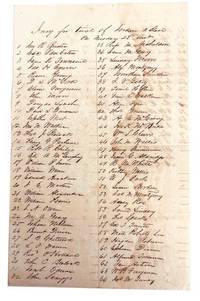
95800Very Good. Single leaf folded to form four pages with list of 83 names on first two pages. Three later horizontal folds probably for filing. Has some pencil markings beside most names -- either a red "x" or an black line. Ink note at top of one of the narrow folded section on last page:Jury of 80 Men for trial of Jorden on Tuesday 28th Inst. Waterstain -- name still quite readable -- a bit wavy but covers about the right third of both leaves as folded. No information as to date or location. Looks like it probably dates sometime in first two-thirds of 19th century. Someone might be able to narrow it down -- most juror names seem common but Plesant W. Ponder probably is not. Later pencil note in unknown hand on last page: possibly Lawrence County Alabama. unknown
1817619331817. Appeals of murder were abolished after this case. Appeals of murder were abolished after this case. "Diabolically Ravished Murdered And Thrown Into a Pit" Trial. Thornton Abraham c.1793-1860 Defendant. Horrible Rape and Murder!! The Affecting Case of Mary Ashford A Beautiful Young Virgin Who was Diabolically Ravished Murdered And Thrown Into a Pit As She Was Returning From a Dance; Including the Trial of Abraham Thornton For the Wilful Murder of the Said Mary Ashford; With the Whole of the Evidence Charge to the Jury &c. Tried at Warwick Assizes Before Mr. Justice Holroyd On the 8th of August 1817. Taken in Short Hand. To Which is Added Copious Elucidations of this Extraordinary Case; And a Correct Plan of the Spot Where the Rape and Murder were Committed &c. &c. London: Published by John Fairburn 1817. ii 60 columns 34 pp 64 1 pp. Several newspaper clippings concerning this case pasted to final leaf rear wrapper and verso of title page. Woodcut folding map of crime scene. Octavo 8-3/4" x 5-1/2". Stab-stitched pamphlet in printed wrappers untrimmed edges. Some soiling and edgewear spine and fold-lines of table reinforced fore-edge mended some toning to text. Early owner inscriptions to front wrapper "Bright" and "St John Crookes" and verso of map "St John Crookes/ Sunderland/ 1856". $950. "Third Edition." Abraham Thornton a bricklayer was accused of the rape and murder of Mary Ashford when she was found dead the morning after a dance where the two had been seen together. Thornton admitted that the two had been consensually intimate but denied the charges of rape and murder. Eyewitness accounts backed up his story and in the absence of other evidence he was acquitted of both charges. Public outcry around his acquittal led to Mary's brother William invoking an "appeal of murder." This uncommon legal practice allowed a retrial of a defendant acquitted for murder but crucially gave the defendant the right to trial by battle. Thornton invoked that right and was released after William Ashford declined the challenge. The case resulted in the abolition of appeals by murder and thus the end of trial by battle. Despite his protestations of innocence the public was thoroughly convinced of his guilt. Unable to lead a normal life Thornton moved to the United States and settled in Baltimore Maryland. One of the former owners of our copy may have been John Bright 1811-1889 a r. unknown
0265999073.Ghardcover. Good. Access codes and supplements are not guaranteed with used items. May be an ex-library book. hardcover
1528501063.Gpaperback. Good. Access codes and supplements are not guaranteed with used items. May be an ex-library book. paperback
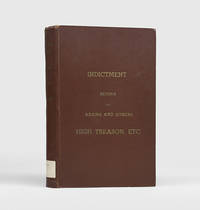
1956184698Pretoria: The Government Printer 1956. A major moment in South African history First edition of the indictment for the "Treason Trial" in which Nelson Mandela and almost the entire anti-apartheid leadership were prosecuted. One defendant Ahmed Kathrada has signed beside his name; the signature was acquired by a collector in recent years. "The core of the treason charge related to a momentous - and for the government disconcerting - event at Kliptown on the outskirts of Johannesburg on 25-26 June 1955. The delegates were drawn from the ranks of the Congress Alliance a coalition of race-based anti-apartheid groups - the ANC still Africans only the Indian Congresses the Coloured People's Congress and the white mix of communists and non-communists. They had come together to draw up the country's first democratic constitution. Out of the deliberations came the endorsement of a Freedom Charter which to western eyes was an unexceptionable statement of democratic principles and equal rights owing something to the UN Charter but virtually nothing to the Communist Manifesto" Herbstein pp. 28-9. In response 156 individuals who attended or were associated with the meeting were arrested under the 1950 Suppression of Communism Act. The trial helped unite the anti-apartheid movement and attracted worldwide support for the struggle and international condemnation of the South African government. The trial lasted over four years after which all the accused were acquitted. However soon after Mandela and other defendants were imprisoned following the Rivonia Trial. 3 vols bound in 1 as issued folio. Ex library of the South African embassy in Bonn with their stamp to the front free endpaper and their shelf label and number to spine; binding rubbed and slightly worn and shaken contents toned. A good copy. Denis Herbstein White Lies: Canon Collins and the Secret War Against Apartheid 2004. unknown
2090502130602439Nihonhyoronsha N.A. Soft Cover. Fine. Number of pages: 288p Size: 19cm Nihonhyoronsha paperback
19952090202120403720Akashishoten 1995. Soft Cover. Fine. Number of books: 1 Akashishoten paperback
19772091502135409573Not Available 1977. Soft Cover. Fine. Number of books: 1 Not Available paperback
0265166837.Gpaperback. Good. Access codes and supplements are not guaranteed with used items. May be an ex-library book. paperback
1334849161.Gpaperback. Good. Access codes and supplements are not guaranteed with used items. May be an ex-library book. paperback
0364433884.Gpaperback. Good. Access codes and supplements are not guaranteed with used items. May be an ex-library book. paperback
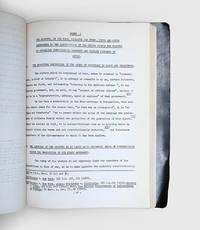
19511903891951. The failed appeal against the "trial of the century" One of very few copies of Emanuel Bloch's appeal seeking to overturn the prosecution of the Rosenbergs at their infamous trial signed by Bloch for submission to the Court of Appeals on the final page. Bloch 1901-1954 an attorney who focused on civil rights was known for defending clients associated with left-wing and communist causes. The Rosenbergs communists accused of sending atomic secrets to the Soviets chose Bloch to lead their defence. The court found the Rosenbergs guilty of espionage in March 1951 and sentenced them to death in April following a trial widely criticized as prejudiced and motivated by Cold War hysteria. J. Edgar Hoover dubbed the case which attracted worldwide attention "the trial of the century". The Rosenbergs were granted time to prepare the appeal which Bloch submitted to the Circuit Court on 5 November 1951. Comprising 143 pages of argument extensively referenced against other legal cases and with an index Bloch sets forth his legal case. It rests on three grounds: the government had not established definite guilt the Rosenbergs had not been granted a fair trial and the "cruel and unusual punishment" violated the eighth amendment. Besides the constitutional grounding Bloch emphasizes the "frantic atmosphere" in which the Rosenbergs were arrested placing the trial within the context of the panic caused by the Soviet Union's acquisition of the atomic bomb. The appeal was denied by the three judges on the court on 25 February 1952. They reported they had carefully examined the trial record against Bloch's appeal and had found the death sentence was constitutional and would stand. Following the defeat Bloch filed a further appeal with the Supreme Court which declined to review the case. A stay on execution was granted to appeal to President Eisenhower who denied the petition. Various other legal challenges the last of which reached the Supreme Court also failed. Despite an international campaign for clemency backed by the Pope and Albert Einstein the Rosenbergs were executed on 19 June 1953. Despite the failure of Bloch's appeal his brief greatly impressed the Rosenbergs. Julius wrote to Ethel on 4 November 1951 "I read the brief and I wrote Manny Bloch telling him what a stupendous job he did and how everlastingly grateful we are for his tireless efforts for us. Darling the brief is a legal masterpiece and in addition is a literary gem. Although I don't have the background to really pass on the legal fine points I can attest to its excellent organization its meticulousness in presenting in a fair light our case the devastating logic of his points and the tremendous assiduous effort Manny exerted in preparing this document. Believe me it's a priceless piece of work from a great man. How proud we are to be considered his friends. I intend to reread it a number of times so I'll be able to better understand some of the legal points raised" The Rosenberg Letters 2013 pp. 253-4. Bloch is often seen as a lawyer unsuited to the case more suited to civil rights work than a major criminal trial. His failure to interrogate properly the government's key witness Harry Gold has been much criticized. This appeal shifted more to Bloch's speciality of constitutional and civil rights probably constitutes a stronger legal case than that which he presented in the original trial. Nonetheless the Rosenbergs were very confident in him and he became a close friend. Bloch delivered the eulogy at their funeral and took guardianship of their sons though he died soon afterwards of a heart attack. This copy of the brief is evidently one of a small number produced for official use alongside the copies which each Rosenberg received. This copy was deposited in the Civil Rights Division of the American Jewish Committee - it is marked as their file copy and subsequently "withdrawn". It is unknown how they acquired the brief - the American Jewish Committee pointedly distanced themselves from the case likely to avoid the association of Jews with communism and treachery which the case did much to encourage among the public. An inscription on the first page reads "Return to Ted Leskes" - Theodore Leskes 1908-1964 was director of the legal division of the American Jewish Committee focusing on civil rights and discrimination. We trace only one other example of the brief at the University of Kansas and no other copy in commerce. Quarto 285 x 217 mm. Containing 154 mimeographed leaves printed recto only paginated comprising i-xi index 143 pages of contents firmly staple-bound in "Accopress binder" an early likely original binding printed title page mounted to front of binder. Housed in a black cloth flat-back box by the Chelsea Bindery. Stamps of American Jewish Committee to front cover and p. i verso. Chipping around title on front cover reinforced with tape at extremities slight wear to binder extremities contents a little toned else clean. A good copy. hardcover
1333158203.Gpaperback. Good. Access codes and supplements are not guaranteed with used items. May be an ex-library book. paperback
0266116663.Gpaperback. Good. Access codes and supplements are not guaranteed with used items. May be an ex-library book. paperback
194547189Krakow: Spóldzielnia Wydawnicza "Czytelnik" Czytelnik Publishing Cooperative 1945. First edition. Softcover. g to von-. Octavo 8 1/4 x 6". 93pp. 13 leaves of double sided photographic plates interleaved and unpaginated. Illustrated tan red and black wrappers with black lettering on the front cover. Photographic b/w frontispiece. Spóldzielnia Wydawnicza "Czytelnik."<br /> <br /> Possibly an earlier publication on lower quality paper compare to a slightly smaller publication by the "Library of the Union of Polish Patriots in the USSR" Biblioteczka Zwiazku Patriotów Polskich w ZSRR with the same text in different layout. That publication issued on higher quality paper and with twenty-eight photogravures three more than in this publication with twelve photographs appearing in both publications though in lesser quality here.<br /> <br /> Court Proceedings of the Polish-Soviet Special Criminal Court established in Lublin in August 1944 in order to investigate the crimes committed by the Germans in the Majdanek extermination camp. Despite the importance of this document it must be mentioned that the Commission made erroneous assumptions regarding the duration of the camp and the number of people killed at Majdanek. The Publishing cooperative "Czytelnik" was established behind Soviet front lines in 1944. It became the first post-World War II. publisher in Poland.<br /> <br /> The total numbers of the victims is still controversial: In this report 1.5 million victims of different nationalities were counted however according to the latest researches there were 79000 victims 59000 of whom were Jews See: Kranz T.: "Bookkeeping of Death and Prisoner Mortality at Majdanek." pp. 81-110. In: Silberklang D. Ed.: Yad Vashem Studies. Vol. 35:1. Jerusalem 2007.<br /> <br /> Illustrated with 25 pages of b/w photographic reproductions including a frontispiece on 13 double-sided interleaved plates altogether thirty-two photographs depicting members of the Commission Nazi guards now prisoners who used to run the camp and survivors alike testifying before the Commission. Also includes views of the actual concentration camp piles of suitcases Zyklon B poison gas pellets gas chambers ovens and survivors amid corpses.<br /> <br /> Wrappers with some chipping rubbing creasing and/or closed tears to extremities. Small stain on the back cover and side edge of book block. Verso of frontispiece with a vertical crease. Some pages throughout with some light age toning or small water spots. Overall text and images clear and vibrant. Wrappers in good interior in very good- condition overall. One of two editions of this work published in Moscow and Krakow in 1945. It is not certain which was released first. Each has different wrappers size pagination and publishers. Spóldzielnia Wydawnicza "Czytelnik" (Czytelnik Publishing Cooperative) unknown
20092090202120408676Kaibundo shuppan 2009. Soft Cover. Fine. Number of books: 1 Kaibundo shuppan paperback
19884465Wiley Law 1988. First edition. Hardcover. Very Good. 4to348 pages red cloth <br/><br/>Trial Practice Library series. Edited by Warsaw who edited WOMEN TRIAL LAWYERS and formerly "Trial Diplomacy Journal". "That trial lawyering is an art rather than a science is acknowledged by nearly all who try to teach trial advocacy. . Those with advocacy teaching experience testify that trial tactics skills and techniques that lead to success . CAN be learned by deicated study and practice. . This is down-to-earth plain lawyering talk full of the kind of information that would pass from a senior partner to an associate during a coffee break conference in a top trial firm - Foreword." Contributors include Rudy Giuliani Philip Corboy Robert Habush Gerry Spence Leonard Ring Jill Wine-Banks etc. Wiley Law hardcover
0444880054.Ghardcover. Good. Access codes and supplements are not guaranteed with used items. May be an ex-library book. hardcover
19582090502113718002Not Available 1958. Soft Cover. Fine. The book is in fine condition. Not Available paperback
nosku747This is the OVERSIZED it didn't fit in my scanner! hardcover stated Boston Edition from 1984. Both the cover and the book are in positively excellent condition. There are no rips tears markings etc. and the pages and binding are tight. This wonderful impossible-to-find item is available for purchase now! Note: All books listed as FIRST EDITIONS are stated by the publisher in words or number lines--or--only stated editions that include only the publisher and publication date. NAME YOUR PRICE!!! Due to the vagaries of market fluctuations an item's listed price should be considered a guideline. Serious buyers are welcome to make a on each and every item listed with the assurance that ALL reasonable offers will be accepted!Like New hardcover
19812092902143900353Not Available 1981. Soft Cover. Fine. The book is in fine condition. Not Available paperback