La Hodde (Lucien de ; 1812-1863) :Livre Rare Book

609 résultats
185020201Paris, Julien, Lanier et Cie (Le Mans, imprimerie de Julien, Lanier), 1850 ; in-8, demi-chagrin bordeaux, dos lisse à faux nerfs dorés, titre doré (reliure de l’époque) ; X-511 pp.
1969474621969 Editions Plon - 1969 - In-8 cartonnage éditeur avec sa jaquette illustrée - 315 pages
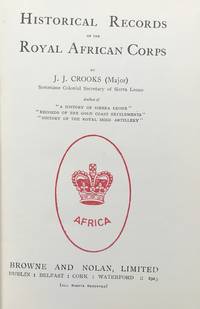
192557810RARE HISTORY OF AN COLONIAL ARMY CORPS <br />first edition small 8vo. viii 136 2 bibliography & advt.pp. maroon cloth lettered and with a design in black on upper cover fine bright copy essentially as new. Rare especially so in this condition. <br />Library Hub formerly COPAC locates only in Cambridge T.C.D. Aberdeen London Library & Instit. Historical Research. OCLC adds only a copy in France. <br />The Royal African Corps 1800-1821 an infantry unit in the British Army grew out of Fraser's Corps of Infantry which had been raised in 1800 for the defence of the Island of Goree off the Senegal coast. It was renamed the African Corps and then in 1804 the Royal African Corps. It was composed primarily of deserters and prisoners with some additional indigenous African soldiers being attached to make up numbers and it was used for colonial garrison duty often of penal establishments. In 1806 the Corps was split with a section sent to the West Indies as the Royal West India Rangers. The remainder sometimes called the Royal York Rangers continued to perform garrison duties in various African colonies until 1819 when the four companies serving in Sierra Leone and Gambia were disbanded. Another section which had been sent to Cape Colony in South Africa and which included foreigners as well as British Army deserters and convicts was disbanded in 1821. <br />Crooks Queen's County now Laois 1842 - 1928 Irish soldier colonial administrator and writer was educated at the Royal Hibernian Military School Dublin where he stayed until 1857 when he enlisted in the British Army. He served in west Africa during the third Anglo-Ashanti War in an Army Service corps probably in the Royal Artillery from 1873 to 1874. He was promoted from Staff sergeant to assistant commissary on probation on 8th September 1873 and later became a Deputy Commissary with the rank of Major. He was for a time colonial secretary or administrator of Sierra Leone. On retirement and return to Dublin he published a series of books on military and colonial history. There is a full account Crooks services in the Dec. 1898 issue of <i>Hibernia. Quarterly Magazine of the Royal Hibernian Military School</i> but we have not been able to examine a copy only recorded copy in B.L. He apparently had a great interest in that magazine and was a frequent contributor. This copy was until recently in Crooks family ownership. Browne and Nolan hardcover
2006x-1847345220Naval & Military Pr 2006. Hardcover. New. 380 pages. 8.50x5.50x1.00 inches. Naval & Military Pr hardcover
1847345220.Ghardcover. Good. Access codes and supplements are not guaranteed with used items. May be an ex-library book. hardcover
1845741730.Gpaperback. Good. Access codes and supplements are not guaranteed with used items. May be an ex-library book. paperback
2006DADAX1847345220Naval & Military Press 2006-06-20. hardcover. New. 5.50x1.00x8.50. Buy with confidence. Excellent Customer Service & Return policy. Naval & Military Press hardcover
ria9781847345226_inpHardcover. New. New Book; Fast Shipping from UK; Not signed; Not First Edition; N/A hardcover
1914001900Dublin: Browne and Nolan Limited 1914. 1st Edition . Hardcover. Very Good/Poor. 8vo format - 7.5" tall. A history of the Royal Irish Regiment of Artillery between 1755 and 1801. This is a presentation copy from the author to R. J. Crowe who claims to have helped him in his researches. Internally very good in original cloth which is a little marked and faded to fore-edge of top board. Minor water staining to margins of frontispiece and portrait of author and with spot foxing to tops of final five pages of index. Inscribed on ffep and with marginalia to two pages from J. J. Crowe. Uncommon. <br/> <br/>A detailed history of the Royal Irish Regiment of Artillery between 1755 and 1801. Browne and Nolan, Limited hardcover
B9781847345226Hardback. New. hardcover
188312345Paris, E. Plon et Cie, 1883 ; in-4, demi-chagrin maroquiné rouge cerise à coins, dos à nerfs soulignés de filets à froid et dorés, caissons richement décorés et dorés, titre doré, doubles filets dorés sur les plats, tête dorée, non rogné (reliure de l’époque) ; (6), 412 pp. ; 10 planches en héliogravure et 1 carte dépliante en couleurs hors-texte, très nombreuses illustrations in-texte, 17 à pleine page.
1803073063.Gpaperback. Good. Access codes and supplements are not guaranteed with used items. May be an ex-library book. paperback
1803073071.Ghardcover. Good. Access codes and supplements are not guaranteed with used items. May be an ex-library book. hardcover
2012DADAX0205867189Routledge 2012-10-11. 6. paperback. New. 0.70x6.00x8.90. Buy with confidence. Excellent Customer Service & Return policy. Routledge paperback
20041-081302708XUniv Pr of Florida 2004. Hardcover. New. 304 pages. 9.00x6.25x1.25 inches. Univ Pr of Florida hardcover
081302708X.Ghardcover. Good. Access codes and supplements are not guaranteed with used items. May be an ex-library book. hardcover
0813010675.Ghardcover. Good. Access codes and supplements are not guaranteed with used items. May be an ex-library book. hardcover
1991444938Jacksonville: University of North Florida Press 1991. Hardcover. Fine/Fine. First edition. Tall octavo. 193pp. Fine in fine dustwrapper. University of North Florida Press hardcover
20048623bdGainesville: University Press of Florida 2004. First Edition Advance Review Copy with publisher’s letter laid-in. Octavo red cloth & white boards hardcover xx 274 pp. Fine in a Fine dust jacket. From dust jacket: In the 1950s and ‘60s Jacksonville faced daunting problems. Critics described city government as boss-ridden expensive and corrupt. African Americans challenged racial segregation and public high schools were disaccredited. The St. Johns River and its tributaries were heavily polluted. Downtown development had succumbed to suburban sprawl. Endorsed by an almost two-to-one majority in 1967 the city of Jacksonville’s decision to consolidate with surrounding Duval County began a transformation of this conservative Deep South backwater city into a prosperous mainstream metropolis. James B. Crooks intorudces readers to preconsolidation Jacksonville and then focuses on three major issues that confronted the expanded city: racial relations environmental pollution and the revitalization of downtown. He shows the successes and setbacks of four mayors -- Hans G. Tanzler Jake Godbold Tommy Hazouri and Ed Austin -- in responding to these issues. During the administration of Mayor Hazouri from 1987 to 1991 Crooks was Jacksonville historian-in-residence at City Hall. Combining observations from this period with extensive interviews and documents he has written an urban history that will fascinate scholars of politics and governmental reform as well as residents of the First Coast City. University Press of Florida, (2004). First Edition, Advance Review Copy, with publisher’s letter laid-in. hardcover books
200808859Paris, Dargaud, 1989 ; in-4, 63 pp., cartonnage de l'éditeur. Eo.
2008Q-0373295014Harlequin Historical 2008-05-27. Mass Market Paperback. New. In shrink wrap. Looks like an interesting title! Harlequin Historical paperback
Fine English Paperback. Pbo. Fine+. Roy. 8vo. (24 x 17 cm). In Turkish. Color ills. 162 p. History and biography of a Cypriot bandit. Under Ottoman rule, in 1571 was introduced the "Millet" system in Cyprus: members of different religions were considered a single "Millet" 'nation' and each Millet had its own religious and educational institutions as well as civil law; the result could be considered self-government (Çevikel 1997). When Cyprus became under the British rule in 1878, the Millet system was maintained with some modifications. It was in these circumstances that the events underlying the epic of the Hasanbullis took place (Gürkan NA; Ismailoglu NA): Turkish Cypriot brothers nicknamed Bulli hid in the mountains in 1887-1888 and 1894-1896 as they believed they were unjustly accused and sentenced. During that time they committed several crimes. Despite this, both Turkish and Greek Cypriots regarded the Hasanbulli brothers positively as people fighting against the regime. Ten to fifteen years later, two epics in Turkish and Greek, plus various publications and works of art based on the event were written (see e.g. Kareklas 1938; Machlouzarides 1973; Gelen 1973; Ismailoglu; Islamoglu 1994; Serdar 1986; Yorgancioglu 1980: 100-102; Sayil 1988: 18; Fedai 1993: 1-7; Gökçeoglu 1993; Gürkan NA; Lyssarides 1995: 11; Bozkurt 1996: 59-64; 1998; Cahit 1997; Sadikoglu 1999: 34; 2000: 34). In these works the events were treated differently: Greek Cypriots depict the Hasanbullis as bandits while the Turkish appear to be brave heroes who rose against the British rule. The current article aims to analyse and discuss differences between these two approaches. THE CASE OF HASANBULLIS In May 1887, at a small village in the impoverished region of Paphos, where the Turks and Greeks live in mixed communities, a Turkish youngster Hasan Ahmet Bulli is unjustly accused of theft. False witnesses as well as his own quickness (which lead him to be nicknamed Bulli, 'bird' in Greek) play a role in the accusation. Once Hasan Ahmet Bulli is convicted, he arms himself and takes to the mountains. He wanders about in the mountains for 18 months, committing murders and fighting with the police. He is caught when he is sheltering at a house during a spell of malaria. He is sentenced to death but his punishment is then converted to life imprisonment. Six years later, in 1894, Ahmet Hasan Bulli's brothers Kaymakam and Hüseyin Ahmet Bulli take to the mountains when accused of committing a murder after one Greek Cypriot is killed in a Turkish- Greek fight over a woman. With others joining them, they form a powerful gang and continue their activities at the mountains until 1896. In the meantime, the elder brother Hasan escapes from prison to join his brothers, but he is shot dead. In 1896, one of the brothers, Hüseyin is killed at a confrontation with the police; Mehmet and other members of the gang are captured and executed by hanging. The Hasanbullis case considerably preoccupied the British administration in Cyprus and it eventually became a matter of prestige. It is obvious that both the Turkish and the Greek in Cyprus saw Hasanbullis as people who rose against the British administration: despite the fact that the British Colonial Regime offered rewards for their capture and enacted special legislation for it, and despite the security troops pursuing them and the use of hired informers, the Hasanbullis managed to live at the mountains for a long time. Unquestionably this was possible only thanks to people who protected, hid, supported, fed, and informed them of any danger. Source: Ethnic perspective in epics: The case of Hasan Bulliler., Ismail Bozkurt.
205paris 1982 in 8 broché 177 pages
19911100571991 Editions Plon - 1991 - In-8, broché, couverture illustrée - 331 p.