68 résultats
19107Receipt of His Majesty's Exchequer London. 6 May 1715. 1p. on 15 x 17.5cm. Aged and worn with loss to edges and laid down on part of a leaf removed from an album. The usual printed text completed in manuscript recording a payment of £25. Note: An account of the 1699 Sarah Stout murder trial at which Cowper 'called expert medical testimony including the famous physicians Samuel Garth and Hans Sloane together with the anatomist William Cowper not related' is given in his entry in the Oxford DNB. [ Receipt of His Majesty's Exchequer, London. ] 6 May 1715. unknown
1824BB056Murder Trial<br /><br />Account of the Murder of the late Mr William Weare . the coroner's inquest the trials of the prisoners and the execution. By George Henry Jones.<br /><br />London 1824.<br /><br />With 3 landscapes 2 folding plates finely lithographed by C J Hullmandel.<br /><br />8vo iv344pp; half-leather marbled boards spine label "Thurtell's Trial" lightly scuffed very solid and clean throughout.<br /><br />First edition.<br /><br />William Weare was a solicitor of Lyon's Inn and a gambler. His killer was John Thurtell 1794–1824 a sports promoter amateur boxer a former Royal Marine officer and a son of the Mayor of Norwich. Thurtell owed Weare a gambling debt of £300 an immense sum at the time equivalent to £24500 in 20151. Thurtell believed Weare had cheated him of the money. Whatever the truth when Weare demanded payment Thurtell murdered him rather than pay up. He invited Weare to join him and his friends – Joseph Hunt a tavern landlord and William Probert a former convict and alcohol merchant – for a weekend of gambling at Probert's cottage at the site of Oaks Close off Gills Hill Lane subsequently popularly known as Murder Lane23 Radlett. On 24 October 1823 they journeyed from London in Thurtell's horse-drawn gig but Weare was killed in a dark lane just short of their destination. The gruesome and callous events created such public sensation that it attracted numerous ballads and theatre shows at the time along with comment by the essayist Babington Macaulay and the crime used variously in the work of Sir Walter Scott William Hazllitt and Robert Louis Stevenson. After the trial one of the accused was hanged and another Joseph Hunt was transported to Botany Bay Australia.<br /><br />Charles Joseph Hullmandel 1789–1850 studied art and printmaking and is considered amongst the most important figures in the development of British lithography. He developed a method for reproducing gradations in tones and for creating the effect of soft color washes which enabled the reproduction of Romantic landscape paintings of the type made popular by J. M. W. Turner. Hullmandel's essay <i>The Art of Drawing on Stone</i> 1824 was an important handbook of lithography issued the same year as this account of the trial.<br />
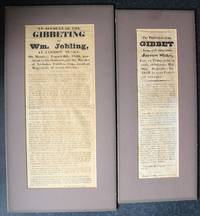
18321579<p>2 original printed text broadsides. "<em>An Account of the Gibbeting of Wm Jobling at Jarrow Slake On Monday August 6th 1832 pursuant to his Sentence for the Murder of Nicholas Fairles Esq resident Magistrate of South Shields" Printed by W. Boag of Newcastle</em> size approx. 14 1/4" x 6 3/4" and <em>"The Particulars of the Gibbet being stole away from Jarrow Slake Late on Friday Night or early on Saturday Morning September 1st 1832 by some Persons yet unknown" Printed by Douglas and Kent of Newcastle </em>size approx. 14 3/4" x 4 3/8". Affixed to the upper corners to thin cream card with brown thick board mounts. Good complete condition browned with evidence of previous horizontal folds. Previous auction lot details affixed to rear board.</p><p><em>Two rare original accounts of the hanging pitching and gibbeting of William Jobling a striking pitman who had been convicted as accomplice in the murder of Nicholas Fairles on the 11th June 1832. And of the subsequent disappearance of his body reputedly removed by Jobling's friends risking seven years transportation. The practise of gibbeting was abolished shortly afterwards in 1834. </em></p><p>Please Note : International postage costs outside the UK are likely to be more expensive than initially quoted by Biblio due to the oversize nature of this item</p> W. Boag Printer & Douglas and Kent Printers
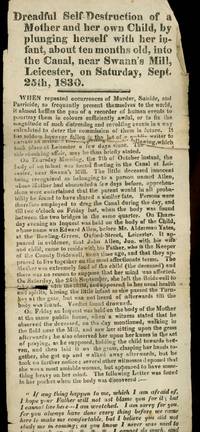
1830z011783Nottingham England: J. Plant 1830. other. Very Good. Clipped article from a Nottingham periodical recounting the lurid murder suicide of a Mrs. Allen and her infant son Edward whose bodies were dredged from the Canal at Leicester in a terrible state of decomposition in October of 1830- a minor local sensation as Mrs. Allen "never indicated the slightest symptoms of insanity". Clipping measures 5 by 14 inches printed on verso only. Very good. Creasing edge wear one inch perforation along crease else complete and unmarked. Digital images available upon request. RARE no copies available on OCLC. J. Plant unknown
18328608London Printed for the Proprietors and sold by W. Nute 1832. 1832 366 2 p. 5 plates one damaged. List of books recently published by Thomas Kelly. Contemporary half calf spine gilt and marbled boards. The front endpaper has been removed and p.171/172 partly in facsimile. A little rubbed on the edges and corners but still an attractive copy. London Printed for the Proprietors, and sold by W. Nute, hardcover
Gilder, Joshua and Anne-LIn Pristine Condition. unknown
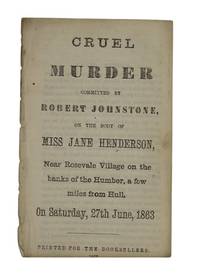
1863AQ33168Glasgow: Printed for the booksellers 1863. 8pp. Disbound. Title page shaved at foot with slight loss to imprint. A prose and verse chapbook recounting the brutal murder of Jane Henderson by her lover Robert Johnstone in 1863 on the outskirts of Hull. On 27th June Johnstone stabbed Henderson multiple times before disposing of her body in a nearby river. The pair had been conducting an illicit affair for a considerable time. Henderson had become pregnant and Johnstone desirous to be rid of her in favour of another woman conspired to murder. Henderson's corpse was soon discovered and upon a person a letter written by Johnstone to lure her to the place of her murder. Johnstone was swiftly arrested and imprisoned. His fate is unrecorded. 'Her throat then I cut while the blood flowed profusely Then she fell like a corpse most dreadful to view; My crime to conceal I drew her near the water And into the Humber her body I threw'. . 16mo. Printed for the booksellers unknown
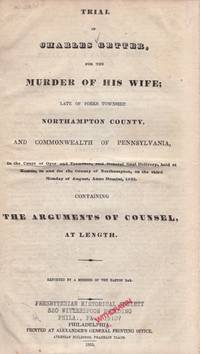
183335550Philadelphia: Printed at Alexander's General Printing Office 1833. First Edition. Hardcover. Good. Octavo. Hardcover. Ex-institutional copy. 72 pages. Original wraps without the outer covers bound in black cloth covered boards with copy of the title pasted down on the front cover. Gilt lettered title on the spine. New tan end sheets front and back. Page 1 is the title page and has two stamps at the bottom: Presbyterian Historical Society Philadelphia and a red withdrawn stamp. Print is small and contents are clean. <br /> <br /> McDade 335 - "Getter convicted of fornication and bastardy was given the option of marrying the girl he had wronged; six weeks later saddled with a wife he did not want he choked her to death.â€. From wikipedia:<br /> <br /> Getter's Island previously known as Abel's Island is a small island in the Delaware River in Easton Pennsylvania in the United States. It is best known as the location of the execution of Charles Getter the last person to be publicly executed in Pennsylvania. History edit Execution of Charles Getter edit The island is named after Charles Getter a farm hand who was hanged on the island in 1833 for the murder of Margaret Lawall a woman he married to avoid prosecution for impregnating her outside of wedlock. Getter's execution was initially scheduled to take place at Center Square in Easton but it was moved to the island - then known as Abel's Island - to accommodate the crowds.<br /> An estimated 15000 to 20000 people some of whom traveled hundreds of miles gathered in the town to view the execution. 12 An initial attempt to hang him failed forcing a second attempt which resulted in his death. A reporter who witnessed the scene was horrified at how little the crowd was affected by the execution and called on lawmakers to take action. 2 Governor George Wolf agreed with the reporter and signed a law banning public execution on April 10 1834. As a result Getter was the last person in Pennsylvania to be publicly executed. 2. Printed at Alexander's General Printing Office hardcover
1693D12884Printed by Edward Jones. and Published by him and Randal Taylor 1693. First Edition. Hardcover. Near Fine. Modern half calf and marbled paper gilt-stamped lettering on spine; 300x187mm; pp. 4 64. Binding is fine. Text block browned as expected; tiny chips at corners of first two leaves. <br/><br/>In December 1692 the young but already dissolute Cornish peer Charles 4th Lord Mohun was involved in a fracas arising from a botched attempt to kidnap the popular actress Anne Bracegirdle. Mohun was acting as accomplice to a young army officer Captain Hill who had taken a fancy to Bracegirdle and decided not to take no for an answer. Their plan to bundle her into a coach was thwarted by the intervention of several of Bracegirdles neighbours but principally by her fellow actor William Mountford. In the ensuing scuffle Mountford was stabbed; he died shortly after. His trial was one of the society events of the year as Mohun had already been part of numerous duels and brawls and tho he was not yet a member of the House his father had been a good Whig and the young Lords future vote was not something that either party were keen to squander. His acquittal proved as sensational as the trial itself had been. One newsletter commented bitterly that a commoner would not have been so fortunate; others debated the intricacies of an attempted appeal that it was thought Mountfords widow intended to lodge but which was expected to be stifled by the Lords. Perhaps most intriguing of all was the conclusion drawn by Queen Mary herself that the verdict was symptomatic of a rot at the very heart of society. Mohun did not learn his lesson. He continued to brawl and only a few years later he was again arrested for another murder of an apparently unrelated Captain Hill. On this occasion he was spared a trial though and took advantage of a royal pardon. Over the next few years he repaid his Whig colleagues trust in him by proving a dependable lieutenant in the House. He may well have been fulfilling precisely the same role when he took the field against the Tory Duke of Hamilton with fatal consequences for both. Printed by Edward Jones... and Published by him and Randal Taylor hardcover
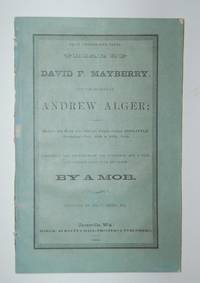
38036Janesville Wis.: Barker Burnett & Hall Printers & Publishers 1855. First edition 8vo 205 x 135 mm 48pp. some light spotting orig. green upper printed wrapper lower wrapper missing disbound. "Mayberry knowing Alger was returning with a sum of money met him on the road in Harmony Wisconsin and killed him with a hatchet while riding with him. Wisconsin had abolished the death penalty and a mob seized Mayberry after his conviction and hanged him in the streets."McDale. McDale The Annals of Murder. Janesville, Wis.: Barker, Burnett & Hall, Printers & Publishers, 1855 unknown
26500Rochford Essex Police Constabulary. Entries dated from the Chief Constable's Office Chelmsford. 6 December 1881 to 30 October 1885. 179pp. foolscap 8vo and contains 332 general orders by 'W. H. Poyntz Major and Chief Constable'. The volume is entirely in manuscript but is not in Poyntz's handwriting. It comprises 168 paginated pages followed by an eleven-page index giving a one-line summary of the 'Purport' of each order. The volume is a ruled notebook in original quarter binding of black cloth spine and marbled boards with the words 'GENERAL ORDERS' printed on a label on the cover with 'Rochford' written in manuscript beneath. Complete and entirely legible on aged and worn paper with a few loose leaves and shaken in heavily worn binding. A detailed and informative volume casting a fascinating light on Victorian provincial policing he entries reflecting the exacting standards of the chief constable. Subjects include procedure punishments pay registrations and promotions leave uniform 'Belts to be worn with Tunics and Great Coats' 'Winter and Summer Gloves' 'Parade in Uniform Boots' 'the length of the Constables hair' drinking on duty 'Gambling and raffling in Public and Beer Houses' transcriptions of letters from the Home Office the giving of testimony 'disused Mine Shafts' 'Boiler explosions'. The most significant entry relates to the murder of Inspector Thomas Simmonds: 'General Order 284 28th. January 1885 The Chief Constable has much gratification in promoting P.C. 107 Alfred Marden to a 1st. Class and at the same time a “Merit†Class Constable for gallant and meritorious Conduct in having on the 20th. instant at Hornchurch within the Liberty of Havering atte Bower after his Superior Officer Inspector Simmons had been struck down by a shot from a revolver fired by one of three armed Burglars whom they were about to search Continued the pursuit of two of these men by himself notwithstanding that while so doing two shots were discharged at him The Conduct of this young Office reflects high credit on himself and through him on the Essex Constabulary'. General Order 314 18 July 1885 reads: 'The Chief Constable directs that Superintendents and Officers in charge of Petty Sessions are to be very particular watching the manner that Constables give evidence when in the Witness Box. Nothing looks worse than its being given in an indistinct and hesitating manner and where such is apparent instruction and practice should be afforded the officer. A Constable must stand straight up at “attention†and not “fiddle about†with his hands in a nervous sort of manner. As putting on the right hand glove after taking the oath seems rather to unsettle some officers and as difficulty seems frequently to arise in replacing it that part of General Order No. 166 dated 15th October 1883 relating thereto is hereby Cancelled'. An example of 'Punishments' is issued 'for the information of Divisions' as General Order 291 23 February 1885: 'P.C. 92. G. Hurrell 1st. Class is – for having been found partially undressed and asleep in a hut while on duty at 2 A.M. on the 10th. instant and for making a false preort against his Inspector – dismissed from the Force P.C. 175 N. Paye 1st. Class 128 A. Whalley 2nd. Class and 138 A. Sweeting 3rd. Class are – for not using proper diligence to return to their Station at Greys when sent to London on duty thereby missing the train and remaining away all night – each fined half a days pay viz: Paye 1s11d Whalley 1s/8d and Sweeting 1s/7d This not being the first Case of the kind that has occurred the Chief Constable wishes it to be clearly understood that any similar neglect of duty will be severely dealt with.' Born in Dublin Poyntz joined the Royal Marine Light Infantry in 1853 and reached the rank of Major serving in Hong Kong China Japan and Woolwich. Chief Constable of Nottingham 1872-1881; and Chief Constable of Essex 1881-1887. For information on his career at Essex see Chapter 5 'Major Poyntz makes Changes 1881-87' of Maureen Scollan's 'Sworn to Serve: Police in Essex 1840-1990' 1993 according to which he put 'new ideas in action' and faced ' public order problems involving Salvation Army and Guy Fawkes festivities'. Under Poyntz 'officers of all ranks were reminded to call on important members of the community when they changed station' while Poyntz himself 'would often appear unannounced when cases were being heard by local justices and sometimes commented unfavourably on the way his officers gave their evidence' see G.O. 314 above. 'Major Poyntz was constantly reminding the superintendents of their responsibilities and their need to check everything from the renewal of pedlars' certificates to the health of their men. They were even ordered to inspect the drains'. [ Rochford, Essex Police Constabulary. ] Entries dated from the Chief Constable's Office, Chelmsford. 6 December 1881 to 30 Octo hardcover
34284Edinburgh: Edinburgh: Printed for G. Hamilton and J. Balfour 1753. First edition 4 288 149 1pp. folding engraved map Birmingham Law Society stamp on title recent half calf marbled boards spine gilt red morocco title label. The Appin Murder occurred on 14 May 1752 near Appin in the west of Scotland and it resulted in what is often held to be a notorious miscarriage of justice. It occurred in the tumultuous aftermath of the Jacobite Rising of 1745. The murder inspired events in Robert Louis Stevenson's novel Kidnapped. Edinburgh: Edinburgh: Printed for G. Hamilton and J. Balfour, 1753 hardcover
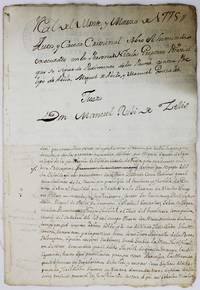
17752247Mineral del Monte 1775. Still very good. 8pp. Small folio. Stitched. Minor wear at edges. Light toning. Minor darkening and patchy staining at upper corner and along top edge. Fascinating documents of a murder in a colonial Mexican mining town during the late 18th century. Nicolas Gregorio Picazo was killed in the town of Mineral del Monte also known as Real del Monte in early March 1775 and a group of three men Phelipe de Avila Miguel de Avila and Manuel Gonzalez were charged with the murder. Real del Monte northeast of Pachuca in Hidalgo is located in the region where the Spanish one of their earliest discoveries of gold and silver following the conquest of the Aztecs in the early 1520s. Real del Monte is particularly rich in silver and is estimated to produced over one billion ounces of the precious metal from its mines over the course of the last five hundred years. The present documents include affidavits and witness statements including one from the widow of the murdered man as well as several procedural decisions from the judges in the case. An interesting record of colonial Mexican homicide proceedings in one its most significant industrial and commercial areas beyond Mexico City. unknown
19522110502150414133Bunkyo shuppan 1952. Soft Cover. Fine. Volume: 1 Bunkyo shuppan paperback
1836665381836. Concord NH 1836. Concord NH 1836. "Oh! Lust Accursed Lust! 'Twas This for Which I Did the Deed" Broadside. Murder. A Private Individual at the Bar. Abr'm Prescott's Confession Of the Murder of Mrs. Sally Cochran of Pembroke N.H.--June 23 1833. Concord NH.: S.n. 1836. 17" x 11-1/2" 43.2 x 29.2 cm broadside. Two columns of verse in twenty stanzas within woodcut ornamental border text headed by large woodcut vignette of a coffin. Light browning and a few minor stains faint horizontal and vertical fold line chipping to edges section lacking from bottom margin just touching bottom right corner of border a few tears along fold lines with no loss to text later repairs to verso. $1950. Abraham Prescott was convicted of the murder of Sally Cochran following two separate highly publicized trials held in Concord New Hampshire in September 1834 and September 1835. Despite a robust and well-crafted insanity defense mounted by his counsel Prescott was sentenced to death. Originally scheduled to be hanged in Hopkinton New Hampshire on December 23 1835 his execution was delayed and he was ultimately executed on January 6 1836. This rare broadside features a verse account that explicitly frames the murder as a crime of passion capturing the sensationalized public sentiment of the era: "Oh! lust accursed lust! 'twas this / For which I did the deed; / Forfeiting heaven and life and bliss / Forfeiting all I need." OCLC locates 7 copies American Antiquarian Society Brown Dartmouth Harvard Peabody Essex Museum University of Michigan Yale. See McDade The Annals of Murder 769. Burt American Murder Ballads 66-67. unknown
186436882np 1864. 4to. Written in ink and signed at the end by Royce on the verso of a single leaf. Several small holes text unaffected a few closed tears two archival tape repairs. Very Good. <br /> <br /> This unusual insightful document illuminates the laws of war applicable to the Civil War. Royce's Petition seeks justice for Confederate Captain Frank R. Gurley. Royce sent it to the Confederate Commission of Exchange. Its author Confederate Captain Moses Strong Royce was captured in Tennessee and imprisoned at Nashville. Gurley Royce's cell-mate had killed Union General Robert McCook of Ohio near Huntsville Alabama in August 1862. <br /> In October 1863 Union forces captured Gurley and charged him with murdering McCook. Gurley Union officials claimed was a guerrilla who shot McCook while the General was lying in an ambulance. Southerners claimed that Gurley was not a guerrilla but a regular soldier in the Confederacy's 4th Alabama Cavalry; and that he killed McCook according to the laws of war. <br /> Harper's Weekly and Frank Leslie's Illustrated Newspaper fanned the flames claiming that lawless Confederate guerrillas murdered the general; feelings ran high. "US General Grant wrote CS General Hardee in December of 1863 and said that although Gurley was a member of the Confederate army that did not preclude him from being tried for having committed a foul murder" online Huntsville-Madison County Public Library essay 'Frank B. Gurley's 1866 Diary'.<br /> Having escaped from prison in March 1864 Royce pleads Gurley's case. "He was confined in a cell for sixty-eight days and allowed only about one hour a day for exercise and was put upon trial for the killing of Genl. McCook. He was obliged to employ counsel to defend himself at an expense of 2500 dollars in greenbacks. The evidence produced completely exonerated him of anything like murder and the argument of his counsel was a complete vindication of his right as a soldier and an officer to do all that he did in bringing Genl. McCook to his death. <br /> "When the trial was nearly ended four communications by flag of truce were sent to the court and were there read - one from Lt. Col. Hambrick one from Genl. Forrest one from Genl. Hardee and one from Genl. Johnston" assuring that Gurley was not a guerrilla but a duly enrolled member of the Confederate military forces. Nevertheless Gurley was found guilty and sentenced to death.<br /> "The undersigned believes that if an effort were to be made by the Confederate Commission of Exchange to have Capt. Gurley exchanged the Federal authorities would immediately send him forward for that purpose and as a friend of Capt. Gurley the undersigned respectfully requests General Johnston to use his influence in procuring the exchange of Capt. Gurley. Respectfully submitted M. S. Royce." <br /> Even after War's end the dispute continued. Gurley having been released from prison in an administrative snafu was re-arrested charged but finally released and placed on parole in April 1866. unknown
GOR003933804Paperback. Very Good. paperback
1914659851914. New York 1912-1914. Image in 30-1/2" x 24" frame. New York 1912-1914. Image in 30-1/2" x 24" frame. "His Famous Wig Composed Entirely of Split Hairs and Adorned with the Ceremonial Crimson Tape" Robinson Boardman 1876-1952. Becker-Rosenthal Murder Trial. Mr. Justice Precedent. New York 1914. 21" x 15-1/2" 53.3 x 39.4 cm gouache image on 26" x 19-1/2" 66 x 49.5 cm sheet image signed twice and inscribed by Robinson caption in pencil below image most likely in another hand laid down on illustration board. Image in 30-1/2" x 24" 77.5 x 60.9 cm wooden frame glazed. Light soiling a few minor stains and four crop-marks to margins outside of image which could be covered with a matte image fine. Several minor scuffs and nicks to frame. An exceptional unique piece of original artwork capturing a defining moment in American legal and criminal history. $3500. This striking original gouache was created to illustrate "Leaden Footed Justice in New York State" a feature article published in the Special Feature section of the New York Tribune on Sunday March 1 1914. The penciled caption reads:"Mr. Justice Precedent wearing his famous wig composed entirely of split hairs and adorned with the ceremonial crimson tape." The caricature was a scathing commentary on the notoriously protracted bureaucratically tangled legal proceedings of the Becker-Rosenthal Murder case which centered on NYPD Police Lieutenant Charles Becker who ran a massive protection racket targeting illegal Manhattan casinos. When gambling house owner Herman Rosenthal threatened to expose Becker's corruption to District Attorney Charles S. Whitman Becker hired a gang of underworld executioners including "Gyp the Blood" and "Lefty Louie" to gun Rosenthal down outside the Hotel Metropole. The investigation and subsequent trials completely dominated New York front pages. Becker's first trial began on October 7 1912 resulting in a conviction that was subsequently overturned on appeal by the New York Court of Appeals due to judicial bias. His highly anticipated second trial began on May 6 1914 just over two months after this cartoon appeared. Becker was convicted a second time and after his appeals were exhausted in 1915 went to the electric chair at Sing Sing-marking the first time in U.S. history a police officer was executed for murder. The case profoundly shook the public psyche and entered the cultural lexicon most. unknown