Babe GuillotineBiblio.com

4 résultats
1649696175.Gpaperback. Good. Access codes and supplements are not guaranteed with used items. May be an ex-library book. paperback
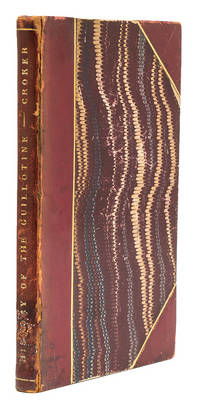
1853257180London: John Murray 1853. Murray's Railway Reading. Illustrated with woodcuts in text. viii 88 pp. 1 vols. 12mo. Contemporary half red calf and marbled boards red printed wrappers preserved. Owner signature of E. Forbes at head of title; ink number on verso of title W.H. Smith blindstamp on back wrapper. Bookplate. Traces of old label or shelfmark at foot of spine some toning of text. Very good. Murray's Railway Reading. Illustrated with woodcuts in text. viii 88 pp. 1 vols. 12mo. John Murray unknown
19452London: Printed at the Minerva Office for Wiliam Lane 1793. Overall 19 x 14 inches in very good clean condition one closed tear at foot folds. There are two states of this dramatic depiction of Louis XVI beheaded by the Guillotine. The other has a similar text but the Guillotine is shown at some distance guarded by soldiers. The text describes the sentencing and the last moments of the King. The broadside was priced at Three Pence or sold Wholesale at One Guinea per Hundred. unknown
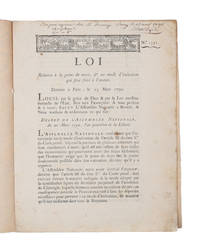
179263223Paris L'Imprimerie Royale 1792. 4to. Stitched in later marbled wrappers with printed book label "Collection Quarré-Reyboyrbon Lille" to inside of front wrapper. Contemporary handwritten inscription above head-piece "Bon pour imprimeur chez M. Descamps Douay le 12 avril 1792." presumably in the hand of Quarré-Reybourbon. A bit of brownspotting and soiling but overall very nice. 4pp. <br/><br/><em>Scarce first printing of the legal document that led to the guillotine becoming France's standard method of judicial execution. This groundbreaking decree of the National Assembly given 20 March 1792 suspended all pendig death punishments and authorized the use of necessary expenses to achieve a more humane method of execution throughout the kingdom. The methods for achieving this humane form of execution is explained in the the annexed text signed by Antoine Louis see below the permanent secretary of the Academy of Surgery. The decree is as follows: “The National Assembly considering that the uncertainty regarding the method of execution of Article III of Title 1 of the Penal Code suspends the punishment of several criminals who are sentenced to death; that it is urgent to put an end to inconveniences which could have unfortunate consequences; that humanity requires that the death penalty be as painless as possible in its execution decrees that there is an emergency.†The Penal Code of 1791 title 1 article 3 Tout condamné aura la tête tranchée “Every condemned person will have their head cut off†should be executed “according to the manner indicated and the method adopted by the consultation signed by the Permanent Secretary of the Academy of Surgery which remains annexed to this decree†and the National Assembly “consequently authorizes the Executive Power to incur the necessary expenses to achieve this method of execution so that it may be uniform throughout the Kingdom.†p. 1 Prior to 1791 under the Ancien Régime there existed a variety of means of capital punishment in France depending on the crime and the status of the condemned person. In 1791 there was a campaign towards the abolition of the death penalty but later that year The National Assembly refused to pass such a law. However torture was abolished and a single method of execution was declared that of beheading which had previously only been applied to nobles. In 1791-92 the development of a mechanical beheading device was set in force by a committee in order to make the death penalty "as painless as possible in its execution" and "uniform throughout the kingdomâ€. Note that before the use of a mechanical beheading device manual beheading and a variety of other methods of execution had been in force in France. Ironically what is now known as the guillotine was developed with the help from Louis XVI – who was a skilled amateur locksmith – with regards to the shape of the blade. This change towards a more painless method was ignited by physician Joseph-Ignace Guillotin in October 1789 at the National Assembly. Later a committee was formed under Antoine Louis the inventor of the guillotine and physician to the King and Secretary to the Academy of Surgery. This committee included Guillotin and although he did not invent the guillotine and opposed the death penalty his name became an eponym for it. After its adoption the device remained France's standard method of judicial execution until the abolition of capital punishment in 1981. The last execution with a guillotine in France took place in 1977. </em> unknown