GUILLOTINELivre Rare Book
114 résultats
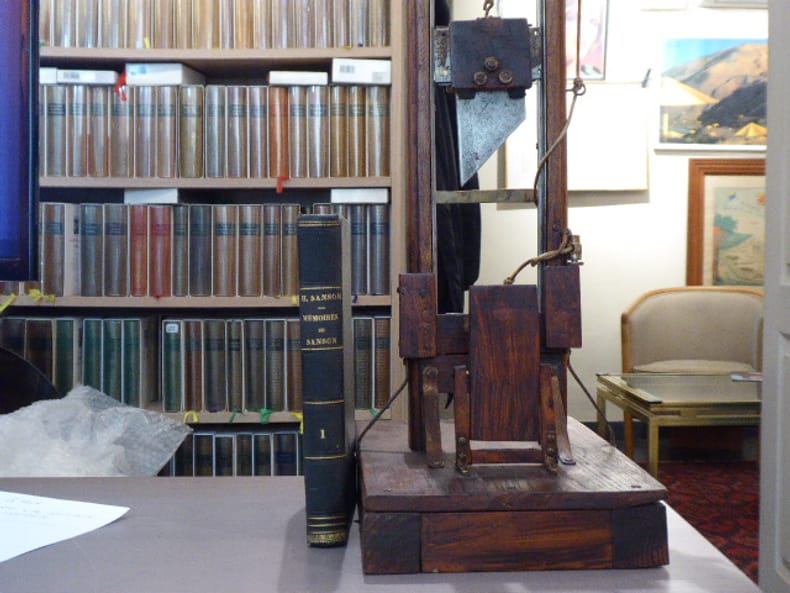
299403S.N. S.L. (Guyane) XXe siècle Très rare réplique en miniature de GUILLOTINE H: 60 cm - Long.: 31 cm - Larg.: 19 cm. Vraisemblablement du Bagne de Cayenne réalisée dans la première partie du XXe siècle en effet, certains détails représentés ici sont présents sur la guillotine de Cayenne et absents de la représentation d'autres "bois de justice". Fabrication très soignée en bois et métal très représentative du travail de certains forçats au bagne de Cayenne. Quelques vis et la corde ont été changés, objet très décoratif en bel état.
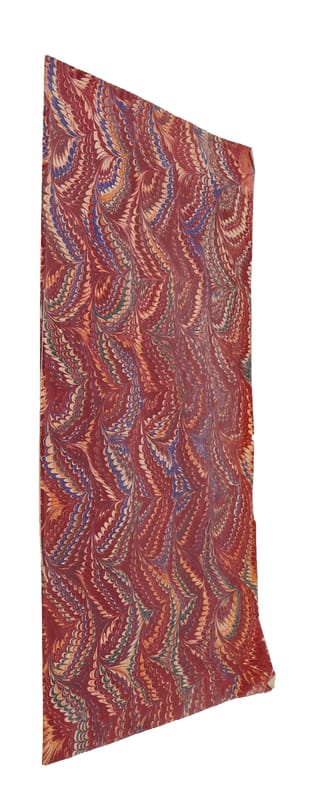
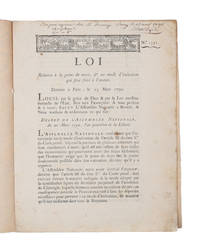
179263223(Paris, L'Imprimerie Royale, 1792). 4to. Stitched in later marbled wrappers, with printed book label ""Collection Quarré-Reyboyrbon, Lille"" to inside of front wrapper. Contemporary handwritten inscription above head-piece ""Bon pour imprimeur chez M. Descamps Douay le 12 avril 1792."" (presumably in the hand of Quarré-Reybourbon). A bit of brownspotting and soiling, but overall very nice. 4pp.
179263223Paris L'Imprimerie Royale 1792. 4to. Stitched in later marbled wrappers with printed book label "Collection Quarré-Reyboyrbon Lille" to inside of front wrapper. Contemporary handwritten inscription above head-piece "Bon pour imprimeur chez M. Descamps Douay le 12 avril 1792." presumably in the hand of Quarré-Reybourbon. A bit of brownspotting and soiling but overall very nice. 4pp. <br/><br/><em>Scarce first printing of the legal document that led to the guillotine becoming France's standard method of judicial execution. This groundbreaking decree of the National Assembly given 20 March 1792 suspended all pendig death punishments and authorized the use of necessary expenses to achieve a more humane method of execution throughout the kingdom. The methods for achieving this humane form of execution is explained in the the annexed text signed by Antoine Louis see below the permanent secretary of the Academy of Surgery. The decree is as follows: “The National Assembly considering that the uncertainty regarding the method of execution of Article III of Title 1 of the Penal Code suspends the punishment of several criminals who are sentenced to death; that it is urgent to put an end to inconveniences which could have unfortunate consequences; that humanity requires that the death penalty be as painless as possible in its execution decrees that there is an emergency.†The Penal Code of 1791 title 1 article 3 Tout condamné aura la tête tranchée “Every condemned person will have their head cut off†should be executed “according to the manner indicated and the method adopted by the consultation signed by the Permanent Secretary of the Academy of Surgery which remains annexed to this decree†and the National Assembly “consequently authorizes the Executive Power to incur the necessary expenses to achieve this method of execution so that it may be uniform throughout the Kingdom.†p. 1 Prior to 1791 under the Ancien Régime there existed a variety of means of capital punishment in France depending on the crime and the status of the condemned person. In 1791 there was a campaign towards the abolition of the death penalty but later that year The National Assembly refused to pass such a law. However torture was abolished and a single method of execution was declared that of beheading which had previously only been applied to nobles. In 1791-92 the development of a mechanical beheading device was set in force by a committee in order to make the death penalty "as painless as possible in its execution" and "uniform throughout the kingdomâ€. Note that before the use of a mechanical beheading device manual beheading and a variety of other methods of execution had been in force in France. Ironically what is now known as the guillotine was developed with the help from Louis XVI – who was a skilled amateur locksmith – with regards to the shape of the blade. This change towards a more painless method was ignited by physician Joseph-Ignace Guillotin in October 1789 at the National Assembly. Later a committee was formed under Antoine Louis the inventor of the guillotine and physician to the King and Secretary to the Academy of Surgery. This committee included Guillotin and although he did not invent the guillotine and opposed the death penalty his name became an eponym for it. After its adoption the device remained France's standard method of judicial execution until the abolition of capital punishment in 1981. The last execution with a guillotine in France took place in 1977. </em> unknown
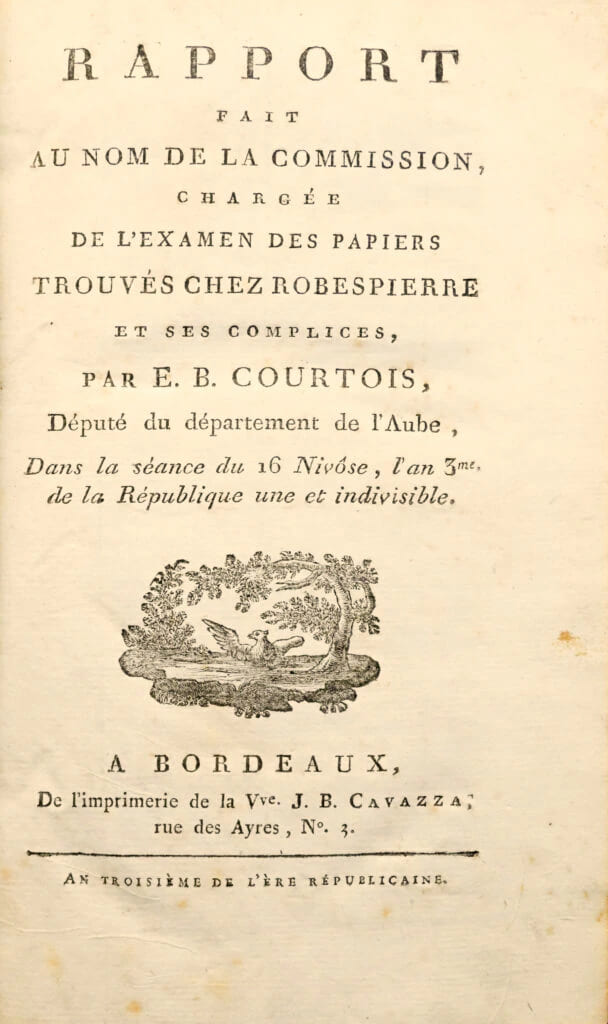
LCS-A59Bordeaux, An Troisième de la République. Bordeaux, Veuve J.B. Cavazza, An troisième (1795). In-8 de 101 pp., (2) ff., pp. 103 à 396 mal chiffrées 386; demi-basane brune, pièce de titre en maroquin rouge, tranches jaspées. Reliure de l’époque. 180 x 111 mm.
19452London: Printed at the Minerva Office for Wiliam Lane 1793. Overall 19 x 14 inches in very good clean condition one closed tear at foot folds. There are two states of this dramatic depiction of Louis XVI beheaded by the Guillotine. The other has a similar text but the Guillotine is shown at some distance guarded by soldiers. The text describes the sentencing and the last moments of the King. The broadside was priced at Three Pence or sold Wholesale at One Guinea per Hundred. unknown
Sm. 8vo., First Edition thus, small age-mark on half-title verso; contemporary half calf, marbled boards, back ruled in gilt, second compartment with red leather label lettered in gilt, all other compartments tooled in gilt with a floral motif, joints cracked (but hinges and binding entirely sound), a most attractive and remarkably crisp, clean copy. Complete with half-title, and 6pp publisher's catalogue (dated February 1817) bound in at end. RARE. We have seen this edition confused with a very similar but shorter (and apparently less elusive) version of Angouleme's memoirs published by Constable in Edinburgh later the same year. NICE COPY OF A KEY DOCUMENTARY RECORD IN THE HISTORY OF FRANCE, THE REVOLUTION AND THE TERROR, AND AFTER CLERY ONE OF THE MOST IMPORTANT CONTEMPORARY ACCOUNTS OF THE IMPRISONMENT OF LOUIS XVI.
CCC-63155. edition john c. winston co philadelphia, non date, reliure demi-chagrin a coin bleu, c'est complet en 3 volumes, dos 5 nerfs, legerement insole, dos tres legerement frottes, l'interieur est tres bon, chaqu'une des illustrations sont protegees par une feuille de soi, le livre est en anglais, in-8, livre non date, photos possible edition john c. winston philadelphia co, binder half blue corner soreness, it is complete in 3 volumes, back 5 nerves, slightly insole, back very slightly rubbed, the interior is very good, each of the illustrations are protected by a sheet of self, the book is in English, in-8, book no date, photos possible
181446404431Paris, Imprimerie de J. R. Lottin, (1814) ; in-8, demi-veau de l’époque. 51 pp.C’est la liste chronologique des personnes condamnées par les tribunaux, soit 1343 noms, avec l’indication de la profession. À la fin on trouve le certificat de Descloseaux, ancien avocat, propriétaire du cimetière de la Madeleine. Parmi les noms de cette liste figurent l’écrivain J. Cazotte, le Roi, le général Custine, la Reine, Brissot, Hébert, le Père Duchesne, Cloots dit Anacharsis, Fabre d’Eglantine, Camille Desmoulins, Heraut de Séchelles, Barras, Malesherbes, l’amiral d’Estaing, Lavoisier, etc. Entre les pp. 2 et 3 on trouve 2 ff. ajoutés l’un portant un plan du cimetière, l’autre l’explication de ce plan (2 pp. manuscrites). Tourneux 12439. Relié à la suite : FONDATION de la chapelle funéraire de Picpus. Paris, J. L. Lottin, (1814) ; 79 pp.Fondation d’une chapelle funéraire sur le terrain où étaient enfouis les restes des condamnés exécutés à la barrière du Trône entre le 14 juin et le 27 juillet 1794. Liste des personnes qui ont souscrit pour cet établissement depuis 1802. Liste des victimes immolées à la barrière du Trône et inhumées au cimetière de Picpus. Liste de 1298 personnes avec leur profession et leur âge et le lieu de leur naissance. Tourneux 12445. Réunion rare de ces deux listes. Rousseurs, fente à une charnière.
1840(LCPCMED-0005)(Un texte rarissime sur le début et sur la véritable fin de la vie de l'homme. Un exemplaire tel que paru, conservé dans sa brochure imprimée d'origine) GIUSTINI Angelo. "QUESTIONE MEDICO-LEGALE... SULL'ANIMAZIONE DEL FETO ANIMALE NEL SENO MATERNO... SUL MOMENTO IN CUI L'ANIMA SI DIVIDE DAL CORPO...". 1840, Viterbo, Tip. Monarchi. 1 volume in-8° (215x152 mm) (dimensions pages 215x152 mm) 88 pp. (y compris titre et dédicace) Brochure imprimée de l'époque. Edition Originale, très rare. Petites brunissures aux extrémités des marges, mais superbe exemplaire tel que paru, à toutes marges, non rogné et conservé dans sa brochure imprimée d'origine. Curieux texte sur le commencement de la vie dans le foetus et sur la vraie fin de la vie dans l'homme. L'auteur, un médecin italien, après avoir résumé les principales théories des anciens et de la science des siècles passés, décrit des cas des personnes vivantes mais jugée déjà mortes. La mort de l'homme correspond à celle de l'activité cérébrale et l'auteur rappelle des cas de condamnés à la guillotine. "Vi sia d'esempio il ghigliottinato, il quale, quantunque gli venga tolto il capo dal busto con la mannaja, conserva ancora per qualche istante la sua intelligenza. Chiamatelo a nome lateralmente, e vedrete che egli rivolgerà verso di voi gli occhi, e su di voi li fisserà ; se altri lo chiama dall'opposta parte, subito rivolge gli occhi alla chiamata : Se il carneficeblo percuote per disprezzo in faccia, fa egli prova di mordere la mano che lo percuote". Aucun exemplaire dans OCLC Worldcat. (LCPCMED-0005) (380,00 €)
8vo., First English Edition, with an engraved plate (moderately spotted), 2 engraved plans on one plate, and two engraved facsimiles on one plate, rear free endpaper and one rear blank preliminary lightly spotted; attractively bound in nineteenth century half calf, marbled boards, back gilt extra with five raised bands, second compartment with red leather label lettered in gilt, all other compartments ruled and elaborately tooled in gilt to a floral design, all edges marbled, marbled endpapers, corners lightly bruised else a remarkably bright, crisp, clean copy in elegant binding. With the 16pp list of subscribers, which includes virtually every member of the Royal family extended to Prince William of Gloucester. This is the early issue with 'Bookselllers' in the publisher's imprint (see ESTCT110766). The plates depict the Temple tower, plans of the second and third floors and two facsimiles of Marie Antoinette's handwriting. Clery's family had been in the service of the French Royal Family since the time of Louis XIV. Together with his brother, he began his career with the Princesse de Guenenee, governess to the royal children, and became valet-de-chambre to the Duke of Normandy (later the Dauphin) in 1785. From 1789, he acted as valet to King Louis XVI and was permitted by Petion to continue to wait on the Royal Family during their imprisonment in the Temple. After the King's execution, Clery accompanied the Madame Royale (Marie-Therese de Bourbon) on her exile to Vienna where he continued to serve until his death. LOVELY COPY OF A KEY DOCUMENTARY RECORD IN THE HISTORY OF FRANCE, THE REVOLUTION AND THE TERROR, AND THE SINGLE MOST IMPORTANT CONTEMPORARY ACCOUNT OF THE IMPRISONMENT OF LOUIS XVI.
155014571Scène représentant la décapitation du fils de Titus Manlius. Rare. En feuille. Coupé à la cuvette. Bon Avant 1550 25,5 x 37 cm
1853257180London: John Murray 1853. Murray's Railway Reading. Illustrated with woodcuts in text. viii 88 pp. 1 vols. 12mo. Contemporary half red calf and marbled boards red printed wrappers preserved. Owner signature of E. Forbes at head of title; ink number on verso of title W.H. Smith blindstamp on back wrapper. Bookplate. Traces of old label or shelfmark at foot of spine some toning of text. Very good. Murray's Railway Reading. Illustrated with woodcuts in text. viii 88 pp. 1 vols. 12mo. John Murray unknown
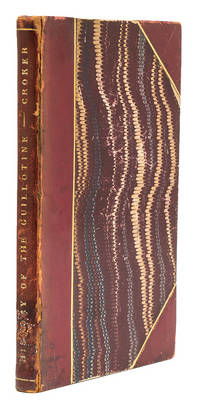
1853257180London: John Murray 1853. Murray's Railway Reading. Illustrated with woodcuts in text. viii 88 pp. 1 vols. 12mo. Contemporary half red calf and marbled boards red printed wrappers preserved. Owner signature of E. Forbes at head of title; ink number on verso of title W.H. Smith blindstamp on back wrapper. Bookplate. Traces of old label or shelfmark at foot of spine some toning of text. Very good. Murray's Railway Reading. Illustrated with woodcuts in text. viii 88 pp. 1 vols. 12mo. Pocket History of the Guillotine and Its Victims. John Murray unknown books
7808Institutions, hommes et faits.In 4 demi-chagrin rouge à nerfs, titre et caissons dorés,plats percaline chagrinée, filets à froid en encadrement.Armes de Paris et Prix Municipal d’excellence,dorés.Faux-titre,titre,VIII,235 pages,texte sur 2 colonnes,illustrations.Tranches dorées. Paris Librairie Furne Jouvet & Cie éditeurs,1893,très bon état
2512in 8 broché couverture grise d’attente une étiquette imprimée sur le premier plat titre 408 pages,non rogné grandes marges.A Paris de l’Imprimerie Nationale des lois Nivôse an III une partie de l’angle inférieur droit est rognée(pages 397 à 408)ma page 408 est poussiéreuse.Sinon bon état.
14510Le nouveau journal. Les mémoires de SANSON. Par le publiciste d’OLBREUSE d’après les documents d’époque. Nouvelle diffusion de l’édition de 1862-1863 du 6 février 1864 a janvier 1866. Dans le Nouveau journal en deux volumes in 4 demi-cuir vert, titre, filets roulette, tomaison dorés. Parution tous les samedis en livraisons de 16 pages, texte sur 3 colonnes, nombreuses illustrations gravées sur bois, dans le texte ; les lecteurs rendus captifs par la forme de feuilleton découvrent au fil des mois une histoire à multiples rebondissements. Les nombreuses illustrations participent à la dramaturgie des scènes. Exécutions célèbres de CARTOUCHE, DAMIEN , Louis XVI, Charlotte CORDAY, La DU BARRY, DANTON, Camille DESMOULINS, ROBESPIERRE, CADOUDAL, LACENAIRE etc. Supplices : de la question, de la roue, de la pendaison, du fer, de la guillotine etc. Rare complet en deux volumes. Cette revue disparaît. L’éditeur annonce qu’ayant crée ce journal pour la publication des mémoires de Sanson et ayant fini sa tache arrête sa publication.
1845622481845 A Paris, Furne et Cie, Libraires-Editeurs - 1845 - Treizième édition - 10 volumes in-8 (environ 14 x 21.7cm), demi-reliure chagrin bleu; cartonnage marbré; dos à 4 nerfs, fleurons, filets et titre en doré - Entre 400 et 600 pages par volume - Gravures en N&B en frontispice et hors texte - Sans l'atlas
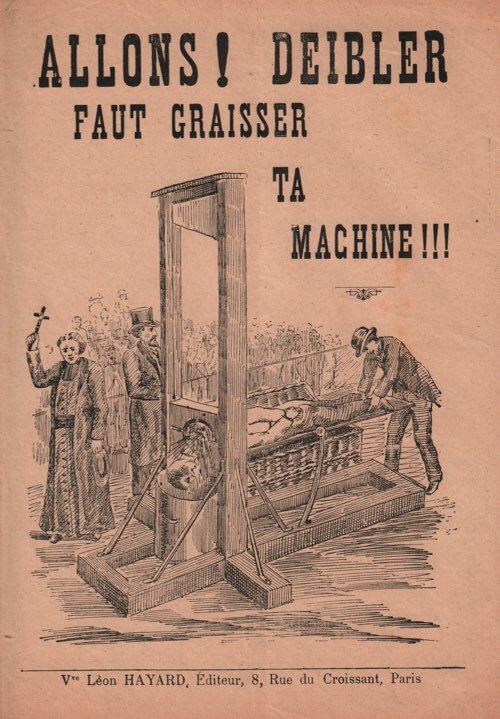
190974640Partitions sur Paris Paname,Partitions Crimes et criminels Hayard 1909 approx.
ORD-14542Amsterdam et se trouve à Paris chez Cellot. 1769. In-12 (97 x 174mm) pleine basane scarifiée, dos à 5 nerfs caissons or, pièce de titre maroquin rouge, gardes peignées, tranches rouges, VIII, 466, (3) pages (errata et catalogue). Sceau imprimé sur le titre, texte difficile à lire entourant un cavalier en armure qui pourrait être un templier ou un croisé. Coins lgt amortis sinon bel exemplaire en reliure de l'époque.
5914In 8 broché,faux-titre,titre,IV,408 pages Paris Persan, Delaunay, Mongié,libraires 1830,édition originale. Très bon exemplaire.
1649696175.Gpaperback. Good. Access codes and supplements are not guaranteed with used items. May be an ex-library book. paperback
194Grand in 8 percaline d'éditeur,plaque dorée encadrée de médaillons rouges,verts et fers dorés sur le premier plat, dos très orné,fers,titre dorés.Décor doré et vert au deuxième plat.Quatre lithographies en sépia hors texte sous serpente.Barbou éditeur Limoges sans date (vers 1850)Beau cartonnage. Histoire,moeurs, description,peinture,tableaux..pendant la Révolution de 1789 dont la relation de l'arrestation de l famille royale à Varennes en Argonne...)
19684Paris Librairie des Publications Modernes 1908 in 12 (18,5x12,5) 1 volume relié demi basane rouge de l'époque, dos lisse à faux nerfs dorés, 316 pages, avec 150 hors-texte et illustrations d'aprés des Documents originaux de l'époque. Sans la couverture illustrée de Georges Rochegrosse. L'aurore du Couteau; Les deux soutiens de la terreur; L''instrument au travail; Le chapitre des régicides; L'épopée de la fille à Guillotin; Le couteau tombé. Bel exemplaire ( Photographies sur demande / We can send pictures of this book on simple request )
1834in 12 broché,couverture illustrée couleurs de ROCHEGROSSE, 314 pages,150 illustrations dans et hors-texte d’après des documents originaux de l’époque.Librairie des publications modernes 1908.
50080Plon,Nourrit et Cie, Paris, 1897


_3.jpg)