[Inquisition]. [Mexican Revolution]Biblio.com
51 résultats
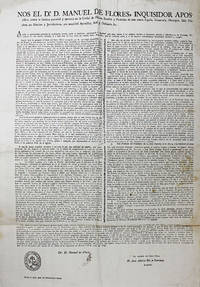
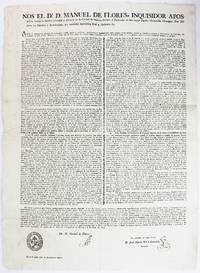
18155342Mexico: 8 de Julio 1815. Very good. Double-sheet broadside measuring 23.75 x 17 inches. Old fold lines some slight rumpling. Minor soiling and wear. A fascinating and rare broadside in which the Inquisition attempts to prohibit pro-independence publications including the 1814 Constitution of Apatzingán during the midst of the Mexican Revolution. Dated July 8 1815 this proclamation of the Inquisition first reiterates a blanket prohibition on what it labels seditious and anti-Catholic publications that is to say anything in favor of the revolution and independence. It warns that any statements in favor of liberty and democracy constitute heresy in the eyes of the Inquisition and that such calls in fact seek to subvert the natural order rather than re-establish it:<br /> <br /> "Producciones de una nueva raza de Filósofos hombres de espíritu corrompido que baxo del especioso titulo de defensores de la libertad maquinan realmente contra ella destruyendo de este suerte el orden político y social y gerarquia de la Religion cristiana exhortando con este language de seduccion á ascudir el yugo de subordinacion y sujecion á las lexítimas Potestades tan recomendada por Jesucristo y pretendiendo por aqui fundar si les fuera posible sobre las ruinas de la Religion y Monarquias aquella soñada libertad que malamente suponen concedida á todos los hombres por la naturaleza: razon porque prohibe los muchos libros que menciona y los demás que sean de la misma clase para precaver con oportuno remedio el daño que puedan occasionar."<br /> <br /> The proclamation then continues in seven numbered sections to outlaw specific works published by the revolutionary government its forces and its supporters. Most significantly the broadside outlaws the Decreto Constitucional para la Libertad de la América Mexicana more commonly known as the Constitution of Apatzingán. This document promulgated by the Congress of Anáhuac on October 22 1814 printed 242 articles for the establishment of republican government in Mexico although it was never brought into force. The propositions put forth by the Constitution are so egregious according to the Inquisition that it is impossible in one edict to denounce them all individually:<br /> <br /> "Excederia los límites de un edicto la especificacion particular de todos y de cada uno de los crasísimos errores que contiene este infernal papel; pero bastará advertir á los Fieles que en él baxo el respetable nombre de Religion Católica Apostólica Romana que sirve de escudo á sus tramas como antes servia el de Fernando VII contra quien tan iniquamente se han declarado rebeldes se introducen las mas groseras heregias y los mayores delerios."<br /> <br /> Nevertheless the authors go on to highlight the most transgressive articles condemn the inferred inspiration of the document from authors like Hobbes and Rousseau and emphasize the rejection of Church doctrine implicit in calls for revolution and democracy:<br /> <br /> "Mas como los Autores de Constitucion se han propuesto revelarse tambien contra la Doctrina expresa de la Iglesia dogmatizan ser licito á los Ciudadanos levantarse contra el Principe prevarle del Reyno mudar el Gobierno monárquico en republicano á pretexto de tirania como si fuera lo mismo fundarlo de nuevo que revelarse contra el ya fundado. Decir que es licito y justo el tal levantamiento contra el lexitimo Principe aunque sea baxo de pretexto de tirania es una proposicion condenada repetidamente por la Iglesia y heregia declarada."<br /> <br /> In the remaining six sections the Inquisition continues to condemn a litany of decrees sermons almanacs manuscripts and other texts that emanate from revolutionary sources or espouse democratic ideas. In all the document serves as an outstanding representation of the royalist Catholic and conservative forces that were attempting to hold power in Mexico during this period and a fascinating example of attempted censorship of revolutionary ideals. Rare we locate only two copies -- one at Berkeley and Medina's copy at the National Library of Chile. 8 de Julio unknown
1815LL 577<p><em>Nos el Dr. D. Manuel de Flores inquisidor aposto</em><em>Ì</em><em>lico contra la here</em><em>Ì</em><em>tica pravedad y apostasi</em><em>Ì</em><em>a en la ciudad de Me</em><em>Ì</em><em>xico estados y provincias de esta Nueva Espan</em><em>̃</em><em>a Guatemala Nicaragua Islas Filipinas sus distritos y jurisdicciones .: A todas y qualesquiera personas de qualquier estado . y habitantes en las ciudades villas y lugares de este nuestro distrito . salud en nuestro Sen</em><em>̃</em><em>or Jesucristo . y a</em><em>Ì </em><em>los nuestros mandamientos firmemente obedecer y cumplir. <strong> Begins </strong>Sabed: Que la paternal solicitud del Santo Oficio encargada por la autoridad aposto</em><em>Ì</em><em>lica leyes del reyno y una inmemorial costumbre . de extirpar en estos reynos no solo las heregias manifiestas sino quanto pueda ofender la pureza de la religion . ha clamado en todos tiempos contra los perversos perturbadores del buen orden religioso y social …</em> Mexico: 8 de Julio 1815.</p><p>Double-sheet broadside measuring 23.75 x 17 inches.Title from caption and beginning of text. Dated and signed at end: Dada en la Inquisicion de MeÌxico aÌ 8 de julio de 1815. Dr. D. Manuel de Flores with his rubric in manuscript. Por mandado del Santo Oficio D. JoseÌ Maria Ris y Garnica secretario with his rubric in manuscript. Title from caption and beginning of text.Dated and signed at end: Dada en la Inquisicion de MeÌxico aÌ 8 de julio de 1815 . Dr. D. Manuel de Flores with his rubric in manuscript. Por mandado del Santo Oficio D. JoseÌ Maria Ris y Garnica secretario with his rubric in manuscript. At foot of sheet: Nadie le quite pena de excomunion mayor.Text in double columns.Printed on 2 sheets joined together to form a single broadside. Seal of the Inquisition with caption "Domine Iudica Causam tuam. Exurge" printed at bottom left corner.</p><p>A fascinating and rare broadside in which the Inquisition attempts to prohibit pro-indepedence publications including the 1814 Consitution of Apatzingán during the midst of the Mexican Revolution. Dated July 8 1815 this proclamation of the Inquisition first reiterates a blanket prohibition on what it labels seditious and anti-Catholic publications that is to say anything in favor of the revolution and independence. It warns that any statements in favor of liberty and democracy constitute heresy in the eyes of the Inquisition and that such calls in fact seek to subvert the natural order rather than re-establish it:</p><p>"Producciones de una nueva raza de Filósofos hombres de espÃritu corrompido que baxo del especioso tÃtulo de defensores de la libertad maquinan realmente contra ella destruyendo de este suerte el orden polÃtico y social y gerarquia de la Religion cristiana exhortando con este language de seduccion á ascudir el yugo de subordinacion y sujecion á las lexÃtimas Potestades tan recomendada por Jesucristo y pretendiendo por aqui fundar si les fuera posible sobre las ruinas de la Religion y Monarquias aquella soñada libertad que malamente suponen concedida á todos los hombres por la naturaleza: razon porque prohibe los muchos libros que menciona y los demás que sean de la misma clase para precaver con oportuno remedio el daño que puedan occasionar."</p><p>The proclamation then continues in seven numbered sections to outlaw specific works published by the revolutionary government its forces and its supporters. Most significantly the broadside outlaws the Decreto Constitucional para la Libertad de la América Mexicana more commonly known as the Constitution of Apatzingán. This document promulgated by the Congress of Anáhuac on October 22 1814 printed 242 articles for the establshment of republican government in Mexico although it was never brought into force. The propositions put forth by the Constitution are so egregious according to the Inquisition that it is impossible in one edict to denounce them all individually:</p><p>"<em>Excederia los lÃmites de un edicto la especificacion particular de todos y de cada uno de los crasÃsimos errores que contiene este infernal papel; pero bastará advertir á los Fieles que en él baxo el respetable nombre de eligion Católica Apostólica Romana que sirve de escudo á sus tramas como antes servia el de Fernando VII contra quien tan iniquamente se han declarado rebeldes se introducen las mas groseras heregias y los mayores delerios."</em></p><p>Nevertheless the authors go on to highlight the most transgressive articles condemn the inferred inspiration of the document from authors like Hobbes and Rousseau and emphasize the rejection of Church doctrine implicit in calls for revolution and democracy:</p><p><em>"Mas como los Autores de Constitucion se han propuesto revelarse tambien contra la Doctrina expresa de la Iglesia dogmatizan ser licito á los Ciudadanos levantarse contra el Principe prevarle del Reyno mudar el Gobierno monárquico en republicano á pretexto de tirania como si fuera lo mismo fundarlo de nuevo que revelarse contra el ya fundado. Decir que es licito y justo el tal levantamiento contra el lexitimo Principe aunque sea baxo de pretexto de tirania es una proposicion condenada repetidamente por la Iglesia y heregia declarada."</em></p><p>In the remaining six sections the Inquisition continues to condemn a litany of decrees sermons almanacs manuscripts and other text that emanate from revolutionary sources or espouse democratic ideas.</p><p><strong>In all the document serves as an outstanding representation of the royalist Catholic and conservative forces that were attempting to hold power in Mexico during this period and a fascinating example of attempted censorship of revolutionary ideals. </strong></p><p>¶ Medina Mexico 11059 confusing the date for "8 de Febrero" instad of "8 de Julio. LL 577</p>
1824111332Paris, chez Chassériau, Libraire, impr. J. Tastu, à Paris 1824 In-18 14,5 x 9 cm. Broché, XI-LXXII-398 pp.,potrait de Juan Antonio Llorente en frontispice, table des matières. Dos cassé. état d’usage.
1853R32451Amsterdam, C.L. Van Langenhuysen 1853 42pp., gebroch., R32451
1900B108346Bruxelles, 1900 16pp., 24cm., brochure originale, bon état, B108346
1879R82791Paris, Gaume s.d. [1879] xii + 460pp., 18cm., reliure cart. (plats marbrés, dos en toile avec titre doré), peu de rousseurs, bon état, R82791
1886R32289Turnhout, Splichal-Roosen 1886 viii + 280pp., couv.défraichie (dos remplacé), page de titre manque sinon complet, texte en bon état
1886R35921Turnhout, Splichal-Roosen 1886 viii + 280pp., br. (dos orig.remplacé), pour la plupart non coupé, bon état
1886R119245Turnhout, Splichal-Roosen 1886 viii + 280pp., 23cm., reliure moderne solide, titre doré au dos, texte frais sauf très peu de rousseurs, bon état, R119245
190020223Mainz, Kirchheim, 1900. 8°, XII, 209 Seiten. Halbleder der Zeit.
184561055[Ca 1845]. 4 x 4 cm. (Blattgröße 5 x 4,5 cm). Feinkartonpassepartout.
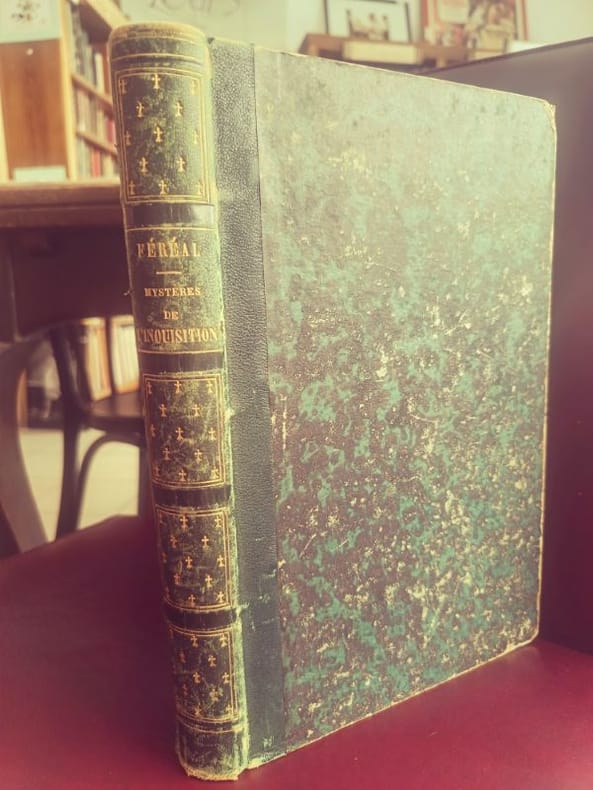
1859LCI-6699Paris, Paul Boizard, éditeur 1859 1 in -8 long Reliure de l'époque en demi-chagrin 398 [p.p] C'est une immersion dans la littérature de dénonciation et d'enquête romancée qui passionna le XIXe siècle. Écrit sous pseudonyme masculin par une femme de lettres engagée, ce texte s'émancipe de l'histoire officielle pour livrer une charge féroce contre les dérives du fanatisme et les rouages des organisations clandestines espagnoles. Le succès de cet ouvrage reposait sur son habileté à mêler documents historiques et ressorts dramatiques, un procédé renforcé par une iconographie spectaculaire et immersive.
18627576Brünn: Fr. Karafiat. (1862). VIII, 542 S. 8°. Mit 12 Holzschnitt-Tafeln und einigen Textholzschnitten. EA. der Übersetzung. Halbleinenband der Zeit.
18625653Brünn, Karafiat, 1862. Priv.-Halbleinen unter Verwendung des Originalumschlages, Gr.-8°, 582 S. mit zahlr. Textholzstichen und 24 ganzseitigen Holzstichen im Anhang (davon der letzte stark beschädigt). 3. Auflage.
1889R80729Gent/ 's Gravenhage, Vuylsteke/ Martinus Nijhoff 1889 Enkel deel 1 (van de 5): xxxix + 640pp.+ 2 kaarten buiten tekst, 23cm., ex.bibl. (2 stempeltjes en 2 ingekleefde ex-librissen, label verwijderd op rug), herbonden in blinde gecart.band, tekst in zeer goede staat, zeldzaam, [Tekst in het Nederlands, met bronnenmateriaal in het Nederlands, Frans en Latijn], R80729
1889B102932Gent/ 's Gravenhage, Vuylsteke/ Martinus Nijhoff 1889-1906 Volledig reeks in 5 volumes (niet verder verschenen), xxxix,640 + xxiii,411 + xlviii,447 + xxxix,553 + xlviii,485 pp., met 2 kaarten buiten tekst in deel 1, 25cm., originele omslagen (enkele ruggen wat hersteld), wat roestplekjes op omslagen en bladsneden, tekst helder, Tekst van de studie in het Nederlands met bronnenmateriaal in het Nederlands en Frans en Latijn, [INHOUD: Eerste deel: tot aan de herinrichting der inquisitie onder keizer Karel V (1025-1520), Tweede deel: Stukken tot aanvulling van het eerste deel (1077-1518), Derde deel: Stukken tot aanvulling van delen I en 2 (1236-1513), Algemeene registers op de eerste drie deelen, Vierde deel: Tijdvak der hervorming in de zestiende eeuw (1514 - 23 september 1525), Vijfde deel: Tijdvak der hervorming in de zestiende eeuw, eerste vervolg (24 september 1525-31 - december 1528)], gewicht: 4.4kg., B102932
184561227P. Boizard 1845 In-4 17 x 27 cm. Reliure de l’époque demi-chagrin noir, dos lisse orné de cadres dorés et à froid, auteur et titre dorés, XV + 588 pp. , 200 gravures. Coins usés, coupes frottées, charnières fendillées, rousseurs soutenues.
1870THEO0543Brünn, Karafiat o. J. (um 1870). gr.-8°, VIII, 582 S., 1 Bl., mit zahlr. Illustr. im Text u. auf Taf., HLdr. d. Zt., stark berieben, bestoß. u. abgewetzt, Leder stark beschabt, RüTit. fast unleserlich, an beiden Kap. rissig, Innentit. u. bis ca S. 40 gebr. Wasserränder an Seitenrand, hs. Verm. u. zahlr. Fingerfl. auf Innentit., Textblock gebr.
1848RELI0120Leipzig, Teubner 1848. 684(2) S., mit gest. Frontispiz u. 10 Holzstich-Tafeln von W. H. Krüger, Ln. d. Zt. m. gldgepr. Rückentit., berieben, großes Nrn.-Etikett auf dem vord. Spiegel, vereinzelt schwach stockfl. Frühe deutsche Ausgabe, die erste Ausgabe erschien in Frankreich wie in Deutschland 1845. Über die Verbrechen der Inquisition, aber auch über Orgien, Folterkammern u.a. Die Tafeln zeigen: Das Prüfungsgewölbe / Die Klostersuppe / Schauritt des Groß-Inquisitors / Das Verhör / Die Strickfolter / Die Geißelung / Die Fußfolter / Die Nagelfolter / Der Ofen / Das Inquisitionsgericht. - Fromm VI, 24 871; Hayn-G. VII,359 (3. Aufl.)
1824CCC-10076. Reliure demi chagrin marron, coins rapés, edition Peytieux & Corneille Paris, 1824. 311 pages, taches de rousseur, couverture frottée. IN-8 . Dos à titré. Quatrième édition augmentée d'une lettre de M.Grégoire, il n y a pas de frontispice, photos possibles Encuadernación pena media marrón sobre rallado, Peytieux y Cornelio., París, 1824. 311pages, pecas, se frotó la cubierta. EN-8. . Volver valorada. Cuarta edición ampliada de una carta de M.Grégoire que n no hay frontispicio posibles fotos
183866875Aarau - Thun, Verlag J. J. Christen, 1838, Auflage: 1. Halbleder, gebunden; schwarz/weiss marmoriertes Überzugspapier, brauner, goldgeprägter Rücken, rotes Rückenschild, Frakturschrift / Anz. Seiten: 316 / 13,5 x 21 cm / Zustand: gut, mässige Gebrauchsspuren; Einband mässig berieben und etwas gebräunt, 2 Ecken leicht bestossen, Papier braunfleckig, Schnitt bestaubt, gebräunt u. gering fleckig, vord. Vorsatzpapier fehlt
190020226München/Leipzig, Oldenbourg, 1900. 8°, XV, 538 Seiten. Illustrierter Orig.Leinen mit marmoriertem Schnitt.
185048965Triest, Österr. Lloyd, um 1850. Bild ca. 12 x 17 cm, Blatt ca. 20 x 25 cm. 1 Blatt, verso weiß.
1856GITc090Lyon Paris Pélagaud et Cie 1856. In-8 VIII XXIV 458pp. Demi chagrin rouge, dos à nerfs orné de pastilles dorées, rel époque.
1856864001856 Paris, Poussielgue-Rusand, 1856, in 8° relié demi-basane, dos à nerfs orné, XIV-588 pages ; cachhets sur le titre ; des rousseurs.