588 résultats
BN330644Amer Mathematical Society. The Mathematical Heritage of Henri Poincare Proceedings of Symposia in Pure Mathematics 39 <br/><br/>The Mathematical Heritage of Henri Poincare Proceedings of Symposia in Pure Mathematics 39 Henri; Browder Poincare Amer Mathematical Society unknown
2026523406Imp. et lib. centrale des chemins de fer 2026. Etat correct Reliure en bon état . Brochure d'origine insolée marges brunies . Nombreux passages soulignés et notes en marge. quelques petites tâches en marge également. in-4. 2026. Relié. 127 pages. Imp. et lib. centrale des chemins de fer unknown
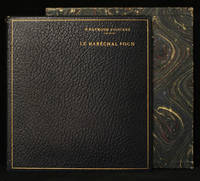
20917Paris Librairie Plon 1929. 12mo. 10 35 2 pp. Square dark blue calf with gilt title on front board gilt inner bordures and marbled end-papers Fritzes Stockholm in marbled slipcase. Uncut. Dedication to Eric Hultmark. Printed in 800 copies whereof 100 on Japanese paper numbered 1-100. This is no. 43. unknown
189745850Berlin Stockholm Paris Beijer 1897. 4to. Without wrappers as extracted from "Acta Mathematica. Hrdg. von G. Mittag-Leffler." Bd. 20 pp. 59-142. <br/><br/><em>First printing of Poincaré's paper in which he succeeded in converting differential equations into integral equations. "It became a major technique for solving initial-and boundary-value problems of ordinary and partial differential equations and was the strongest impetus for the study of integral equations." Morris Kline. </em> unknown
189539131Berlin Uppsala & Stockholm Paris 1895. 4to. Without wrappers as extracted from "Acta Mathematica. Hrsg. von G. Mittag-Leffler" Bd. 20 pp. 59-142. <br/><br/><em>First edition. In this paper Poincaré succeeded in converting differential equations into integral equations. "It became a major technique for solving initial-and boundary-value problems of ordinary and partial differential equations and was the strongest impetus for the study of integral equations." Morris Kline. </em> unknown
188749613Berlin G. Reimer 1887. 4to. Bound in contemporary half cloth with gilt lettering to spine. In "Acta Mathematica" Vol 10 1887. Entire volume offered. Stamps to title page otherwise a fine and clean copy. Pp. 310-12. Entire volume: 4 397 pp. <br/><br/><em>First printing of Poincaré's reply to Thomé's critique of an earlier paper by Poincaré. In his reply Poincaré "seems to have created a theory of asymptotic expansions where previously there had only been ad hoc techniques and to have opened the door for the return into rigorous mathematics of divergent series." Bottazzini Hidden Harmony. </em> hardcover
188249173Paris: Gauthier-Villars 1882. 4to. No wrappers. In: "Comptes Rendus Hebdomadaires des Seances de l'Academie des Sciences" Vol 94 No 4 15 17. Pp. 149- 184 pp. 997-- 1068 a. pp. 1139- 1214. 3 entire issues offered. Poincare's papers: pp. 163-168 1038-1042 a. 1166-67. <br/><br/><em>First appearance in print of the discovery of the automorphic forms which Poincaré named Fuchsian functions."One of Poincaré's first discoveries in mathematics dating to the 1880s was automorphic forms. He named them Fuchsian functions after the mathematician Lazarus Fuchs because Fuchs was known for being a good teacher and had researched on differential equations and the theory of functions. Poincaré actually developed the concept of these functions as part of his doctoral thesis. Under Poincaré's definition an automorphic function is one which is analytic in its domain and is invariant under a discrete infinite group of linear fractional transformations. Automorphic functions then generalize both trigonometric and elliptic functions." Wikipedia. </em> unknown
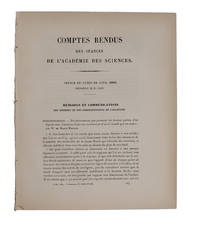
a103423dParis 1882 first edition. Gauthier Villars. Hardcover. Thick 4to. Marbled boards with half blue leather. Marbled end papers. 1431p. in volume. Poincare articles at p. 23-26 626-28 766-68. Many other important articles on other topics in same volume by Louis Pasteur Etienne Marey others. Text is Near Fine binding is very secure; hinges are not cracked. Cover leather is rubbed and somewhat worn. Overall Good plus. no owner marks. Pictures available on request. . hardcover
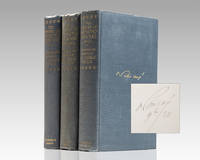
1926151171New York: Doubleday Page & Company 1926-1929. First American edition of this first-hand detailed account of French foreign policy diplomacy and the events leading to World War I. Octavo the first three volumes out of four original publisher's cloth with gilt titles to the spines facsimile signature of Raymond Poincaré stamped in gilt to the front panels tissue-guarded frontispiece to volume one. Boldly signed and dated 1928 by Raymond Poincaré on the front free endpaper of volume one. In very good condition. Translated and adapted by Sir George Arthur. Preface by the Duke of Northumberland K.G. The Memoirs of Raymond Poincaré translated and adapted into English by Sir George Arthur present the reflections of the French statesman who served as President of France from 1913 to 1920 during the critical years of the First World War. Originally written by Poincaré as a detailed political record of diplomacy wartime leadership and international negotiations the memoirs offer insight into the strategic decisions and alliances that shaped the conflict and its aftermath. Sir George Arthur’s English adaptation made these writings accessible to a broader readership preserving Poincaré’s account of French policy his interactions with Allied leaders and his interpretation of the diplomatic tensions that preceded the war. Doubleday, Page & Company hardcover
1993SONG1563961172Springer 1993-10-01. 1992. hardcover. Used: Good. 6.50x4.75x9.50. Buy with confidence. Excellent Customer Service & Return policy. Springer hardcover
188541900Stockholm F.& G. Beier 1885. 4to. Orig. printed wrappers to Acta Mathematica 4:3. Extracted from "Acta Mathematica" Vol. 4. Pp. 201-312. Clean and fine. <br/><br/><em>First appearance of a major paper on differential equations of the first order".the whole theory of automorphic functions was from the start guided by the idea of integrating linear differential equations with algebraic coefficients. Poincaré simultaneously investigated the local problem of linear differential equation in the neighborhood of an "irregular" singular point showing for the first time how asymptotic developments could be obtained for the integrals. A little later 1884 the paper offered he took up the question also started by I.L. Fuchs of the determination of all differential equations of the first order in the complex domain algebraic in y and y' and having fixed singular points; his rechearches was to be extended by Picard for equations of the second order and to lead to the spectacular results of Painlevé and his school at the beginning of the tweentieth century."DSB. </em> unknown
2012x-1461295823Springer New York 2012. Paperback. New. reprint edition. 483 pages. 9.25x6.10x1.10 inches. Springer New York paperback
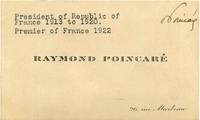
1922019533Paris France: not published 1922. Autograph. Very good condition. No Binding. Signed by Authors. First Edition. A printed calling card measuring approximately 2.25" x 3.75" with typed identification upon which is signed "R. Poincare". No date circa 1922. The card was removed from a sheet of paper and the residue remains on the back of the card. Poincare was Prime Minister in 1912 and serving as President of the Republic from 1913 to 1920. In 1922 Poincaré returned to power as Prime Minister. In 1923 he ordered the Occupation of the Ruhr to enforce payment of German reparations. His government was defeated by the Cartel des Gauches at the elections of 1924. He served a third term as Prime Minister in 1926-1929. . not published unknown
191639010c. 1916. Poincaré's official carte de visite elegantly printed "Raymond Poincaré / Président de la République" with a lengthy inscription WRITTEN DURING HIS PRESIDENCY AND DURING THE FIRST WORLD WAR to a close friend: "Merci mon cher ami de votre bienveillante appréciation. On a peu de mérite à parler clairement lorsqu'on rend la pensée de ce merveilleux pays: il suffit d'être un bon philosophe. Ami je me rappelle cette charmante après diner que nous avons passé au Prieuré. Dites je vous prie à Madame Dumay en lui présentant mes respects que nous vous réinviterons après la paix. Votre serviteur dévoué. Poincaré signed with initials. 6.6 x 10.7 cm. In perfect condition. <br/><br/> unknown
192339310Paris: Firmin-Didot 1923. Poincaré's carte de visite with four lines of autograph text and his monogram signature. THE TEXT MENTIONS M. André MAGINOT THE MINISTER OF WAR WHO WAS TO PROMOTE THE CONSTRUCTION OF THE FAMOUS "MAGINOT LINE". Poincaré 1860-1934 was elected to the Académie Française in 1909 and served as president of France from 1913 to 1920 thus during all of World War One. In perfect condition. A great rarity. <br/><br/> Firmin-Didot unknown
191249614Berlin G. Reimer 1912. 4to. Bound in contemporary half cloth with gilt lettering to spine. In "Acta Mathematica" Vol 35 1912. Entire volume offered. Stamps to title page otherwise a fine and clean copy. Pp. 1-28. Entire volume: 4 398 1 27 19 pp. <br/><br/><em>First appearance of Poincaré's report on 1910 Bolyai Prize which was awarded to David Hilbert in recognition of his work in fields of invariant theory transcendent number e constant after Lindemann arithmetic the Hilbert-Waring theorem geometry integral equations and the Dirichlet’s principle.In 1910 Hilbert became only the second winner of the Bolyai Prize of the Hungarian Academy of Sciences. It was the recognition of the fact that Hilbert was one of the leading mathematicians of his time. The first winner of the prize in 1905 was Henri Poincare the most prolific mathematician of the 19th century.Poincaré about the works and achievements of David Hilbert in fields of invariant theory transcendent number e constant after Lindemann arithmetic the Hilbert-Waring theorem geometry integral equations and the Dirichlet’s principle. </em> hardcover
190949622Berlin Uppsala & Stockholm Paris Almqvist & Wiksell 1909. 4to. Bound in contemporary half cloth with gilt lettering to spine. In "Acta Mathematica" Vol 33 1909. Entire volume offered. Stamps to title page otherwise a fine and clean copy. pp. 195-200.Entire volume: 6 392 12 pp. <br/><br/><em>First printing of Poincaé's work on Fredholm's equation.". heuristic variational arguments convinced Poincaré that there should be a sequence of "eigenvalues" and corresponding "eigenfunctions" for this problem but for the same reasons lit was not able to prove their existence. A few years later Fredholm's theory of integral equations enabled him to solve all these problems; it is likely that Poincareé's papers had a decisive influence on the development of Fredholm's method in particular the idea of introducing a variable complex parameter in the integral equation. It should also be mentioned that Fredholm's determinants were directly inspired by the theory of "infinite determinants" of H. von Koch which itself was a development of much earlier results of Poincaré in connection with the solution of linear differential equations." DSB </em> hardcover
190739130Berlin Stockholm Paris Almqvist & Wiksell 1907. 4to. Without wrappers as extracted from "Acta Mathematica. Hrsg. von G. Mittag-Leffler" Bd. 31 pp. 1-63. <br/><br/><em>First edition. Clebsch and Riemann tried to solve the problem of the uniformization for curves. "In 1882 Klein gave a general uniformization theorem but the proof was not complete. In 1883 Poincaré announced his general uniformization theorem but he too had no complete proof. Both Klein and Poincaré continued to work hard to prove this theorem but no decisive result was obtained for twent-five years. In 1907 Poincare in the offered paper and Paul Koebe independently gave a proof of this uniformization theorem.With the theorem on uniformization now rigorously established an improved treatment of algebraic functions and their integrals has become possible." Morris Kline. </em> unknown
189839135Berlin Uppsala & Stockholm Paris Almqvist & Wiksell 1898. 4to. Without wrappers as extracted from "Acta Mathematica. Hrsg. von G. Mittag-Leffler." Bd. 22 pp. 89-178. <br/><br/><em>First edition. "As soon as he came into contact with the work of Riemann and Weierstrass on Abelian Functions and algebraic geometry Poincaré was very much attracted by those fields. His papers on these subjects occupy in his complete works as much space as those on automorphic functions their dates ranging from 1881 to 1911. One of his main ideas in these papers is that of "reduction" of Abelian functions. Generalizing particular cases studied b Jacobi Weierstrass and Picard Poincaré proved the general "complete reducibility" theorem."DSB. </em> unknown
189739134Berlin Uppsala & Stockholm Paris Almqvist & Wiksell 1897. 4to. No wrappers as extracted from "Acta Mathematica. Hrsg. von G. Mittag-Leffler." Bd. 21 pp. 83-97. <br/><br/><em>First edition. In this paper Poincaré arrives at a new theorem about canonical transformation and in his later "Methodes Nouvelles" he proved this theorem using a variiational principle of mechanics known today as the Hamilton principle. </em> unknown
1915041847Paris: Ministère De L'instruction Publique Et Des Beaux-Arts 1915. 1st Edition . Hardcover. Very Good. Plates. 397 405 Pp .Quarter Brown Morocco Gilt Yellow Endpapers. No Marks Not Ex-Library. First Printing Some Wear Gilt Bright Hinges Tight.Text In French. <br/> <br/> Ministère De L'instruction Publique Et Des Beaux-Arts hardcover
18963699Paris: Gauthier-Villars 1896. FIRST EDITION. With numerous text diagrams. Contemporary half-morocco and cloth. From the library of George E. Hale with a small presentation bookplate to the Mount Wilson Observatory Library from Adriaan van Maanen and the blind-stamp of the library on the fly-leaf. First edition of the author's classic work on probability and statistics. His fundamental discoveries on differential equations as well as the theories of Laplace Gauss and Bertrand are here described. This treatise greatly influenced modern works on the subject.<br /> <br /> Poincaré 1854-1912 was an eminent French mathematician physicist and astronomer. His important contributions to mathematical techniques pure mathematics celestial mechanics and analysis were recognized by his appointment to memebership in the Académie des Sciences in 1887 and the Royal Society in 1894.<br /> <br /> Poggendorff IV p. 1178; Struik A Concise History of Mathematics pp. 278-281; Zeitlinger II 13456. Gauthier-Villars unknown
a85211a1911. Complete article in French at pp. 109-132 in single complete issue of Rendiconti del Circolo Mathematico di Palermo Tomo XXXI. Wraps. Article "reproduit avec l'autorisation de l'Academie Hongroise des Sciences." The Hungarian Bolyai prize was awarded to Poincare in 1905 and the second time to David Hilbert in 1910. This article discusses the award and summarizes the work of Hilbert. Several additional articles on other mathematical topics in same issue as well. Good plus small closed tear on one page of text in lower margin not affecting text light foxing on cover light chipping on spine. Rare. . paperback
189949640Berlin Stockholm Paris Beijer 1899. 4to. Bound in contemporary half cloth with gilt lettering to spine. In "Acta Mathematica" Vol 22 1899. Entire volume offered. Stamps to title page otherwise a fine and clean copy. pp. 1-18; Pp. 89-178; Pp. 201-358.Entire volume: 4 388 2 pp. <br/><br/><em>First printing of these important papers: POINCARÉ: First edition. "As soon as he came into contact with the work of Riemann and Weierstrass on Abelian Functions and algebraic geometry Poincaré was very much attracted by those fields. His papers on these subjects occupy in his complete works as much space as those on automorphic functions their dates ranging from 1881 to 1911. One of his main ideas in these papers is that of "reduction" of Abelian functions. Generalizing particular cases studied b Jacobi Weierstrass and Picard Poincaré proved the general "complete reducibility" theorem."DSB.VOLTERRA: First edition. As the north and south poles instead of being fixed points on the earth's surface wander round within a circle of ab. 5o ft. in diameter the result is a variability of terrestial latitudes generally. Volterra gives an elaborate mathematical analysis of these yearly fluxtuations. </em> hardcover
188745902Stockholm Beijer 1887. 4to. With the original wrappers in "Acta Mathematica 9:4. Band. No backstrip. Fine and clean. Pp. 321-380. Entire issue: Pp. 321-400 <br/><br/><em>First printing of Poincaré important - but partly unrecognized - paper which coined the term 'Poincaré lemma'. Even though it is named after Poincaré the discovery has by attributed to the Italian mathematician Vito Volterra who published a series of papers in 1889 on this subject. </em> unknown