Henri Poincaré , Edouard GuillaumeLivre Rare Book
1 189 résultats
1924LR31-HN6Rare exemplaire de l'édition originale, bon exemplaire, léger manque au niveau de la coiffe inférieure, intérieur en partie non coupée, uniformément un peu jauni , 81 p. + table des matières
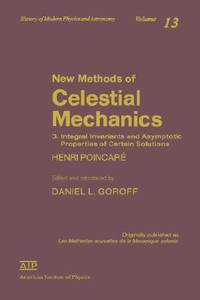
189256937Paris, Gauthier-Villars, 1892, in-8, XIX, (1), 432pp, demi-chagrin marron foncé de l'époque, dos liise orné, tranches mouchetées, Première édition. Leçons professées pendant le premier semetre 1888-1889 à la faculté des Sciences de Paris, rédigées par Blondin Couverture rigide
1563961172New. Brand new and still unused unknown
19051301170006Paris : Gauthier-Villars 1/1/1905. Hardcover. Good. Paris : Gauthier-Villars 1905. 8vo. Volume One and Volume Two parts 1 and 2 bound together. 365pp.; 165pp; 137pp. Quarter bound in contemporary leather with matching corners. Spine cloth lacking. Patterned grey cloth boards. Rubbing to extremities. Minor cracking to hinges. Tight binding; solid boards. Interior pages are clean unmarked and in excellent condition. Ships daily. Paris : Gauthier-Villars hardcover
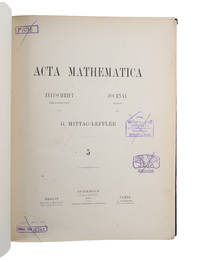
188462251Berlin, Stockholm, Paris, F. & G. Beijer, 1884. 4to. In contemporary half cloth. Stamps to title-page and last leaf. In ""Acta Mathematica"", no 5, 1884/1885. Entire issue offered. Pp. 209-278. [Entire issue: (4) 408 pp.].
188246049Berlin, Stockholm, Paris, F. & G. Beijer, 1882. Large4to. As extracted from ""Acta Mathematica"", no backstrip. With title-page and front free end-paper. In ""Acta Mathematica"", volume 1. Title pages with library stamp. A fine and clean copy. Pp. (6), 62.
188462251Berlin Stockholm Paris F. & G. Beijer 1884. 4to. In contemporary half cloth. Stamps to title-page and last leaf. In "Acta Mathematica" no 5 1884/1885. Entire issue offered. Pp. 209-278. Entire issue: 4 408 pp. <br/><br/><em>First publication of this groundbreaking paper which together with his three other papers on the pubject not offered here constitute the discovery of Automorphic Functions. "Before he was thirty years of age Poincaré became world famous with his epoch-making discovery of the "automorphic functions" of one complex variable or as he called them the "fuchsian" and "kleinean" functions." DSB.These manuscripts written between 28 June and 20 December 1880 show in detail how Poincaré exploited a series of insights to arrive at his first major contribution to mathematics: the discovery of the automorphic functions. In particular the manuscripts corroborate Poincaré's introspective account of this discovery 1908 in which the real key to his discovery is given to be the recognition that the transformations he had used to define Fuchsian functions are identical with those of non-Euclidean geometry. See Walter Poincaré Jules Henri French mathematician and scientist.The idea was to come in an indirect way from the work of his doctoral thesis on differential equations. His results applied only to restricted classes of functions and Poincaré wanted to generalize these results but as a route towards this he looked for a class functions where solutions did not exist. This led him to functions he named Fuchsian functions after Lazarus Fuchs but were later named automorphic functions. First editions and first publications of these epochmaking papers representing the discovery of "automorphic functions" or as Poincaré himself called them the "Fuchsian" and "Kleinian" functions."By 1884 Poincaré published five major papers on automorphic functions in the first five volumes of the new Acta Mathematica. When the first of these was published in the first volume of the new Acta Mathematica Kronecker warned the editor Mittag-Leffler that this immature and obscure article would kill the journal. Guided by the theory of elliptic functions Poincarë invented a new class of automorphic functions. This class was obtained by considering the inverse function of the ratio of two linear independent solutions of an equation. Thus this entire class of linear diffrential equations is solved by the use of these new transcendental functions of Poincaré." Morris Kline.Poincaré explains how he discovered the Automorphic Functions: "For fifteen days I strove to prove that there could not be any functions like those I have since called Fuchsian functions I was then very ignorant; every day I seated myself at my work table stayed an hour or two tried a great number of combinations and reached no results. One evening contrary to my custom I drank black coffee and could not sleep. Ideas rose in crowds; I felt them collide until pairs interlocked so to speak making a stable combination. By the next morning I had established the existence of a Class of Fuchsian functions those which come from hypergeometric series; i had only to write out the results which took but a few hours.the transformations that I had used to define the Fuchsian functions were identical with those of Non-Euclidean geometry." </em> hardcover
188246049Berlin Stockholm Paris F. & G. Beijer 1882. Large4to. As extracted from "Acta Mathematica" no backstrip. With title-page and front free end-paper. In "Acta Mathematica" volume 1. Title pages with library stamp. A fine and clean copy. Pp. 6 62. <br/><br/><em>First publication of this groundbreaking paper which became Poincaré first paper in his much celebrated and famous six-paper series which together constitute the discovery of Automorphic Functions. "Before he was thirty years of age Poincaré became world famous with his epoch-making discovery of the "automorphic functions" of one complex variable or as he called them the "fuchsian" and "kleinean" functions." DSB.These manuscripts written between 28 June and 20 December 1880 show in detail how Poincaré exploited a series of insights to arrive at his first major contribution to mathematics: the discovery of the automorphic functions. In particular the manuscripts corroborate Poincaré's introspective account of this discovery 1908 in which the real key to his discovery is given to be the recognition that the transformations he had used to define Fuchsian functions are identical with those of non-Euclidean geometry.The idea was to come in an indirect way from the work of his doctoral thesis on differential equations. His results applied only to restricted classes of functions and Poincaré wanted to generalize these results but as a route towards this he looked for a class functions where solutions did not exist. This led him to functions he named Fuchsian functions after Lazarus Fuchs but were later named automorphic functions. First editions and first publications of these epochmaking papers representing the discovery of "automorphic functions" or as Poincaré himself called them the "Fuchsian" and "Kleinian" functions."By 1884 Poincaré published five major papers on automorphic functions in the first five volumes of the new Acta Mathematica. When the first of these was published in the first volume of the new Acta Mathematica Kronecker warned the editor Mittag-Leffler that this immature and obscure article would kill the journal. Guided by the theory of elliptic functions Poincarë invented a new class of automorphic functions. This class was obtained by considering the inverse function of the ratio of two linear independent solutions of an equation. Thus this entire class of linear diffrential equations is solved by the use of these new transcendental functions of Poincaré." Morris Kline.Poincaré explains how he discovered the Automorphic Functions: "For fifteen days I strove to prove that there could not be any functions like those I have since called Fuchsian functions I was then very ignorant; every day I seated myself at my work table stayed an hour or two tried a great number of combinations and reached no results. One evening contrary to my custom I drank black coffee and could not sleep. Ideas rose in crowds; I felt them collide until pairs interlocked so to speak making a stable combination. By the next morning I had established the existence of a Class of Fuchsian functions those which come from hypergeometric series; i had only to write out the results which took but a few hours.the transformations that I had used to define the Fuchsian functions were identical with those of Non-Euclidean geometry." </em> unknown
1895S6990Paris:: Georges Carre 1895. 1895. At head of title: Cours de la Faculte des Sciences de Paris . . . Cours de Physique Mathematique. 8vo. iv 316 pp. 33 figs. Modern brown buckram gilt spine. Fine. FIRST EDITION. DSB XI pp. 51-61; Gascoigne 6883.6; Parke Guide to the literature of mathematics and physics p. 167. Georges Carre, 1895. hardcover books
1895S6990Paris:: Georges Carre 1895. 1895. At head of title: Cours de la Faculte des Sciences de Paris . . . Cours de Physique Mathematique. 8vo. iv 316 pp. 33 figs. Modern brown buckram gilt spine. Fine. FIRST EDITION. DSB XI pp. 51-61; Gascoigne 6883.6; Parke Guide to the literature of mathematics and physics p. 167. Georges Carre, 1895. hardcover
5601Paris Emile-Paul Frères, éditeurs 1916 in 12 (18x14,5) 1 volume reliure demi maroquin marron à coins de l'époque, tête dorée, couverture conservée, 55 pages. Reliure signée Henry-John?. Exemplaire sur Hollande van Gelder, N°3 tiré spécialement pour l'auteur. Raymond Poincaré, Bar-le-Duc 1860 - Paris 1934, avocat et homme d'Etat français, président de la République française du 18 février 1913 au 18 février 1920. Henriette Poincaré, née Henriette Adeline Benucci, Passy 1858 - Paris 1943, épouse de Raymond Poincaré, président de la République. Envoi autographe signé par Maurice Barrés à Mme Raymond Poincaré. Bel exemplaire
190246066HB1902. EA. Paris E. Flammarion 1902. Kl.-8°. 2 Bl. 284 S. Halblederband der Zeit mit goldgeprägtem Rückentitel und Linienvergoldung auf marmorierten Deckeln leicht berieben. Vergoldeter Kopfschnitt. Erste Vakatseite mit kleinem Einriss. Durchgehend leicht bis mäßig gebräunt. Sonst in schöner Erhaltung. unknown
191150Budapest: Magyar Tudományos Akadémia Société Franklin 1911. Only edition. Published unbound. In fine condition. Only edition. Published unbound. 38 p. The “International Bolyai János Prize of Mathematics†founded by the Hungarian Academy of Sciences in 1902 with the aim to compensate the lack of Nobel Prize in the field of mathematics. It is awarded in every five years to mathematicians having published their monograph describing their own important new results. The prize was given first time in 1905 to Henry Poincaré and for second time to David Hilbert. Because of the outbreak of WWI and other historical and political reasons the prize was not given until the year 2000.<br /> David Hilbert was awarded in 1910 by the committee of Gyula Julius KÅ‘nig Gusztáv Rados Gösta Mittag-Leffler and Henry Poincaré.<br /> In the brochure there is a short description of the Prize a few words about the committee and the declaration that for the years 1905–1906 Hilbert is awarded. The following 36 pages is the report of Poincaré about the works and achievements of Hilbert in fields of invariant theory transcendent number e constant after Lindemann arithmetics the Hilbert-Waring theorem geometry integral equations and the Dirichlet’s principle. Magyar Tudományos Akadémia (Société Franklin) unknown
188244432Leipzig, B.G. Teubner, 1882. 8vo. Original printed wrappers, no backstrip. In ""Mathematische Annalen. Begründet 1882 durch Rudolf Friedrich Alfred Clebsch. XIX. [19] Band. 4. Heft."" Entire issue offered. [Poincaré:] Pp. 553-64. [Entire issue: Pp. 435-594].
188247185Leipzig, B.G. Teubner, 1882. 8vo. Bound in recent full black cloth with gilt lettering to spine. In ""Mathematische Annalen"", Volume 37, 1890. Entire volume offered. Library label pasted on to pasted down front free end-paper. Small library stamp to lower part of title title page and verso of title page. Fine and clean. Pp. 182-228. [Entire volume: IV, 604 pp.].
188244432Leipzig B.G. Teubner 1882. 8vo. Original printed wrappers no backstrip. In "Mathematische Annalen. Begründet 1882 durch Rudolf Friedrich Alfred Clebsch. XIX. 19 Band. 4. Heft." Entire issue offered. Poincaré: Pp. 553-64. Entire issue: Pp. 435-594. <br/><br/><em>First printing of Poincaré's paper on his comprehensive theory of complex-valued functions which remain invariant under the infinite discontinuous group of linear transformations. In 1881 Poincaré had published a few short papers with some initial work on the topic and in the 1881 Klein invited Poincaré to write a longer exposition of his results to Mathematische Annalen which became the present paper. This however turned out to be an invitation to at mathematical dispute:"Before the article went to press Klein forewarned Poincaré that he had appended a note to it in which he registered his objections to the terminology employed therein. In particular Klein disputed Poincaré's decision to name the important class of functions possessing a natural boundary circle after Fuch's a leading exponent of the Berlin school. The importance he attached to this matter however went far beyond the bounds of conventional priority dispute. True Klein was concerned that his own work received sufficient acclaim but the overriding issue hinged on whether the mathematical community would regard the burgeoning research in this field as an outgrowth of Weierstrassian analysis or the Riemannian tradition." Parshall. The Emergence of the American Mathematical Research Community. Pp. 184-5.The issue contains the following important contributions by seminal mathematicians:1. Klein Felix. Ueber eindeutige Functionen mit linearen Transformationen in sich. Pp. 565-68.2. Picard Emile. Sur un théorème relatif aux surfaces pour lesquelles les coordnnées d´un point quelconque s´experiment par des fonctions abéliennes de deux paramètres. Pp. 578-87.3. Cantor Georg. Ueber ein neues und allgemeines Condensationsprincip der Singularitäten von Functionen. Pp. 588-94. </em> unknown
188247185Leipzig B.G. Teubner 1882. 8vo. Bound in recent full black cloth with gilt lettering to spine. In "Mathematische Annalen" Volume 37 1890. Entire volume offered. Library label pasted on to pasted down front free end-paper. Small library stamp to lower part of title title page and verso of title page. Fine and clean. Pp. 182-228. Entire volume: IV 604 pp. <br/><br/><em>First printing of Poincaré's paper on his comprehensive theory of complex-valued functions which remain invariant under the infinite discontinuous group of linear transformations. In 1881 Poincaré had published a few short papers with some initial work on the topic and in the 1881 Klein invited Poincaré to write a longer exposition of his results to Mathematische Annalen which became the present paper. This however turned out to be an invitation to at mathematical dispute:"Before the article went to press Klein forewarned Poincaré that he had appended a note to it in which he registered his objections to the terminology employed therein. In particular Klein disputed Poincaré's decision to name the important class of functions possessing a natural boundary circle after Fuch's a leading exponent of the Berlin school. The importance he attached to this matter however went far beyond the bounds of conventional priority dispute. True Klein was concerned that his own work received sufficient acclaim but the overriding issue hinged on whether the mathematical community would regard the burgeoning research in this field as an outgrowth of Weierstrassian analysis or the Riemannian tradition." Parshall. The Emergence of the American Mathematical Research Community. Pp. 184-5.The issue contains the following important contributions by seminal mathematicians:1. Klein Felix. Ueber eindeutige Functionen mit linearen Transformationen in sich. Pp. 565-68.2. Picard Emile. Sur un théorème relatif aux surfaces pour lesquelles les coordnnées d´un point quelconque s´experiment par des fonctions abéliennes de deux paramètres. Pp. 578-87. </em> hardcover
1929170615Garden City New York: Doubleday Doran & Company 1929 & 1931. First US editions in English first printings presentation copies inscribed by the author on the half-title of each volume respectively "À Mr Aage Birger Nilsen R. Poincaré" and "À Monsieur Aage B. Nilsen Hommage de l'auteur R. Poincaré". Poincaré 1860-1930 served as President of France from 1913 to 1920. Prior to the war he was noted for his anti-German policy and shifting the Franco-Russian alliance to an offensive posture. During the war he maintained a belligerent position though from 1917 was increasingly sidelined by prime minister Clemenceau who led the Versailles negotiations. Poincaré's memoirs were published in French in 11 volumes. In total four volumes appeared in English: two volumes published in 1926 which covered 1912 and 1913 and these marked as volume III and IV taking the narrative through to the end of 1915. Although in French Poincaré's memoirs cover the entirety of the war these were the only volumes published in English. They were published in the US and UK the same years. The recipient Nilsen acquired the signatures of various prominent figures in the 1920s including Winston Churchill and George Gershwin; there are references to him as a military attaché and railroad executive. 2 vols octavo. Original blue cloth spines lettered in gilt. With dust jackets. Unclipped jackets with a hint of rubbing and soiling: fine copies in near-fine jackets. hardcover
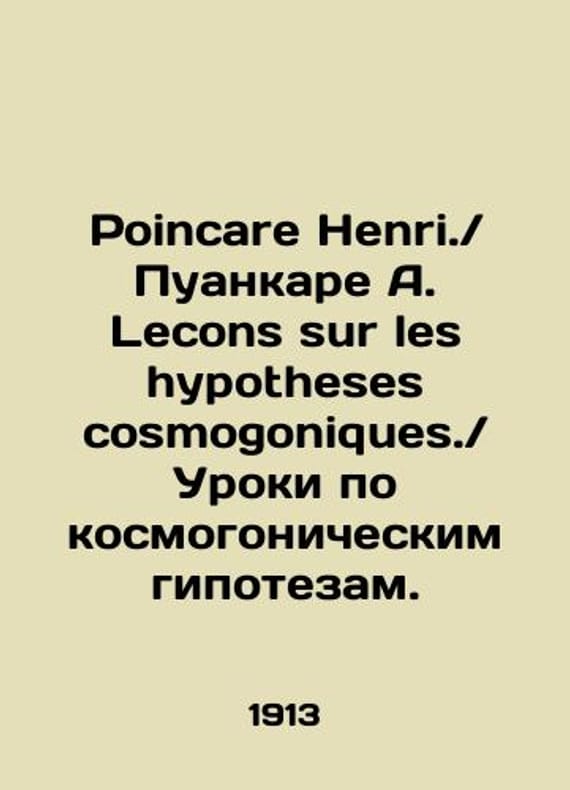
alb6c19b6df96d09e6cPoincare Henri. / Poincare A. Lecons sur les hypotheses cosmogoniques. / Lessons on cosmogonic hypotheses. In French (ask us if in doubt)/Poincare Henri./ Puankare A. Lecons sur les hypotheses cosmogoniques./ Uroki po kosmogonicheskim gipotezam. Cosmogonic Hypotheses. In French. Second Edition. Paris. 1913. 294s. We have thousands of titles and often several copies of each title may be available. Please feel free to contact us for a detailed description of the copies available. SKUalb6c19b6df96d09e6c
alb5b8069b387bb5b72Poincare A. Science and Method. In Russian (ask us if in doubt)/Puankare A. Nauka i metod.. Short description: In Russian (ask us if in doubt).Authorized translation of Boris Koren under the editorship of N. A. Gezekhus. St. Petersburg Edition by N. P. Karbasnikov. 1910. 238s. We have thousands of titles and often several copies of each title may be available. Please feel free to contact us for a detailed description of the copies available. SKUalb5b8069b387bb5b72
alb0ec412f31e2ce207Poincare A. Mathematical Creation. Psychological Study. In Russian /Puankare A. Matematicheskoe tvorchestvo. Psikhologicheskiy etyud. Translation by E.G. Runina, edited by M.G. Rebinder. Yuryev Typography by Ed.Bergman. 1909. 24 p.We have thousands of titles and often several copies of each title may be available. Please feel free to contact us for a detailed description of the copies available.SKUalb0ec412f31e2ce207.
alb31d21f8f822b2a92Poincare Henri. Science and Hypothesis. In Russian /Puankare Anri. Nauka i gipoteza. Translation from the 2nd, corrected French edition by A.V. Cherniavsky. Edited by A.G. Genkel. St. Petersburg. Typography of the Slovo Joint Stock Company. 1906. 238 p. We have thousands of titles and often several copies of each title may be available. Please feel free to contact us for a detailed description of the copies available. SKUalb31d21f8f822b2a92.
187323392Paris:: Berger-Levrault 1873-1876. contemporary quarter calf and marbled boards. Bindings a little rubbed with some chipping to the tops of spines; tight and sound. 8vo. A few text illustrations. Berger-Levrault, hardcover
1993Q-1563961172Springer 1993-10-01. Hardcover. New. In shrink wrap. Looks like an interesting title! Springer hardcover
189239133(Berlin, Uppsala & Stockholm, Paris, 1892 a. 1897. 4to. Without wrappers as extracted from ""Acta Mathematica Hrsg. von G. Mittag-Leffler."", Bd. 16 and 20, pp. 297-339 and pp. 313-355.