588 résultats
189245849Berlin Uppsala & Stockholm Paris 1892 a. 1897. 4to. Without wrappers as extracted from "Acta Mathematica Hrsg. von G. Mittag-Leffler." Bd. 16 and 20. Fine and clean. Pp. 297-339 pp. 313-355. <br/><br/><em>First edition of these important papers on the polarization of light. The geometrical representation of different states of polarization by points on a sphere is due to Poincare. The method shown to visualize the different states of polarization is given in these two papers and the method is called Poincare's Sphere. </em> unknown
4897018Short description: In Russian. Poincare Henri. Hypothesis and Science. The Printing House of G. Lissner and A. Geschel. The image is provided for reference only. It may reflect condition of one of the available copies or only help in identifying the edition. Please feel free to contact us for a detailed description of the copies available. SKU4897018 unknown

6796538Short description: In Russian. Poincare Henri. Selected Works. Moscow: Science 1971-. You are welcome to reach out to us for a detailed description of the copies currently available. Delivery of this book may take longer than usual including extended processing and pre-shipping time no expedited shipping is available. Please advise us if you have a set date or a deadline to receive your order.SKU6796538 unknown
10351647Short description: In Russian. Poincare Henri. Science and Hypothesis. The journal Popular Science Library. The image is provided for reference only. It may reflect condition of one of the available copies or only help in identifying the edition. Please feel free to contact us for a detailed description of the copies available. SKU10351647 unknown
alb07b54907abb6ac4aComplete translation from French of A.I.Bachinsky N.M.Solovyov and R.M.Solovyev. M. T-shirt printing house A.I.Mamontov. 1904. 268 p. Please contact us for details on condition of available copies of the book. SKUalb07b54907abb6ac4a. unknown
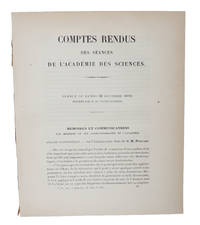
189251648Paris: Gauthier-Villars 1892. 4to. No wrappers. In: "Comptes Rendus Hebdomadaires des Seances de l'Academie des Sciences" Vol 115 No 18. Pp. 633- 696. Entire issue offered. Poincare's paper: pp. 633-637. <br/><br/><em>First printing of a seminal paper in mathematics founding the field of ALGEBRAIC TOPOLOGY by announcing and setting the agenda for his 1895 paper. Analysis Situs describes the relative position between objects points lines surfaces without bothering about their sizes. </em> unknown
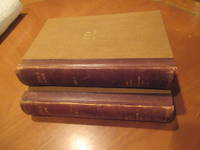
190849616Berlin Stockholm Paris Almqvist & Wiksell 1908. 4to. Bound in contemporary half cloth with gilt lettering to spine. In "Acta Mathematica" Vol 31 1908. Entire volume offered. Stamps to title page otherwise a fine and clean copy. Pp. 1-64. Entire volume: 8 408 2 12 pp. <br/><br/><em>First appearance of Poincaré's important paper in which he presented the first solution to the problem of the uniformization of curves - now know as The Uniformization Theorem. Clebsch and Riemann tried to solve the problem of the uniformization for curves. "In 1882 Klein gave a general uniformization theorem but the proof was not complete. In 1883 Poincaré announced his general uniformization theorem but he too had no complete proof. Both Klein and Poincaré continued to work hard to prove this theorem but no decisive result was obtained for twent-five years. In 1907 Poincare in the offered paper and Paul Koebe independently gave a proof of this uniformization theorem.With the theorem on uniformization now rigorously established an improved treatment of algebraic functions and their integrals has become possible." Morris Kline. </em> hardcover
189749621Berlin Uppsala & Stockholm Paris Almqvist & Wiksell 1897. 4to. Bound in contemporary half cloth with gilt lettering to spine. In "Acta Mathematica" Vol 21 1897. Entire volume offered. Stamps to title page otherwise a fine and clean copy. pp. 83-97; Pp. 331-341.Entire volume: 6 376 pp 4 plates. <br/><br/><em>First printing of this paper in which Poincaré arrives at a new theorem about canonical transformation and in his later "Methodes Nouvelles" he proved this theorem using a variiational principle of mechanics known today as the Hamilton principle.Also included is the first printing of Poincaré's principal address at the first International Congress of Mathematicians held in Zürich in 1897. </em> hardcover
1896D20001Paris: Georges Carré 1896. First Edition. Hardcover. Very Good. Burgundy half-morocco raised bands gilt-lettered spine marbled boards and endpapers top edge gilt. Light wear the paper browned as always. <br/><br/> Georges Carré hardcover
191217483<p>Paris: Gauthier-Villars 1912 Second edition. Contemporary half calf. Spine richly gilt-decorated red label. . Octavo. A fine copy wkitht he original wrappers bound in. Henry Poincaré 1854-1912 was one of the most versatile mathematicians physicists and philosophers of the pre-modern era. He came extremely close to announcing the special theory of relativity just months before Einstein. In this treatise on probability theory Poincaré introduces the foundation of modern ergodic theory and expands on Gauss's law of large numbers. Whereas Gauss in Theoria Motus proved the normal law of error by assuming that the probability of a certain deviation depends only on the magnitude of the deviation Poincaré relaxes this assumption and shows that a law much more general than the Gaussian distribution may be deduced. See Whittaker The Calculus of Observations p. 218.</p> Gauthier-Villars,
18898698792Georges Carre 1889. This is an ex-library book and may have the usual library/used-book markings inside.This book has hardback covers. In poor condition suitable as a reading copy. No dust jacket. Re-bound by library. Refurbished large 8vo. Cloth panels from boards and backstrip secured onto newer binding. Gilt lettering and simple borders on backstrip. Bumped corners and a little fraying. Interior is secure clean and clear though pages a little age toned. Trimmed. One or two detached but present pages. Please note the Image in this listing is a stock photo and may not match the covers of the actual item1250grams ISBN: Georges Carre hardcover
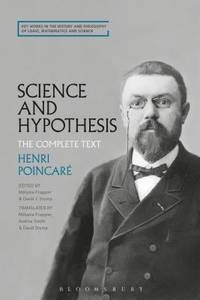
2017x-1350026778Bloomsbury USA Academic 2017. Hardcover. New. 288 pages. 9.00x6.00x0.50 inches. Bloomsbury USA Academic hardcover
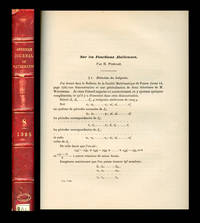
18861389Baltimore: John Hopkins University 1886. 1st Edition. FIRST EDITION OF POINCARE'S PROOF & A GENERALIZATION OF TWO THEOREMS OF KARL WEIERSTRASS a German mathematician frequently cited as the ‘father of modern analysis.' "Henri Poincaré 1854-1912 was a mathematician theoretical physicist and a philosopher of science famous for discoveries in several fields and referred to as the last polymath one who could make significant contributions in multiple areas of mathematics and the physical sciences" Stanford Encyclopedia of Philosophy. <br /> <br /> While the proof Poincare published here had appeared in a French journal Poincare wanted it placed in American Journal of Mathematic the journal offered here so that he could both reproduce and expand upon it. As with many of Poincare's work this one exists or involves the interaction between various branches of mathematics. <br /> <br /> A translation of the first paragraph of Poincare's paper reads: ""I have given in the Bulletin de la Societe mathematique de France t. 12 page 124 a proof and a generalization of two theorems of M. Weierstrass. I wish to reproduce them here succinctly by making some additions which are essential to the proof" Poincare 289. The paper proceeds under six headings respectively: Reduction of Integrals; Singular Case of Reduction; Generalization of the Theorem of Abel; Intermediary Functions; Transformation; Sum of Zeros" Poincare 289. <br /> <br /> Poincare's proof and generalization relates to Weierstrass's work on Abelian functions and algebraic geometry. In fact "as soon as he came into contact with the work of Riemann and Weierstrass on Abelian functions and algebraic geometry Poincare was very much attracted by those fields. His papers on these subjects occupy in his complete works as much space as those on automorphic functions their dated ranging from 1881 to 1911. One of the main ideas in these papers is that of "reduction" of Abelian functions. Generalizing particular cases studied by Jacobi Weierstrass and Picard Poincare proved the general "complete reducibility" theorem. Abelian varieties can be decomposed in sums of "simple" abelian varieties having finite intersection. Poincare noted further that Abelian functions corresponding to reducible varieties and even to products of elliptic curves that is Abelian varieties of dimension 1 are "dense" among all Abelian functions - a result that enabled him to extend and generalize many of Riemann's results on theta functions and to investigate the special properties of the theta functions corresponding to the Jacobian varieties of algebraic curves. Dictionary of Scientific Biography Vol. 11 p. 54. CONDITION & DETAILS: Full volume handsomely bound in half red leather and marbled boards scuffed and rubbed at the edges and spine; raised bands at the spine as well as gilt-lettering. Ex-libris bookplate front paste-down library "Due Date" label tipped-in rfep small library number sticker spine. No other library markings. 4to. Clean and bright throughout. Very good. John Hopkins University hardcover
189949640Berlin Stockholm Paris Beijer 1899. 4to. Bound in contemporary half cloth with gilt lettering to spine. In "Acta Mathematica" Vol 22 1899. Entire volume offered. Stamps to title page otherwise a fine and clean copy. pp. 1-18; Pp. 89-178; Pp. 201-358.Entire volume: 4 388 2 pp. <br/><br/><em>First printing of these important papers: POINCARÉ: First edition. "As soon as he came into contact with the work of Riemann and Weierstrass on Abelian Functions and algebraic geometry Poincaré was very much attracted by those fields. His papers on these subjects occupy in his complete works as much space as those on automorphic functions their dates ranging from 1881 to 1911. One of his main ideas in these papers is that of "reduction" of Abelian functions. Generalizing particular cases studied b Jacobi Weierstrass and Picard Poincaré proved the general "complete reducibility" theorem."DSB.VOLTERRA: First edition. As the north and south poles instead of being fixed points on the earth's surface wander round within a circle of ab. 5o ft. in diameter the result is a variability of terrestial latitudes generally. Volterra gives an elaborate mathematical analysis of these yearly fluxtuations. </em> hardcover
188745902Stockholm Beijer 1887. 4to. With the original wrappers in "Acta Mathematica 9:4. Band. No backstrip. Fine and clean. Pp. 321-380. Entire issue: Pp. 321-400 <br/><br/><em>First printing of Poincaré important - but partly unrecognized - paper which coined the term 'Poincaré lemma'. Even though it is named after Poincaré the discovery has by attributed to the Italian mathematician Vito Volterra who published a series of papers in 1889 on this subject. </em> unknown
18963699Paris: Gauthier-Villars 1896. FIRST EDITION. With numerous text diagrams. Contemporary half-morocco and cloth. From the library of George E. Hale with a small presentation bookplate to the Mount Wilson Observatory Library from Adriaan van Maanen and the blind-stamp of the library on the fly-leaf. First edition of the author's classic work on probability and statistics. His fundamental discoveries on differential equations as well as the theories of Laplace Gauss and Bertrand are here described. This treatise greatly influenced modern works on the subject.<br /> <br /> Poincaré 1854-1912 was an eminent French mathematician physicist and astronomer. His important contributions to mathematical techniques pure mathematics celestial mechanics and analysis were recognized by his appointment to memebership in the Académie des Sciences in 1887 and the Royal Society in 1894.<br /> <br /> Poggendorff IV p. 1178; Struik A Concise History of Mathematics pp. 278-281; Zeitlinger II 13456. Gauthier-Villars unknown
a85211a1911. Complete article in French at pp. 109-132 in single complete issue of Rendiconti del Circolo Mathematico di Palermo Tomo XXXI. Wraps. Article "reproduit avec l'autorisation de l'Academie Hongroise des Sciences." The Hungarian Bolyai prize was awarded to Poincare in 1905 and the second time to David Hilbert in 1910. This article discusses the award and summarizes the work of Hilbert. Several additional articles on other mathematical topics in same issue as well. Good plus small closed tear on one page of text in lower margin not affecting text light foxing on cover light chipping on spine. Rare. . paperback
1915041847Paris: Ministère De L'instruction Publique Et Des Beaux-Arts 1915. 1st Edition . Hardcover. Very Good. Plates. 397 405 Pp .Quarter Brown Morocco Gilt Yellow Endpapers. No Marks Not Ex-Library. First Printing Some Wear Gilt Bright Hinges Tight.Text In French. <br/> <br/> Ministère De L'instruction Publique Et Des Beaux-Arts hardcover
191249614Berlin G. Reimer 1912. 4to. Bound in contemporary half cloth with gilt lettering to spine. In "Acta Mathematica" Vol 35 1912. Entire volume offered. Stamps to title page otherwise a fine and clean copy. Pp. 1-28. Entire volume: 4 398 1 27 19 pp. <br/><br/><em>First appearance of Poincaré's report on 1910 Bolyai Prize which was awarded to David Hilbert in recognition of his work in fields of invariant theory transcendent number e constant after Lindemann arithmetic the Hilbert-Waring theorem geometry integral equations and the Dirichlet’s principle.In 1910 Hilbert became only the second winner of the Bolyai Prize of the Hungarian Academy of Sciences. It was the recognition of the fact that Hilbert was one of the leading mathematicians of his time. The first winner of the prize in 1905 was Henri Poincare the most prolific mathematician of the 19th century.Poincaré about the works and achievements of David Hilbert in fields of invariant theory transcendent number e constant after Lindemann arithmetic the Hilbert-Waring theorem geometry integral equations and the Dirichlet’s principle. </em> hardcover
190949622Berlin Uppsala & Stockholm Paris Almqvist & Wiksell 1909. 4to. Bound in contemporary half cloth with gilt lettering to spine. In "Acta Mathematica" Vol 33 1909. Entire volume offered. Stamps to title page otherwise a fine and clean copy. pp. 195-200.Entire volume: 6 392 12 pp. <br/><br/><em>First printing of Poincaé's work on Fredholm's equation.". heuristic variational arguments convinced Poincaré that there should be a sequence of "eigenvalues" and corresponding "eigenfunctions" for this problem but for the same reasons lit was not able to prove their existence. A few years later Fredholm's theory of integral equations enabled him to solve all these problems; it is likely that Poincareé's papers had a decisive influence on the development of Fredholm's method in particular the idea of introducing a variable complex parameter in the integral equation. It should also be mentioned that Fredholm's determinants were directly inspired by the theory of "infinite determinants" of H. von Koch which itself was a development of much earlier results of Poincaré in connection with the solution of linear differential equations." DSB </em> hardcover
190739130Berlin Stockholm Paris Almqvist & Wiksell 1907. 4to. Without wrappers as extracted from "Acta Mathematica. Hrsg. von G. Mittag-Leffler" Bd. 31 pp. 1-63. <br/><br/><em>First edition. Clebsch and Riemann tried to solve the problem of the uniformization for curves. "In 1882 Klein gave a general uniformization theorem but the proof was not complete. In 1883 Poincaré announced his general uniformization theorem but he too had no complete proof. Both Klein and Poincaré continued to work hard to prove this theorem but no decisive result was obtained for twent-five years. In 1907 Poincare in the offered paper and Paul Koebe independently gave a proof of this uniformization theorem.With the theorem on uniformization now rigorously established an improved treatment of algebraic functions and their integrals has become possible." Morris Kline. </em> unknown
189839135Berlin Uppsala & Stockholm Paris Almqvist & Wiksell 1898. 4to. Without wrappers as extracted from "Acta Mathematica. Hrsg. von G. Mittag-Leffler." Bd. 22 pp. 89-178. <br/><br/><em>First edition. "As soon as he came into contact with the work of Riemann and Weierstrass on Abelian Functions and algebraic geometry Poincaré was very much attracted by those fields. His papers on these subjects occupy in his complete works as much space as those on automorphic functions their dates ranging from 1881 to 1911. One of his main ideas in these papers is that of "reduction" of Abelian functions. Generalizing particular cases studied b Jacobi Weierstrass and Picard Poincaré proved the general "complete reducibility" theorem."DSB. </em> unknown
189739134Berlin Uppsala & Stockholm Paris Almqvist & Wiksell 1897. 4to. No wrappers as extracted from "Acta Mathematica. Hrsg. von G. Mittag-Leffler." Bd. 21 pp. 83-97. <br/><br/><em>First edition. In this paper Poincaré arrives at a new theorem about canonical transformation and in his later "Methodes Nouvelles" he proved this theorem using a variiational principle of mechanics known today as the Hamilton principle. </em> unknown
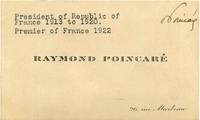
1922019533Paris France: not published 1922. Autograph. Very good condition. No Binding. Signed by Authors. First Edition. A printed calling card measuring approximately 2.25" x 3.75" with typed identification upon which is signed "R. Poincare". No date circa 1922. The card was removed from a sheet of paper and the residue remains on the back of the card. Poincare was Prime Minister in 1912 and serving as President of the Republic from 1913 to 1920. In 1922 Poincaré returned to power as Prime Minister. In 1923 he ordered the Occupation of the Ruhr to enforce payment of German reparations. His government was defeated by the Cartel des Gauches at the elections of 1924. He served a third term as Prime Minister in 1926-1929. . not published unknown
191639010c. 1916. Poincaré's official carte de visite elegantly printed "Raymond Poincaré / Président de la République" with a lengthy inscription WRITTEN DURING HIS PRESIDENCY AND DURING THE FIRST WORLD WAR to a close friend: "Merci mon cher ami de votre bienveillante appréciation. On a peu de mérite à parler clairement lorsqu'on rend la pensée de ce merveilleux pays: il suffit d'être un bon philosophe. Ami je me rappelle cette charmante après diner que nous avons passé au Prieuré. Dites je vous prie à Madame Dumay en lui présentant mes respects que nous vous réinviterons après la paix. Votre serviteur dévoué. Poincaré signed with initials. 6.6 x 10.7 cm. In perfect condition. <br/><br/> unknown