POINCARE, HenriBiblio.com
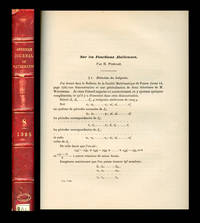
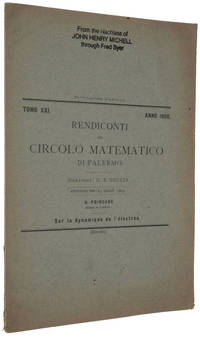
Sur la Dynamique de l'Électron. Offprint from: Rendiconti del Circolo Matematico di Palermo vol. 21 no. 1 December 1906
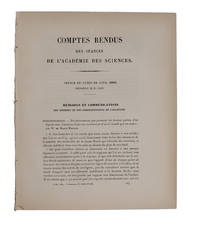
19064926Palermo: Tipografia Matematica 1906. First edition. <p>First edition extremely rare offprint of this crucial paper submitted in July 1905 which many historians believe entitles Poincaré to a share with Einstein and Lorentz of the credit for the discovery of special relativity. Poincaré shows that the Lorentz transformations form a group and that the Maxwell-Lorentz electron theory is invariant under this so-called 'Lorentz group'. Poincaré also puts forward a relativistic theory of gravity.</p>. THE SPECIAL THEORY OF RELATIVITY. <p>First edition extremely rare separately-paginated offprint of this crucial paper in the development of the special theory of relativity in which Poincaré showed that the Lorentz transformations form a group and that the Maxwell-Lorentz electromagnetic theory is invariant under this 'Lorentz group' when augmented by space and time translations it becomes what is now known as the 'Poincaré group'. "The development of mathematics in the nineteenth century began under the shadow of a giant Carl Friedrich Gauss; it ended with the domination by a genius of similar magnitude Henri Poincaré. Both were universal mathematicians in the supreme sense and both made important contributions to astronomy and mathematical physics . Poincaré was active in the discussions concerning Lorentz's theory of the electron from 1899 on; Poincaré was the first to observe that the Lorentz transformations form a group . and many physicists consider that Poincaré shares with Lorentz and Einstein the credit for the invention of the special theory of relativity" DSB. "In 1905 1906 and 1908 Poincaré published three important papers on the dynamics of the electron. Of these the first is a note in the Comptes Rendus submitted 5 June that summarizes the second paper submitted 23 July 1905 the offered paper in which Poincaré introduced the Lorentz group" Gray pp. 361-362. In these papers "Poincaré mentions the negative result of Michelson's experiment and concludes that 'this impossibility to prove absolute motion appears to be a general law of nature.' He then sets out to demonstrate that the transformations of the electromagnetic field equations which he calls 'the Lorentz transformations' form a group. But there is more: he closes his article by wondering about the effect of the Lorentz transformations on forces in general and in particular on gravitation. It is a question that Einstein would not ask until 1907 and which would lead him to general relativity. In that same article Poincaré assumes that gravitation propagates 'at the speed of light' and introduces the idea of a 'gravitational wave' . the Frenchman lays the foundations of a theory of gravitation that in his own words 'would not be altered under the group of Lorentz transformations' that is to say it would be 'Lorentz invariant.' Moreover in the same article Poincaré introduces time as a fourth imaginary coordinate as well as the four-dimensional approach which Minkowski would make precise in 1908 without mentioning Poincaré" Eisenstaedt p. 35. "Poincaré undoubtedly discovered many of the ideas that now form our mental picture of the theory of special relativity and associate with the name of Einstein. In his analysis of the relativistic nature of investigations into space and above all time he discussed how different observers can compare time measurements by exchanging light signals he called for a new physics in which the speed of light is an impassable limit and he came up with the Lorentz group - all of this independently of Einstein and mostly before him. He was indeed well ahead of Einstein in speculating about a truly relativistic theory of gravity" Gray p. 368. Poincaré's paper was the first to demonstrate the power of symmetry or invariance principles in physics. "One hundred years after Poincaré proposed the symmetry principle for all physical laws under uniform relative motion symmetry principles in physics have transcended both kinetic and dynamic properties and are at the very heart of our understanding of the universe" Hsu & Zhang p. xxii. We have located three institutional copies Deutsches Museum Max Planck Institut Rice University. No copies in auction records.</p> <br /> <p>"When in the early 1890s Hertz and Heaviside perfected Maxwell's electrodynamics of moving bodies they noted that it was incompatible with Fresnel's theory of aberration but decided to postpone further study of the relation between ether and matter. Unknown to them Lorentz had long ago reflected on this relation and reached conclusions that sharply departed from Maxwell's original ideas. Unlike Maxwell's British disciples Lorentz learned Maxwell's theory in a reinterpretation by Hermann Helmholtz that accommodated the continental interpretation of charge current and polarization in terms of the accumulation flow and displacement of electric particles" Darrigol 2005 p. 7.</p> <br /> <p>"By 1878 Lorentz had arrived at an understanding close to that upon which his later electron theory was founded: charged harmonic oscillators exist within ponderable molecules and the ether in intermolecular spaces retains the same properties as it has in a vacuum. Through the 1880s Lorentz continued to be concerned with molecular physics but chiefly in the context of the mechanical theory of heat. Prompted by Hertz's critique of Maxwell's theory as it applied to bodies in motion Lorentz returned to the foundation of electrodynamics in the early 1890s . In 1892 he published his first statement of the electron theory La theorie électromagnétique de Maxwell et son application aux corps mouvants" McCormmach pp. 461-462. </p> <br /> <p>According to Lorentz's theory the ether is stationary and is not dragged along by bodies moving through it so the earth has an absolute velocity relative to the ether. The question was whether or not the earth's absolute velocity is detectable through optical or electromagnetic effects of the accompanying ether 'drift' or 'wind'. The magnitude of the effects of the wind is measured theoretically by the ratio of the speed of the earth's motion v to the speed of light c. The ratio is small for the earth but not so small as to be beyond the reach of observation. The effects of this wind however were not observed and for his theory to be credible Lorentz had to explain their absence. Lorentz studied these questions in detail in his Versucheiner Theorie der electrischen und optischen Erscheinungen in bewegten Körpern 1895. "He showed that according to the theory an unexpected compensation of actions eliminates all effects of the ether wind to first-order approximation i.e. neglecting terms involving the very much smaller second and higher powers of v/c. He analysed the absence of first-order effects of the ether wind in phenomena such as reflection refraction and interference with the aid of a formal 'theorem of corresponding states'. The theorem asserts that to first-order accuracy no experiments using terrestrial light sources can reveal the earth's motion through the ether. By introducing transformations for the field magnitudes and spatial coordinates and a 'local time' Lorentz showed that to first-order approximation the equations describing a system in a moving reference frame are identical with those describing the corresponding system in a frame at rest in the ether for which Maxwell's equations hold exactly" Jungnickel & McCormmach pp. 233-235. "At the end of his treatise Lorentz acknowledged that his corresponding states theorem could not account for the second-order null effect of the Michelson-Morley experiment. He referred to his calculation earlier in the treatise of the influence of translation on the electric i.e. electrostatic force. If he argued the molecular forces are influenced in the same way as the electric force then a ponderable body such as the arms of Michelson's interferometer must contract in the direction of the earth's motion in a ratio of √1 - v2/c2 in order that its molecular configuration remain in equilibrium" McCormmach p. 471. This contraction was exactly what was required to explain the null result of the Michelson-Morley experiment.</p> <br /> <p>"Poincaré had been teaching electrodynamics at the Sorbonne for several years. After reviewing the theories of Maxwell Helmholtz Hertz Larmor and Lorentz he judged that the latter was the one that best accounted for the whole range of optical and electromagnetic phenomena. Yet he was not entirely satisfied with Lorentz's theory because he believed it contradicted fundamental principles of physics . the principle of relativity the principle of reaction and the principle of least action . Lorentz's theory satisfied Poincaré's relativity principle only approximately and did so through what Poincaré called two 'coups de pouce' 'fudges': the local time and the Lorentz contraction. Moreover it violated Poincaré's reaction principle . Lorentz took some of Poincaré's criticism seriously. In 1904 he offered a new version of his theory in which the invariance of optical phenomena held at every order in v/c without the 'coups de pouce' reproached by Poincaré" " Darrigol 2005 p. 9.</p> <br /> <p>"Poincaré reacted enthusiastically to Lorentz's memoir because he saw in it an opportunity to satisfy the relativity principle in a complete and exact manner. He published the results of the ensuing reflections under the title 'Sur la dynamique de l'electron' first as a short note of 5 June 1905 in the Comptes Rendus and as a bulky memoir in the Rendiconti of the Circolo matematico di Palermo for the following year" Darrigol 2005 pp. 9-12.</p> <br /> <p>"He first defined the 'relativity postulate' as follows:</p> <br /> <p>'It seems that the impossibility of experimentally detecting the absolute motion of the earth is a general law of nature; we naturally incline to assume this law which we shall call the Postulate of Relativity and to do so without any restriction.'</p> <br /> <p>"Correcting Lorentz's expression of the transformed source terms he then showed that the Lorentz transformations . left the Maxwell-Lorentz equations invariant . Poincaré showed that they formed a group . He noted that the coordinate transformations left the quadratic form x2 y2 z2 - c2t2 invariant and could thus be regarded as rotations in a four-dimensional space with an imaginary fourth coordinate. He obtained the relativistic law for the addition of velocities for which the combined velocity always remains inferior to the limit c.</p> <br /> <p>"Next Poincaré showed that a model of the contractile electron could be conceived in which the cohesive forces the so-called Poincaré tension preserved the Lorentz invariance. He thus retrieved Lorentz's expression for the momentum of the electron. Lastly he argued that in order to be compatible with the postulate of relativity gravitational interactions should propagate at the velocity of light; and he proposed modifications of Newton's law of gravitation that made it compatible with Lorentz invariance. </p> <br /> <p>"Thus there is no doubt that Poincaré regarded Lorentz invariance as a general requirement for the laws of physics and that he identified this formal condition with the principle of relativity" ibid. p. 12. </p> <br /> <p>In paragraph 1 of the Rendiconti paper Poincaré wrote Maxwell's equations in potential form and in units in which c = 1. He observed that if in one coordinate frame one has a sphere such as an electron moving at constant velocity then in a second frame moving at constant velocity relative to the first the sphere will be seen as an ellipsoid the shape of which depends on the velocity of the sphere. He next obtained the components of the electric and magnetic fields in the new frame and observed that Maxwell's equations were still satisfied. He also wrote down the new addition law for velocities. In paragraph 2 Poincaré stated a version of the principle of least action and used it to deduce a formula for the pressure on an electron. In paragraph 3 he then showed that a Lorentz transformation leaves the action unaltered and so re-obtained the Lorentz invariance of Maxwell's equations. In paragraph 4 Poincaré shows that the Lorentz transformations form a group. In paragraph 5 Poincaré used his theory of Lorentz transformations to rederive the Langevin waves that describe the electromagnetic field produced by a single moving electron. In paragraph 6 he considered the much-discussed topic of the Lorentz contraction of electrons. In paragraphs 7 and 8 Poincaré returned to the question of whether the contraction hypothesis makes it impossible to detect motion. He showed that the true reason that absolute motion cannot be detected using electromagnetic phenomena is that the Lorentz transformations form a group and that Maxwell's equations are invariant under it. In paragraph 9 he considered the possibility of detecting absolute motion using phenomena that were not of electromagnetic origin such as gravitation. He considered the effect of a Lorentz transformation on any function of time position and velocity. He further assumed that any suitable law of attraction would reduce to Newton's law for bodies at rest and would not disagree with astronomical observations of slowly moving objects. He looked for invariants under the Lorentz group and found that if speeds faster than light are allowed then time can pass negatively. He excluded this possibility and deduced that he was left with the proposition that gravity would travel at the same speed as light. He noted that as the deviations from Newton's laws are of second order in the ratio v/c they will be difficult to observe.</p> <br /> <p>"To sum up in 1905/6 Poincaré obtained a version of the theory of relativity based on the principle of relativity and the Lorentz group. He believed this symmetry should apply to all forces in nature. He exploited it to derive the dynamics of the electron on a specific model and to suggest a modification of the law of gravitation. He nevertheless maintained the ether as the medium in which light truly propagated at the constant velocity c and clocks indicated the true time. He regarded the quantities measured in moving frames as only apparent although the principle of relativity forbade any observational distinction between a moving frame and the ether frame. He understood the compatibility of the Lorentz transformations of coordinates with the optical synchronization of clocks and the invariance of the apparent velocity of light but hesitated on the physical significance of the Lorentz contraction and never discussed the dilation of time" ibid. pp. 14-15.</p> <br /> <p>Poincaré's achievements in this paper have led some to argue that he and Lorentz should be considered the true inventors of the special theory of relativity rather than Einstein. "By 1905 Poincaré's and Einstein's reflections on the electrodynamics of moving bodies led them to postulate the universal validity of the relativity principle according to which the outcome of any conceivable experiment is independent of the inertial frame of reference in which it is performed. In particular they both assumed that the velocity of light measured in different inertial frames was the same. They further argued that the space and time measured by observers belonging to different inertial systems were related to each other through the Lorentz transformations. They both recognized that the Maxwell-Lorentz equations of electrodynamics were left invariant by these transformations. They both required that every law of physics should be invariant under these transformations. They both gave the relativistic laws of motion. They both recognized that the relativity principle and the energy principle led to paradoxes when conjointly applied to radiation processes. On several points - namely the relativity principle the physical interpretation of Lorentz's transformations to first order and the radiation paradoxes - Poincaré's relevant publications antedated Einstein's relativity paper of 1905 by at least five years and his suggestions were radically new when they first appeared. On the remaining points publication was nearly simultaneous . The differences between the two theories of Einstein and Poincaré are sometimes regarded as implying different observable predictions even within the domain of electromagnetism and optics. In reality there is no such disagreement for Poincaré's ether is by assumption perfectly undetectable and every deduction made in Einstein's theory can be translated into a deduction in Poincaré's theory . In sum then Einstein could have borrowed the relativity principle the definition of simultaneity the physical interpretation of the Lorentz transformations and the radiation paradoxes from Poincaré" Darrigol 2004. </p> <br /> <p>"In 1919 the mathematician Mittag-Leffler wrote to Einstein asking him to contribute an article to the Acta Mathematica volume in honor of Poincaré. Four months later Einstein responded. The letter had reached him after a long delay and 'it might be too late' now. Mittag-Leffler replied that Einstein could still send a paper if he cared to do so. Two and a half months later Einstein replied that obligations and travel prevented him from contributing adding that his decision 'should be considered as nothing but high respect for the task'.</p> <br /> <p>"In December 1920 a New York Times correspondent interviewed Einstein in his home on the Haberlandstrasse in Berlin. In reply to a question about the origins of relativity theory Einstein said 'It was found that Galilean invariance would not conform to the rapid motions in electrodynamics. This led the Dutch professor Lorentz and myself to develop the theory of special relativity'. An additional mention of Poincaré's pioneering ideas might have been gracious. In an interview with Le Figaro in 1921 he expressed his great admiration for Poincaré however.</p> <br /> <p>"In the early 1950s I once asked Einstein how Poincaré's Palermo paper had affected his thinking. Einstein replied that he had never read that paper. I owned a copy and asked if he would like to borrow that. Yes he said he would. I brought it to him. It was never returned to me. Some time after Einstein's death I asked Helen Dukas if she would please look for it. It had vanished ." Pais p. 171.</p> <br /> <p>Darrigol O. 2004 'The Mystery of the Einstein-Poincaré Connection' Isis 95 2004 pp. 614-626. Darrigol 'The genesis of the theory of relativity' Séminaire Poincaré 1 2005 pp. 1-22. Eisenstaedt The Curious History of Relativity 2006. Gray Henri Poincaré: A Scientific Biography 2012. Hsu & Zhang Lorentz and Poincaré invariance. 100 Years of Relativity 2001. Jungnickel & McCormmach Intellectual Mastery of Nature. Theoretical Physics from Ohm to Einstein Vol. 2 1986. McCormmach 'H. A. Lorentz and the Electromagnetic View of Nature' Isis 61 1970 pp. 459-497. Pais Subtle is the Lord 1982.</p> <br/> <br/> 8vo 257 x 174 mm pp. ii 1 2-48 journal pagination 129-176. Original printed wrappers a little darkened at edges upper outer corner of rear wrapper creased former owner's private ink stamp on front wrapper. A very good copy. [Tipografia Matematica] unknown
SOPHIA RARE BOOKS · Danemark38 500,00 $US≈ 32 574,85 €