Poincaré, HBiblio.com
1 189 résultats
9353956129.Gpaperback. Good. Access codes and supplements are not guaranteed with used items. May be an ex-library book. paperback
a112510Issues for July 1922 Vol. IX no 3 and Vol XX no. 1. January 1933. Octavo original printed wraps. pp. 111-183; pp. 1-130. Two complete issues. G and VG. 1922 issue has a few tiny mss ink lines at end of table of contents otherwise no owner marks. 1922 issue has reinforced backstrip; both volumes are clean and bright and securely bound. Pair: . paperback
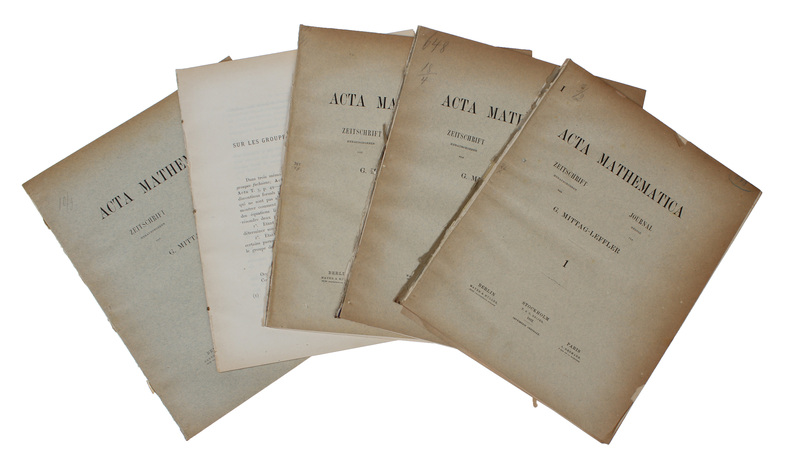
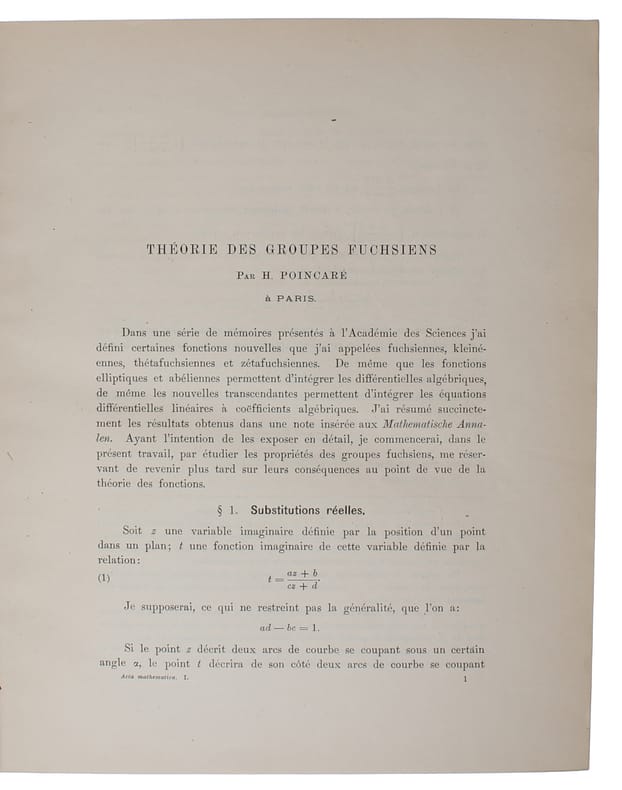
188245854Berlin, Stockholm, Paris, F. & G. Beijer, 1882-84. Large4to. As extracted from ""Acta Mathematica"", no backstrip. With title-page and the original wrappers. (except for paper no. 3 and 5 which only has the title page). In ""Acta Mathematica"", volume 1-5. Title pages with library stamp. Internally clean and fine. Vol. I, pp. 1-62" Pp. 193-294 Vol. II, pp. 97-113 Vol. III. pp. 49-92 Vol. IV pp. 201-312" Vol. V pp. 209-278.
188246049Berlin, Stockholm, Paris, F. & G. Beijer, 1882. Large4to. As extracted from ""Acta Mathematica"", no backstrip. With title-page and front free end-paper. In ""Acta Mathematica"", volume 1. Title pages with library stamp. A fine and clean copy. Pp. (6), 62.
188460243Berlin, Stockholm, Paris, F. & G. Beijer, 1882-84. Large4to (272 x 230 mm). Three volumes uniformly bound in contemporary half calf with gilt lettering to spine. In ""Acta Mathematica"", volume 1-5. Light wear to extremities, boards and spines with scratches. Stamp to verso of front board in all volumes. First three leaves in first volume detached, otherwise internally fine and clean. Vol. I, pp. 1-62" Pp. 193-294 Vol. II, pp. 97-113 Vol. III. pp. 49-92 Vol. IV pp. 201-312" Vol. V pp. 209-278.
201707124Paris, Georges carré editeur , 1892 ; in-4, 432 pp., cartonnage de l'éditeur. Cours de physique mathématique, demi cuir noir orné.
1923R160219476Gauthier-Villars et cie. 1923. In-8. Broché. Bon état, Couv. convenable, Dos satisfaisant, Papier jauni. XIX + 458 pages - quelques figures en noir et blanc dans le texte - étiquette sur le 2ème plat.. . . . Classification Dewey : 510-Mathématiques
1918230581918 Paris : Gauthier-Villars, 1918/9 Epreuve corrigée de la these parue en 1919,en feuilles non rogné,corrections manuscrites en marge ,à relier,82p.
189256937Paris, Gauthier-Villars, 1892, in-8, XIX, (1), 432pp, demi-chagrin marron foncé de l'époque, dos liise orné, tranches mouchetées, Première édition. Leçons professées pendant le premier semetre 1888-1889 à la faculté des Sciences de Paris, rédigées par Blondin Couverture rigide
Mm 100x150 Collana "Manuali Hoepli". Volume rilegato in piena tela editoriale. Opera in ottime condizioni. SPEDIZIONE IN 24 ORE DALLA CONFERMA DELL'ORDINE
BAZ10946Le Livre contemporain BROCHE, COUVERTURE REMPLIEE, un des 126 exemplaires tires pour LE LIVRE CONTEMPORAIN, PARFAIT ETAT SAUF PETIT MANQUE AU PIED DU DOS
189739134Berlin Uppsala & Stockholm Paris Almqvist & Wiksell 1897. 4to. No wrappers as extracted from "Acta Mathematica. Hrsg. von G. Mittag-Leffler." Bd. 21 pp. 83-97. <br/><br/><em>First edition. In this paper Poincaré arrives at a new theorem about canonical transformation and in his later "Methodes Nouvelles" he proved this theorem using a variiational principle of mechanics known today as the Hamilton principle. </em> unknown
189749621Berlin Uppsala & Stockholm Paris Almqvist & Wiksell 1897. 4to. Bound in contemporary half cloth with gilt lettering to spine. In "Acta Mathematica" Vol 21 1897. Entire volume offered. Stamps to title page otherwise a fine and clean copy. pp. 83-97; Pp. 331-341.Entire volume: 6 376 pp 4 plates. <br/><br/><em>First printing of this paper in which Poincaré arrives at a new theorem about canonical transformation and in his later "Methodes Nouvelles" he proved this theorem using a variiational principle of mechanics known today as the Hamilton principle.Also included is the first printing of Poincaré's principal address at the first International Congress of Mathematicians held in Zürich in 1897. </em> hardcover
188545788Stockholm Beijer 1885. 4to. As extracted from "Acta Mathematica 21. Band. No backstrip. Fine and clean. Pp. 83-97. <br/><br/><em>First printing of Poincaré's paper in which he developed the idea published by Fuchs in 1884. Fuchs established that the equation with fixed branch points can be made into a Riccati equation if its genus - the genus of the corresponding Riemann surface - with respect to u and du/dz is zero and can be integrated using elliptic functions if the genus is 1. </em> unknown
a103423dParis 1882 first edition. Gauthier Villars. Hardcover. Thick 4to. Marbled boards with half blue leather. Marbled end papers. 1431p. in volume. Poincare articles at p. 23-26 626-28 766-68. Many other important articles on other topics in same volume by Louis Pasteur Etienne Marey others. Text is Near Fine binding is very secure; hinges are not cracked. Cover leather is rubbed and somewhat worn. Overall Good plus. no owner marks. Pictures available on request. . hardcover
188745902Stockholm Beijer 1887. 4to. With the original wrappers in "Acta Mathematica 9:4. Band. No backstrip. Fine and clean. Pp. 321-380. Entire issue: Pp. 321-400 <br/><br/><em>First printing of Poincaré important - but partly unrecognized - paper which coined the term 'Poincaré lemma'. Even though it is named after Poincaré the discovery has by attributed to the Italian mathematician Vito Volterra who published a series of papers in 1889 on this subject. </em> unknown
189746182Berlin Stockholm Paris F. & G. Beijer 1897. 4to. Without wrappers as extracted from "Acta Mathematica. Hrdg. von G. Mittag-Leffler." Bd. 21. No backstrip. Fine and clean. Pp. 331-341. <br/><br/><em>First printing of Poincaré's principal address at the first International Congress of Mathematicians held in Zürich in 1897. </em> unknown
45403531like new. unknown
0265721857.Gpaperback. Good. Access codes and supplements are not guaranteed with used items. May be an ex-library book. paperback
026085848X.Ghardcover. Good. Access codes and supplements are not guaranteed with used items. May be an ex-library book. hardcover
0265648017.Gpaperback. Good. Access codes and supplements are not guaranteed with used items. May be an ex-library book. paperback
0260982938.Ghardcover. Good. Access codes and supplements are not guaranteed with used items. May be an ex-library book. hardcover
1016628781.Ghardcover. Good. Access codes and supplements are not guaranteed with used items. May be an ex-library book. hardcover
189839135Berlin Uppsala & Stockholm Paris Almqvist & Wiksell 1898. 4to. Without wrappers as extracted from "Acta Mathematica. Hrsg. von G. Mittag-Leffler." Bd. 22 pp. 89-178. <br/><br/><em>First edition. "As soon as he came into contact with the work of Riemann and Weierstrass on Abelian Functions and algebraic geometry Poincaré was very much attracted by those fields. His papers on these subjects occupy in his complete works as much space as those on automorphic functions their dates ranging from 1881 to 1911. One of his main ideas in these papers is that of "reduction" of Abelian functions. Generalizing particular cases studied b Jacobi Weierstrass and Picard Poincaré proved the general "complete reducibility" theorem."DSB. </em> unknown
188639132Berlin Uppsala & Stockholm Paris 1886. 4to. Without wrappers as extracted from "Acta Mathematica. Hrsg. von G. Mittag-Leffler." Bd. 8 pp. 295-344. <br/><br/><em>First edition. "The full recognition of the nature of those divergent series that are useful in the representation and calculation of functions and a formal definition of those series wer achieved by Poincaré and Stieltjes independently in 1886. Poincaré called these series asymptotic while Stieltjes continued to use the term semiconvergent. Poincaré took up the subject in order to further the solution of linear differential equations. Impressed by the usefulness of divergent series in astronomy he sought to determine which were useful and why. he succededed in islolating and formulating the essential property.Poincaré applied his theory of asymptotic series to diffrential equations and theree are many such uses in his treatise on celestical mechanics 'Les Methodes nouvelles de la mechanique céleste". Morris Kline. </em> unknown