1 180 résultats
188245910[Berlin, Stockholm, Paris, F. & G. Beijer, 1882]. Large4to. As extracted from ""Acta Mathematica"", In ""Acta Mathematica"", volume 1. Clean and fine. Pp. 193-294.
188462251Berlin Stockholm Paris F. & G. Beijer 1884. 4to. In contemporary half cloth. Stamps to title-page and last leaf. In "Acta Mathematica" no 5 1884/1885. Entire issue offered. Pp. 209-278. Entire issue: 4 408 pp. <br/><br/><em>First publication of this groundbreaking paper which together with his three other papers on the pubject not offered here constitute the discovery of Automorphic Functions. "Before he was thirty years of age Poincaré became world famous with his epoch-making discovery of the "automorphic functions" of one complex variable or as he called them the "fuchsian" and "kleinean" functions." DSB.These manuscripts written between 28 June and 20 December 1880 show in detail how Poincaré exploited a series of insights to arrive at his first major contribution to mathematics: the discovery of the automorphic functions. In particular the manuscripts corroborate Poincaré's introspective account of this discovery 1908 in which the real key to his discovery is given to be the recognition that the transformations he had used to define Fuchsian functions are identical with those of non-Euclidean geometry. See Walter Poincaré Jules Henri French mathematician and scientist.The idea was to come in an indirect way from the work of his doctoral thesis on differential equations. His results applied only to restricted classes of functions and Poincaré wanted to generalize these results but as a route towards this he looked for a class functions where solutions did not exist. This led him to functions he named Fuchsian functions after Lazarus Fuchs but were later named automorphic functions. First editions and first publications of these epochmaking papers representing the discovery of "automorphic functions" or as Poincaré himself called them the "Fuchsian" and "Kleinian" functions."By 1884 Poincaré published five major papers on automorphic functions in the first five volumes of the new Acta Mathematica. When the first of these was published in the first volume of the new Acta Mathematica Kronecker warned the editor Mittag-Leffler that this immature and obscure article would kill the journal. Guided by the theory of elliptic functions Poincarë invented a new class of automorphic functions. This class was obtained by considering the inverse function of the ratio of two linear independent solutions of an equation. Thus this entire class of linear diffrential equations is solved by the use of these new transcendental functions of Poincaré." Morris Kline.Poincaré explains how he discovered the Automorphic Functions: "For fifteen days I strove to prove that there could not be any functions like those I have since called Fuchsian functions I was then very ignorant; every day I seated myself at my work table stayed an hour or two tried a great number of combinations and reached no results. One evening contrary to my custom I drank black coffee and could not sleep. Ideas rose in crowds; I felt them collide until pairs interlocked so to speak making a stable combination. By the next morning I had established the existence of a Class of Fuchsian functions those which come from hypergeometric series; i had only to write out the results which took but a few hours.the transformations that I had used to define the Fuchsian functions were identical with those of Non-Euclidean geometry." </em> hardcover
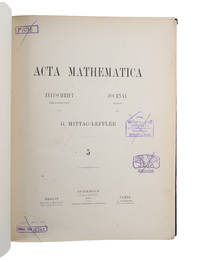
188245910Berlin Stockholm Paris F. & G. Beijer 1882. Large4to. As extracted from "Acta Mathematica" In "Acta Mathematica" volume 1. Clean and fine. Pp. 193-294. <br/><br/><em>First printing of Poincaré's famous paper which conjectured the uniformization theorem for the Riemann surfaces of algebraic curves. It also constitute the second paper in Poincaré's exceedingly important series of six paper's which together represent the discovery of Automorphic Functions. "Before he was thirty years of age Poincaré became world famous with his epoch-making discovery of the "automorphic functions" of one complex variable or as he called them the "fuchsian" and "kleinean" functions." DSB.These manuscripts written between 28 June and 20 December 1880 show in detail how Poincaré exploited a series of insights to arrive at his first major contribution to mathematics: the discovery of the automorphic functions. In particular the manuscripts corroborate Poincaré's introspective account of this discovery 1908 in which the real key to his discovery is given to be the recognition that the transformations he had used to define Fuchsian functions are identical with those of non-Euclidean geometry.The idea was to come in an indirect way from the work of his doctoral thesis on differential equations. His results applied only to restricted classes of functions and Poincaré wanted to generalize these results but as a route towards this he looked for a class functions where solutions did not exist. This led him to functions he named Fuchsian functions after Lazarus Fuchs but were later named automorphic functions. First editions and first publications of these epochmaking papers representing the discovery of "automorphic functions" or as Poincaré himself called them the "Fuchsian" and "Kleinian" functions."By 1884 Poincaré published five major papers on automorphic functions in the first five volumes of the new Acta Mathematica. When the first of these was published in the first volume of the new Acta Mathematica Kronecker warned the editor Mittag-Leffler that this immature and obscure article would kill the journal. Guided by the theory of elliptic functions Poincarë invented a new class of automorphic functions. This class was obtained by considering the inverse function of the ratio of two linear independent solutions of an equation. Thus this entire class of linear diffrential equations is solved by the use of these new transcendental functions of Poincaré." Morris Kline.Poincaré explains how he discovered the Automorphic Functions: "For fifteen days I strove to prove that there could not be any functions like those I have since called Fuchsian functions I was then very ignorant; every day I seated myself at my work table stayed an hour or two tried a great number of combinations and reached no results. One evening contrary to my custom I drank black coffee and could not sleep. Ideas rose in crowds; I felt them collide until pairs interlocked so to speak making a stable combination. By the next morning I had established the existence of a Class of Fuchsian functions those which come from hypergeometric series; i had only to write out the results which took but a few hours.the transformations that I had used to define the Fuchsian functions were identical with those of Non-Euclidean geometry." </em> unknown
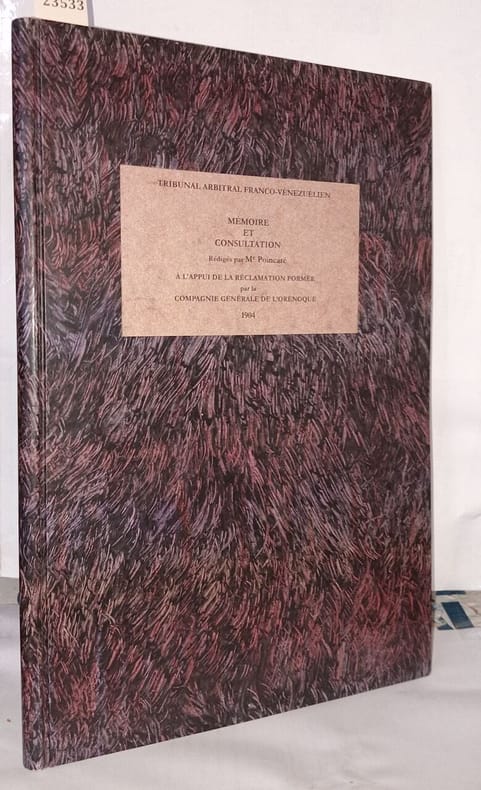
1904523406Imp. et lib. centrale des chemins de fer 1904 127 pages in-4. 1904. Relié. 127 pages.
2026523406Imp. et lib. centrale des chemins de fer 2026. Etat correct Reliure en bon état . Brochure d'origine insolée marges brunies . Nombreux passages soulignés et notes en marge. quelques petites tâches en marge également. in-4. 2026. Relié. 127 pages. Imp. et lib. centrale des chemins de fer unknown
0243292910.Gpaperback. Good. Access codes and supplements are not guaranteed with used items. May be an ex-library book. paperback
0364241411.Ghardcover. Good. Access codes and supplements are not guaranteed with used items. May be an ex-library book. hardcover
192892213Dresden: Aretz 1928-29. 547, 565, 420 Seiten. 8° (17,5-22,5 cm). Orig.-Broschuren. [Softcover / Paperback].
Mm 150x210 Edizione a cura di Guido Altarelli e Giorgio Capon - Volume cartonato con sovraccoperta, 154 pagine. Opera in ottime condizioni, interno pari al nuovo. SPEDIZIONE IN 24 ORE DALLA CONFERMA DELL'ORDINE.
190446775New York: McGraw Publishing Co. 1904. 8vo. xi 3 255 1 pp. 145 text illustrations & diagrams. Burgundy-coloured cloth gilt lettering on spine minor edgewear slight fraying head & foot of spine minor wear to corners ex-lib markings on endpapers & title still G- copy. First edition of this classic and important early work on radio. McGraw Publishing Co., hardcover
1019787015.Ghardcover. Good. Access codes and supplements are not guaranteed with used items. May be an ex-library book. hardcover
1164897799.Gpaperback. Good. Access codes and supplements are not guaranteed with used items. May be an ex-library book. paperback
1437098932.Gpaperback. Good. Access codes and supplements are not guaranteed with used items. May be an ex-library book. paperback
1437227554.Ghardcover. Good. Access codes and supplements are not guaranteed with used items. May be an ex-library book. hardcover
21296234-nnew. unknown
ria9783662319659_inpPaperback. New. New Book; Fast Shipping from UK; Not signed; Not First Edition; N/A paperback
3662319659.Gpaperback. Good. Access codes and supplements are not guaranteed with used items. May be an ex-library book. paperback
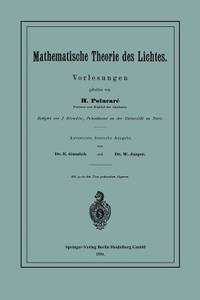
x-3662319659Springer Verlag 1894. Paperback. New. 119 pages. German language. 9.25x6.10x0.25 inches. Springer Verlag paperback
B9781498152754Hardback. New. hardcover
45178774like new. unknown
1164219545.Ghardcover. Good. Access codes and supplements are not guaranteed with used items. May be an ex-library book. hardcover
1164058002.Gpaperback. Good. Access codes and supplements are not guaranteed with used items. May be an ex-library book. paperback
1498182399.Gpaperback. Good. Access codes and supplements are not guaranteed with used items. May be an ex-library book. paperback
0548773440.Gpaperback. Good. Access codes and supplements are not guaranteed with used items. May be an ex-library book. paperback
1015515584.Ghardcover. Good. Access codes and supplements are not guaranteed with used items. May be an ex-library book. hardcover