Aymard, JacquesAntiquariat.de

257 résultats
19512762EBParis, E. De Boccard, 1951. 4°. 25,5 cm. 610 Seiten. Original-Broschur.
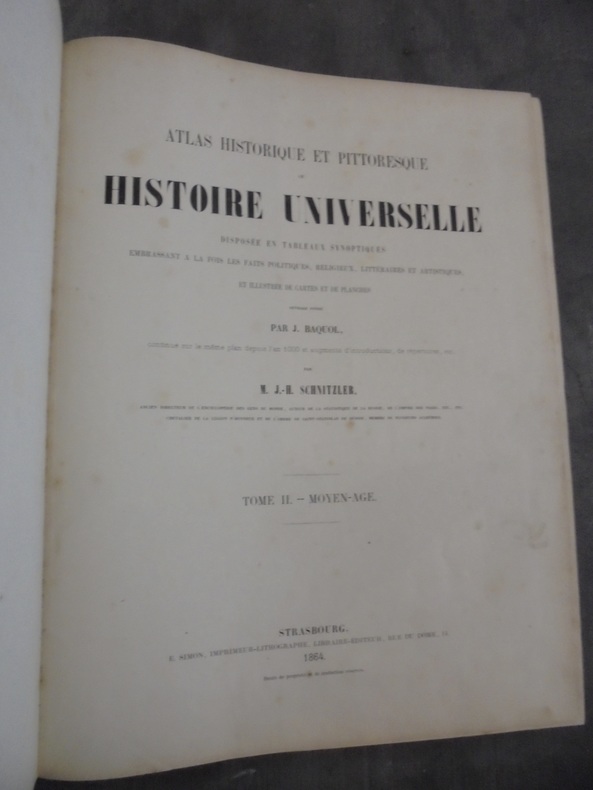
DIV494C217E. Simon, Strasbourg. 1864. pages 4ff.- Tableau lithographié - 64 tableaux chronologiques double page - 16 tableaux illustrés en référence aux thèmes du Moyen Âge - 2 cartes géographiques double page
200452504BBStuttgart, Klett-Cotta, 2004. Groß-8°. 23 cm. 276 Seiten. Original-Pappband. Mit Original-Schutzumschlag.
Very light shelfwear to book. DJ has minor shelfwear and creasing. ; A sweeping, revisionist history of the Roman Empire from one of our foremost classicists. Ancient Rome was an imposing city even by modern standards, a sprawling imperial metropolis of more than a million inhabitants, a "mixture of luxury and filth, liberty and exploitation, civic pride and murderous civil war" that served as the seat of power for an empire that spanned from Spain to Syria. Yet how did all this emerge from what was once an insignificant village in central Italy? In S. P. Q. R. , world-renowned classicist Mary Beard narrates the unprecedented rise of a civilization that even two thousand years later still shapes many of our most fundamental assumptions about power, citizenship, responsibility, political violence, empire, luxury, and beauty. From the foundational myth of Romulus and Remus to 212 ce? Nearly a thousand years later? When the emperor Caracalla gave Roman citizenship to every free inhabitant of the empire, S. P. Q. R. (the abbreviation of "The Senate and People of Rome") examines not just how we think of ancient Rome but challenges the comfortable historical perspectives that have existed for centuries by exploring how the Romans thought of themselves: how they challenged the idea of imperial rule, how they responded to terrorism and revolution, and how they invented a new idea of citizenship and nation. Opening the book in 63 bce with the famous clash between the populist aristocrat Catiline and Cicero, the renowned politician and orator, Beard animates this “terrorist conspiracy, ” which was aimed at the very heart of the Republic, demonstrating how this singular event would presage the struggle between democracy and autocracy that would come to define much of Rome’s subsequent history. Illustrating how a classical democracy yielded to a self-confident and self-critical empire, S. P. Q. R. Reintroduces us, though in a wholly different way, to famous and familiar characters? Hannibal, Julius Caesar, Cleopatra, Augustus, and Nero, among others? While expanding the historical aperture to include those overlooked in traditional histories: the women, the slaves and ex-slaves, conspirators, and those on the losing side of Rome’s glorious conquests. Like the best detectives, Beard sifts fact from fiction, myth and propaganda from historical record, refusing either simple admiration or blanket condemnation. Far from being frozen in marble, Roman history, she shows, is constantly being revised and rewritten as our knowledge expands. Indeed, our perceptions of ancient Rome have changed dramatically over the last fifty years, and S. P. Q. R. , with its nuanced attention to class inequality, democratic struggles, and the lives of entire groups of people omitted from the historical narrative for centuries, promises to shape our view of Roman history for decades to come. ; 608 pages
A La Haie, chez Pierre van Cleef, 1750, volumi 2, in-8 piccolo, legatura di fine Settecento in pieno vitello "radicato", titolo e piccoli fregi neoclassici in oro ai dorsi, tagli rossi, pp. XIV, 204 - [2], da 205 a 488. Con 2 tavole incise in rame. Piccola traccia di tarlo al margine inferiore di alcune carte.
18795061DBTübingen, Verlag der H. Laupp'schen Buchhandlung, 1879. 4°. 26,5 cm. VIII, 599 Seiten. Halblederband mit goldgeprägtem Rückentitel.
188968302Couverture rigide. Cartonnage muet. 58 pages.
186923391869 Paris, Michel Lévy Frères, 1869, In huit, 400 pp, broché, rousseurs et mouillures, petit manque sur la couverture,
187123521871 Paris, Michel Lévy Frères, 1871, In huit, 325 pp, reliure en demi-chagrin noire, pas de rousseurs,
190592543Couverture rigide. Reliure toile de l'éditeur. 451 pages. Quelques rousseurs.
1968133831Couverture rigide. Reliure de l'éditeur. 182 pages.
1912680191912 Paris, Librairie Hachette , 1912 , in douze , v-365 pp, reliure en demi-chagrin rouge,bon état
1884689871884 Paris, Librairie Hachette , 1884 , Deux volumes in douze , xiv-403 pp, 413 pp, reliure en demi-chagrin marron,bon état, coiffes légèrement déchirées,intérieur très frais et papier non piqué
1890695741890 Paris, Librairie Hachette, 1890, in douze ,11,5*18,2, 376 pp, Reliure en demi-chagrin brun, bon état, dos légèrement frotté, quelques rares annotations au crayon de papierétat convenable
1891GITh316Paris Hachette 1891. In-8 462pp. Demi vélin ivoire à coins, dos lisse, pièces de titre et de tomaison rouges, tête brique, reliure de l'époque. Rousseurs par endroits, petit manque en tête de la pièce de titre, reliure solide et en bon état. TOME I SEUL complet de son texte et des sujets traités (conversion de Constantin, Christianisme et éducation romaine, conséquences de l'éducation païenne sur les auteurs Chrétiens, conversion de Saint Augustin, "Manteau" de Tertullien, fusion des éléments sacrés et profanes. (4569)
197599921969Colin Armand Colin 1975, In-8 broché, 327 pages. Bon état.
Armand Colin 1975, In-8 broché, 327 pages. Bon état.
198327457Couverture souple. Broché. 327 pages.
1960142717Couverture rigide. 25 x 31 cm. Relié. 288 pages. Jaquette.
1933129419Couverture souple. Broché. 16 x 25 cm. 157 pages. Papier bruni. Mouillure en marge.
1966141610Couverture souple. Brochure de 40 pages.
15753559FBFrankfurt, von Corvinus für Strada, 1575. 2°. 37 x 25 cm. [12] Blatt, 265 Seiten, [12] Blatt, 35, 207 Seiten. Schweinslederband der Zeit auf fünf Bünden mit handschriftlichem Rückentitel in Tinte. [7 Warenabbildungen]
15753558FBFrankfurt, von Corvinus für Strada, 1575. 2°. 37 x 25 cm. [12] Blatt, 265 Seiten, [12] Blatt, 35, 207 Seiten. Pergamentband der Zeit mit handschriftlichem Rückentitel späterer Zeit und Rundum-Rotschnitt. [7 Warenabbildungen]
208MEQUIGNON-HAVARD - PARIS et BRUXELLES - 1828.Hommes Illustres: 194 pages , plus 3 pages de table des chapitres. Césars: 174 pages, plus 2 pages de table des chapitres.1 gravure en frontispice (Les Sabines), 1 en page de titre (Cléopatre)., plus 2 gravures hors-texte.Rousseurs.In-douze. Belle reliure cuir, entourage et titre dorés.
MEQUIGNON-HAVARD - PARIS et BRUXELLES - 1828. Hommes Illustres: 194 pages , plus 3 pages de table des chapitres. Césars: 174 pages, plus 2 pages de table des chapitres. 1 gravure en frontispice (Les Sabines), 1 en page de titre (Cléopatre)., plus 2 gravures hors-texte. Rousseurs. In-douze. Belle reliure cuir, entourage et titre dorés.