343 résultats
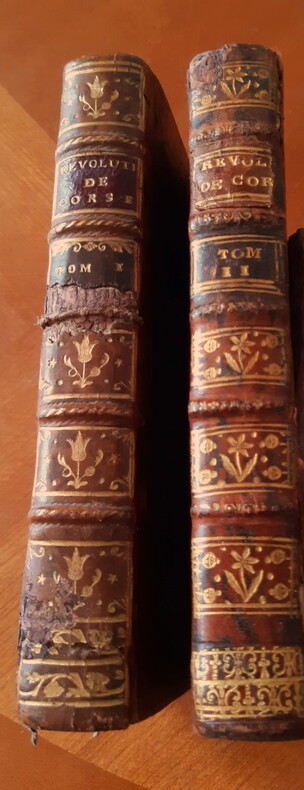
57255aafLondres (= Amsterdam, M.M. Rey), 1775, in-8vo, 6 ff. + 370 p. (qqs taches brunes dans dern. 2 ff.) / 2 ff. + 412 p., sans les 2 ff. d'errata, taches, quelques soulignés, reliures en veau marbré, pièce de titre et tom. aux dos, dos richement ornés en or, filet doré sur les coupes, un plat avec deux pet. éraflures près du dos, pet. accroc à une coiffe sup., tranches rouges.
1792233591792 Lavis sépia - bru de noix, rehauts pastels et mine de plomb, ovale, (1792), 44 x 34 cm., cadre doré à palmettes style XVIIIème.
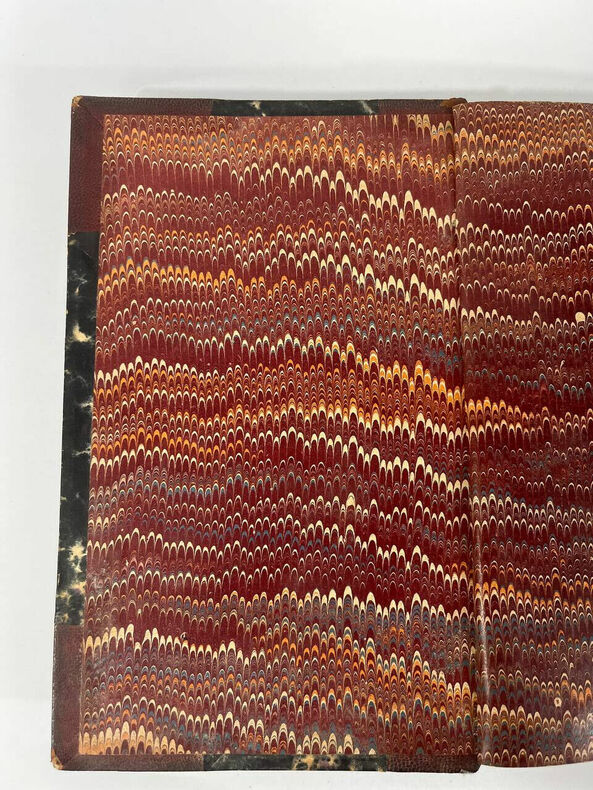
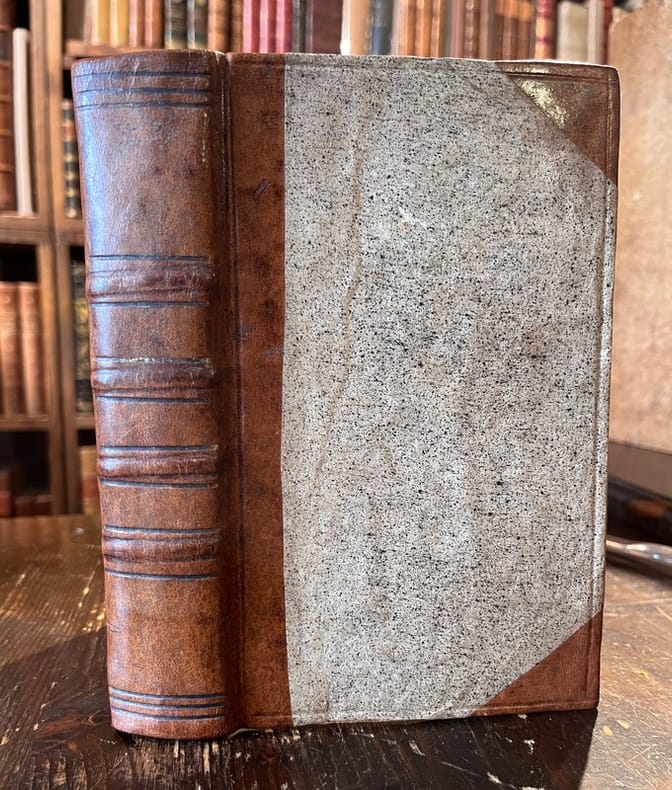
18040076New York, Hopkins & Seymour, 1804. First edition. Octavo, 22 x 14 cm, (4 ff.) 238 pp. Bound in half-grained wine leather with corners. Spine almost smooth with very light raised bands; title and name of the publisher William Coleman, of the Evening Post, stamped in gilt block letters; multiple gilt fillets on and around the bands; gilt fleurons; date on the lower spine. Dark marbled covers, gilt fillets on the joints and corners. Marbled endpapers with glowing patterns tinged with orange, blue and cream waves. Contemporary binding. Title page with pen signature, word from the New York district chief Edward Dunscomb, preface--all unpaginated. Some uncut pages. This book brings together five collections of texts linked to the person of Alexander Hamilton, founding father of the then very young Republic of the United States. Of note: a few letters by Aaron Burr, the man who killed Hamilton in a duel... "An American statesman, Alexander Hamilton (January 11, 1755 or 1757 – July 12, 1804) was an influential interpreter and promoter of the American Constitution, as well as the founder of the nation's financial system, the Federalist Party, the United States Coast Guard, and The New York Post newspaper. As the first Secretary of the Treasury, Hamilton was the principal author of the economic policies of George Washington's administration. He initiated the financing of state debts by the federal government as well as the creation of a national bank, a system of tariffs, and friendly trade relations with Great Britain. His vision included a strong central government led by a vigorous executive branch, a strong commercial economy, with a national bank and support for manufacturing, and a strong military. This vision was challenged by the more agrarian Founding Fathers of Virginia, Thomas Jefferson and James Madison, who formed a rival party. They favored strong states based in rural America and protected by relevant state militias rather than a strong national army and navy. They denounced Hamilton as too pro-Britain and the monarchy in general, and too oriented toward cities, businesses, and banks. This volume was published the same year that Hamilton died in the duel with Aaron Burr." Extremely rare book, the few remaining copies of which survive in libraries in the United States or sell for over $2,000. *********************************** New York, Hopkins & Seymour, 1804. En anglais. Édition originale. In-8, 22 x 14 cm, (4 ff.) 238 pp. Relié demi-chagrin lie-de-vin à coins. Dos quasi lisse aux nerfs très légers, titre et nom de l'éditeur William Coleman, de l'Evening Post, frappés en caractères d'imprimerie dorés, multiples filets dorés aux nerfs, fleurons dorés, date en queue. Plats marbrés sombres, filets dorés aux mors et coins. Pages de garde marbrées à motifs rougeoyants teintés de vagues oranges, bleu et crème. Reliure d'époque. Page de titre avec signature à la plume, mot du chef de district de New York Edward Dunscomb, préface d'une page non paginés. Quelques pages non coupées. Ce livre regroupe cinq recueils de textes liés à la personne d'Alexander Hamilton, père fondateur de l'alors toute jeune République des États-Unis. À noter la présence de lettres d'Aaron Burr, l'homme qui tua Hamilton lors d'un duel... "Homme d'État américain, Alexander Hamilton (11 janvier 1755 ou 1757 - 12 juillet 1804) fut un interprète et un promoteur influent de la Constitution américaine, ainsi que le fondateur du système financier du pays, du Parti fédéraliste, de la Garde côtière américaine et du journal The New York Post. Premier secrétaire au Trésor, Hamilton fut le principal auteur des politiques économiques de l'administration de George Washington. Il prit l'initiative du financement des dettes des États par le gouvernement fédéral ainsi que de la création d'une banque nationale, d'un système de tarifs douaniers et de relations commerciales amicales avec la Grande-Bretagne. Sa vision comprenait un gouvernement central fort dirigé par un pouvoir exécutif vigoureux, une économie commerciale forte, avec une banque nationale et un soutien à l'industrie manufacturière, ainsi qu'une armée forte. Cette vision fut contestée par les pères fondateurs de Virginie plus agrariens, Thomas Jefferson et James Madison, qui formèrent un parti rival. Eux favorisaient des États forts basés dans l'Amérique rurale et protégés par des milices relevant de l'État plutôt que d'une armée et d'une marine nationales fortes. Ils dénonçaient Hamilton comme trop favorable à la Grande-Bretagne et à la monarchie en général, et trop orienté vers les villes, les entreprises et les banques. Ce volume fut publié la même année que la mort d'Hamilton lors du duel avec Aaron Burr." Livre rarissime dont les quelques copies restantes subsistent dans des bibliothèques aux États-Unis ou se vendent à plus de 2000 dollars.
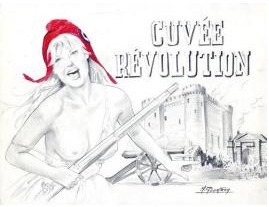
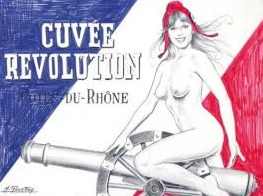
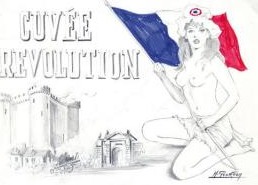
1978211121978 1 Mine de plomb et feutre, signée en bas à droite, (1989), 27.2 x 36 cm.
1978211141978 1 Mine de plomb et feutre, signée en bas à gauche, (1989), 27 x 36 cm.
18752No place, no date, (Paris, 1790.) 2 volumes. (4), 166, 141 pp.; 31 pp. 8vo. Modern half morocco, spine gilt in compartments, marbled boards (volume 1), modern half morocco, marbled boards (volume 2). Martin & Walter 15478 (first volume only); Sabin 28152 (first volume only); not in Echeverria & Wilkie; not in JFBL. Original edition, extremely rare with the "Supplement ...." which is almost always lacking. Against the policy of La Luzerne with regards to the colonies. Gouy d'Arcy led the colonial delegates in support of the Tennis Court Oath: the colonies had sent delegates to the upcoming Estates General in France and had even drafted their own cahiers des doléances in which they voiced their demands for more home rule and economic freedom.Gouy d'Arcy acquired a consderable fortune by marrying Anne-Amable Hux de Bayeux, a rich creole from Saint-Domingue and he became an ardent defender of colonial and Saint-Domingue interests, was founder of the colonial committee of Paris and the Club Massiac, and was instrumental in legislation favouring the colonists, and a fierce opponent of Brissot and the Amis des Noirs. Together with Moreau de Saint-Méry, he organized fierce opposition to any colonial reform (see: Albert Soboul, Dictionnaire historique de la Révolution française, pp. 516-7.)The original frontcover of volume one is preserved and gives, both recto and verso, the chronology of the events in Saint-Domingue covering the period December 1st 1789 - 22 October 1790. - Very rare in this complete state.
951Amsterdam : Desbordes, 1701. L'EXEMPLAIRE DE LA SCANDALEUSE MADEMOISELLE DE CHAROLAIS AU CHÂTEAU D'ATHIS, AYANT SUBI LE COURROUX DE LA RÉVOLUTION
1978211131978 1 Mine de plomb et feutre, signée en bas à droite, (1989), 24.5 x 32,5 cm.
184847737Paris: Binet 1848. First Edition. Original oversized pictorial broadside 52.5x78cm.; adorned with calendars for the years 1849 and 1850 on left and right margins and eleven steel-engraved vignettes of scenes from the February Revolution in Paris 1848. Previous folds with some subsequent splitting touching text and images without loss general wrinkling and a few soil spots else Very Good overall. The movement to overthrow the July Monarchy burst on the scene following the highly unpopular outlawing of political campaign banquets a tradition used by middle class oppositionists to circumvent the laws banning political meetings and public demonstrations. When all political banquets were banned in February 1848 Republicans and Orleanists alike descended on the city of Paris quickly ousting Louis-Philippe I and establishing the Second Republic. The present calendar broadside is adorned with several momentous scenes from the days of the 22nd to the 24th including the capturing of the Place de la Concorde; the Chateau d'Eau now the Place de la République; the Tuileries; and the hotel de Ville. Also includes depictions of the transportation of a crucifix from the captured Tuileries to St. Roch as a symbol of its liberation from the captivity of the monarchy; and the Duchess of Orléans with her two young sons at the Chamber of Deputies unsuccessfully arguing that her young son Louis grandson of Louis-Philippe I be named the new monarch. Between eight small vignettes are three larger scenes of Lamartine declaring the Second Republic; a group portrait of the leading figures of the new government and the Revolution; and la Marianne uniting French citizens whether they be clergymen soldiers middle class laboring class white or black. We find none in commerce or the auction records as of February 2020 nor separately catalogued in OCLC. Binet unknown
184847737Paris: Binet 1848. First Edition. Original oversized pictorial broadside 52.5x78cm.; adorned with calendars for the years 1849 and 1850 on left and right margins and eleven steel-engraved vignettes of scenes from the February Revolution in Paris 1848. Previous folds with some subsequent splitting touching text and images without loss general wrinkling and a few soil spots else Very Good overall. The movement to overthrow the July Monarchy burst on the scene following the highly unpopular outlawing of political campaign banquets a tradition used by middle class oppositionists to circumvent the laws banning political meetings and public demonstrations. When all political banquets were banned in February 1848 Republicans and Orleanists alike descended on the city of Paris quickly ousting Louis-Philippe I and establishing the Second Republic. The present calendar broadside is adorned with several momentous scenes from the days of the 22nd to the 24th including the capturing of the Place de la Concorde; the Chateau d'Eau now the Place de la République; the Tuileries; and the hotel de Ville. Also includes depictions of the transportation of a crucifix from the captured Tuileries to St. Roch as a symbol of its liberation from the captivity of the monarchy; and the Duchess of Orléans with her two young sons at the Chamber of Deputies unsuccessfully arguing that her young son Louis grandson of Louis-Philippe I be named the new monarch. Between eight small vignettes are three larger scenes of Lamartine declaring the Second Republic; a group portrait of the leading figures of the new government and the Revolution; and la Marianne uniting French citizens whether they be clergymen soldiers middle class laboring class white or black. We find none in commerce or the auction records as of February 2020 nor separately catalogued in OCLC. Binet unknown books
10257Paris, Chez Moutardier, An VII (1799). 3 volumes in-8 reliure plein vélin, pièces de tomaison veau brun ornées de fleurons dorés, tranches mouchetées, 426 + 534 + 448 pp. Cette édition rare et recherchée fût écrite par le Citoyen CHAS. Le 3e tome est entièrement consacré à la Guerre d'Indépendance américaine. Bon exemplaire très frais malgré quelques rousseurs.
1220Hambourg : s. n., 1798. UNE RARE CHRONIQUE ANTI-RÉVOLUTIONNAIRE
17919Paris, Desenne, Nicolle et Desenne jeune, 1807. 4 volumes. (4), 75, (2), 346 pp.; (4), 505 pp.; (4), 469 pp.; (4), 431 pp. 8vo. Contemporary sprinkled calf, spines gilt in compartments, labels with gilt lettering, gilt ornamental border on sides, very lightly rubbed. Catalogue Russica, ii, R-1529; cf.: Zaleski, i, 16. First edition. Deals with the first partition of Poland in 1772, in an attempt to restore the balance of power in this part of Europe between Prussia, the Austrian Empire and Russia after Russia's successes against the Ottoman Empire and the danger of an Austrian-Russian war.In Paris the problem of Poland was discussed with extraordinary intensity. The circles of diplomats, writers, and economists were extraordinary sensitive. The work of Rulhière, published posthumously in 1807, but which circulated widely in manuscript from the seventies and eighties, is typical. The political element dominated: the struggles of men and circumstances, intrigues, betrayals, violence. But above this rose the desparate will of the Poles to live and act, even when everything around them was collapsing. Consult for an elaborate treatment of the Polish question and Rulhière's book: F. Venturi, The End of the Old Regime in Europe, 1768-1776. The First Crisis, chapter VII). The Anecdotes sur la révolution de Russie had appeared already before, in 1797. - A nice copy.
615Paris : Imprimerie royale, 1837. EXEMPLAIRE RÉIMPOSÉ IN-4 SUR GRAND PAPIER VÉLIN
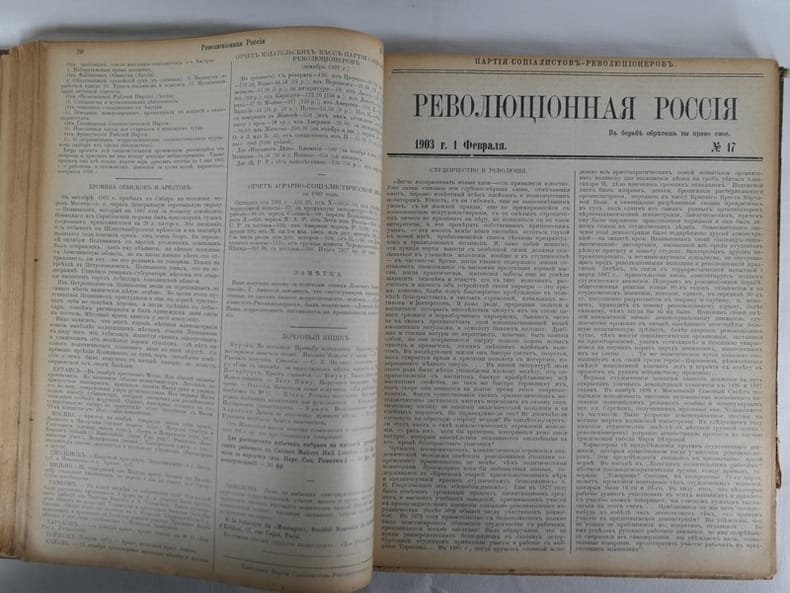
190282433Imprimerie du Parti Socialiste-Révolutionnaire, 1902-1903, in-8, demi-reliure toilée,, 24, 28, 20, 28, 28, 28, 24, 24, 24, 20, 20, 20, 20, 20, 20, 20, 23, 20, 24, 26, 24, 24, 20, 24, 24, 24, 24, 24, 24, 24, 24 pp. Bon état.
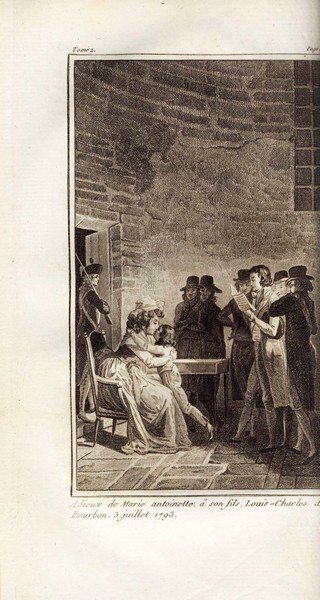
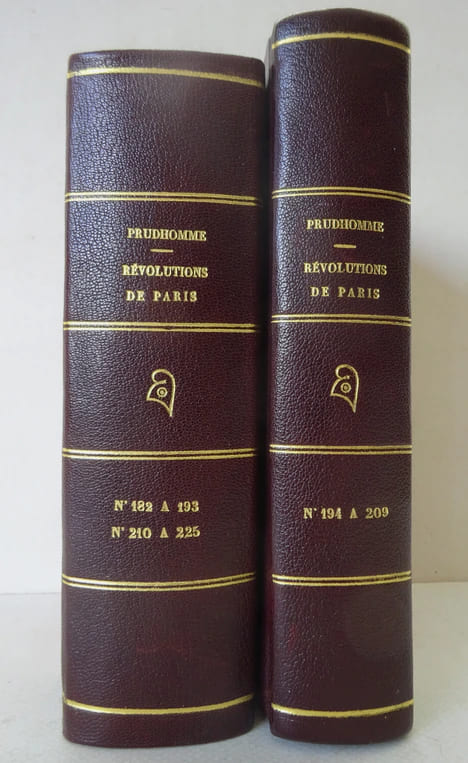
GMF-759[RÉVOLUTION FRANÇAISE]. PRUDHOMME Louis-Marie. Les Révolutions de Paris, dédiées à la Nation. Avec gravures & cartes des Départmens. 1792-1794. 2 volumes in-12, contenant les numéros 182 (29 décembre 1792) à 225 (10 ventôse An II de la République [28 février 1794]), reliures en demi-chagrin marron moderne, dos lisse ornés de filets dorés et d'un bonnet phrygien. Louis-Marie Prudhomme, né à Lyon en 1752 et mort à Paris le 20 avril 1830, est un journaliste français. Dès le 12 juillet 1789, et ce jusqu'au 28 février 1794, Prudhomme publie ce journal, dont le principal rédacteur est Élisée Loustalot, avec Sylvain Maréchal, Pierre Gaspard Chaumette et Fabre d'Églantine, et qui connaît un grand succès. Sa publication prit fin avec le numéro 225, le 10 ventôse de l’an II (28 février 1794). "C'est le tableau le plus complet, le plus exact, le plus impartial, des agitations de la capitale pendant les premières et les plus dramatiques années de la Révolution..." (Hatin, 147). "Aucune [publication] n'est plus riche en détails sur l'ensemble des 4 premières années de la Révolution" (Hatin, 148-49). Le numéro 225 est le dernier de la série. Dans ce numéro, Prudhomme déclare devoir s'arrêter à cause du "délabrement de [sa] santé". Toutefois, les dangers qu'il y avait à poursuivre une telle publication en cette période troublée ont certainement joué un rôle déterminant. Mouillures et rousseurs. Plupart des (très laides) gravures manquantes. Ex-libris étiquette de Jean-Pierre Legrand (1930-2019), avec annotations de celui-ci sur une page de garde.
47600Berlin: 1848: Vereins Buchdruckerei. Broadside 27cm x 20cm ca 10-3/4" x 8". Printed in blackletter on white wove stock. Slightly toned with old vertical and horizontal fold-lines; creased at margins; Very Good. Satirical broadside in the form of a fictional speech by King Friedrich Wilhelm IV in which he ironically expresses support for the demands made by liberal parliamentarians at the May 18th Parliamentary Assembly in Frankfurt-am-Main. These included expanded rights for the underprivileged classes including most importantly universal male suffrage; attenuation of executive power; the election of a permanent German parliament and monetary reforms including a unified German currency. The great wave of liberal revolt that washed over the European Continent in 1848 proved short-lived; by 1851 most of the newly-established liberal régimes had been quashed by reactionary movements with radical leaders either imprisoned murdered or driven into exile. Out of this crucible would arise the Franco-Prussian War and the militant Marxist nihilist and anarchist movements of later in the century. A highly evocative document of the first wave of German radical revolt. Rare; OCLC and KVK note three locations only all in Germany. Vereins Buchdruckerei unknown
1771412EDITION ORIGINALE. Ed. Chez Herissant, Paris :1771. 2 vol. In -12 ( 17 X 10 cm) , pleine reliure de l’époque de basane fauve mouchetée, dos à nerfs et à caissons ornés et dorés. Pièces de titre de maroquin grenat , pièces de tomaison de maroquin vert à caractères et filets dorés. T1 : 329 p.p., 4 p. De corrections et additions. T2 : 316 p.p.2 p. De corrections et additions , 2 p. Approbation et privilège du Roi.
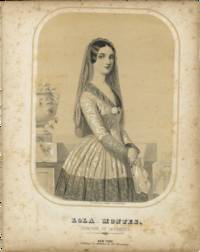
1848Cat360New York: Atwill 201 Broadway 1848. Folio. Complete at 9 pages. Two songs with lithographic portrait of Lola Montez by Sarony & Major. Soft rag paper. Light foxing else very good. A likely very early American printing of two pieces tied directly to the upheavals of 1848 issued just as news and personalities of the European revolutions were electrifying American audiences. The first “Der Lieben Warnun†Love’s Warning is attributed to Ludwig I King of Bavaria whose abdication in March 1848 followed the political scandal surrounding his relationship with Lola Montez. The second “Les Girondins: Mourir pour la Patrie†with text by Alexandre Dumas and music by Alphonse Varney is one of the most popular revolutionary hymns of the period here presented in English and French. At center is the finely printed lithographic portrait of Lola Montez born Eliza Rosanna Gilbert 1821–1861 identified as “Countess of Landsfeld.†Produced by Sarony & Major the image reflects her brief but consequential position in Bavaria where Ludwig elevated her to the nobility and granted her influence at court. Her presence became politically explosive; student unrest and ministerial crisis forced both her exile and the King’s abdication making her a widely discussed celebrity at the time. <br /> <br /> Montez arrived in the United States in late 1848 quickly converting this notoriety into a touring career. She performed her “Spanish dances†including the sensational “Spider Dance†on stages from New York to New Orleans and later turned to lecturing advertising appearances on “Heroines of History†beauty and personal independence. During the early 1850s she followed the western circuit appearing in San Francisco during the Gold Rush where she commanded high fees and played to packed houses of miners and merchants. She toured through Australia in 1855–56 before returning to the United States where she settled in New York and shifted increasingly toward writing and reform-minded lectures before her death in 1861 possibly of syphilis. The piece was published by Joseph Atwill at his 201 Broadway location which he would abandon soon after to board the steamer Crescent City to Chagres eventually making his way to San Francisco and opening Atwill’s Music Store on Washington St. possibly San Francisco’s first music store before heading off to the mines and then returning to San Francisco a year later to open another music store. OCLC #904564957 locating a single copy at Goucher College. Atwill, 201 Broadway unknown
207581790 - 1794. In-8 relié en demi-veau brun à coins, dos muet à nefs orné de filets à froid, tranches mouchetées rouge.
15233Paris, H. J. Gouchon ; Tome I- 1935, in-8, broché, 422 pp. Tome II- 1937 ; in-8, broché ; 202 pp. ; (124) pp. de tableaux et figures. Tome III- 1940 ; in-8, broché ; 261 pp., figures.
192114021Paris, Tolmer 1921, 1 in-4 Paris, Tolmer, 1921, in-4, broché remplié, sous chemise demi-toilé, 26 pages non paginé.
6 volumes in-8, demi-chagrin vert bronze de l'époque, dos à 4 faux nerfs filetés or, ornés de compartiments encadrés de triples filets dorés, large flet d'encadrement à froid sur les plats, titres et tomaisons dorés. "C'est en gouvernant que Guizot tire ici les enseignements de l'histoire anglaise, de la monarchie des Stuarts à l'avènement de son régime parlementaire moderne, en passant par la République de Cromwell. Réflexion d'un grand historien sur l'évolution de la société et de la politique britannique, où se reflète l'histoire de France" (L. Theis). (Rosanvallon, 'Le moment Guizot', p. 384) Très bon exemplaire, frais, bien relié à l'époque.
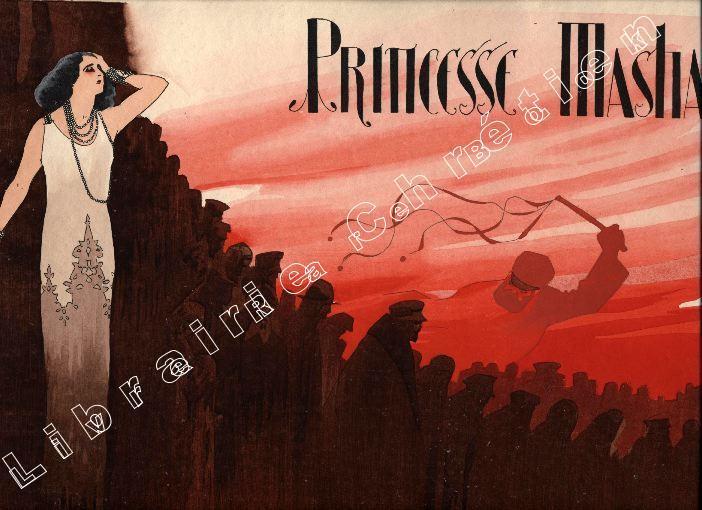
1927165181927 Illustration coloriée au pochoir sur le recto et le verso du feuillet, couverture titrée, Paris, Les Ateliers d'arts graphiques du Matin, 1927, 23 x 32 cm.
19832880EBNeapel., Lucio Amelio Editore., 1983. 48 x 34 cm. 31 nicht paginierte S. Illustrierter OPappband., 2880E Stampa in trecento esemplari. Einband angestaubt und ganz leicht nachgedunkelt, ein weißer Fleck am oberen Rand. Private handschiftliche Widmung auf Schmutztitel in hellem Filzstift, sonst gutes Exemplar.