29 résultats
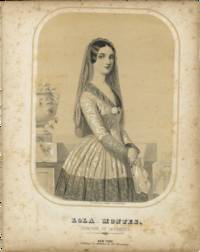
1848Cat360New York: Atwill 201 Broadway 1848. Folio. Complete at 9 pages. Two songs with lithographic portrait of Lola Montez by Sarony & Major. Soft rag paper. Light foxing else very good. A likely very early American printing of two pieces tied directly to the upheavals of 1848 issued just as news and personalities of the European revolutions were electrifying American audiences. The first “Der Lieben Warnun†Love’s Warning is attributed to Ludwig I King of Bavaria whose abdication in March 1848 followed the political scandal surrounding his relationship with Lola Montez. The second “Les Girondins: Mourir pour la Patrie†with text by Alexandre Dumas and music by Alphonse Varney is one of the most popular revolutionary hymns of the period here presented in English and French. At center is the finely printed lithographic portrait of Lola Montez born Eliza Rosanna Gilbert 1821–1861 identified as “Countess of Landsfeld.†Produced by Sarony & Major the image reflects her brief but consequential position in Bavaria where Ludwig elevated her to the nobility and granted her influence at court. Her presence became politically explosive; student unrest and ministerial crisis forced both her exile and the King’s abdication making her a widely discussed celebrity at the time. <br /> <br /> Montez arrived in the United States in late 1848 quickly converting this notoriety into a touring career. She performed her “Spanish dances†including the sensational “Spider Dance†on stages from New York to New Orleans and later turned to lecturing advertising appearances on “Heroines of History†beauty and personal independence. During the early 1850s she followed the western circuit appearing in San Francisco during the Gold Rush where she commanded high fees and played to packed houses of miners and merchants. She toured through Australia in 1855–56 before returning to the United States where she settled in New York and shifted increasingly toward writing and reform-minded lectures before her death in 1861 possibly of syphilis. The piece was published by Joseph Atwill at his 201 Broadway location which he would abandon soon after to board the steamer Crescent City to Chagres eventually making his way to San Francisco and opening Atwill’s Music Store on Washington St. possibly San Francisco’s first music store before heading off to the mines and then returning to San Francisco a year later to open another music store. OCLC #904564957 locating a single copy at Goucher College. Atwill, 201 Broadway unknown
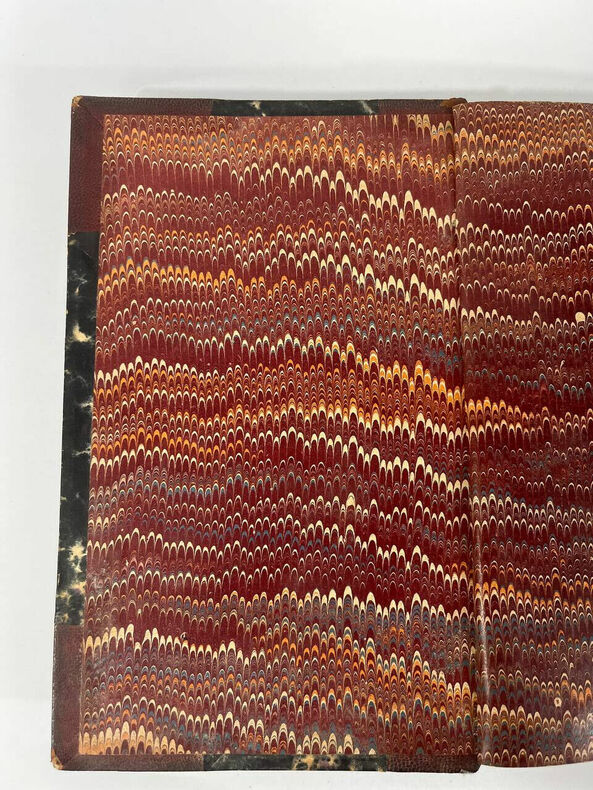
18040076New York, Hopkins & Seymour, 1804. First edition. Octavo, 22 x 14 cm, (4 ff.) 238 pp. Bound in half-grained wine leather with corners. Spine almost smooth with very light raised bands; title and name of the publisher William Coleman, of the Evening Post, stamped in gilt block letters; multiple gilt fillets on and around the bands; gilt fleurons; date on the lower spine. Dark marbled covers, gilt fillets on the joints and corners. Marbled endpapers with glowing patterns tinged with orange, blue and cream waves. Contemporary binding. Title page with pen signature, word from the New York district chief Edward Dunscomb, preface--all unpaginated. Some uncut pages. This book brings together five collections of texts linked to the person of Alexander Hamilton, founding father of the then very young Republic of the United States. Of note: a few letters by Aaron Burr, the man who killed Hamilton in a duel... "An American statesman, Alexander Hamilton (January 11, 1755 or 1757 – July 12, 1804) was an influential interpreter and promoter of the American Constitution, as well as the founder of the nation's financial system, the Federalist Party, the United States Coast Guard, and The New York Post newspaper. As the first Secretary of the Treasury, Hamilton was the principal author of the economic policies of George Washington's administration. He initiated the financing of state debts by the federal government as well as the creation of a national bank, a system of tariffs, and friendly trade relations with Great Britain. His vision included a strong central government led by a vigorous executive branch, a strong commercial economy, with a national bank and support for manufacturing, and a strong military. This vision was challenged by the more agrarian Founding Fathers of Virginia, Thomas Jefferson and James Madison, who formed a rival party. They favored strong states based in rural America and protected by relevant state militias rather than a strong national army and navy. They denounced Hamilton as too pro-Britain and the monarchy in general, and too oriented toward cities, businesses, and banks. This volume was published the same year that Hamilton died in the duel with Aaron Burr." Extremely rare book, the few remaining copies of which survive in libraries in the United States or sell for over $2,000. *********************************** New York, Hopkins & Seymour, 1804. En anglais. Édition originale. In-8, 22 x 14 cm, (4 ff.) 238 pp. Relié demi-chagrin lie-de-vin à coins. Dos quasi lisse aux nerfs très légers, titre et nom de l'éditeur William Coleman, de l'Evening Post, frappés en caractères d'imprimerie dorés, multiples filets dorés aux nerfs, fleurons dorés, date en queue. Plats marbrés sombres, filets dorés aux mors et coins. Pages de garde marbrées à motifs rougeoyants teintés de vagues oranges, bleu et crème. Reliure d'époque. Page de titre avec signature à la plume, mot du chef de district de New York Edward Dunscomb, préface d'une page non paginés. Quelques pages non coupées. Ce livre regroupe cinq recueils de textes liés à la personne d'Alexander Hamilton, père fondateur de l'alors toute jeune République des États-Unis. À noter la présence de lettres d'Aaron Burr, l'homme qui tua Hamilton lors d'un duel... "Homme d'État américain, Alexander Hamilton (11 janvier 1755 ou 1757 - 12 juillet 1804) fut un interprète et un promoteur influent de la Constitution américaine, ainsi que le fondateur du système financier du pays, du Parti fédéraliste, de la Garde côtière américaine et du journal The New York Post. Premier secrétaire au Trésor, Hamilton fut le principal auteur des politiques économiques de l'administration de George Washington. Il prit l'initiative du financement des dettes des États par le gouvernement fédéral ainsi que de la création d'une banque nationale, d'un système de tarifs douaniers et de relations commerciales amicales avec la Grande-Bretagne. Sa vision comprenait un gouvernement central fort dirigé par un pouvoir exécutif vigoureux, une économie commerciale forte, avec une banque nationale et un soutien à l'industrie manufacturière, ainsi qu'une armée forte. Cette vision fut contestée par les pères fondateurs de Virginie plus agrariens, Thomas Jefferson et James Madison, qui formèrent un parti rival. Eux favorisaient des États forts basés dans l'Amérique rurale et protégés par des milices relevant de l'État plutôt que d'une armée et d'une marine nationales fortes. Ils dénonçaient Hamilton comme trop favorable à la Grande-Bretagne et à la monarchie en général, et trop orienté vers les villes, les entreprises et les banques. Ce volume fut publié la même année que la mort d'Hamilton lors du duel avec Aaron Burr." Livre rarissime dont les quelques copies restantes subsistent dans des bibliothèques aux États-Unis ou se vendent à plus de 2000 dollars.
1848321451848 Bulletin de la Société d'Histoire de la Révolution de 1848 et des Révolutions du XIXe siècle, N°6, 1990, in 8° broché, 216 pages.
1848188932Société d'histoire dela révolution de 1848 Société d'histoire de la révolution de 1848, 1991. In-8 broché de 189 pageds; Couverture un peu poussiéreuse.