26 résultats
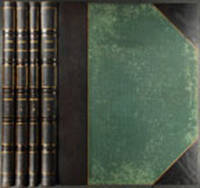
183322742Philadelphia: Samuel Augustus Mitchell vol I; Carey Lea & Carey vols II & III; Carey & Lea vol IV 1833. 4 volumes folio. 15 x 12 inches. 27 hand-colored engraved plates by Alexander Lawson 11 after Titian R. Peale 15 after A. Rider and 1 after J.J. Audubon and A. Rider. Extra-illustrated with 5 uncoloured engraved plates in vol. IV. Usual paper toning in vol. IV minor offsetting in vols. II-IV short repaired tear to an uncoloured plate in vol. IV. 19th-century black half morocco over green cloth-covered boards the spine in six compartments with raised bands lettered in the second and fourth the compartments bordered in gilt with double fillets marbled endpapers top edge gilt.<br/> <br/>Provenance: Juliette Clary inscribed by Bonaparte on the vol. I title "Offert par l'auteur a sa Cousine Juliette"<br/> <br/>A very fine set of the first edition first issue of this important American ornithological work inscribed by Prince Bonaparte to his cousin and with additional uncoloured states of the plates in volume four.<br/> <br/>Bonaparte's important continuation of Wilson's American Ornithology describes 60 birds not in the original work. "A love for the same department of natural science and a desire to complete the vast enterprise so far advanced by Wilson's labors has induced us to undertake the present work" Bonaparte writes in the preface "in order to illustrate what premature death prevented him from accomplishing as well as the discoveries subsequently made in the feathered tribes of these States." "The work which had been performed by Wilson's hands alone now gave employment to several individuals. Titian R. the fourth son of Charles Wilson Peale not only collected many of the birds figured while on the Long expedition which were credited to Thomas Say who originally described them in footnotes scattered through the report; or in a subsequent private trip to Florida during the winter and spring of 1825 under the patronage of Bonaparte; but also drew the figures engraved for the first and two plates for the fourth and last volume. A German emigrant by the name of Alexander Rider of whom little is known beyond that he was a miniature painter in 1813 and a portrait and historical painter in 1818 was responsible for the remainder of the drawings with the exception of the two figures of plate 4 of volume I." Frank L. Burns On Alexander Wilson. That plate the Great Crow Blackbird is notable as being the first book appearance of any engraving after John James Audubon. Perhaps the most influential artist involved with the work however was Bonaparte's master engraver Alexander Lawson arguably the most talented ornithological engraver in America at that time. Three issues of the first edition of Wilson's continuation have been identified. This fine set is comprised of the rare first issue of vol. 1 with the Mitchell imprint and containing the first issue of plate 6 in that volume see Ellis/Mengel and with first issues of volumes two through four published by Carey & Lea and printed by William Brown. Carey & Lea later reissued the first volume with their own imprint after purchasing the rights to the publication from Mitchell in 1828. The third issue includes volumes reprinted by T.K. and P.G. Collins with their imprint replacing that of William Brown for Carey & Lea with unchanged dates on the titles but actually printed in about 1835 after the completion of the final volume. We are aware of the existence of only one other inscribed set of Bonaparte's Ornithology to have appeared on the market in the last 30 years inscribed to the Count Charles de Chatillon.<br/> <br/>Anker 47; Bennett 16; Coues 1:609; Ellis/Mengel 312a-b; Fine Bird Books 1990 p. 78; Nissen IVB 116; Sabin 6264; Wood 247; Zimmer p.64. Samuel Augustus Mitchell [vol I]; Carey, Lea & Carey [vols II & III]; Carey & Lea [vol IV] unknown books