Romanov Nikolay VasilievichLivre Rare Book

481 résultats
albe169e0dce3a80253Romanov N. Alexander Andreevich Ivanov. In Russian (ask us if in doubt)/Romanov N. Aleksandr Andreevich Ivanov.. Short description: In Russian (ask us if in doubt).the meaning of his work: With a portrait and 5 drawings by M. Store employee. 67 p. 1 sheet of portrait 5 sheets of paper. 20.0x14.5 sm. We have thousands of titles and often several copies of each title may be available. Please feel free to contact us for a detailed description of the copies available. SKUalbe169e0dce3a80253
albcc4fb405e7aecf8fRomanov K. the King of the Jews. In Russian /Romanov K.K. Tsar iudeyskiy. White city. 2005. We have thousands of titles and often several copies of each title may be available. Please feel free to contact us for a detailed description of the copies available. SKUalbcc4fb405e7aecf8f.
alb9a2d573087baa198Novanov N.I. New Sketch by P.A. Fedotov Krestina In Russian /Romanov N.I. Novyy eskiz P.A. Fedotova Krestiny A separate print from the magazine Old Years, October 1911. St. Petersburg: Sirius printing house 1911. Circulation 75 copies. With an illustration attached to a separate one. The article tells the story of the creation and fate of one of the variants of the painting by Krestina P. A. Fedotov. We have thousands of titles and often several copies of each title may be available. Please feel free to contact us for a detailed description of the copies available. SKUalb9a2d573087baa198.
alb0f290a7c7d426d08Romanov N. (Romanoff N) V. Falileev. V. Falileeff. In Russian /Romanov N. (Romanoff N) V. Falileev. V. Falileeff. Artistic Editor S. Abramov. In French. Moscow-Petrograd. Edition de LEtat 1923.8s. We have thousands of titles and often several copies of each title may be available. Please feel free to contact us for a detailed description of the copies available. SKUalb0f290a7c7d426d08.
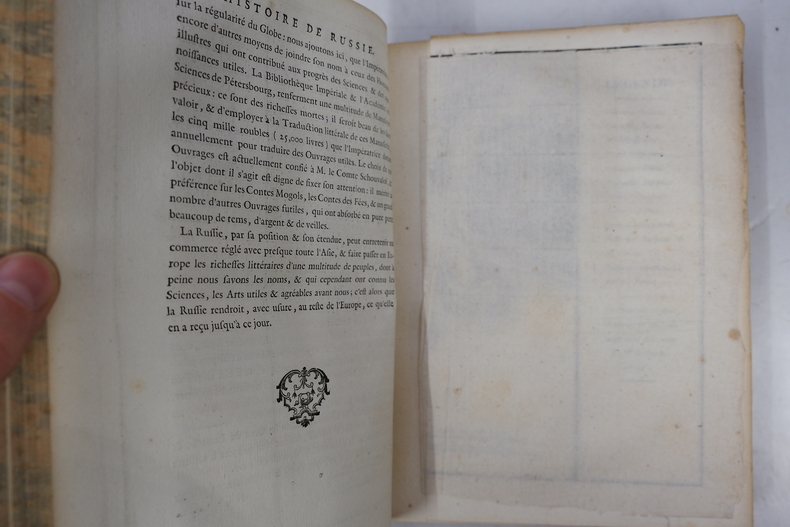
HIS4129M1783, à Paris chez Froullé, à Versailles chez Blaizot. Tome 1 seulement de l'histoire de la Russie moderne après 3 tomes sur la Russie ancienne. Petit in-4, reliure d'époque, plein veau havane marbré, dos à nerfs orné, pièces de titre et tomaison, plats encadrés de filets, filets sur chasses, toutes tranches marbrées. (2)-VII-(1)-XX-510-(2)pp. Ouvrage complet de ses planches comprenant une grande carte dépliante de la Russie, une planche dépliante représentant la bataille et la destruction de la flotte turque dans le port de Tzeme, un portrait de Catherine II ainsi que 10 tableaux (dont 9 dépliants). Coins, mors et coiffes frottés. Intérieur bon. Très beau volume
In 8° (16×9,5 cm); (2 b.), (10), 271, (13) pp. e 2 c. di tav. fuori testo una in antiporta con due nobili che sullo sfondo di una battaglia sorreggono un bel ritratto di “Petrus Alexewitz Czar et Magnus Dux Moscoviae” e una grande carta più volte ripiegata della Russia. Bella legatura coeva in piena pelle con dorso a 5 nervi e titolo e ricchi fregi ai tasselli. Qualche strofinatura e spellatura. Tagli spruzzati in rosso. Zigrinatura in oro al taglio dei piatti. Un piccolo strappetto al margine interno della grande carta della Russia realizzata dal cartografo Hermann Moll, senza perdita di carta ed ininfluente e nel complesso esemplare in buone-ottime condizioni di conservazione. Prima edizione francese, uscita un anno dopo la prima inglese, di questa relazione della Russia del celebre ingegnere e viaggiatore inglese John Perry (1670-1732). Specializzato in ingegneria navale visse varie avventure a bordo delle navi inglesi avendo spesso a che fare con i corsari francesi. Durante uno scontro con un corsaro perse l’utilizzo del braccio destro. In seguito ad un altro scontro con una nave corsara andò sotto processo in Inghilterra, insieme al comandante della nave inglese, in seguito alla cattura del veliero da parte dei francesi. Dalla testimonianza di Perry che pubblicò un libello su questi fatti, il comandante della nave fuggì ad attacco in corso lasciando lui e l’equipaggio alla mercè dei corsari. Nel 1698 venne liberato dal carcere in seguito ad espressa richiesta dello Zar Pietro che aveva individuato in Perry l’esperto ingegnere navale ed idrauliche di cui necessitavano i suoi cantieri pietroburghesi. Il suo primo impiego fu riferire allo Zar sulla possibilità di stabilire un canale tra il fiume Volga ed il Don. L’opera fu iniziata nel 1700, ma i progressi compiuti erano lenti, a causa dell’incapacità dei lavoratori, il ritardo nella fornitura dei materiali e l’opposizione della nobiltà. Perry fra l’altro si era risentito con lo Zar per il ritardo nel pagamento del suo stipendio. Nel settembre 1701 Perry che nel frattempo aveva ricevuto il titolo di “Controllore supremo delle opere marittime russe” venne convocato a Mosca dove gli fu presentato l’ordine di stabilire sulla riva destra del fiume Voronej un nuovo bacino artificiale. Nel 1711, dopo i ritardi dovuti alla guerra contro i Turchi, gli viene ordinata la creazione di un canale tra San Pietroburgo e il Volga ma il fatto che lo Zar continua a non riconoscere il suo stipendio, Perry inizia ad arrabbiarsi tanto che andando oltre ad una saggia protesta si espone direttamente con lo Zar scatenando un litigio furibondo con quest’ultimo. Avendo paura per la sua vita si pone sotto la protezione dell’ambasciatore inglese, il signor Whitworth, e torna in Inghilterra sul finire del 1712. Nel corso del suo servizio di quattordici anni “in Russia, ho solo ricevuto un anno di stipendio” scrive Perry nel suo celebre scritto sulla Russia. Nel 1716 pubblicò questo interessantissima descrizione della Russia e delle condizioni di lavoro in questo paese. L’opera è basilare per la comprensione non solo degli usi e costumi russi degli inizi del settecento ma anche per avere una chiara visione dei costi e del processo di modernizzazione della Russia di Pietro il Grande. “This ingenious officer and mechanic was engaged by the Russian Ambassador, at a salary of 300 pounds a year, to superintend in paticular a communication then making between the Volga and the Don. In an introduction to his work Perry gives an account of the many disappointments he experienced during fourteen years of residence in Russia, which he was finally forced to quit without receiving his expected renumeration. Of the country itself, and of the various plans of the Czar for its improvement, a pleasing account is given” (Cox). Prima rara edizione francese in buone-ottime condizioni di conservazione. A good copy. First french edition. Raro. Rare.
2002__3110460254De Gruyter 2002. Hardcover. New. 480 pages. 9.45x6.30x9.61 inches. De Gruyter hardcover
9134078Short description: In Russian. Romanov Nikolai Ilyich. V.Falileev. Moscow; Petrograd: State Publishing House 1923. The image is provided for reference only. It may reflect condition of one of the available copies or only help in identifying the edition. Please feel free to contact us for a detailed description of the copies available. SKU9134078 unknown
9134078"Short description: In Russian. Romanov, Nikolai Ilyich. V.Falileev. Moscow; Petrograd: State Publishing House, 1923. You are welcome to reach out to us for a detailed description of the copies currently available. Delivery of this book may take longer than usual including extended processing and pre-shipping time, no expedited shipping is available. Please advise us if you have a set date or a deadline to receive your order.SKU9134078"
1995x-0792337077Kluwer Academic Pub 1995. Hardcover. New. 1st edition. 822 pages. 10.00x6.75x1.50 inches. Kluwer Academic Pub hardcover
187018-0-89St. Petersburg, Selbstverlag, um 1870. jeweils Foto: 15,2 x 9,8 cm; Karton: 16,7 x 10,9 cm
9134089Short description: In Russian. Romanov Panteleimon Sergeevich. Stories. Moscow: Ogonyok 1926. The image is provided for reference only. It may reflect condition of one of the available copies or only help in identifying the edition. Please feel free to contact us for a detailed description of the copies available. SKU9134089 unknown
SLIVCN-9781536142662NOVA SCIENCE PUBLISHERS INC (11/2018)
2002CBS-9789067643610Misclenious Publishers 2002. New. Misclenious Publishers unknown
2002CBS-9789067643610Misclenious Publishers 2002. New. Misclenious Publishers unknown
102157Marseille, Barlatier-Fessat père et fils, s.d. (1875), in-8, 2 vol. : texte de [4]-VIII-341 pp.; et atlas de 61 (sur 62) pl. dépl, Demi-chagrin noir, Rare édition originale de ce traité sur les installations portuaires commerciales, accompagné d'un atlas de planches dépliantes, rehaussées en bleu. Ce précieux exemplaire est enrichi d'un envoi signé de l'auteur à "Son altesse impériale Monseigneur le Grand Duc Constantin, Grand-Amiral" : Constantin Nikolaïevitch de Russie (1827-1892), grand-amiral et réformateur de la Flotte impériale de Russie sous le règne de son frère, le tsar Alexandre II. Le prince voyagea en Angleterre et en France pendant l'année 1857, afin d'y étudier les marines modernes. Louis Barret (1828-1887), ingénieur des docks de Marseille étudia à l'École d'Aix-en-Provence, où il obtint son diplôme en 1847. Il se distingua pour ses travaux sur l'hydraulique maritime et pour ses ouvrages multiples. Ses connaissances étaient précieuses pour la France, comme pour l'étranger; il se mit notamment au service de la Compagnie Poutiloff, en Russie, afin de mener des études de port à Odessa et à St-Péterbourg (Trotabas). C'est sans doute à cette occasion qu'il rencontra le grand duc grand-duc Constantin Nikolaïevitch. Exemplaire d'une importante valeur historique, hélas incomplet d'une planche (la n° 51). Trotabas, Nécrologie de Louis Barret, dans le Bulletin administratif publié par la Société des anciens élèves des écoles nationales d'arts et métiers (n°8, août 1887, pp. 355-364). Ex-libris d'Henri Viellard. Cachets de l'Institut catholique de Paris et étiquettes en pied des dos. Couverture rigide
1995021856Paramus: Backbone Publishing Company 1995. Paramus: Backbone Publishing: 1995. 4to x 16" wide. Second edition revised and expanded. 277 pp. Dr. Ilya P. Romanov was a true Polarman. In more than forty years of Arctic expedition and observational science Dr. Romanov experienced all aspects of Arctic field operations and Arctic science: airborne hydrographic and sea ice surveys; drifting ice station science and logistics; and shipbased oceanography and ice navigation. Early in his career he recognized the scientific merit of a long-term systematic program to measure geometric properties of sea ice and snow cover throughout the Arctic Basin and marginal seas. Maps and diagrams throughout. Repaired tears to dust jacket some soiling on pages edges. Very good in very good dust jacket protected with a fresh archival-quality mylar cover. Second Edition Revised and Expanded. Hard Cover. Very Good/Very Good. Illus. by Illustrated. 4to - over 9¾ - 12" tall. Backbone Publishing Company Hardcover
191839666Петроград Petrograd: ИздательÑтво «Свободное ИÑкуÑÑтво» Liberal Arts 1918. Limited First edition. Hardcover. poor to vg. 1/1000. Folio.157 1pp. Original printed dust-jacket over half green cloth and decorative paper covered boards. Pictorial endpapers. Decorative head- tailpieces and initials. <br /> <br /> Lavishly illustrated with 101 duo-tone photographic reproductions mounted onto heavy paper this handsome volume documents the amazing true story of a wealthy family's contribution to the arts and architecture in a little town of northern Russia. Solvychegodsk is located on the north bank of the Vychegda River not far from its confluence with the Northern Dvina. Despite its sleepy appearance Solvychegodsk contains two of the most elaborate examples of religious architecture and applied arts in all Russia. Founded in the 14th century Solvychegodsk was called the Stroganov town due to the rich local salt works owned by the Stroganov family. The family created a salt monopoly which brought them enormous wealth and Solvychegodsk became the center of a private empire. The family's achievements placed them in positions of exceptional influence both political and cultural. The family’s lavish patronage of the arts started with the patriarch of the dynasty Anika Ioanniky Stroganov 1497-1570 whose primary contribution to Russian architecture is the Annunciation Cathedral begun in 1560 and apparently concluded in the early 1570s. <br /> <br /> The Cathedral contains a grandiose gilded iconstasis which was carved in Moscow by a team led by Grigori Ivanov and transported here in 1693. The origins of the famed Stroganoff school of iconography and the decorative arts can be seen here in opulent examples of enamel painting and other applied arts on display in the cathedral. Another architectural jewel built by the Stroganov family is the Presentation Cathedral whose soaring interior is created by a vaulting system of paired arches that support the large structure and its five cupolas. The magnificent icons within the Presentation Cathedral were painted on canvas instead of treated boards in a western style by a Stroganov painter Stepan Narykov. The striking photographs depict in detail all these splendors exterior and interior views of all the brick churches as well as frescoes icons and other artwork including some which were later destroyed by the Soviets. Written before the Bolshevik Revolution and published in its immediate aftermath this book is the last remaining testimony of the town's architectural and artistic jewels. Indeed the Soviet period would inflict much damage on the cultural heritage of Solvychegodsk. Of the town's twelve brick churches at the beginning of the 20th century eight were destroyed and two others left in ruined state. However the two Stroganov cathedrals still stand in their monumental glory. One of 1000 numbered copies of which this is No. 887.<br /> <br /> Dust-jacket partly creased and torn along edges. Head of spine slightly age-toned. Minor soiling along edges of covers. Text in Russian. DJ in overall poor to fair binding in good interior in very good condition. ИздательÑтво «Свободное ИÑкуÑÑтво» (Liberal Arts) hardcover
In 8° (16,8x12,5 cm); due opere in un volume: (2), 231, (1 b.), V, (1) pp. e (2), 167, (1 b.), III, (1 b.) pp. Legatura coeva in mezza pelle rossa con titolo, iniziali dell’autore, data e filetti in oro ai tasselli ed ai filetti. Dorso a 4 nervi. Iniziali dell’autore in oro anche al piatto anteriore. Qualche leggerissima e rara fioritura, alcune rare note a matita e nel complesso esemplare, in buone-ottime condizioni di conservazione. Seconda edizione della prima opera e prima edizione della seconda opera. Celebre e rara raccolta di poesie del Granduca di Russia, Konstantin Konstantinovic Romanov (Strel'na, 22 agosto 1858 – Pavlovsk, 15 giugno 1915). Nipote dell’Imperatore Nicola I di Russia fu un poeta e drammaturgo di motevole importanza. Quarto figlio del granduca Konstantin Nikolaevic di Russia e della moglie, la principessa Alessandra di Sassonia-Altenburg, Konstantin Romanov nacque nel palazzo di Costantino a Strelna. Nonostante che fin dalla giovanissima età dimostrasse grande predisposizione per la letteratura e assai minor interesse per la corriera militare, venne, come ogni Romanov, avviato a questa carriera nella Marina Imperiale Russa. Nella Marina non rimase a lungo, insoddisfatto dall’ambiente, passando ben presto nell'elitario reggimento Izmajlovskij della Guardia Imperiale dove, fra l’altro, si distinse, durante il servizio. Omosessuale dichiarato, nonostante questo, considerava di primaria importanza i propri “doveri” verso la famigli imperiale e così sposò, nel 1884, la principessa Elisabetta di Sassonia-Altenburg, sua seconda cugina, la quale, con il matrimonio, divenne la granduchessa Elizaveta Mavrikievna (in famiglia meglio conosciuta come Mavra) e dalla quale ebbe nove figli. Come padre e marito fu devoto e sempre attento alle necessità della moglie e dei figli. Pianista di talento, fu mecenate di numerosi artisti e divenne anche, per meriti, presidente della Società Musicale Russa. Amico di Pëtr Il'ic Cajkovskij, è comunque nella letteratura che diede il meglio. Poliglotta, a lui si devono alcune apprezzate traduzioni in russo di grandi classici tedeschi (Schiller e Goethe in primis) ed inglesi (era particolarmente orgoglioso della sua traduzione dell'Amleto). Esperto drammaturgo e poeta, produsse e diresse diverse rappresentazioni teatrali da lui scritte (ed almeno in un caso, vi prese parte anche come attore). Konstantin, insieme alla sua famiglia, fu tra i pochi membri della famiglia reale ad essere sempre accolti con piacere a corte da Alessandro III e dalla zarina Alessandra Feodorovna prima, poi da Nicola II che vedevano nella sua slavofilia artistica e nella sua devozione al dovere, un ottimo esempio, da contrapporre allo stile di vita mondano e frivolo di molti altri granduchi. Proprio per il suo carattere aperto e gioviale, fu uno dei più intimi amici della sorella della zarina, Elizaveta Fëdorovna moglie Sergej Aleksandrovic (fu uno dei pochi membri della famiglia reale ad esser presente al funerali di questi quando il Granduca venne ucciso con un attacco dinamitardo). Se pubblicamente la sua vita era caratterizzata da morigeratezza ed equilibrio, nel privato fu confusionaria e piena di contrasti. Anche la sua omosessualità non venne conosciuta in vita, ma divenne pubblica solo dopo la sua morte quando i suoi diari, videro la luce. Questi scritti schietti e diretti dimostrarono tutta la sensibilità e l’amore del Granduca per sua moglie e la sua famiglia ma anche i suoi sensi di colpa per i tradimenti con altri uomini ai quali non seppe resistere. Nei suoi diari Konstantin Romanov affermò che tra il 1893 ed 1899 egli si astenne dalla pratica di quello che egli definiva come il suo "peccato principale"; però, dopo la nascita del settimo figlio, Konstantin divenne un assiduo frequentatore dei numerosi bordelli maschili di San Pietroburgo. Nel 1904 egli scrisse nel suo diario che «ordinai al mio cocchiere [...] di andare, e continuai a piedi fin dopo la bath-house. Avevo intenzione di proseguire dritto [...] ma prima ancora di raggiungere il ponte Pevceskij, mi girai ed entrai. E così mi ero arreso ancora una volta, senza lottare poi molto contro le mie inclinazioni depravate». Il ciclo di resistenze e capitolazioni alle tentazioni è un tema molto frequente delle pagine di diario di Konstantin Romanov. Strinse diverse lunghe relazioni con uomini ma negli ultimi anni della sua vita, Konstantin scrisse nei suoi diari che la sua omosessualità, diventava sempre meno pressante, sia perché egli aveva raggiunto una propria pace interiore, sia a causa dell'età avanzata e della cattiva salute. Allo scoppio della Prima Guerra Mondiale, la coppia Granducale con l’intero entuorage, fu colta di sorpresa in territorio tedesco mentre era in vacanza. Fatta prigioniera come ostaggio, venne poi liberata su intervento diretto del Kaiser che permise alla famiglia di ritornare in Russia. Accompagnati al fronte, dovettero affrontare a piedi il passaggio dalle linee tedesche a quelle russe, cosa che segno profondamente la salute, già precaria del Granduca. La morte di uno dei figli in guerra segnò di nuovo Konstantin portandolo ad un tale livello di prostrazione che la morte lo colse il 15 giugno del 1915. La morte gli risparmiò di assistere allo sterminio di buona parte della sua famiglia dopo la fine dello Zar e della sua famiglia. Sopravvissero alla “Rivoluzione” solo la moglie e tre dei suoi figli (uno salvato per intercessione di Maksim Gor'kij che aveva cercato di salvare tutti i Romanov). L’opera qui presentata raccoglie i componimenti poetici scritti dal Granduca tra gli anni 1879 e 1888. I suoi componimenti, seppur anonimi, incontrarono il favore della critica, tanto che furono numeorsi gli articoli a lui dedicati su riviste specializzate e altrettanti furono i commenti entusiasti di numerosi celebri poeti russi che li lessero senza sapere chi ne fosse l’autore. Per ragioni legate alla sua posizione nella famiglia imperiale, Konstantin non firmò l’opera se non con le iniziali, anche se verso la fine della sua vita, l’attribuzione divenne pubblica, tanto che moltissime sue opere furono distrutti durante la “Rivoluzione” rendendole rare, quando non rarissime, specialmente quelle stampate prima del 1900 quando ancora, il Granduca, stampava le sue opere, anonime, in poche copie. Si sa ad esempio che la prima edizione dei suoi componimenti (qui presenti in seconda edizione), edita nel 1886, venne stampata in meno di mille copie, non per la vendita, ma regalate direttamente dal Granduca a personalità ed amici a lui vicini. Allo stesso modo si comportò il Granduca per la stampa della seconda parte dei suoi componimenti nel 1889. Stampò, sempre in circa 1000 copie, la seconda raccolta dei suoi componimenti e decise di ristampare alcune copie, in seconda edizione, della prima raccolta da donare a personalità ed artisti che non conosceva ancora, al momento della stampa della prima edizione. Probabilmente Konstantin curò anche la legatura dei volumi, cosa che spiegherebbe la curiosa presenza delle sue iniziali al piatto anteriore del volume che noi presentiamo. Una terza raccolta poetica che raccoglieva i componimenti scritti tra il 1889 ed il 1899 venne pubblicata nel 1901. Rarità bibliografica.
191462465СПб.: тип. "СельÑкого веÑтника" 1914. Hardcover/Hardback. Fair. <p>Драма в четырёх дейÑтвиÑÑ… и пÑти картинах. ВладельчеÑкий новый переплёт. ПÑтна ÑыроÑти на первых Ñтраницах. ДарÑÑ‚Ð²ÐµÐ½Ð½Ð°Ñ Ð½Ð°Ð´Ð¿Ð¸ÑÑŒ.</p><p>ПьеÑу К. Ð . на евангельÑкий Ñюжет «Царь ИудейÑкий» и авторÑкие Ð¿Ñ€Ð¸Ð¼ÐµÑ‡Ð°Ð½Ð¸Ñ Ðº ней Ðœ. Ð. Булгаков иÑпользовал как материал Ð´Ð»Ñ Ñ€Ð¾Ð¼Ð°Ð½Ð° «МаÑтер и Маргарита».</p><p> Ðвтор драмы «Царь ИудейÑкий» – Великий КнÑзь КонÑтантин КонÑтантинович Романов 1827-1892 двоюродный дÑÐ´Ñ ÐÐ¸ÐºÐ¾Ð»Ð°Ñ II президент ПетербургÑкой Ðкадемии наук пиÑавший под пÑевдонимом К.Ð . ÐеÑÐ¼Ð¾Ñ‚Ñ€Ñ Ð½Ð° выÑокий художеÑтвенный и нравÑтвенный уровень и положительные отзывы пьеÑа была запрещена руÑÑким Синодом по причине неÑоответÑÑ‚Ð²Ð¸Ñ Ð¾Ñ‚Ð´ÐµÐ»ÑŒÐ½Ñ‹Ñ… трактовок образов героев Ñ ÐºÐ°Ð½Ð¾Ð½Ð¸Ñ‡ÐµÑкими предÑтавлениÑми. По разрешению Ð¦Ð°Ñ€Ñ Ð¿ÑŒÐµÑа была поÑтавлена любительÑким придворным театром Ðрмитажа и ÑоÑтоÑлоÑÑŒ только неÑколько показов ÑÐ¿ÐµÐºÑ‚Ð°ÐºÐ»Ñ Ð¿Ñ€ÐµÐ¸Ð¼ÑƒÑ‰ÐµÑтвенно Ð´Ð»Ñ Ð²Ñ‹ÑокопоÑтавленной публики. Музыку к пьеÑе напиÑал Ð.К. Глазунов руководил поÑтановкой режиÑÑер Ð.Ð. Ðрбатов. ИоÑифа ÐримафейÑкого тайного ученика ХриÑта Ñыграл Ñам автор КонÑтантин Романов.</p><p>С великим кнÑзем вели перепиÑку И. Ð. Гончаров Я. П. ПолонÑкий Ð. Ð. Фет ценивший его Ð²ÐºÑƒÑ Ð¸ даже поручавший ему иÑправлÑÑ‚ÑŒ Ñвои Ñтихи. О поÑтичеÑком творчеÑтве К. Ð . воÑторженно отзывалÑÑ ÐŸ. И. ЧайковÑкий которому великий кнÑзь поÑвÑтил одно из Ñвоих Ñтихотворений `О люди вы чаÑто Ð¼ÐµÐ½Ñ Ñзвили так больно.`.Принадлежал к так называемой Ñтарой школе был продолжателем клаÑÑичеÑких традиций. ПервоклаÑÑным талантом поÑÑ‚ К. Ð . не обладал но занÑл Ñвое меÑто в иÑтории руÑÑкой литературы. Многие его ÑÑ‚Ð¸Ñ…Ð¾Ñ‚Ð²Ð¾Ñ€ÐµÐ½Ð¸Ñ Ð¾Ñ‚Ð»Ð¸Ñ‡Ð°Ð»Ð¸ÑÑŒ мелодичноÑтью и были положены на музыку Ñамое извеÑтное — Ñ€Ð¾Ð¼Ð°Ð½Ñ Â«Ð Ð°Ñтворил Ñ Ð¾ÐºÐ½Ð¾â€¦Â» Ñ Ð¼ÑƒÐ·Ñ‹ÐºÐ¾Ð¹ П. И. ЧайковÑкого Ñочинившего музыку также на «Я Ñначала Ñ‚ÐµÐ±Ñ Ð½Ðµ любила…» «Вот миновала разлука» и другие ÑÑ‚Ð¸Ñ…Ð¾Ñ‚Ð²Ð¾Ñ€ÐµÐ½Ð¸Ñ Ðš. Ð . Сам напиÑал неÑколько романÑов на Ñтихи Ð’. Гюго «Луч денницы блеÑнул дорогаÑ» Ð. К. ТолÑтого «Ðе верь мне друг когда в избытке горÑ» «О не пытайÑÑ Ð´ÑƒÑ… унÑÑ‚ÑŒ тревожный» и «Горними тихо летела душа небеÑами» Ð. Ð. Майкова «Он уж ÑнилÑÑ Ð¼Ð½Ðµ когда-то» и «Далеко на Ñамом море» — впервые они были напечатаны в 1880 году в Германии; в 1889 году нотоиздательÑтво П. ЮргенÑона выпуÑтило их в МоÑкве.</p> СПб.: тип. "СельÑкого веÑтника" hardcover
alb38da72f8eae33772Romanov N. K. Amu and Uzboy. In Russian (ask us if in doubt)/Romanov N. K. Amu i Uzboy. Short description: In Russian (ask us if in doubt).Samara governorate type. 1879. 4 III 55 p. We have thousands of titles and often several copies of each title may be available. Please feel free to contact us for a detailed description of the copies available. SKUalb38da72f8eae33772
albe74986d4bf556a37K.R. (led by K.K. Romanov). K.R. Poems (1900-1910) In Russian (ask us if in doubt)/K.R. (Vel. Kn. K.K. Romanov). K.R. Stikhotvoreniya (1900-1910) Short description: In Russian (ask us if in doubt).The collection includes poetry-poems elegies sonnets from 1900-1910 from the cycles: By the coast Seasons Nights Dreams and Dumas Images of the Past In formation selected translations and the translation of Goethe's drama in Tavrida. At the end of the collection are placed a bibliographic index and an index of names. We have thousands of titles and often several copies of each title may be available. Please feel free to contact us for a detailed description of the copies available. SKUalbe74986d4bf556a37
alb657b90b5a62f4543"K.R. (Prince K.K. Romanov). Poems. 1879-1912. In 3 Vol. Vol. 1-3. In Russian /K.R. (Knyaz K.K. Romanov). Stikhotvoreniya. 1879-1912. V 3 t. T. 1-3. St. Petersburg. Type. Imp. Akad. Science. 1913-1915. Vol. 1: XII, 417 p.; Vol. 2: VI, 452 p., 5 l.; Vol. 3: IV, 453-903 p., 3 l. 8 sm. We have thousands of titles and often several copies of each title may be available. Please feel free to contact us for a detailed description of the copies available. SKUalb657b90b5a62f4543."
1922001842Saint-Briac: By the author 1922. Softcover. First edition; 18 ½â x 12 ¼â ; newsprint single sheet recto only; folded with intersecting crease lines; a few small nicks and cuts to edges; light uniform age-toning; ruled with an intricate border and a stylized drawing of a crown; illustrated with two large photographs of Kirill and his wife Victoria Melita of Saxe-Coburg and Gotha â Feodorovna; very good condition. An apparently unrecorded piece of the Russian Imperial Familyâs history the broadside was published by Kirill himself in France where he lived in exile after the October Revolution. Kirill Vladimirovich Romanov 1876 â 1938 was the son of Grand Duke Vladimir Alexandrovich Romanov and the grandson of Tsar Alexander II. His wife whom he married in 1905 without Tsar Nicholas IIâs consent was his first cousin and the granddaughter of Queen Victoria. The marriage caused an uproarious scandal throughout the courts of the European nobility for the union was in open defiance of the Russian Orthodox Churchâs ruling that first cousins could not marry and furthermore for the fact that Victoria Feodorovna had just divorced her first husband also a first cousin. During the February Revolution of 1917 Kirill swore allegiance to the Russian Provisional Government in hopes of ingratiating himself and possibly becoming a regent after Nicholas IIâs impending abdication. Shortly after in June of 1917 the family escaped to Finland then Germany and finally to the tiny village of Saint-Briac in France. In 1922 four years after Nicholas IIâs execution and two years before a London court order declared Nicholasâ brother Mikhail II legally dead Kirill published his current âdeclarationâ to his compatriots stating that he did not believe the news of Nicholasâ death and that he hoped his cousin would return to the throne but in the meantime the Russian people needed a âperson in chargeâ to lead them. He continued on to state that until a definitive proof of the whereabouts of Mikhail Nicholas and his son Aleksei was presented or a Zemskii Sobor an assembly summoned by a tsar or a patriarch chose a new ruler he would appoint himself Guardian of the Sovereignâs Throne. His statement was endorced at the bottom of the broadside by his relative Prince Dmitrii Golitsyn-Muravlin. His aspirations were rivaled by Grand Duke Nikolai Nikolaevich Romanov grandson of Nicholas I but with the formerâs death in 1929 Kirill would indeed become the undisputed leader of the monarchists. After claiming the throne he would become known as the âSoviet Tsarâ for his sympathies for the regime and his biggest support would come from an émigré monarchist organization styling itself âThe Legitimists.â After his death Kirill was succeeded by his son Vladimir Kirilovich who proclaimed himself âHead of the Romanovsâ but this was never accepted by any other member of the Romanov family. Saint-Briac: By the author paperback books