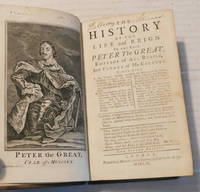
PETER THE GREAT - PETER DES GROSSENBiblio.com
THE HISTORY OF THE LIFE AND REIGN OF THE CZAR PETER THE GREAT EMPEROR OF ALL RUSSIA AND FATHER OF HIS COUNTRY. Containing I. His Travels Studies and Personal Fatigues for the attaining of Knowledge in Civil and Military Affairs and the Improvement of his Subjects. II. His Introduction of Arts and Sciences Naval Force and Commerce with Foreign Nations: Also his many Reformations in Church and State the Army and the Customs and Manners of his People. III. His Wars with the Swedes Turks Tartars and Persians; Victories by Sea and Land; Acquisitions of Territory and Increase of Power. IV. His Regard to Genius and Merit with the surprizing Instances of his Favour to General Le Fort Prince Menzikoff and the Empress Catharine: And his severe Justice on Offenders particularly in the Proceedings against the rebellious Czarewitz. Faithfully abridged from the best Historians by J. Bancks Author of Miscellaneous Works in Verse and Prose in Octavo adorned with Sculptures and illustrated with Notes.
1740100257<p>London: Printed for J. Hodges at the Looking-glass on London-Bridge MDCCXL 1740. 1740. Very good. - Octavo 6-5/8 inches high by 4 inches wide. Hardcover bound in full calf with a black leather title label and decorations in gilt within raised bands on the spine. The covers are slightly rubbed and bumped with a minor chip to the head of the spine and a portion of the title label chipped off. 4 346 & 14 pages illustrated with a portrait frontispiece engraved by George Bickham the Younger c. 1706–1771 and an engraved head-piece tail-piece and a formal decorated initial. There are two small pieces out of the front margin of page 3/4 without loss of text and a small tear in the margin of page 65/66 without loss of text. Very good.</p><p>Second edition published in the same year as the first.</p><p>From the library of Captain Colin Campbell of Kilberry with his armorial bookplate with the motto "Ne Oublie Pas" signed "R.M." R. Mountaine on the front pastedown and the ownership names of "Kilberry" and "Minard" handwritten at the head of the title page.</p><p>"CAMPBELL COLIN d. 1782 of Kilberry major of 100th foot obtained an unenviable notoriety in consequence of a fatal assault committed by him on Captain John McKaarg or Macharg a brother officer while stationed at the island of Martinico in 1762. The cause of difference is said to have originated at Jersey where Campbell at that time major-commandant of the 100th foot was obliged to take the payment of McKaarg's company out of his hands owing to the latter's pecuniary difficulties. On the arrival of the regiment at Martinico McKaarg took every opportunity of vilifying Campbell who demanded in writing an explanation. McKaarg replied in a curt letter. Campbell immediately proceeded to McKaarg's tent armed with a bayonet and a small-sword and demanded satisfaction. McKaarg having a broad sword only endeavoured to evade a meeting. Thereupon Campbell struck him several times with his sword. McKaarg was compelled by his antagonist to beg for his life and immediately expired. He had received eleven wounds two of which were mortal. Campbell was arrested and on 6 April 1762 was tried for murder by a general court-martial held at Fort Royal. He endeavoured to prove that McKaarg had fallen in a fair duel. On 14 April the court adjudged Campbell to be cashiered and declared him incapable of serving his majesty in any military employment whatsoever. Pending the king's consideration of the sentence Campbell escaped from the island. Owing to some informalities the proceedings were not confirmed but he was immediately dismissed from the army. . The relatives of Captain McKaarg subsequently brought an action of assythment against Campbell and ultimately damages. were awarded to them. Campbell chiefly resided in Edinburgh where he attracted notice by his foppery and was well known as an antiquated old beau. In the summer he visited Buxton and the other fashionable watering-places of the day. He died unmarried at Edinburgh in 1782 and his estate at Kilberry in Argyllshire descended to his nephew." Quoted from the Dictionary of National Biography volume 8 page 349. The Oxford Dictionary of Biography gives Campbell's death date as 1798.</p><p>"The action of assythment is now no more than a legal antiquity but in 1767 we find its scope and character were the subject of much discussion in the Court. It appears that while the 100th Regiment of Foot had been fighting the French in Martinique Captain Colin Campbell of Kilberry had killed Captain Macharg a brother officer in a quarrel. For this offence he was cashiered by sentence of court-martial. Captain Macharg's relatives brought an action of assythment in the Court of Session. In the defence of Captain Campbell it was pled that assythment was a proceeding for infliction of a fine and not for payment of damages and that Captain Campbell having already been tried and punished could be liable to no further legal proceedings for the same offence. Assythment was said apparently with reason to have been instituted to take the place of the right of private vengeance which early law allowed to the relatives of a murdered man and to have been regarded more as a criminal penalty than as a civil reparation. His counsel quoted Balfour's Practicks to the effect that assythment was paid 'to the kin bairins and freindis in contentation of their damnage and for pacifying of their rancor' and Bankton who had laid it down that assythment was given to the wife and nearest. of-kin 'that they might be reconciled to the manslayer.' Captain Macharg's relatives however were successful in maintaining on the other hand that assythment was an action for payment of reparation and not of a fine and the Court remitted to the Lord Ordinary to fix the amount." Quoted from "The Green Bag" 1889-1914 volume 15 page 442.</p> London: Printed for J. Hodges, at the Looking-glass on London-Bridge, MDCCXL [1740]. hardcover