REFUGE (Eustache du)Livre Rare Book
Traicté de la Cour ou Instruction des Courtisans. Dernière édition
1656003202A Amsterdam, chez les Elzéviers, 1656
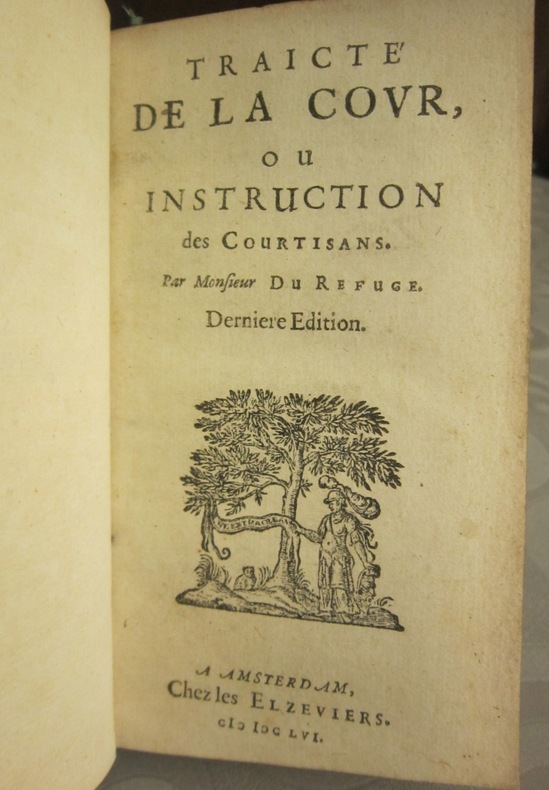
Henri Picard et Fils · Paris, France500,00 €
17 résultats
168987043Apud Henricum Wetstenium | Amstelaedami(Amsterdam) 1689 | 8.90 x 15.20 cm | relié
1656003202A Amsterdam, chez les Elzéviers, 1656
1668PHO-1879Paris, Chez Pierre Le Petit, 1668. Petit in-12, veau, dos à nerfs orné avec pièce de titre, épidermures, coiffe sup. arasée, manque en coin à la page de titre.
1688002823Paris, Estienne Michallet, 1688
16813459Christophe Journel, 1681. In-12 (16,9 x 10 cm), 204 pp., reliure d'époque veau brun, dos orné à quatre nerfs pièce de titre papier. Epitre de l'auteur au Roy Louis XIV, agrémentée d'un bandeau et d'une lettre ornée. Achevé d'imprimer en 1673. Ex-libris de Madame la Comtesse des Courtils, lithographié par N. Boudin à Gisors. (coins émoussés - dorure du dos en partie effacée).
1678108521678 Paris, chez Estienne Michallet, 1678; in-4°, plein veau brun de l'époque, dos à nerfs orné et doré, titre doré sur étiquette ocre; (12) ff. - 490 pp. (chiffré par erreur 400) - ( 1) f. (Additions, extrait du privilège). Edition originale (cf. Saffroy I. 8705)
169429Paris Chez Nicolas Le Gras 1694 1 vol. in-12 (16,5 x 10 cm)(16), 224 pp.Avec Avis , Préface, Table des chapitres, Extrait du Privilège du Roi.Bandeaux, lettrines, culs- de lampe.Plein veau moucheté de l'époque. Dos à cinq nerfs, caissons dorés. Roulettes sur les coupes. Ex-libris manuscrit "M de Coupsarte".Pièce de titre en déficit remplacée par une inscription manuscrite. Mors fendus en tête, l'un sur 1 cm, l'autre sur 0,5 cm. Trace d'un verre ou d'une bouteille sur le premier plat.
1687G121057Norimbergae [Nurnberg], Sumtibus Joh. Andreae Endteri filiorum [Edter] 1687 [24] + 286 + [4] pp. + ca. 160 genealogical tables, with full-page engraved frontispiece by Sandrart and with ca. 60 engraved coats of arms, ornamental initials, engraved head- and tailpieces, 35x24cm., contemporary full-leather binding (some use at corners and ends, gilt title and decorations on spine), text in Latin, text is clean and bright, [Interesting genealogical work on the French nobility, with genealogical tables and coat of arms for each family], weight: 2.6kg., G121057
166853793P., Charles de Sercy, 1668, in-4°, illustré de 36 représentations de blasons et armoiries, d'une belle vignette à la page de titre, de lettrines, bandeaux et de culs-de-lampe, reliure plein veau moucheté, dos à 5 nerfs, caissons ornés et titres dorés, coupes guillochées, tranches mouchetées (rel. de l'époque), trace de mouillure ancienne angulaire, un mors fendu sur 10 cm, état correct (Saffroy, I, 12974)
169889610Théodore MUGUET | Paris 1698 | 24.7 x 36 cm | 2 volumes brochés
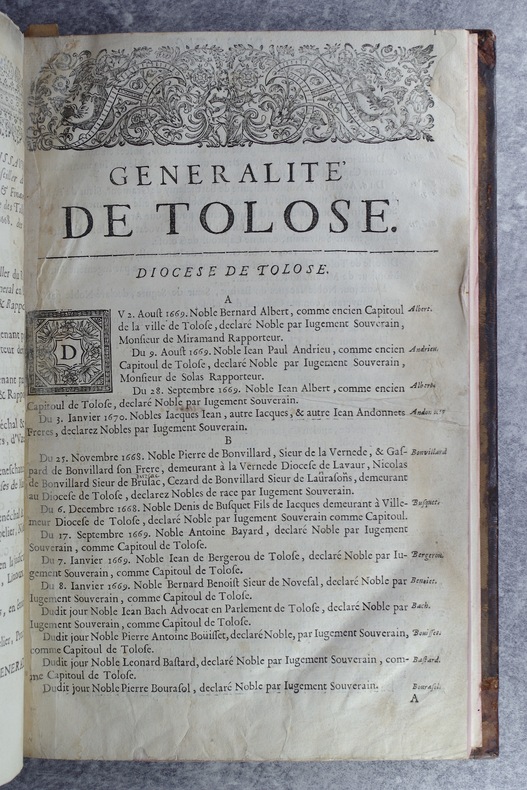
16761196A PEZENAS. PAR JEAN MARTEL, IMPRIMEUR ORDINAIRE DU ROY, & DES ESTATS GENERAUX DE LA PROVINCE DE LANGUEDOC, & DE LA VILLE. 1676. IN-FOLIO (23 X 34,5 X 3 CENTIMETRES ENVIRON) DE (8) + 68 + 92 ET (3) PAGES, RELIURE D'EPOQUE PLEIN VEAU MARBRE, DOS A CINQ NERFS ORNE DE CAISSONS A FLEURONS DORES, TITRE DORE SUR ETIQUETTE MAROQUIN HAVANE, TRANCHES ROUGES. ILLUSTRE DE QUELQUES FIGURES GRAVEES SUR BOIS. EDITION ORIGINALE RARE (SAFFROY. 26642) DIVISEE EN DEUX PARTIES, L'UNE SUR LA GENERALITE DE TOULOUSE, L'AUTRE SUR CELLE DE MONTPELLIER. COMPLETE IN-FINE PAR 3 PAGES D'"ERRATA OU OMISSIONS DU PRESENT CATHALOGUE DE LA NOBLESSE DU LANGUEDOC"; CE SUPPLEMENT, INCONNU DE SAFFROY, MANQUE EGALEMENT DANS L'EXEMPLAIRE DETENU PAR LA BIBLIOTHEQUE NATIONALE. QUELQUES TRACES DE MOUILLURES ANCIENNES, QUELQUES RARES PIQURES DE VER EN MARGE DE QUELQUES FEUILLETS, PETIT MANQUE DE PAPIER DANS L'ANGLE SUPERIEUR DES PAGES 91-92 AVEC PETIT MANQUE DE TEXTE (ON JOINT UNE PHOTOCOPIE DE CES 2 PAGES D'APRES L'EXEMPLAIRE DETENU PAR LA BIBLIOTHEQUE NATIONALE), SINON BON EXEMPLAIRE.
1668176982Philippe Borde A Lyon, chez Philippe Borde, Laurens Arnaud etc 1668. Cinq tomes In-12 reliés pleine basane marbrée, dos à nerfs très ornés, pièces de titre de maroquin rouge et de tomaison marrons, nom d'un propriétaire du temps en doré en pieds "C. Gonin", gardes de papier marbré, tranches rouges. Mention sur les pages de titre "Reveu et exactement corrigé de plusieurs fautes et sentences obmises, qui ont esté supplées, avec une notable addition (sic)". Tome I : Epitre dédicatiore au Roy puis à la Noblesse et avis au lecteur sur le dessein de ce livre et table des sommaires suivi du texte sur 668 pages et d'une importante et précise table des matières nommée "Table des choses plus remarquables contenues en ce livre" - Tome II : Mention en sous titre : Le Prélat, le Cavalier, l'Homme d'Estat, la Dame. A la sapience de Dieu incarnée - Le dessein et l'ordre du livre puis Table des sommaires, titres et sections contenûs en ce second tome de la Cour Sainte suivi de "A la Noblesse qui se dédie à l'Egise" et 742 pages pour le texte et Table des matières plus remarquables contenües en ce livre - Tome III : Mention en sous titre : Les Maximes. Epitre à Monseigneur le Prince suivie de la Table des Maximes et Exemples contenües en ce III tome de la Cour Sainte + 534 pages et table idem précédent tome - Tome IV : Mention en sous titre : L'Empire de la Raison, sur les Passions. Epitre à Monseigneur, Monseigneur le Duc d'Anguien, fils aisné de Monseigneur le Prince + 632 pages contenant, entre autres, "La vraye histoire de la très illustre et très glorieuse Marie Stuart, Reyne de France et d'Escosse" + Table des matières - Tome V : Mention en sous titre : Selon l'Ordre ancien. Epitre Invocation à la très Sainte Vierge suivi de Au lecteur. Table des Histoires contenues en ce supplèment et dernier tome de la Cour Sainte. Suivi de l'approbation des Docteurs en Théologie, L. Blondel et L. Helyes. + 595 pages. Sur les cinq pages de titre figure la mention manuscrite du temps : "A la communauté orthodoxe de l'adoration perpétuelle du Saint Sacrement de l'Autel " et une belle gravure sur bois à l'identique pour les cinq tomes. Chaque tome orné de bandeaux, lettrines et culs de lampes. Coiffes un peu arasées sans gravité, celle du tome IV légérement détachée, petits accrocs avec petits manques de cuir en pieds des tomes II et IV, des coins un peu émoussés. Corps des volumes en bon état. L'auteur, Nicolas Caussin, prêtre jésuite, confesseur de Louis XIII. Ensemble en bonne condition, bien complet et rare.
1693B78157Antverpiae [Antwerpen], Ex typographia Knobbariana [Michael Knobbaert] 1693 vii + 64 + [3] pp.illustrated with 3 engraved coats of arms, xylographic printer's device representing coat-of-arms on titlepage, woodcut initials, [Please note: folding map is missing], blind wrappers d'epoque (spine reinforced), The original imprint notice was "Ex typographia Knobbariana apud Franciscum Muller sub signo S.Petri M.DC.XCIII" now covered by a cut out which mentions "Bruxellis Apud Simonem t'Serstevens Bibliopolam prope Templum RR.PP.Dominicanorum. 1721", 34cm., few vague spots on some pages, text bright and clear, good copy (though incomplete: map is missing), rare, B78157
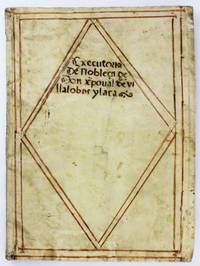
16265681Lima 1626. Still very good. 62 i.e. 61 leaves. Folio. Limp vellum ruled and lettered in ink; edges sprinkled red and black. Some creasing and staining to vellum. Small tissue repair to first leaf of text. Occasional dampstaining and foxing. Accomplished in a highly legible hand. An outstanding and minutely-detailed colonial Spanish patent of nobility accomplished in Lima in the early part of the 17th century and illustrated with two full-page coats of arms. This patent was commissioned by one Cristóbal de Villalobos y Lara corregidor or mayor of the Province of Yampares a province in Bolivia in the Department of Chuquisaca. The office of corregidor was a municipal position although the office holder was also required to assist the army in times of war. Among the many duties of this position were to promote and to carry out all manner of public works maintain health standards and the police force verify weights and measures avoid contraband and prohibited merchandise and in general observe and impose commercial standards. The patent of nobility was a highly formal official document which not only confirmed the noble rank of the recipient but also could grant certain privileges commensurate with rank. As a result the form was highly stylized structured and often quite lengthy -- the text of the present example runs to nearly 120 pages and traces the lineage of Villalobos y Lara for generations generously assessing his claims to nobility. The outstanding features of the document are the two full-page illustrations of the new nobles' coats of arms on the initial two leaves accomplished in gouache and gilt. Each shield features differing emblems in four quarters lies on a folial background and is headed by a knight's helmet. The second illustration also features a depiction of St. Sebastian and a knight on horseback who is trampling what appear to be smiling peasants. Patents of nobility from colonial Spanish America from this early date are very rare on the market and the present example has survived in fine condition. unknown
1667J1876Paris, de l'Imprimerie Royale, 1667 ; in-4, 6-280 pp. (manque lapp. de faux-titre), reliure entièrement restaurée plein cuir, (vrai-dos) dos orné à 5 nerfs, sauvegardé sur 3 ficelles, plats sauvegardés aux armes d'archevêque [avec les signes distinctifs d'évêque (peut-être Nicolas-Joseph de Paris)] (mors fendus, coiffes usées, pièce de titre avec manque, plats frottés, coins enfoncés, pages de garde en simili), tranches marbrées (traces de mouillure sur l'ensemble des marges, côté gouttière), mériterait une nouvelle restauration, avec sauvegarde. 1ère édition. Antoine Bilain, avocat au Parlement de Paris, mort en 1672, publia cet ouvrage, où il explique les droits et les revendications de la couronne d'Espagne sur la Franche-Comté et des Pays-Bas. En 1668, La France entre en guerre contre l'Espagne et les Provinces-Unis, ainsi que la Suède. La guerre se solde par le Traité d'Aix-la-Chapelle et la France doit rendre la Franche-Comté, mais elle garde Lille, Douai, Courtrai et Charleroi. État moyen.
1700ABC_50128Spain 1700. Contemporary elaborately gold-tooled red morocco sewn on six supports with the corresponding raised bands on the spine the gold-tooling is built up from numerous impressions of small pointillé tools creating a large intricate centrepiece within two detailed frames gold-tooled board edges and turn-ins marbled pastedowns and gilt edges. Folio. With an elaborately decorated letterpress title page the letters of the title are highlighted in blue red gold and silver and are surrounded by a contemporary hand-drawn hand-coloured and highlighted in gold and silver floral frame in the same style as the other floral borders in this work including equally decorated arms of the Echeniques y Aguirres family. All text is set within woodcut borders incorporating the familys coat of arms the borders show two different floral designs which are repeated throughout the work. All borders are vividly coloured by a contemporary hand and highlighted in gold and silver. Rare ejecutorias de hidalguía of the Echeniques y Aguirres family. The work is beautifully bound in contemporary richly gold-tooled morocco and it is handsomely decorated throughout with contemporary hand-coloured borders which are highlighted in gold and silver. Among the most impressive legal artefacts produced in early modern Spain are the ejecutorias de hidalguía royal documents issued when a family had successfully proven its noble status before the highest courts of the kingdom. These richly ornamented works are far more than dry legal records: they preserve genealogies heraldic descriptions testimonies of limpieza de sangre purity of blood and the voices of neighbours and officials who vouched for a familys lineage. They were the final seal that converted a favourable verdict into a binding hereditary right. The present work is dated 24 July 1664 and comprising 233 pages. It opens with a hand-painted title page bearing the family arms and every leaf is bordered with coloured decoration. The Echenique y Aguirre family originated in Erratzu a village in the Baztan Valley of Navarre. Martín de Echenique and María de Aguirre both natives of the valley were the parents of five sons Lorenzo Juan the elder Juan Pedro and another Juan whose activities spread across the Iberian Peninsula. From their home region the brothers established themselves in Madrid Pamplona Seville and elsewhere forming part of the thriving network of Basque and Navarrese merchants.In 1659 the brothers petitioned for their heraldic rights to be formally confirmed. The Rey de Armas Bernardo de Fonseca y Pinto issued an official grant later certified by herald Rodrigo Méndez Silva combining elements from the Errazuriz Echenique and Aguirre lineages. The resulting arms featured the iconic black-and-white chequered pattern of the Baztan Valley enhanced with chevrons gold fields and coloured bands. Although later heraldists noted that this composition was more elaborate than the traditional local arms such embellishment was typical of mid-17th-century grants where royal heralds often produced grander shields at the clients request. By royal order the five brothers were authorised to use these arms freely on seals rings chapels tombs and household objects in this work the arms are displayed on every leaf.It records the full proceedings of the lengthy trial brought before the kingdoms senior judiciary. It opens with the royal heading of King Philip IV followed by the legal narrative of the case heard first by the mayors of the High Court then by the Regents and the Royal Council.The opposing party was none other than the municipal authorities of the Tierra y Valle de Baztán who challenged the brothers claim. The result preserved in this volume was a firm royal recognition of the Echenique y Aguirre lineage as noble in perpetuity.The present work is bound in sumptuous contemporary red morocco its boards covered with intricate gold tooling arranged in the refined pointillé and a petit fers French-inspired style of the second half of the 17th-century. The tooling is reminiscent of the work of celebrated French and Dutch binders like le Gascon only known by this nickname Florimond Badier and Albert Magnus.With a later pencil annotation on the first flyleaf providing a brief bibliographical or descriptive note about the content and significance of the work and stating the year 1657. Pages 232-233 bear the date 24 July 1664 along with the signatures of the royal authorities and members of the Echeniques y Aguirres family page 233 includes a large royal blind stampits verso is covered by a separate piece of paper with a manuscript note presumably by the official issuing the stamp signed by a certain Juan. The front hinge is slightly damaged at the foot of the spine some browning and staining throughout. Otherwise in good condition.l Google Arts & Culture Las ejecutorías de hidalguía; Il congreso de estudios vascos 324; Máximo Diago Hernando "Los hombres de negocios navarros en el Madrid de mediados del siglo xvii: los Echenique del valle de Baztan" Principe de Viana 274 May-August 2019 pp. 925-950. hardcover
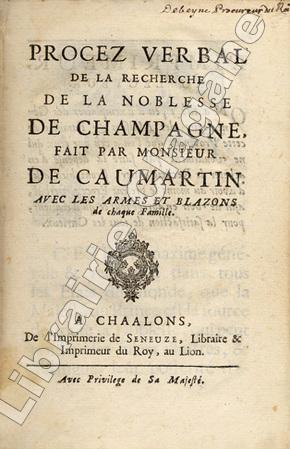
167310661À Chaalons, Imprimerie de Seneuze, s.d. (achevé d'imprimer le 1er septembre 1673) ; in-8 ; plein veau marbré, dos à nerfs décoré et doré, pièce de titre grenat, tranches rouges (reliure de l'époque) ; 160 pp.