33 résultats
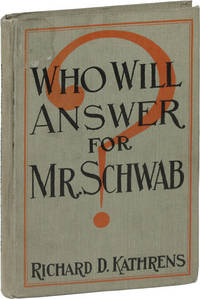
192014043Kansas City: Burton Publishing Co 1920. First Edition. Small octavo 19cm. Cloth boards lettered in red and black; 184pp. Presentation copy warmly inscribed on front endpaper to UMWA President John L. Lewis: "To John L. Lewis Esq / I am with you heart and soul in any honest effort to better the condition of the heroic hardies who work under ground / R.D. Kathrens" dated 1920. Light wear and soil to boards; presentation leaf has been tipped-on to a stub; a few marginal marks in text possibly in Lewis's hand; Very Good. Publishes a series of letters from the author to Charles Schwab who at this time was President of Bethlehem Steel seeking Schwab's support in implementing a sort of "maximum wage" scheme in the United States. Kathrens's letters grow increasingly indignant as Schwab steadfastly ignores his requests for the courtesy of a reply: ".it is hardly consistent with the civilities--as we understand them west of the Alleghenies--to shoo me away or send me to the back door or require me to deal with the servants." Kathrens professes his own sanity and good judgment frequently enough that our sympathies fall firmly on the side of Mr. Schwab. Includes a full reprint of Kathrens' earlier effort The Menace of the Millionaire and reprints other letters to and from Samuel Untermeyer and George W. Perkins. Burton Publishing Co unknown books
188122131Philadelphia: Bavis & Pennypacker Printers 1881. 7 1 pp. Original front printed wrapper present light chipping disbound. Light edgewear. Good. OCLC 50404979 2. Bavis & Pennypacker, Printers unknown books
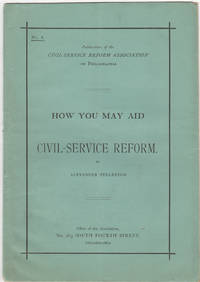
188238710Philadelphia: Office of the Association 1882. First edition. Stitched paper wrappers. Very good partially unopened uncut mail fold contents clean. 14 pp. Sm. 8vo. Publications of the Civil-service Reform Association of Philadelphia.; no. 8;. Office of the Association unknown books
189234668Baltimore: Shaw Bros. Print 1892. First Edition. Small 12mo 15.5cm.; publisher's olive printed wrappers; 19pp. Previous owner has stitched the wrappers to textblock though the upper cover has since separated the stock rather brittle from age and poor quality with a few tiny chips and shallow losses along extremities. Still a Good unfaded copy contents in fine condition. Paper read by the Warden of the Western State Penitentiary in Pennsylvania. This printed version appears to be unrecorded though we do find mention of it in an issue of The Journal of Prison Discipline and Philanthropy from the same year. Wright blames the increase in crime in the United States to the arrival of "unworthy and undesirable immigrants" and argues that the answer is "sterner and more repressive lines" in prison discipline as a deterrant. We find no copies in OCLC as of August 2017 nor in the NUC. Shaw Bros. Print unknown books
2027Philadelphia: G. W. Mentz & Son 1840. . 16mo full contemporary leather worn; partial leather spine label; ownership notation dated 1858 on the verso of the front free endpaper The Appendix the last 131 pp. contains "Formularies for the use of the churches together with rules and orders for the government of the General Synod" pp. 46-48 of the first pagination Philadelphia: G. W. Mentz & Son, 1840. hardcover books
197114621Washington: USNSA United States National Student Association 1971. First Edition. Octavo 23cm. Original printed wrappers; 298pp. Ownership signature to front cover and title page; mild external wear and soil; Very Good. Collection of essays on educational reform including contributions by Carl rogers Rick Kean Gerald Farber James Nixon Peter Marin and others. USNSA [United States National Student Association] unknown books
188647659London: Longmans Green & Co. and Liverpool: The Financial Reform Association 1886. 8vo; contemporary half calf over marbled boards with red morocco spine label; front and rear boards detached inexpert repairs made made with buckram but contents are clean and sound; good. <br/><br/> Longmans, Green & Co. and Liverpool: The Financial Reform Association hardcover books
199099233Accra: Ghana Law Reform Commission 1990. 10p. 7.25x9.75 inches very good in original stapled decorative wraps. Ghana Law Reform Commission unknown books
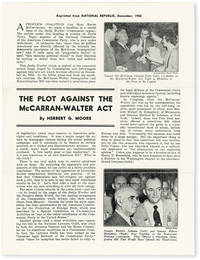
195251262Los Angeles: Freedom Clubs 1952. Offprint. Quarto 11" x 8-1/2"; bifolium; 4pp. Two horizontal mailing folds as issued else Fine. Reprinted from the December 1952 issue of the National Republic. Right-wing attack on attempts to block passage of the McCarran-Walter Immigration Act which established immigration restrictions in order to ". safeguard the country from communism "Jewish interests" and undesirables . deemed as external threats to national security" REF: Marinari. "Divided and Conquered: Immigration Reform Advocates and the Passage of the 1952 Immigration and Nationality Act." Journal of American Ethnic History vol. 35 no. 3 Spring 2016. Freedom Clubs unknown books
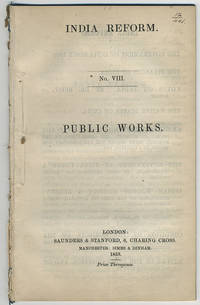
185315278London: Saunders & Stanford; Manchester: Simms & Diham 1853. Small 8vo. 1 f. 47 1 pp. 1 f. <br><br>In the society's series: "India reform" this being number 8. Condemnation of deteriorated infrastructure during the first 20 years of British rule. Uncommon. <br>Â Â Â Â <br>Â Â Â Â NSTC 2I1607 & 2I1608 for the series. Removed from a nonce volume. Good condition. Saunders & Stanford; Manchester: Simms & Diham unknown books
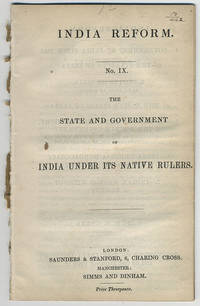
185315279London: Saunders & Stanford; Manchester: Simms & Diham 1853. Small 8vo. 40 pp. <br><br>In the society's series: "India reform" this being number 9. Library of Congress attributes authorship to John Sullivan. Condemnation of British assumptions that regarded native rule as evil and wrong. Uncommon. <br>Â Â Â Â <br>Â Â Â Â NSTC 2I1607 & 2I1608 for the series. Removed from a nonce volume. Good condition. Saunders & Stanford; Manchester: Simms & Diham unknown books
190473808Washington 1904. Paperback. Good. 19p. Pamphlet. Disbound removed from a bound volume. No separate wrapper present. 23cm. Stitching gone. 58th Congress 2d Session. Document No. 150. <br/><br/> paperback books
193715340New York: G. P. Putnam's Sons 1937. First Edition. Octavo 21cm. Orange cloth 336pp frontis photographic plates; pictorial dustjacket. Boards soiled and faintly dampstained on upper one-third of rear board; uncommon jacket is present; price-clipped with moderate overall wear and soil with dampstaining and clear tape remnants visible on verso. Internally clean tight and unmarked; Good to Very Good overall. A critical examination of child labor practices in America. Well-illustrated with photographic plates depicting young children in harsh working environments as well as portraits of politicians and activists associated with child labor laws. Uncommon in jacket. G. P. Putnam's Sons unknown books
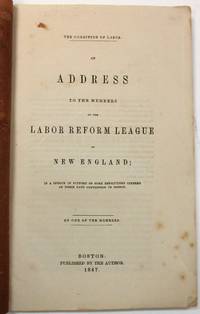
184728539Boston: Published by the Author 1847. Original printed wrappers stitched 32pp. Wrappers chipped repair to front wrap no text loss else Very Good.<br/><br/> An early scarce and unusual radical critique of American capitalism. Apologists for Negro slavery would echo this New England condemnation of the free labor system. The author says wage labor in America is "worse than things at the South."<br/> The League attributes "the evils which oppress and burden the men and women of New England" to "a vicious social organization." America is "but one remove from.the Feudal state. Labor and capital are in direct antagonism. Or rather that labor is passive while capital wages a ceaseless war a guerilla war at least upon it cutting off its resources whenever it is possible. Instead of standing upon an equal footing with capital and being able to treat with it upon an equal basis it stands in the market-place like a slave." The author and the League urge the "Organization of Labor and the Association of Laborers whereby they shall work for themselves and not for another and receive the Profits of their own Labor." <br/>Sabin 15187. Goldsmiths'-Kress Library of Economic Literature 35408.16. OCLC locates ten copies under several accession numbers as of January 2021. Published by the Author unknown books
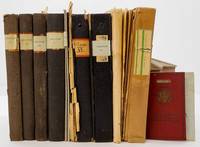
3080Together seven three-ring binder notebooks binders worn boards on vol. VI broken off -- retained by us as out of "respect du fonds" -- containing approximately 876 typescript and manuscript pages. TOGETHER WITH: 29 file folders of articles ideas proposals and miscellaneous publishing materials consisting of approximate 300 typescript and manuscript pages housed in a new Hollinger box. TOGETHER WITH: two of Lasker's passports 1921 and 1926 and a large b/w studio portrait photograph undated. An important discovery. This is the private largely unpublished literary archive of the noted social reformer Bruno Lasker 1880-1965 containing well over a thousand pages of typed and hand-written manuscripts. These writings date from 1923 until the year of his death in 1965. Lasker's social work is well known and concerned racial prejudice and justice trafficking and human rights immigration and immigrants' rights poverty in America and economic inequality. The present literary archive is hitherto UNKNOWN; without it a full and balanced assessment of Bruno Lasker's life and work cannot be undertaken. <br/><br/>That the materials herein are mostly unpublished is attested by Lasker's own statement in the first of seven folio notebook diaries named "Reflections." In addition to the "Reflections" the archive also contains working typescripts of 29 essays speeches and proposals including 19 writings which were evidently destined for a collection to be entitled "Rational Sympathy" that never appeared. It is instructive to present the transcription of Lasker's handwritten "To My Executors" in its entirety which appears in the seventh and final volume of his "Reflections" diaries:<br/><br/>"This is the seventh volume of what might be called a diary though entries never were made with the frequency suggested by that term. It consists of original reflections observations and discussions suggested either by experiences by reading or by verbal colloquies. Only a minute portion of this material therefore has ever entered into literary use i.e. publication and the bulk of it constitutes a continuous though not intentional progression of my major concerns sentiments and ideas over a large part of my life. Or rather it constitutes a collection which represents my un-professional pre-occupations sic. Those connected with my work are more likely to be embodied in memoranda articles prefaces book reviews reports and lectures. These are for the most part either on record as printed documents or in the parallel series of binders much larger in number which has now reached vol. XXX which I call my workbooks and which properly form an appendix to my recorded autobiography made for the Oral History Project at Columbia University and will be deposited with it in the archives of the Butler Library of that institution. NOTE: the 30 volumes were indeed deposited at Columbia University -- Bruno Laster Papers 1923-1951.<br/><br/>"The present collection or diary therefore is unpublished literary raw material and on my decease may either be handed to some interested person to be mined for items worth preserving perhaps even for the production -- such as I contemplate myself if I should find myself with enough time energy and self-confidence for such a task -- of an unpretentious volume or two of short essays or may also be appended to my MSS autobiography at Columbia University. Seattle May 8 1957. signed Bruno Lasker."<br/><br/>Lasker "Reflections" diaries were written for an audience of just one person: himself. It is clear that again and again Lasker turned to the writings herein for inspiration as is attested by other materials in the present archive SEE FINDING AID. As a social commentator Laske was erudite and penetrating. He observes and elaborates on an unusually broad array of topics SEE FINDING AID and have found ourselves continuously impressed by his intelligence imagination introspection and his command of the English language. The personal nature of the diaries is attested by just one poignant passage in Vol. I namely the entry dated July 26 1925 which in its entirety consists of 18 paragraphs:<br/><br/>"Yet but two weeks ago everything seemed so plain; I had the sensation of knowing that all was right that I was encircled by an all-loving power that there was in the world an all-seeing eye comprehending everything comprehending everything there is from the beginning to the end of time that nothing was impossible and therefore nothing pre-determined. I must have known or at least I must have been overpowered by consciousness that the being of this overarching trinity of power was knowable even though I could only see a glimpse of it afar. And that consciousness did not come to me in a state of dreaming but in one of those rare states of unusual clarity when the mind leaps unimpeded over chasms of difficulty. For days after I walked as one who had seen as one who thought he saw -- and then gradually the light grew dimmer and I saw no more. <br/><br/>"Yet even in this returning blindness I do not feel as one utterly lost neither worried nor sorrowful; for what I have glimpsed once I know I shall glimpse again and from that lighted cave I shall proceed to other caves as yet unexplored."<br/><br/>A sample passage from the same volume of "Reflections" on a very different topic: <br/><br/>"These suburban and small-town Negroes are magnificent. They dress well without garishness; their children are clean and well behaved; they are courteous without being abject -- above all they are available for any odd job that needs doing whether it be an extra hand in the kitchen on Jane's wedding day the cleaning of a gutter the hauling of a load of gravel or voting hansome sic Herman into office as overseer of the poor. The question is how long will they remain contented with the modest roles we have assigned to them How long will it be until their bank savings will make them independent of contractors and tradesmen who overcharge them of housewives who too openly and sneeringly despise them of landlords and industrialists who exploit them<br/><br/>"Another question is how long will it be until the white Americans with their insane pride in an imaginary Nordic descent will realize that the annual addition to the population they have denied to east and south European peoples or part of it is being made by a race which they deem even lower in the scale of human values" <br/><br/>FINDING AID:<br/><br/>Reflections Vol. 1: January 24 1924 to September 8 1925. Ca. 120 pp. numbered 1-112 with "Rough Index" manuscript; topics include -- but certainly are not limited to -- telepathy surplus wealth the social worker's dilemma assimilation and language the Americanization of the Iroquois Goethe's botanical writings popular fiction "My Reputation for Wit" habits and survival poverty prejudice measure of civilization "If This Be Treason" suggestions for authors world friendship beauty and illusion sex interest American manners wage-slaves substitution for war mechanics and divinity whimsical news seeing cities international credit sanctity of the home childhood reminiscences "Natural Science" Bible reading Bragdon's "Four Dimensional Distances" suffering for an ideal man-made trouble tradition the failure of Christianity the deteriorating environment and climate change Europe's race overpopulation the character of race the Christian church idealists' fractured man "Go and Sin No More" beauty of landscape workers' participation baby language erotic theology self-government for India "Das Heilige" liberation of youth a suction theory of population suburban and small-town negroes white Americans and much more. <br/><br/>Reflections Vol. 2: September 9 1925 to July 12 1926. Ca. 92 pp. numbered 113-205 with "Rough Index" manuscript; topics include -- but are certainly not limited to -- jaywalking "Nibelungenlied" social observations patrician cultures contract and conduct moral unrest in modern life "Religious" architecture the Golden Rule Holy Communion Christian dynamic intuition and experience internationalism America's mental age the 18th century stray thoughts stray observations friendliness and mechanism teaching internationalism social workers and the churches dishonesty Tompkins Square dramatic value of absence stature and experience claims of the church reading habits sex relations cultural heritages the Cleveland Madonna Christianity life and breath philanthropists the absurdity of female models as ideals of beauty and much more. <br/><br/>Reflections Vol. 3: August 10 1926 to March 23 1928. Ca. 130 pp. numbered 206-334 with "Rough Index" typed; topics include -- but are certainly not limited to -- theory of chance pluralism and free will fantastic eugenics comparison with Rome laws of life neighborhood as sociological museum an outline for a comedy bias of "scientists" Dewey on animal experimentation unreality of Jewish ideals Freud: Beyond the Pleasure Principle Freud's scientific courage Mozart and Jazz stray thoughts sacrifice of racial and cultural heritage necessary real sex problems of today that of normal folk El Greco and Van Dyck Fiction: a bridge between folkways and new understanding Broadway: a vain search for life Bach and the inferiority complex the future of music the absurdity of War Departments of Government the neighborhood playhouse public celebrations and rites modern music diet and internationalism sport and commercialism acting and the Kinema sic the "Modernistic" home kinetic aims in painting fear of religion art criticism in America conflict of creative and possessive impulses popular reactions to cleverness in the arts and much more. <br/><br/>Reflections Vol. 4: April 28 1928 to January 30 1934 and June 25 1934. Ca. 138 pp. numbered 335-473 with "Contents" in manuscript / partially typed; topics include -- but are certainly not limited to -- immortality A.E. Housman socialism in a new world free will the new industrial revolution and land values progress and vandalism choral music "Can We Change Human Nature" ethics and aesthetics continuous social registration cultural conservation ribaldry Ruth St. Denis: Symbol of Vandalism dynamic architecture dream cities enlarged horizons and morality superstition satire the "Medea of Euripides reflections at fifty hypocritical liberals science and consciousness "Rome is Burning" notes for a play "Ancient Sound" notes for a play common sense may be nonsense why radicals have long hair "Are Canaries Cheerful" ventriloquists in the pulpit life without sentiment social work as a profession gardens "C'est l'heure" aerial surveys a dream "Most people would rather have footmarks around their grave than flowers" museum policy new problems of wealth social theory and social practice our concern with techniques the Last Judgment severity of colonial powers a Christmas card blessings of poverty sic notes for sociological studies extremists fashions and new wealth from a future textbook of literature "What We Confront in American Life" notes for a speech two news films the greatest luxury Germany: a nation in flight the sense of guilt the immoral science what is "social" reform social re-education obeying traffic signals party principles the need for laughter and much more.<br/><br/>Reflections Vol. 5 according to the "Advertisement" laid into Reflections Vol. 1 was "unfortunately mutilated apparently to provide the main substance for one or more projected volumes of essays": April 18 1936 to July 19 1936. Ca. 14.5 pp. numbered 96-111 with typed "Contents." NB: Lasker writes: "Pages 1 - 96 consisting of observations and reflections in Eastern Asia in 1935-1936 mainly China Japan Java but also including Malaya Indochina Philippines and sea voyages have been incorporated with the documentary material appended to the typewritten record of the tape-recorded autobiography made by the Oral History Project Columbia University and to be deposited in the archives of the Butler Library of that University 1957. No literary use has been made of that material; but since it is largely reportorial and perhaps rather unique because of its informal character and aesthetic as well as sociological appreciation of things seen it seemed more appropriate for preservation in that connection than for the possible implementation of future reflective lectures or articles. ~ BL." Lasker also writes: "The diary pages following p. 111 are temporarily mislaid" as of January 1957 these are not known to have survived. Topics include American symphonic music in our time Common sense and universally valid knowledge Patriotism The intimacy of Oriental art symmetry in art the precariousness of the present peace expensive vulgarity dogmatism in "factual knowledge" and literacy and propaganda.<br/><br/>Reflections Vol. 6: January 31 1937 to October 31 1952 sic. Ca. 187 pp. numbered 1-187 with "Contents" in manuscript / partially typed; topics include -- but are certainly not limited to -- socialism and aristo-democracy authoritarian education age composition of the Supreme Court feminine beauty boys' clubs as citadels of capitalism institutional philanthropy and the relief of suffering on breaking a cut-glass dish understanding the self-sufficient cultures of Germany and Japan on getting wet with two raincoats selection as a creative process in art visual unreality in America eggs in modern literature notes for an article our lessening dependence on land surface "God knows" the cross on Mt. Davidson industrial unionism reflections in a library "The limited edition is a parasite that flourishes where literature is in decay" landscape with a figure desire for survival Bruckner's Fourth Symphony antisemitism and the Jewish future invention and war sexual promiscuity translation from Victor Hugo reducing college admission failures of American social science training reflections on Easter marriage for life impressionism and peace America's 20th-century Chinoiserie Bibles are dangerous Catholic priesthood a subway ride and the shadow of the third World War "Who are the Slum Dwellers of Today" experimental art free enterprise love of children walnuts and class government the poison of advertising fear of books satiety epic follies "The Fur Coat" outline for a short story loud song loud color the blight of old age the Russian communist a young priest Descartes' idea of God loneliness in a crowd freedom of women "Career" an outmoded concept prohibition of firearms thrift early morning things rarely seen an old man's joys efficiency expert revolutionary fanaticism death in a hospital "private room" American humor and much more. <br/><br/>Reflections Vol. 7: January 3 1953 to June 25 1965. Ca. 195 pp. numbered in 1-31 32-195 with typed "Contents" and instructions "To My Executors" in MS see transcription; topics include -- but are certainly not limited to -- Stalin's divinity and my own theories of probability Nicolai Hartmann's ontology of a stratified universe the vanity of "saints" Tristan and Iseult and the temper of medieval life childhood memories and religious conversion Milton's "Paradise Lost" the measurement of happiness crime and business classical perfection childish innocence and imagination in literature a squashed mosquito Boethius and prophecy the moral dilemma of our time: support for the stand of J. Robert Oppenheimer an old man's dreams: their moral significance love and morality the future of socialism national defense Salvator sic Dali's "Crucifixion" looking at life through the sun-glasses of prejudice the dream of human flight uniformed women youthful marriages the right to live cultural decay loneliness fatalism "Pictures that have influenced my life" Ruskin the American standard of living teaching science widowhood and its terror Trotsky's diary the burden of memories social change without revolution: the American home our decaying speech habits a reasonable view of death friendship and spiritual growth "Come Nearer Death" and much more. <br/><br/>ADDITIONAL TYPESCRIPTS / MANUSCRIPTS: 29 file folders preserved in a Hollinger box together with Bruno Lasker's 1921 U.S. passport featuring a signed photograph Lasker as a 41 year-old man; his 1926 U.S. passport; and a large undated b/w photograph of Lasker as an elderly man.<br/><br/>"Notes for Articles and Unfinished Articles":<br/><br/>1. Pragmatism and Prophesy 1927 see also Rational Sympathy IX<br/>2. By a Javanese Roadside<br/>3. Goethe: the Poet as Botanist<br/>4. Social Work and Social Forecast 1929 for a speech at Smith College <br/>5. The Marriage of Heaven and Hell notes for a one-act play<br/>6. Village of a Thousand Mandarins Pearl River Delta 1941<br/>7. Why Porcelain is Called China 1928<br/>8. The Youth Movement of Germany 1921 and 1924 for Survey Graphic journal<br/>9. Some Observations on Harlem 1924 for Survey Graphic journal<br/>10. A Philosopher on the Fifth Avenue<br/>11. The Good Life: prospectus and proposal for an ethics magazine social ethics social education 1929-1931<br/>12. Conflict of Values<br/><br/>"Notes on Diary and Other Material for Possible Book Use": <br/><br/>13. "Go and Sin No More": Pages from a Sociologist's Diary -- plans for publication of materials from "Reflections" vols. 1-6 SEE BELOW<br/>14. Misc. Publications Files: Upcoming Projects and "Manuscripts in Hand"<br/>15. Fugues: Studies in Life's Counterpoint 90 pp. for the Survey journal<br/><br/>"Rational Sympathy and Other Essays" Manuscript / Unfinished Book 1952<br/><br/>16. Man's Changing Universe<br/>17. The Combat of Superstition<br/>18. Fear of Religion<br/>19. This Talk about Spiritual Dynamic<br/>20. Individual and Society / Self-Indulgence and Discipline<br/>21. Thoughts on Immortality I<br/>22. Thoughts on Immortality II<br/>23. Pragmatism and Prophecy<br/>24. On the Sharing of Food<br/>25. The Philanthropist<br/>26. Humility: True and False<br/>27. Fidelity and Honor<br/>28. Published articles 1927-1946<br/>29. An Old Man Speaks. <br/><br/>Lasker defines and refines the fascinating history and sweeping contents of the "Reflections" series for some future reader on a typed "Advertisement" sheet laid into Vol. 1. It bears repeating in full: <br/><br/>"This series of seven manuscript volumes - the fifth unfortunately mutilated apparently to provide the main substance for one or more projected volumes of essays "The Good Life" "Science and Religion" etc. - started as a journal or diary. But in the course of time the entries became fewer and longer; and it seems to me that the new title " Reflections" with which I am now relabelling these binders is more appropriate. <br/><br/>"This series was preceded by other - handwritten - diaries one or two may inadvertently be preserved together with a thin paper cahier of carbon-copied early letters home from London in my green sailor's chest. These early diary entries are in part excessively sentimental and betray a highly emotional attitude toward my experiences and observations in my early twenties. And even up into the thirties for I distinctly remember a piece written on the birth of my daughter which I later have read with astonishment. <br/><br/>"Although it began as a diary and continued as a more or less conscious endeavor to preserve some of my passing thoughts for potential further literary uses this series in the main has been in my mind a substitute for lacking opportunities to express myself in writing on matters of intensive though passing and unprofessional interest. I wrote each piece - usually late at night or in hours of uninterrupted leisure at home - as a sort of editorial addressed to just one reader my future self. The occasions which stimulated such writing ranged from personal experiences to things seen and heard but more and more came to be dominated by my reading in many fields. Many of them carry on a sort of dialogue with some author or other not always in stark disagreement with his views but more often in admiration for him but somehow feeling urged to stress some aspect of the matter which to me he seemed to have neglected or perhaps misinterpreted. In this way I have managed through the years to retain my status in my own eyes at any rate as a writer and social student fully conscious though I have been at all times of my lack of skill and literary grace. <br/><br/>"This attitude on my part more fully revealed itself to me when I tried on various occasions spread over many decades to collect some of these minor essays for publication as contributions to some particular field of interest such as the change in moral standards the survival of a truly religious faith when all superstitions have been thrown out of one's conscious awareness of the personal relation to the cosmic forces and so forth. The task it always appeared was beyond my capacity - not because of insuperable technical difaculties but simply because these spontaneous and previously uncorrected entries were too clumsy too half-cocked and sometimes too dull and verbose to lend themselves to rewarding further manipulations - and to publication in any form. In part too intimate and in part roaming over too vast a region of concerns in which I needs must remain an errant amateur traveller these pages essentially remained either intellectual exercises of insufficient substance to be of interest to anyone but their perpetrator or else too way moody to represent even the writer's own thinking about the subject at issue under conditions other than those which had stimulated the initial effort at self-expression. <br/><br/>"That the entries gradually peter out is not so much a result of lacking enterprise or mental energy as of the fact that in recent years I have used another outlet for many of my cogitations and reflections: the notes appended to my collection of abstracts on Prophetics - a theme so large as to invite comments on my part on the widest range of topics. -- July 1 1962 Bruno Lasker."<br/><br/>The present archive contains Lasker's own design for a possible publication of selections from the "Reflections" SEE FINDING AID Hollinger box folder 13. The title of the proposed work is "Go and Sin No More: Pages from a Sociologist's Diary" alternate title: "Looking at Life: Chosen Leaves from the Diary of a Sociologist to 1950." A truncated version of Lasker's outline follows:<br/><br/>Introduction<br/>I. Faith and Knowledge / On Human Worth<br/>II. Rational Sympathy / Family<br/>III. Conflict of Values<br/>IV. Contact and Conduct<br/>V. Moral Attitudes / Crime<br/>VI. Morals and Taste / Parables<br/>VII. Citizenship<br/>VIII. Social Reform.<br/><br/>COLUMBIA UNIVERSITY BRUNO LASKER PAPERS: These were donated by Lasker himself in 1965 includes "further material on Mr. Lasker's history of his life career namely material covering the period 1957-1965 and material for his Study of Prophetics. The latter group -- the result of several decades of accumulation -- deals with conditions psychological and physical methods history and case studies of prediction. It comprises some 5000 pages in 33 binders of abstracts and comments; an index of abstracts by names topics and sub-topics; notes for a substantial bibliography; printed and manuscript materials; and the typed draft of an unpublished book 'Dates of Destiny'" SOURCE: Columbia University Columns XV:1 1965 pp. 40-41. <br/><br/>PARTIAL BIBLIOGRAPHY MONOGRAPHS: <br/><br/>Bruno Lasker Race Attitudes in Young Children 1929 one of the first to challenge notions of innocence race and "color-blindness" in young children <br/>-----. Human Bondage in Southeast Asia 1950 a classic study of the evolution of dependency in the history of human -----. Changing standards of living in South China as affected by overseas migration 1935<br/>-----. Japan in jeopardy 1937<br/>-----. Living on a moderate income; the incomes and expenditures of street-car men's and clerks' families in the San Francisco bay region 1937<br/>-----. Populations adrift 1941<br/>-----. Problems of the Pacific 1931<br/>-----. Propaganda from China and Japan: A case study in propaganda analysis 1938<br/>-----. Standards and planes of living in the Far East; a guide to discussions of postwar changes and prospects 1953<br/>-----. Books of Southeast Asia: a select bibliography 1956<br/>-----. Asia on the Move 1945<br/>-----. Peoples of South-East Asia 1944<br/>-----. Filipino Immigration to Continental United States and to Hawaii 1931<br/>-----. Jewish Experiences in America 1930<br/>-----. With B.S. Rowntree. Unemployment in York UK: a social study 1911.<br/><br/>PROVENANCE: Estate of Russell Johanson Ravenna Rare Books Seattle. unknown books
1736692621736. London 1736. Fourth & final edition. London 1736. Fourth & final edition. "Evasions Tricks Turns and Quibbles" Legal Criticism. Law Reform. Great Britain. Law Quibbles: Or A Treatise of the Evasions Tricks Turns and Quibbles Commonly Used in the Profession of the Law To the Prejudice of Clients And Others; Necessary to be Perused by All Attornies And Those Who Are or May be Concerned in Law Suits Trials &c. To Avoid the Many Abuses Delays and Expences Introduc'd into Practice. With Abstracts of All the Late Statutes for Amending the Law Relating to Attornies Arrest and Bail Bribery Forgery and Perjury Juries Justices of Peace Prisoners in Execution Law Process Rents of Tenants &c. Under the Proper Heads. And an Essay on the Amendment and Reduction of the Laws of England And a New Proposed Act of Parliament For a Thorough Regulation of the Practice of the Law. Corrected and much Enlarged. To Which is Now Added a Second part Containing Every Curious Precedents of Conveyances in Extraordinary Cases; Likewise Proceedings and Precedents in Chancery And at Common Law in English; With Law-Notes Thereon. London: Printed by E. and R. Nutt And R. Gosling 1736. viii 72 132 135 13 pp. Octavo 8" x 4-3/4". Later quarter calf over cloth raised bands red and black lettering pieces and shelf label to spine blind-stamped institution name and small security tag to front board endleaves added. Moderate rubbing to extremities heavier rubbing to spine with some chipping to ends. Moderate toning to text slightly heavier in places light foxing to a few leaves "14821" in tiny hand to head of title page institution stamps to foot of title page endleaves and edges of text block. $200. Fourth and final edition. First published in 1724 with later editions in 1726 1729 and 1736 this book offers advice with concise examples and citations. Topics are listed alphabetically. This is followed by a hortatory essay on the laws of England with suggestions for legal reform. The New Propos'd Act of Parliament listed on the title page is not in fact included in this work all editions. All editions of this work are scarce. English Short-Title Catalogue T94359. unknown books
197017644Washington DC: NORML Circa 1970s. First Edition. Very good. Three buttons two 1.25" diameter and one .5" diameter. Match book 2" x 2.25" approx. Touches of toning and edgewear very good overall. <br/><br/>Collection of souvenir ephemera from NORML the marijuana advocacy organization founded in 1970. NORML unknown books
1996183829Boston: MASS CANN / NORML 1996. 13x19 inch poster green purple and black design on white background very good. Poster design by Gary Grimshaw. At top: "No more prisoners! End marijuana prohibition!" Speakers included John Sinclair Mel King Steven Hager and others and well as seven bands. MASS CANN / NORML unknown books
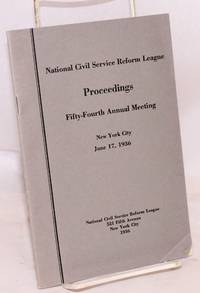
1936144587New York: National Civil-Service Reform League 1936. 31p. slightly worn wraps. The group takes aim at partisan mismanagement of civil service branches. National Civil-Service Reform League unknown books
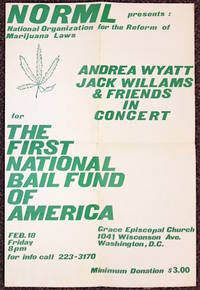
1972211726Washington DC: NORML 1972. 12.5x18.5 inch poster neatly folded into quarters for mailing address and cancellation on the blank verso with remnants of tape. NORML unknown books
185256007Boston: Bazin & Chandler printers 1852. 8vo pp. 22 2; original salmon printed wrappers; very good. Includes a list of officers honorary members and the society's constitution. Sabin 52684. <br/><br/> Bazin & Chandler, printers unknown books
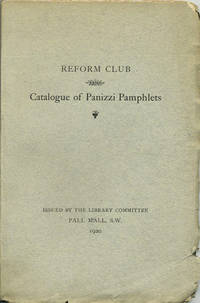
192040054London: Library Committee 1920. First edition. Paper wrappers. A very good copy wrappers edgeworn soiling on corners to a few leaves occasional marginalia. 58 pp. 8vo. Collected by Sir Anthony Panizzi and presented to Louis Fagan who presented them to the Reform Club in 1880. Library Committee unknown books
193146420New York: Macmillan Company 1931. First Edition. Octavo 22cm.; publisher's maroon gilt-lettered buckram blue-green printed dust jacket; vii7318pp.; photographic frontispiece eleven leaves of photographs printed on rectos and versos. A hint of shelf wear to cloth extremities endpapers toned bottom corner of upper jacket flap clipped though upper corner retaining original price of $3.50 shallow chips along jacket extremities most notably at spine ends spine additionally a bit toned with brief soil spot at foot not affecting cloth binding else Near Fine in a Very Good copy of the scarce dust jacket. This work the result of a year-long study of penological practices across the globe from the criminal tribes in India Japanese penal institutions and the Parchman prison farm in Mississippi. John L. Gillin 1871-1958 was president of the American Sociological Association and showed little qualms at Parchman Farm's use of the strap as a disciplinary practice. Macmillan Company unknown books
189934303Chicago: The Reform Advocate 1899. <br><br>The special supplement of 21 January 1899 i.e. Vol. XVI no. 23 of this Jewish newspaper celebrating the event detailed in the title. Original illustrated wrappers. Folded horizontally. Little dog-earing. Very good. Yes with lots of advertisements. The Reform Advocate unknown books
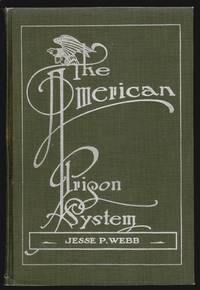
192014968Salem Oregon: Printed for the author at the Oregon State Penitentiary 1920. First Edition. Hardcover. Fine. 262 pp. A fine copy in original cloth. Webb spent ten years incarcerated at the Oregon State Penitentiary providing him with more than sufficient material for this reasoned and well written critique. He argues that the prison system is purely punitive and utterly fails to rehabilitate prisoners: "Every prison is a school for crime.As a rule instead of prison changing the convict to an honest man it makes him a more vicious man. It generally destroys the little good character he has left." He identifies failures in the legal system sentencing prison employment programs and attempts at rehabilitation through religion. Although ultimately "more is expected of prisons than they can possibly fulfill" and other social reforms are needed to address the problem of crime Webb still believes that serious attempts at rehabilitation are worthwhile. "Force prisons out of politics and place men in charge who understand humanity. For of all tasks there is no greater than that of remaking men." Printed for the author at the Oregon State Penitentiary hardcover books