[ECONOMIC REFORM] [WADE, John]Biblio.com
53 résultats
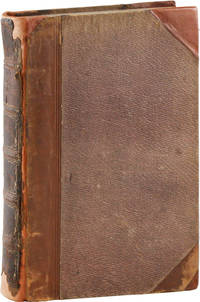
183156386London: Effingham Wilson 1831. Octavo 22.5cm. Later half brown calf purple cloth over boards and subsequently rebacked with brown calf reinforcements to corners top edge stained other edges sprinkled red; orange endpapers; xx576pp. Lacking frontispiece. Externally worn but skilfully repaired internally clean with occasional spots of foxing: Very Good. <br /> <br /> A key text of early nineteenth-century English parliamentary reformers: "a massive compendium of all the abuses electoral ecclesiastical legal" that they "sought to abolish. . . its emphasis on the need to have practical as well as equitable representation lies at the root of parliamentary democracy." The book "passed through edition after edition continually augmented with new arguments new reports of abuses and new statistics"; this 1831 edition "was the most influential coming as it did on the eve of the Reform Bill 1832" Printing and the Mind of Man p.180. PMM296. GOLDSMITHS 23071. KRESS C.638. Effingham Wilson unknown
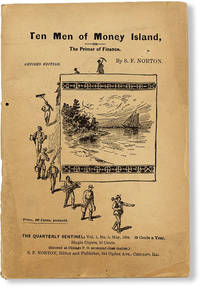
189448920Chicago: By the Author 1894. Revised Edition. 12mo 20cm; original pictorial wrappers stapled; 931pp; illus. Text is tanned and a bit brittle at the edges neat splits to front wrapper above and below the staples with several tiny tears and a few slivers missing from wrapper extremities particularly at preliminary and terminal leaves; Good complete copy. A tax reform utopia originally published serially in the Chicago Sentinel between 1879 and 1885. An author's note at base of title page states: ".it was then published in cheap pamphlet form - of which over a hundred thousand copies have since been sold. Its popularity as an educator seems to warrant the present better and more expensive edition." Issued as Vol. I no. 1 in Norton's Quarterly Sentinel apparently a successor to his weekly newspaper of the same name. No further numbers of the Quarterly appear to have been issued. <br /> <br /> Ten Men of Money Island was variously reprinted even as late as 1930 including editions by Wayland's Appeal to Reason the London utopian publisher Reeves and the Chicago publisher F.J. Schulte. SARGENT p.45 citing only the London ed. Not in Negley or Lewis and not found in Wright. By the Author unknown
1852113934London E. Wilson 1852. 1852 edition. Hardback. A good copy in the original cloth with printed-label to spine. Slight dust-dulling with minor rubbing toning and some light staining. Internally very good. Remains well-preserved overall; tight bright clean and strong. Scans on request. ; 672 pages; Description: 672 p. Subjects: Committee for Reform of the Board of Customs London. London, E. Wilson hardcover
189512571NY: Reform Clulb Sound Currency Committee. Very Good- with no dust jacket. 1895. First Edition. Hardcover. Usual xlib markings. The spine is darkened with wear at the top. Oterwise very tight & clean internally. ; Ex-Library; 8vo 8" - 9" tall; 508 pages . Reform Clulb Sound Currency Committee hardcover
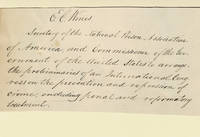
1871100858<p>circa 1871-72. 1871-72. Very good. - Over 35 words by the American Congregational minister and prison reform advocate listing his credentials under his signature penned on a 4-1/8 inch high by 8-1/4 inch wide sheet of paper. Signed "E.C. Wines" above his credentials "Secretary of the National Prison Association of America and Commissioner of the Government of the United States to arrange the preliminaries of an International Congress on the prevention and repression of crime including penal and reformatory treatment." Once mounted into an album with tape and glue stains on the verso including a spot rubbed raw. There is a tiny tear to the lower portion of the left edge. Very good.</p><p>The American Congregational minister and prison reform advocate Enoch Cobb Wines 1806-1879 served as a pastor in Cornwall Vermont and East Hampton Long Island as well as a professor of languages at Pennsylvania's Washington College. He was appointed secretary of the New York Prison Association in 1862 and subsequently the National Prison Association in 1870. He organized the first international congress on prison discipline held in London in 1871-72.</p> circa [1871-72].
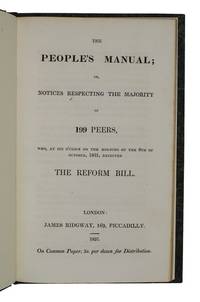
1831AQ30613London: James Ridgway 1831. 32pp. Modern marbled paper boards printed paper lettering-piece to spine. A trifle rubbed. Scattered spotting. The first edition of a register of the 199 members of the House of Lords that voted against the passing of the Reform Bill. A second edition appeared the same year. . First edition. 8vo. James Ridgway hardcover
183284913London: Effingham Wilson 1832. A New Edition Greatly Enlarged and Corrected. Octavo. 23cm. Bound in later rather institutional black buckram with paper title label. 16pp. ads to front matter; xxxii; 683pp. 1pp ads to rear. Minor wear and bumping to extremities with a little rippling of the cloth to the front board strong and tight; internally clean later endpapers ink ownerships to front flyleaf frontispiece portrait "Friends of Reform - Foes of Revolution" quite heavily spotted with some offsetting to the title page edges untrimmed some occasional light spotting within. A very good copy in a later binding of a rather unwieldy work.<br /> <br /> A later printing of Wade's incendiary 1820 catalog of abuses performed by the Church The King the Government and various business interests against the people security and progress of Great Britain. A continued bestseller demonstrating a fervent appetite on the part of the British public to read Wade's excoriating denunciation of the upper classes and their merely wealthy counterparts. On a number of fronts this public airing of secretly dirty laundry met with some political and social success and led to some very public gestures at reform. Effingham Wilson unknown
186276501Philadelphia: Philadelphia Society for Alleviating the Miseries of Public Prisons 1862-1871. First editions. Octavo. Various paginations but all complete. Publisher’s printed green wrappers two issues have had their wrappers reattached a few instances of erosion to spine but never affecting integrity. Overall in very good condition.There were two main series of this publication. The first series began in 1845 under the title Pennsylvania Journal of Prison Discipline and Philanthropy and in 1862 a second or “new†series was begun leaving off the Pennsylvania no doubt in hopes of national readership. It was a yearly publication. This two-series format continued until the journal ceased publication in 1920 after which it was succeeded by what is now known as The Prison Journal. The Pennsylvania Prison Society founded in Philadelphia in 1787 was the first private agency to concentrate specifically on correctional issues. The society's journal was one of the earliest periodicals devoted solely to studies of correction and crime. The articles run the gamut of subjects related to these fields from discussions of penal philosophy to inmate interviews and even down to the brass tacks of the costs involved in running a prison. . The journal not only provides information on prison conditions and the evolution of the American penal system particularly in Pennsylvania but also offers a detailed record of the penal reform movement in this country. They were remarkably foresighted. This can be seen in the following two quotes; "The readers of this Journal need not be told that we are not very sanguine in our expectations of the permanent reformation of the mass of convicts. There are doubtless instances enough of success in such efforts to warrant and encourage them and we are not to suppose that they are ever wholly useless. The true position for us to take is this. The earlier we address ourselves to the cultivation of right principles and habits in a human being the more hopeful is the prospect of success" and this little gem "May we not easily forget that between a score of men in our prison cells and twenty score of men that may be selected from society at large the only difference is that the former are detected rogues and the latter are perhaps greater rogues undetected" It was a bold movement away from prison as a punishing experience toward a kinder belief that prisoners must once again become useful members of society. Philadelphia Society for Alleviating the Miseries of Public Prisons unknown
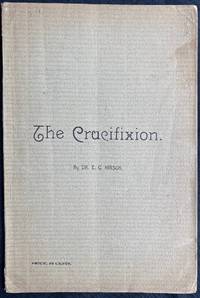
189243449Chicago: Bloch 1892. paperback. 1st edition original printed green paper wrappers 8vo. 49 pages. Singerman 4345. <br> <br> Rabbi Emil G. Hirsch 1851-1923 "who headed Chicago's Sinai Congregation for forty-two years and led Reform Judaism into the Progressive movement and down social justice pathways was born in Luxemburg.<br> One of several Jews involved in founding the NAACP Hirsch was married to the daughter of abolitionist rabbi David Einhorn and served in his father-in-law's former pulpit in Baltimore before moving to Louisville Kentucky and then Chicago. He was professor of rabbinical literature and philosophy at the University of Chicago in 1892 active in the Republican Party and editor of several influential Jewish publications" Lawrence Bush in Jewish Currents<br> "Hirsch and his congregants struggled to come to terms with the large number of Jewish immigrants who moved to Chicago after 1880 boosting the Jewish community from about 10000 in 1880 to over 300000 in 1920.For the established Jews represented by Sinai the Jewish 'Ghetto' - the immigrant neighborhood on the city's West Side - appeared to represent a world apart and a sharp contrast to Sinai's radical and inclusive reform agenda: a highly visible expression of Jewish ethnicity and traditional Judaism which Reform Jews associated with isolation discrimination and exclusion." <br> Nevertheless during the 1890s "Hirsch spoke up against the deplorable condition of Jews in the Russian Empire and reached out to West Side residents. His support for workers' rights also won him much support among Jewish immigrants who overwhelmingly belonged to the working class.<br> "Hirsch worked closely with Jane Addams and other members of the Hull House circle. In 1908 Hirsch and Addams were among the co-founders of the NAACP. Hirsch inspired several members of Sinai congregation: Sears and Roebuck president and philanthropist Julius Rosenwald was one of Hirsch's closest associates so was legal scholar Julian Mack who presided over a widely noted juvenile court in Chicago in the first decade of the 20th century. <br> Hannah Solomon was one of the founders of the organized Jewish women's movement in the United States. Joseph Schaffner and Harry Hart were the leading partner of the clothing manufacturer Hart Schaffner & Marx one of Chicago's largest employers. Influenced by Hirsch's social theology Schaffner and Hart settled with their workers during the 1910-1911 clothing strike recognizing their right to form a union" Tobias Brinkmann.<br> <br> SUBJECT S : Jesus Christ -- Jewish interpretation. Jewish Christ -- Crucifixion.OCLC: 13532781. Light wear excellent condition a beautiful copy Very Good Condition B AMR-2-2-XLF#. Chicago: Bloch unknown
1845547003New York: American Female Moral Reform Society 1845. Unbound. Very Good. Single leaf folded to make eight pages. One quarter of first page toned old folds very good or better. A cursory examination of the contents indicates that the American Female Moral Reform Society weren't very enthusiastic about prostitution. American Female Moral Reform Society unknown
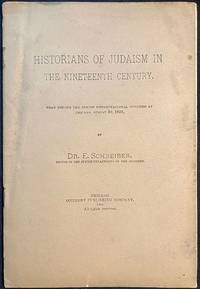
189442366Chicago: Occident Pub. Co 1894. 1st edition. Original Printed Wrappers. 8vo. 28 pages. 23 cm. Singerman 4766. <br> <br> “We have no work like it in the English language. It is a valuable contribution to the literature of the Reform Movement. Dr. Schreiber has acquitted himself remarkably well in performing the difficult task of portraying in biographies the origin and growth of reform in Judaism. The book should be read by every Israelite be he conservative or radical. – Jewish Spectator Memphis†Back cover. <br> <br> The Author Rabbi Emanuel Schreiber was head of the Religious Department at the Occident Publishing Company which published this work and also produced the “Occident Newspaper†no apparent connection to Leeser’s Occident published in Chicago 1873-1896. It was a “weekly radical reform Jewish journal. It was devoted to general news politics literature science art and the interest of the Hebrews of the Northwest….this paper was printed in both English and German†Scott “Newspapers And Periodicals of Illinois 1814-1879.†Urbana 1911. The paper described itself as "The foremost radical reform Jewish newspaper in the world. It is edited by the most eminent writers of today" from the rear cover of this work. <br> <br> Subjects: Jews -- Historiography. Jewish historians. OCLC: 7426681. <br> <br> Some staining to wrappers and occasional text pages paper bright and binding very good very well preserved Very Good Condition Overall. B AMR-43-30-XX-LDBLVRF-'ex. Chicago: Occident Pub. Co unknown
187230317Philadelphia: Published for the Industrial League by Henry Carey Baird 1872. First Edition. Octavo 23.5cm.; disbound from larger volume with remnants of cloth spine still present; 96pp.; frontispiece full-page illus. throughout. Very faint previous vertical fold else Very Good and fresh. The title story is a satirical utopia intended to discredit supporters of laissez-faire economics and the Free-Trade League in particular. LEWIS p. 57; SARGENT p. 29; not in NEGLEY. Published for the Industrial League by Henry Carey Baird unknown
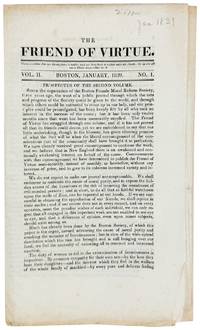
183933043Boston: New England Female Moral Reform Society 1839. Very Good. Boston: New England Female Moral Reform Society 1839. First Edition. Octavo; self-wrappers unopened. 16pp. Toning and creasing to edges with a few minor nicks; about Very Good. <br /> <br /> The New England Female Moral Reform Society's stated goal was the "prevention of licentiousness" prostitution the moral double standard regarding both and protecting young women from the "unprincipled destroyer who seduce and ruin the unsuspecting." Indeed this issue devotes a section to "Street Beggars" who are imposters attempting to lead astray the young and unsuspecting. The paper continues in telling the story of two young women who were led to "a house of ill fame" by one such imposter and were saved from a member of the society and thus saved "from this sink of iniquity. from her 'whose house is the way to hell going down to the chambers of death.'"<br /> <br /> Also of note here is the ongoing "Letters to Sarah E. Grimke" portion of this publication which runs several pages in this issue gently arguing several points regarding the role of women in society. The letter concludes with a post script that the author has just received Grimke's pamphlet "Equality of the Sexes" acknowledges her sincere obligations and urges everyone who reads this publication to also read Grimke's. Scarce in retail. New England Female Moral Reform Society unknown
1840ST20302-02London: Francis Baisler 1840. FIRST EDITION. 195 x 130 mm. 7 3/4 x 5". xi 1 307 1 4 pp. <br/> Publisher's black pebbled morocco covers elaborately decorated in blind with gilt centerpieces smooth spine decorated in gilt all edges gilt gutter between the end of the text and the ads at the back expertly reinforced. With 10 engraved plates including the frontispiece and engraved title. Dedication page with contemporary ink ownership inscription of Wm. C. Drysdale. Noticeable discoloration to pastedowns and flyleaves from binding adhesive plates negligibly foxed otherwise especially clean and fresh internally with only the most trivial of imperfections; the exceptionally clean binding showing virtually no signs of use.<br/> <br/> This collection of essays and verse promoting Protestant thought and values comes in a beautifully preserved Victorian publisher's binding. The editor of this work Charlotte Elizabeth Tonna 1790-1846 was an evangelical Protestant social reformer particularly devoted to exposing poor factory conditions and improving the welfare of women and the poor. Writing under the name Charlotte Elizabeth she made "contributions to social reform literature and her use of the 'Christian Lady's Magazine' as a forum to influence politics through her female readers mark her as a significant nineteenth-century figure especially for other women social reform writers such as Harriet Beecher Stowe . . . and Elizabeth Gaskell." DNB Of particular note in our volume is an essay by Charlotte Elizabeth discussing the figure of Katherine Parr sixth wife of Henry VIII as a model of Protestantism and womanhood. Francis Baisler unknown
1871229841871. Parliament House of Commons. Report from the Select Committee on Protection of Infant Life 1871 documents the development of state intervention into infant care mortality and childcare practices in industrial Britain establishing a foundational record in the history of child welfare law and public health regulation. Produced in response to widespread concern over infant deaths associated with "baby farming" the report supports research into nineteenth-century social reform gender and labor history and the emergence of legal frameworks governing child protection. Its findings informed subsequent legislation including the Infant Life Protection Act of 1872 and later reforms expanding state oversight of childcare marking a significant shift toward recognizing infant welfare as a matter of public responsibility rather than private domestic concern.<br /> <br /> Parliament House of Commons. Report from the Select Committee on Protection of Infant Life; together with the Proceedings of the Committee Minutes of Evidence Appendix and Index. London: Ordered by the House of Commons to be Printed 20 July 1871. First edition. The volume records proceedings of a parliamentary inquiry directed "to inquire as to the best means of preventing the destruction of the lives of infants put out to nurse for hire by their parents." Contents include formal committee findings extensive Minutes of Evidence and appended statistical and documentary material. Testimony from surgeons coroners medical editors and local officials details infant mortality rates across London Lancashire Yorkshire and Scottish industrial centers. Witnesses describe systems of paid infant care including lump-sum "adoption" payments and weekly nursing arrangements that enabled maternal wage labor alongside accounts of infants transferred "generally immediately after birth" to low-cost nursing establishments. The report analyzes financial structures secrecy in lying-in houses and disparities in care tied to poverty and illegitimacy. Discussions within the proceedings reveal tensions between criminal law enforcement Poor Law administration and emerging public health authorities while tabulated data and narrative testimony together document patterns of neglect mortality and institutional response.<br /> <br /> The material documents the system of early child welfare regulation through parliamentary inquiry medical testimony and statistical evidence revealing how infant care practices were scrutinized categorized and brought under state oversight and providing primary-source evidence for the study of legal intervention in family life the expansion of public health governance and the consolidation of parens patriae authority. Issued at a time of accelerating industrialization and urban poverty the report demonstrates how gendered labor economic precarity and unregulated childcare markets contributed to infant mortality and prompted legislative reform. Large octavo; single volume; contemporary red cloth with black spine label lettered in gilt. Light rubbing minor surface wear and small spots to binding with edge wear; internally light toning and scattered marginal wear; text clean and fully readable. Overall condition: Very good. unknown
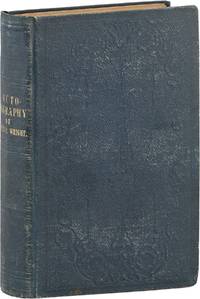
184986600Boston: Bela Marsh 1849. First Edition. First printing. Octavo 18.5cm. Publisher's green embossed cloth titled in gilt; pale salmon endpapers; 414pp; mezzotint portrait frontispiece. A quite attractive copy just lightly rubbed to boards with a few scattered spots of foxing to text; solidly Very Good overall and somewhat uncommon thus. <br /> <br /> A significant if entirely idiosyncratic work in the annals of American radical reform as much a philosophical treatise as an autobiography. American pacifist freethinker feminist and abolitionist Henry Clarke Wright 1797-1870 though little remembered was among the most interesting radical voices of the mid-19th century a defrocked Presbyterian minister who in his adopted role as a "Christian reformer" preached against all established religions and adopted a thoroughly stridently contrarian voice in nearly every field of social reform he touched which was practically all of them. His views opposing established government put him directly in the line of such individualist anarchists as Lysander Spooner and Benjamin Tucker while his opposition to slavery was so uncompromising that he was ejected from the American Antislavery Society in 1837. He remained closely associated with most of the New England radical abolitionist community however especially with William Lloyd Garrison with whom he frequently collaborated. <br /> <br /> Like most of Wright's commercially-issued works this one was published by the Boston radical publisher Bela Marsh known for disseminating works by fellow abolitionists and freethinkers during the antebellum period. 86600. Bela Marsh unknown
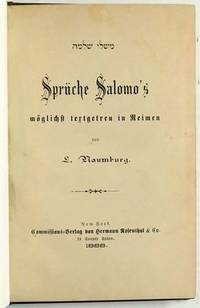
188841415New York: Commissions Verlag von Hermann Rosenthal & Co 1888. hardback. 1st edition. Original Cloth. 8vo 88 pages 17 cm. In German with scattered Hebrew. Singerman 3624. Title translates as "The Proverbs of Solomon as true to the Text as Possible in Rhyme." The Book of Proverbs "Mishli Shlomoh" or Solomon's Proverbs is a book in the third section of the Hebrew Bible Ketuvim. Written by King Solomon it discusses values moral behavior the meaning of human life and ethical conduct. <br> Louis Naumurg 1813-1902 "went to America after 1848 and was elected cantor of Reform Congregation Keneseth Israel at Philadelphia Pa. which position he held from 1850 to 1860. In 1865 he was chosen minister of Congregation Rodeph Shalom Pittsburg Pa.<br> During his earlier years in America Naumburg acted as teacher and reader in the synagogue of the Congregation Keneseth Israel of Philadelphia. He prepared a metrical version in German of the Book of Proverbs" this work Cyrus Adler & Josiah Cohen in JE. <br> Naumburg's biography appears in the American Hebrew March 1902. <br> <br> SUBJECTS: Bible. Proverbs -- Paraphrases German. OCLC: 10245073. OCLC-Worldcat lists 7 copies worldwide NYPL JTS Duke Penn Brown Columbia Boston Public None beyond the American East Coast. <br> <br> All Edges Gilt. Spine and endpapers replaced some light staining about Very Good Condition. B AMR-57-21-BRKK-lxe. New York: Commissions Verlag von Hermann Rosenthal & Co unknown
182055414London: John Fairburn 1820. First Edition. First printing. Octavo in fours 22cm. In nineteenth-century half brown calf with marbled paper over boards seven double gilt rules to spine with blind ornament in compartments titled in gilt on brown leather spine label all edges sprinkled brown; plain endpapers; iv 480pp. 1944 pencil ownership inscription to rear endpaper. A straight sound copy with minor general wear to boards paper lightly scuffed edges rubbed internally largely clean with one or two pencil marks and small spots of foxing: Very Good. <br /> <br /> A key text of early nineteenth-century English parliamentary reformers: "a massive compendium of all the abuses electoral ecclesiastical legal" that they "sought to abolish." The book "passed through edition after edition continually augmented with new arguments new reports of abuses and new statistics. . . its emphasis on the need to have practical as well as equitable representation lies at the root of parliamentary democracy" Printing and the Mind of Man p.180. Previously published in installments in 1819; this is the first book edition. PMM296. GOLDSMITHS 23071. KRESS C.638. John Fairburn unknown
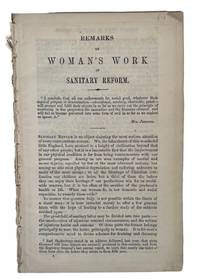
1858197991858. Women Employment Pamphlet titled "Remarks on Woman's Work in Sanitary Reform" England. No Date believed to be circa 1858 measures 5.25" x 8.5". 20 pages. Pamphlet discusses the role of women in the field of Sanitary Reform in England and offers a rare look at the advancement for women's employment equality documenting the skills they have the contributions they can make and the overall benefit they have on society. The pamphlet begins by describing tough physical conditions and suffering in England asking: "What can woman do in her domestic and social capacities to remedy these evils" It also breaks down the field of sanitary labor. "The great field of sanitary labor may be divided into two pars: the amelioration of injurious external circumstances and the reform of injurious habits and customs. Of these parts the former belongs principally to man the latter principally to woman." The pamphlet identifies the tasks of woman within this role: "It is for woman in her functions of mother housewife and teacher to effect those urgently needed changes in infant management domestic economy education and the general habits of her own sex without which humanity could never attain to its desired state of bodily perfection through all injurious external circumstances were changes. It is for her to teach and apply the laws of health in her own provinces where man cannot act." OCLC Worldcat locates no copies in US Institutions but two copies in Europe at the University of Edinburgh and the University of Aberdeen at the time of this writing. Binding is slightly chipping but all pages are held together with only minor wear. Overall pamphlet is in very good condition. unknown
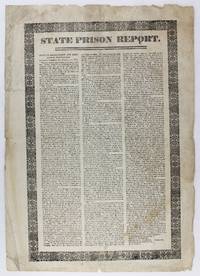
18343806Providence 1834. Good plus. Broadside 15 x 10.5 inches printed in three columns within an ornamental border. Old folds short splits along some folds a few small chips moderate dust-soiling and foxing. Untrimmed. A rare broadside disseminating a report from a five-man committee of the General Assembly of Rhode Island recommending penal code reform and the establishment of a state prison in the Ocean State in 1834. The beginning of the report expounds upon the inconsistency of the various legal punishments meted out in county jails. The committee then evaluates different methods of imprisonment in New York Pennsylvania Connecticut and other states concluding as follows: "On the whole the committee are in favor and recommend to the General Assembly the erection of a State penitentiary on the principle of solitary confinement at labor with instruction in labor in morals and religion." The committee hoped this prison reform would "relieve the State from the future support of convicts and may produce a moral reformation in those who may be subjected to its operation." We could locate just one copy of this broadside in OCLC at Brown. unknown
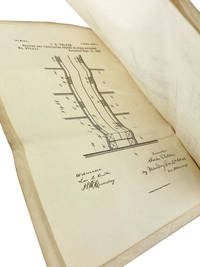
188721386Washington: H. Peters 1887. Very Good. Washington: H. Peters 1887. Folio 30.5cm.; ribbon-bound engraved self-wrappers wax-sealed and accomplished in manuscript; 8ll. of photo-engraved plans printed on versos only followed by 3pp. text printed in double columns on rectos only. Previous mail folds extremities a bit chipped and toned ribbons slightly frayed else Very Good internally clean and sound. Signed by Acting Secretary of State D.L. Hawkins and Commissioner of Patents Burton J. Hall. <br /> <br /> Detailed patent application submitted by the Superintendent of the Chicago Bridewell Prison on September 13 1887. Charles E. Felton ca. 1832-1909 was the prison's longest serving overseer having held the position from its opening in 1872 until his retirement in 1890. Formerly a printer in Buffalo New York Felton entered the field of prison administration through the usual political platforms though he assumed his position in Chicago not through the usual channels but based on his previous experience serving as director of the Erie PA correctional facility. A Democrat and avid duck hunter with a rather unfocussed eye on the mayoralty of Chicago Felton was especially interested in enforcing labor in his prisons as a means of reducing costs and galvanizing individual reformation a position he clung to even past his retirement. <br /> <br /> The present patent submitted with steel manufacturer Herbert B. Streeter 1833-1919 offered substantial air circulation improvements for prisons "or other structures where the tiers of cells or dormitories have an open hall or corridor without separation by floors or otherwise." Previously the Chicago House of Corrections had just one small ventilating flue leaving the air "absolutely foul and poisonous." The plans depicted here show two foul air flues and one steam-coil heating device per cell as well as additional open air gratings for increased circulation. Though it is unclear whether the patent was ever approved Felton in an address delivered before the Prison Congress four years later complained that the increase in crime rates could be blamed in part on "the comfortable quarters" offered prospective convicted criminals. Also to blame "the present views of the public and acts of legislatures as to systems of prison labor and its ease to the prisoner.the quality of food; their the prisoners' easy access to visitation and the readiness with which a sympathetic public accepts as true the complaints of the prisoners" "Inter Ocean" newspaper October 14 1891. This patent submitted to improve the comfortable prison cells Felton so bemoaned an important document for students and historians of prison reform architecture and engineering. H. Peters unknown
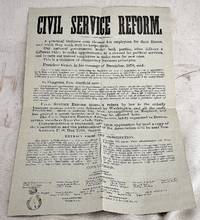
18812301150003Civil Service Reform Association Boston Mass. 1881. First Edition. Art Prints & Posters. Very Good. American Civil Service Reform : Massachusetts : Good Governance in the Gilded Age Original Broadside. Sheet in excellent condition. Printed on blue paper. Two folds. Dimensions: 14 1/2 x 21 inches. Small ink stamp on bottom left corner dated 1881. <br> The broadside lays out the principles of good government. It offers quotes from President Grant and Gen. Garfield about the importance of civil service reform; the example of success in England; explains the core reason for the Civil Service Reform Association; a brief view of the Association's constitution; and a list of the principal officers. <br> The Association's President Moorfield Storey and other "Mugwumps" were strongly in favor of anti-corruption / good government reforms advocated by Grover Cleveland and other reformers. "The principles' of the Association were as follows: "That while certain officers of the Government should be in sympathy with the policy of the Administration the routine business should be conducted on business principles; that officers should be appointed on account of fitness for the work to be done and should be continued in office as long as they do that work well' that offices should not be used for partisan purposes; that Representatives are chosen to legislate and their time should not be given to the distribution of patronage; that the adoption of the well-devised system carrying out these principles will insure better administration and better legislation." Also includes a reprinted article on the Association from the New York Times February 19 1881. Civil Service Reform Association (Boston, Mass.) unknown
186943448Chicago: Ed. Bühler's Buchhandlung 1869. paperback. 1st edition. Original printed paper wrappers 12mo 26 pages. 22cm. In German. Title translates as "A Critique of Christian Missionary Activities in Particular the 'Jewish Mission.'" Singerman 2126. <br> <br> Leading Chicago Reform Rabbi Bernard Felsenthal here pushes back against Christian attempts to convert Jews to Christianity. Felsenthal 1822-1908 was born in Bavaria and ordained in America by David Einhorn serving the Zion-Gemeinde of Chicago starting with its formation in 1864. Felsenthal was among the first American Reform leaders to favor participation in the Zionist Congress at Basel in 1897 against overwhelming opposition from his Reform colleagues. <br> <br> SUBJECTS Descriptor:Missions to Jews. Christianity and other religions -- Judaism. Judaism -- Relations -- Christianity. Proselytizing -- Illinois -- Chicago. Missions aupre`s des Juifs. Christianisme -- Relations -- Judai¨sme. Judai¨sme -- Relations -- Christianisme. Prose´lytisme -- Illinois -- Chicago. Christianity. Interfaith relations. Judaism. Missions to Jews. Proselytizing. Missions to Jews OCLC: 475232105. <br> <br> Light wear to wrappers with expert repair to margin of upper corner; somewhat dusty small name stamp on blank reverse of title page tiny owner stamp on rear wrapper "ex-libris Tobias Schanfaber;" see en.wikipedia.org/wiki/Tobias_Schanfarber internally bright about Very Good- Condition B AMR-67-9-DRXBGGF-'le. Chicago: Ed. Bühler's Buchhandlung unknown
184639101Philadelphia 1846. 16 of 18 issues lacking 1 and 2 bound together in contemporary three-quarter calf with marbled boards. Pages numbered 33-288. Some leaves browned. General title page is absent; a small bookplate "Bodichon Scalands Robertsbridge" covers the caption title of No. 3. This is the bookplate of Barbara Leigh Smith Bodichon notable British artist feminist writer and women's rights activist who founded the first women's college at the University of Cambridge. Bound in contemporary quarter calf rubbed and marbled paper over boards. Occasional text browning. Except as noted Very Good. <br /> <br /> This periodical is a literary anthology of American and British reformist prose and poetry with significant anti-slavery contributions. The authors included John Greenleaf Whittier James Russell Lowell Ralph Waldo Emerson Nathaniel Hawthorne Henry Longfellow John Pierpont Lydia Maria Child Harriet Martineau Lydia Sigourney Alfred Lord Tennyson Elizabeth Barrett and William Lloyd Garrison who wrote three poems for the journal one while imprisoned for libel of a merchant he had accused of illegal slave trading. <br /> The anti-slavery pieces are not only poetic most famous being Whittier's "Branded Hand" but also include his essay on the "Slave Market at Washington" Child on the "Economy of Slavery" the "Declaration of Sentiments of the American Anti-Slavery Society" and principles of the 1838 "Peace Convention" organized by Garrison. <br /> LCP 10848. AI 46-7277 6. Not in Lomazow or Mott. unknown
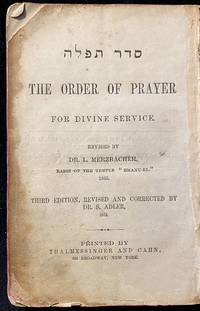
186441716New York: Printed by Thalmessinger and Cahn 1864. Hardback. Original boards. 8vo. 181 pages 18 cm. In English and Hebrew. Singerman 1845. Includes Order of prayer in the house of Mourners and Hymns for divine service in the Temple Emanu-El. Reform siddur. Samuel Adler was a prominent German-American Reform rabbi who authored many works on the Talmud and other topics. He succeeded Dr. Leo Merzbacher as Rabbi of Temple Emanu-El the first Reform Jewish congregation in New York City Wikipedia 2019. SUBJECTS: Siddurim - Texts - Reform Judaism. OCLC lists 12 copies worldwide OCLC:11329485. Third edition. Spine rebacked lacks blank endpapers. Lightly damp stain to left margin. General wear and staining but all contents good. B AMR-56-56-D!B-'@. New York: Printed by Thalmessinger and Cahn unknown