640 résultats
19692091502135420891Not Available 1969. Soft Cover. Fine. Number of books: 1 Not Available paperback
19502080702109504928Farmland Section Farmland Department Fukuoka Prefecture 1950. Soft Cover. Fine. Number of pages: 4 books Size: 26cm Farmland Section, Farmland Department, Fukuoka Prefecture paperback
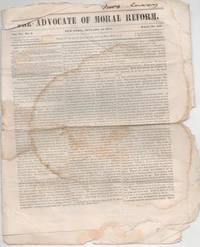
76-0629New York: Female Moral Reform Society 1837. One issue. pgs. 201-208. Uncut folded quarto. 31 x 26 cm sheet. Good missing sections of right margins old folds light damp staining age toning. Subjects: murder suicide; immorality of theatrical amusements; licentiousness will never be materially lessened except by a truly Christian education of children; correspondence; poem titled The Calling of God; list of agents etc. New York: Female Moral Reform Society, 1837. unknown
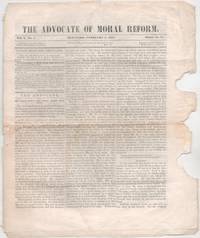
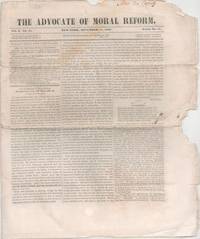
76-0633New York: Female Moral Reform Society 1840. One issue. pgs. 9-16. 31 x 26 cm sheet. Good missing sections of right margins old folds light damp staining age toning. New York: Female Moral Reform Society, 1840. unknown
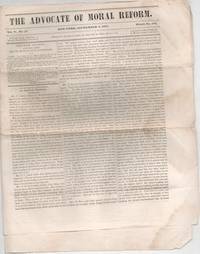
76-0630New York: Female Moral Reform Society 1837. One issue. pgs. 353-360. 31 x 26 cm sheet. Good missing sections of right margins old folds light damp staining age toning. New York: Female Moral Reform Society, 1837. unknown
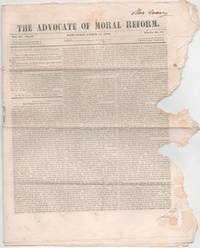
76-0631New York: Female Moral Reform Society 1839. One issue. pgs. 129-136. 31 x 26 cm sheet. Good old folds light damp staining age toning. New York: Female Moral Reform Society, 1839. unknown
76-0632New York: Female Moral Reform Society 1837. One issue. pgs. 57-64. 31 x 26 cm sheet. Good missing sections of right margins old folds light damp staining age toning. New York: Female Moral Reform Society, 1837. unknown
2090502113700324Not Available N.A. Soft Cover. Fine. The book is in fine condition. Not Available paperback
19392092902137305707Toei-sha 1939. Soft Cover. Fine. The book is in fine condition. Toei-sha paperback
19662110502150400648Japan Reform Bill Publishing Association Toyoake-cho Aichi-gun Aichi Prefecture 1966. Soft Cover. Fine. Volume: 1 Japan Reform Bill Publishing Association (Toyoake-cho, Aichi-gun, Aichi Prefecture) paperback
20152090502113708969Not Available 2015. Soft Cover. Fine. The book is in fine condition. Not Available paperback
20052110502150400403Nihonhyoronsha 2005. Soft Cover. Fine. Volume: 1 Nihonhyoronsha paperback
19722090502113700368Not Available 1972. Soft Cover. Fine. The book is in fine condition. Not Available paperback
19572090502113703580Not Available 1957. Soft Cover. Fine. The book is in fine condition. Not Available paperback
19962111902156001044Japan Institute of International Affairs 1996. Soft Cover. Fine. The book is in fine condition. Japan Institute of International Affairs paperback
19982111902158301579Fusosha 1998. Soft Cover. Fine. Number of pages: 336 p Out of print Size: Size cm: 21 x 15 x 2.2 Number of books: 1 Fusosha paperback
19432111902156002125Fujin'notomosha 1943. Soft Cover. Fine. The book is in fine condition. Fujin'notomosha paperback
19512080202105301221farmland committee 1951. Soft Cover. Fine. Volume: 1 farmland committee paperback
19582090502113717892Not Available 1958. Soft Cover. Fine. The book is in fine condition. Not Available paperback
19622090502113706534Not Available 1962. Soft Cover. Fine. The book is in fine condition. Not Available paperback
200461978Washington DC: U. S. Government Printing Office 2004. Presumed first edition/first printing. Wraps. Very good. No dust jacket as issued. iii 588 p. Illustrations. Serial No. 108-206. This hearing examins the latest medical science regarding cervical cancer and ongoing Federal efforts to treat the disease and prevent infection from the virus that causes it. U. S. Government Printing Office paperback
200364416Washington DC: U.S. Government Printing Office 2003. Presumed first edition/first printing. Wraps. Good. No dust jacket as issued. iii 206 p. Serial No. 107-156. This is the record of hearings that were part of the process of assessing the impacts of the September 11th attacks and the federal response to them. U.S. Government Printing Office paperback
200763262Washington DC: U.S. Government Printing Office 2007. Presumed first edition/first printing. Wraps. Very Good. No dust jacket as issued. iii 213 p. Occasional footnotes. Serial No. 109-232. U.S. Government Printing Office paperback
200566635Washington DC: U. S. Government Printing Office 2005. Presumed first edition/first printing. Wraps. Good. No dust jacket. iii 352 p. Title continues: One Hundred Eighth Congress Second Session April 1 2004. Serial No. 108-226. From Wilipedia: Medical Marajuana "Medical cannabis refers to the parts of the herb cannabis used as a physician-recommended form of medicine or herbal therapy or to synthetic forms of specific cannabinoids such as THC as a physician-recommended form of medicine. The Cannabis plant has a long history of use as medicine with historical evidence dating back to 2737 BCE. Cannabis is one of the 50 "fundamental" herbs of traditional Chinese medicine and is prescribed for a broad range of indications. One of the major criticisms of cannabis as medicine is opposition to smoking as a method of consumption. However smoking is no longer necessary due to the development of healthier methods. Today medicinal cannabis patients can use vaporizers where the essential cannabis compounds are extracted and inhaled. In addition edible cannabis which is produced in various baked goods is also available and has demonstrated longer lasting effects. The United States Food and Drug Administration FDA issued an advisory against smoked medical cannabis stating that "marijuana has a high potential for abuse has no currently accepted medical use in treatment in the United States and has a lack of accepted safety for use under medical supervision. The National Institute on Drug Abuse NIDA state that "Marijuana itself is an unlikely medication candidate for several reasons: 1 it is an unpurified plant containing numerous chemicals with unknown health effects; 2 it is typically consumed by smoking further contributing to potential adverse effects; and 3 its cognitive impairing effects may limit its utility". The Institute of Medicine run by the United States National Academy of Sciences conducted a comprehensive study in 1999 to assess the potential health benefits of cannabis and its constituent cannabinoids. The study concluded that smoking cannabis is not recommended for the treatment of any disease condition but did conclude that nausea appetite loss pain and anxiety can all be mitigated by marijuana. While the study expressed reservations about smoked cannabis due to the health risks associated with smoking the study team concluded that until another mode of ingestion was perfected that could provide the same relief as smoked cannabis there was no alternative. In addition the study pointed out the inherent difficulty in marketing a non-patentable herb. Pharmaceutical companies will not substantially profit unless there is a patent. For those reasons the Institute of Medicine concluded that there is little future in smoked cannabis as a medically approved medication. The report also concluded that for certain patients such as the terminally ill or those with debilitating symptoms the long-term risks are not of great concern. Marinol was less effective than the steroid megestrol in helping cancer patients regain lost appetites. A phase III study found no difference in effects of an oral cannabis extract or THC on appetite and quality of life QOL in patients with cancer-related anorexia-cachexia syndrome CACS to placebo. "Citing the dangers of cannabis and the lack of clinical research supporting its medicinal value" the American Society of Addiction Medicine in March 2011 issued a white paper recommending a halt to using marijuana as a medicine in U.S. states where it has been declared legal." U. S. Government Printing Office paperback
200461678Washington DC: U. S> Government Printing Office 2004. Presumed first edition/first printing. Hardcover. Good. No dust jacket as issued. iii 508 p. Illustrations. Serial No. 108-276. This hearing was held at Kailua-Kona Hawaii. This hearing is a continuation of the subcommittee's work on the problem of methamphetamine abuse--a problem that was ravaging the State of Hawaii and other parts of the United States. Meth in Hawaii came from superlabs in California and Mexico and from small local laboratories. The hearing sought to address "Firstly what to we need to do to reduce the supply of meth " and "Second how shouldwe deal with the environmental issues created in the wake of a meth lab seizure " U. S> Government Printing Office hardcover