5 résultats
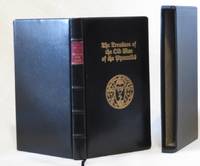
200233086Seattle: Trident Books 2002. First edition. Fine Condition. Full leather bound in slipcase; English transaltion by Stephanie Diakite; Text in English and French; 46 black-and-white plates; Small volume Limited edition of 300 numbered copies very few were leather bound; 7" X 4.5"; xii 98 pages. Trident Books unknown
25889Undated but on Britannia paper watermarked 1805; and the San Ysidro was a prison ship at Plymouth between May 1805 and September 1814. Napoleon’s Egyptian Campaign 1798-1801 inspired a period of ‘Egyptomania’ culminating in Champollion’s decipherment of the Rossetta Stone. The contribution of the author of this letter to this outpouring of scholarly activity is an offer to the President of the Society of Antiquaries of London to blow up one of the pyramids in order to extract their contents. See the recipient’s entry in the Oxford DNB. 3pp 8vo. Bifolium of laid Britannia paper watermarked 1805. Fifty-five lines well laid out and written in a neat and stylish hand. In fair condition somewhat grubby and warn folded into a packet. Addressed to ‘The Right Honorable the Earl of Leicester. / F.R.S. / President of the Society of Antiquaries / London.’ Signed: ‘Wm. Lydiard - / Master’s Mate of HM Prison Ship San Ysidro / Plymo’ Dock’. The text begins: ‘. excess of servility and drudgery to which they were driven even to the making of Brick and other debasing services; some writers have from thence inferred that the Pyramids being of stone is a proof that they were not founded by them no work of that kind being recorded: but is it not recorded that they built Treasure Cities’ He proceeds to discuss whether as ‘Some authors affirm’ the pyramids are ‘the Tombs of Kings’. He states that he was ‘a few days since’ ‘furnished with the official account of the capture of Alexandria’ The French garrison at Alexandria had surrendered to the British on 2 September 1801. and that ‘it immediately struck me with a desire of troubling you on this subject with the view of observing to you that if it is the intention of government to follow up their success in that quarter; whether this may not afford a good opportunity for opening one or two of these mysterious piles’ Warming to his theme he continues: ‘it surely can be done - gunpowder has a speedy effect in operations of this nature - the trouble might not be small but I certainly would not hesitate to undertake the performance of it neither can I imagine I would take any very considerable time or expense to execute it.’ After this surprising offer he goes some way to redeeming himself by stating: ‘There may be some valuable remains of antiquity deposited in those closed which may materially tend to the illustration of the ancient history manners or customs of the Egyptians’. He ends with reference to ‘sacred Scripture’ and the ‘plundering of the Temple by Shishak’. Undated, but on Britannia paper watermarked 1805; and the San Ysidro was a prison ship at Plymouth between May 1805 and Septembe unknown
1885140641885. Zangaki photograph of the Sphinx and Pyramids circa 1870s records the Giza plateau through the commercial photographic practice that shaped European and American visual knowledge of Egypt in the late nineteenth century. The Zangaki brothers Greek photographers active in Ottoman Egypt from the 1870s into the 1890s specialized in views of ancient monuments urban scenes and daily life producing albumen prints for travelers and the expanding tourist market. This image supports research into archaeological tourism Orientalist visual culture early commercial photography in Egypt and the circulation of ancient Egyptian monuments as collectible photographic subjects.<br /> <br /> Albumen photograph by Zangaki circa 1870s. The unmounted sepia print measures 8.5 x 10.9 inches and shows the Sphinx in the foreground with the Pyramids rising behind it using depth and monumentality to place the viewer within one of the most widely circulated nineteenth-century Egyptian views. The composition belongs to the commercial photographic vocabulary of the period when photographers working from Cairo Port Said and Nile-route studios produced portable images for visitors who wanted material records of antiquity travel and empire-era encounter.<br /> <br /> Unounted with sepia tonality and no stated major defects; good. An early Zangaki view of Giza offers strong documentary value for collections focused on nineteenth-century photography Egyptology travel culture the history of tourism and the visual construction of the ancient world in the modern colonial period. unknown
1885141111885. Set of two vintage Albumen photographs 8 1/4" X 10-1/2" 8.25" x 10.5" made in the 1800s. Unmounted. First photo shows a view of the Pyramids with a foreground of Palm Trees and Native men on Camels. The Sphinx can be seen in the distance. Etched into the lower left of the photograph are the words "Palmiers & Pyramides vue Generale 494" and in the lower right the photographer's mark "JP Sebah." Very clean condition with a few small flaws in the emulsion. Pascal Sébah opened his photography studio in Istanbul in 1857 and by 1873 was successful enough to open another studio in Cairo. After he died in 1886 the studio was managed by his brother Cosmi until Pascal's son Jean joined him in 1888. Due to the mark this is most likely a photograph by Jean Pascal Sebah. An excellent example. Second photo captures a scene on the Nile in Egypt with pyramids in the background by Cosmi Sebah. The photographer's signature in the negative lower right recto. Several minor scattered imperfections including a waviness throughout. Overall condition is good. unknown
19782090502113718219Not Available 1978. Soft Cover. Fine. The book is in fine condition. Not Available paperback

