Dwight D EisenhowerBiblio.com
2 résultats
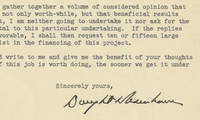
18122102918/12/1948. <blockquote><p>The Founding Letter of the Renowned Eisenhower Center for the Conservation of Human Resources</p></blockquote><p><strong>Yet during the war rejections and discharges of men for mental defects reached a total of more than two million.</strong></p><p><strong>This type of problem would affect industry as well and Ike sought to establish an entity to research causes and solutions</strong></p><p>In December 1948 Eisenhower was called to Washington where he met with Averill Harriman Omar Bradley and Harry Truman. The leadership of the military had not settled on a plan to counter the rising Soviet threat and wanted Ike's opinion on fighting force preparedness. He remained in Washington for these meetings in the first two weeks of December. The immediate threat was Russia and a possible attack. The long term threat was to create a more efficient military. He had been assured that such a job should it require long hours would be compatible with his new job at Columbia University and so he made that real.</p><p>Eisenhower gave thought and consideration on how to present the needs and issues and introduce the concept and program director. This letter/presentation is a product of that and in it Eisenhower also speculates on the role played by education and poverty and ponders whether “industry trade unions the school the church do to help reduce the volume of lossâ€. The recipient was Henry Ford II president of the Ford Motor Company who was one of America’s top industry leaders and well as a personal acquaintance who would become a friend.</p><p>The letter is at its essence how to learn from the failures of fighting force recruitment and support during World War II apply it to the next combat and see how far that lesson could be taken to workplace life and the reintegration.</p><p><strong>Typed letter signed</strong> on his Columbia University letterhead New York December 18 1948 to Ford. <em>“It seems to me that the time has come when the wastage of American resources must be combated along all fronts. There are numbers of organizations directing their efforts toward conservation of natural resources including the soil. Our future prosperity is going to depend directly upon the success of their achievements. There is another sector of the conservation problem however that deserves immediate attention and that so far has not been made the subject of widespread intelligent attack. It is the wastage of manpower through mental and emotional failures.</em></p><p><em>“My own attention was drawn forcibly to the matter during the war particularly in the late months of 1944 when the country found that its ability to supply replacements for the battleline was badly strained. Units had to fight under truly desperate handicaps by reason of lack of manpower. Yet during the war rejections and discharges of men for mental defects reached a total of more than two million. One of the numerous reasons that finally decided me to come to Columbia was the hope of assisting in finding some kind of an answer to this national problem. Obviously in the event of great emergency our manpower will be in limited supply but the basic problem is far broader in scope. Manpower losses of this kind imply tremendous costs and inefficiencies for our economy.</em></p><p><em>“This I believe is a particularly propitious time to begin a down-to-earth study of the matter. There exist today the rejection records of the two million men lost in World War II. Most of them are still alive and they provide therefore a great body of factual information for any group that can organize itself sufficiently well to dig out and correlate the facts. In addition there is available in business corporations an important body of personnel information bearing on civilian maladjustments which invites exploration and evaluation.</em></p><p><em>“It would seem particularly important to find out whether there are common causative factors responsible for these human failures. Numerous questions immediately suggest themselves. Among these are: 1. Are these men generally from the undereducated groups 2. Are they generally urban or rural in origin 3. How do these men spend their leisure time 4 Are they underfed or otherwise definitely underprivileged 5. Do they show a long history of emotional instability or do these defects come out only under fear or other stress 6. What has happened to them Are they now a charge upon society or are they leading useful lives </em><em>7. How accurate were our war-time yardsticks for measuring ""mental deficiency"" 8 What can industry trade unions the school the church do to help reduce the volume of loss Dozens of other questions suggest themselves but the foregoing will indicate some of the specific points I have in mind.</em></p><p><em>“Shortly after coming to Columbia University I detailed a very able young professor Eli Ginzberg to prepare a memorandum which would show the capacity and qualifications of this institution for undertaking a significant study in this area. His report is attached. Although the study of human resources is so important that it would warrant continuing support I have thought it best to propose a limit of five years on this investigation. My thought is that regardless of continuing scientific research into the various aspects of the question we need to develop at an early date helpful practical methods that will contribute much more than past procedures to the efficient utilization of human resources.</em></p><p><em>“The Columbia Deans commented on the enclosed proposal and they were unanimously of the belief that the investigation should be undertaken. Now I am particularly anxious to get the opinions of men who are experienced in business labor agriculture finance the church etc. and I should therefore like to have your reactions to the above suggestions which are amplified in the accompanying memorandum. </em><em>It might be that a large percentage of mentally ineffective manpower is inescapable and is a natural result of our particular civilization. This I do not believe and certainly I will not accept such a conclusion until we have done our best to prove or disprove the case</em></p><p><em>“However until I can gather together a volume of considered opinion that the proposed task is not only worth-while but that beneficial results should flow out of it I am neither going to undertake it nor ask for the financial support vital to this particular undertaking. If the replies are predominantly favorable I shall then request ten or fifteen large organizations to assist in the financing of this project. I wish that you would write to me and give me the benefit of your thoughts on this proposal. If this job is worth doing the sooner we get it under way the better.â€</em></p><p><strong>It comes with the retained response from Ford and the copy of the report sent by Eisenhower to Ford being Ford's copy.</strong></p><p>A few of these letters were sent out and the response was positive so these words heralded the establishment at Columbia of a project originally called The Conservation of Human Resources and later renamed The Eisenhower Center for the Conservation of Human Resources. Dr. Ginzberg ran the project while Eisenhower invigorated it with energy and direction until he left Columbia to run for president. The work provided for a three-pronged approach: 1 a study of inadequacy and maladjustment in civilian and military life 2 a study of the factors contributing to the development of talent and superior performance and 3 changing patterns of work in a dynamic economy. Over the years it has published numerous works a few of which are “The Ineffective Soldier: Lessons for Management and the Nation†“The Changing U.S. Labor Market†“The New Suburbanization: Challenge To The Central City†and “The physician and the poorâ€. The Center remains active today.</p> unknown
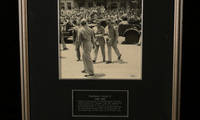
18062245918/06/1945. <blockquote><p>An extraordinary photo and the only one we have ever seen portraying Eisenhower returning home in victory</p></blockquote><p>For the General Dwight D. Eisenhower the Supreme Allied Commander the last two years of the war would be his most challenging. Eisenhower would oversee the gargantuan plan for the invasion of Europe: the largest air sea and land assault in history. He would be the one to give the ultimate order that he knew would send thousands of young men to their deaths. And despite a top-notch staff and talented commanders it would be he alone who would have to shoulder the crushing responsibility of decision making. As June 1944 dawned D-Day approached. On June 1 Ike moved his command post from London to Portsmouth where he lived in a tiny trailer that he christened “my circus wagon.†It was here that he gave the go-ahead for a June 5 landing which was called back due to bad weather. Ike’s meteorologist forecast a brief window of clear weather for June 6. Sensing that it was now or never in the early morning of June 5 Ike gave the order “OK let’s go†for the 6th.</p><p>By late evening June 6 it was clear that Operation Overlord the invasion of Normandy had succeeded. The Allies had put more than 150000 men ashore and the beachheads were littered with Allied tanks and artillery. In late July the Allies would finally achieve a breakout in Normandy and by August 25 Paris would be liberated. The Allies advanced eastward through the autumn of 1944. But hopes to end the war before Christmas were dashed when bad weather set in. And on December 16 as Ike was promoted to the new five-star rank of General of the Army the Germans launched a final attack: the Battle of the Bulge. Initially successful it in the end failed. The Allied offensive picked up again in early spring 1945. In mid-April Ike inspected a concentration camp near Gotha Germany. He was visibly shaken by the horrors he witnessed there. Immediately he summoned reporters and congressional representatives from the United States; he believed firmly that history must have an accurate and permanent record of these unspeakable atrocities. By early May the collapse of the Third Reich was imminent. Just before 3:00 a.m. on May 7 1945 a weary Eisenhower accepted the German unconditional surrender. Someone on Ike’s staff opened a bottle of champagne in a half-hearted attempt to celebrate but it was flat. Exhausted everyone went to bed. But the defeat of Nazi Germany - perhaps the most important victory in modern warfare - was accomplished.</p><p>The month after the German surrender was incredibly busy for Ike. Unending paperwork a flood of congratulations and mountains of correspondence threatened to bury him. Then came the moment Ike longed for - he started back home to the United States. On June 12 he stopped in London for a victory celebration and made a speech in the Guildhall. There he said “Humility must always be the portion of any man who receives acclaim earned in blood of his followers and sacrifices of his friends….He may have written a chapter that will glow forever in the pages of military history. Still even such a man…would sadly face the facts that his honors cannot hide in his memories the crosses marking the resting places of the dead. They cannot soothe the anguish of the widow or the orphan whose husband or father will not return.""</p><p>Then it was on to Washington where he arrived June 18 1945. General George C. Marshall waited with Mrs. Mamie Eisenhower at National Airport for Ike’s arrival. The purpose of the visit was to give General Eisenhower a proper homecoming complete with parades and other celebrations to recognize his remarkable efforts in leading the Allies to victory in Europe. Eisenhower’s plane landed at 11:30 A.M. The group departed from the airport for the Pentagon and Marshall rode with Eisenhower. At the Pentagon Secretary of War Henry L. Stimson greeted Eisenhower and then Ike spoke briefly to thank the many people in the War Department for their support. Eisenhower departed for a grand Victory Parade through the streets of Washington with his staff to the cheers of thousands. It was the greatest ovation ever accorded anyone in the nation's capital. After the parade Eisenhower went to the Capitol for a reception arranged by Congress. He told Congress that the welcome given him was in reality the tribute of a grateful country to the three million U.S. soldiers who helped achieve the victory in Europe. Ike then went to the White House to meet with President Truman and his cabinet and advisors with operations against Japan being the main topic on the agenda. Marshall was with him at the Congressional reception and also at the White House meeting.</p><p>A large 10 by 13 inch<strong> photograph</strong> of Eisenhower with Marshall on their way to meet President Truman at the White House amidst jubilation June 18 1945 the very day Ike returned victorious after V-E Day <strong>signed</strong> by Eisenhower. An extraordinary photo and the only one we have ever seen portraying Eisenhower returning home in victory.</p> unknown