412 résultats
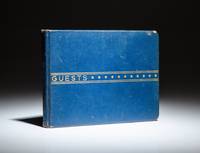
195110813Boston: Samuel Ward Stationery 1951. Guest Book. Full leather. Very good. The Guest Book from President Harry Truman's "Air Force One" featuring signatures from President Harry S. Truman General Dwight D. Eisenhower Representative John F. Kennedy Indian Prime Minister Jawaharlal Nehru and his assistant Indira Nehru Ga. Octavo 125pp. Full blue leather title stamped in gilt on cover. Housed in custom blue leather clamshell title on cover over red morocco label. This book is from the private collection of the pilot Colonel Chester C. Moomaw. Includes ephemera from Colonel Moomaw. The plane used for these trips was a Lockheed Constellation under the designation of SAM 8608. Notable flights include: Wake Island 1950 Independence MO 1949 New Delhi 1949 Berlin 1949 Little White House in Key West 1950 and Santiago 1950. An exceptional piece includes the signatures of three US Presidents as well as various US Cabinet secretaries chairmen of the Joint Chiefs of Staff Prime Ministers of India and numerous other dignitaries. Signed by the following dignitaries with their contemporary title:<br/> <br/>Harry Truman President of the United States<br/>Dwight D. Eisenhower President of Columbia University<br/>John F. Kennedy House Representative<br/> <br/>Jawaharlal Nehru Prime Minister of India<br/>Indira Nehru Gandhi Assistant to Prime Minister of India<br/> <br/>George C. Marshall Secretary of Defense<br/>Dean Acheson Secretary of State<br/>Dean Rusk Assistant Secretary of State<br/> <br/>Omar Bradley Chairman of the Joint Chiefs of Staff<br/>Hap Arnold General of the Air Force<br/>Andrew Goodpaster General of the Army<br/>Matthew Ridgway General of the Army<br/>Forrest Sherman Chief of Naval Operations<br/>Frank Pace Secretary of the Army<br/>Stuart Symington Secretary of the Air Force<br/>Louis A. Johnson Secretary of Defense<br/>J. Lawton Collins Chief of Staff Army<br/> <br/>James Fulbright Senator<br/>Warren Magnuson Senator<br/>Stephen T. Early White House Press Secretary<br/>Averell Harriman Special Assistant to the President<br/>Hoyt Vandenberg Chief of Staff Air Force<br/>Margaret Truman Daughter of President Truman<br/>Stephen J. Springarn Administrative Assistant to the President<br/>Clark M. Clifford White House Counsel<br/>Vannevar Bush Engineer<br/>Arthur Vandenberg Senator-President Pro Tempore<br/>Charles W. Sawyer Secretary of Commerce<br/>Gabriel Gonzalez Videla President of Chile<br/>Bernard Baruch Presidential Adviser. Samuel Ward Stationery unknown books
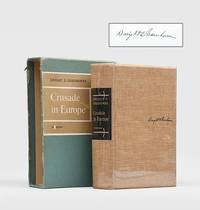
1948190523Garden City NY: Doubleday & Company Inc. 1948. His signed wartime memoir First edition signed limited issue number 1198 of 1426 copies signed by Eisenhower under his D-Day message to the troops here preserving both the slipcase and original acetate both often missing. Crusade in Europe made Eisenhower a rich man "becoming one of the most widely translated and sold books of all time. It is often compared to Grant's memoirs as a classic of military writing" ANB. Octavo. Original light brown buckram over bevelled boards spine lettered in gilt on black ground facsimile signature to front cover in black top edge gilt others untrimmed. With acetate jacket and original printed card slipcase. With 16 black and white plates from photographs selected by Edward Steichen 4 double-page maps and 38 full-page maps to the text map endpapers. A fine copy slipcase worn but holding. hardcover
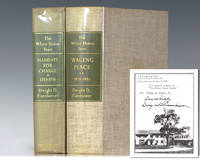
1963133263Garden City NY: Doubleday and Company 1963-65. Signed limited first editions of Eisenhower's memoirs each one of 1500 copies. Thick Octavo two volumes original tan cloth with green morocco spine labels lettered in gilt cartographic endpapers. One of 1500 numbered copies signed by the author. Association copy Waging Peace is an Advance presentation copy inscribed by Eisenhower to Secretary of Defense Thomas S. Gates Jr. "Devotedly Dwight D. Eisenhower" on an Eisenhower Farm Gettysburg Pennsylvania bookplate. The recipient Thomas S. Gates is mentioned numerous times in both of these volumes. "To replace Neil McElroy as Secretary of Defense I prevailed on Secretary of the Navy Tom Gates to delay his return to private life. He first took the post of Deputy Secretary for the duration of Mr. McElroy's term and then in December assumed the post of Secretary of Defense. During his term as Secretary he had the satisfaction of seeing the Polaris developed by the Navy under his leadership make its first successful firings and join America's growing arsenal." p. 254 The White House Years: Waging Peace 1956-1961. Fine in the original acetate dust jackets. An exceptional association. This is the story of President Eisenhowers first administration. Dwight D. Eisenhower one of the major figures of the twentieth century writes an account of the events as he saw them leading up to a sweeping mandate and then pursues the theme of change in the years 1953-1956 Doubleday and Company hardcover
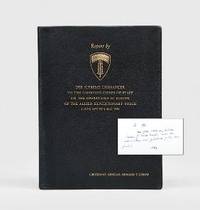
1946190508Washington DC: US Government Printing Office 1946. Presented to his "oldest and best friend" a key commander at D-Day First edition presentation copy specially bound for Leonard T. Gerow and inscribed by Eisenhower on the initial blank "To 'Gee' one of the outstanding battle leaders of World War II with the admiration and gratitude of his old friend Ike". Gerow 1888-1972 was in command of the V Corps at Omaha Beach on D-Day and became the first American general to enter Paris after its liberation in 1944. "Gerow was his oldest and best friend in the theater and V Corps headquarters would provide a haven in moments of anxiety more than once" Eisenhower p. 176. The careers of the two men were closely intertwined. "Eisenhower and Gerow were opposites. Gerow trim and meticulous was a chronic worrier. Eisenhower hale and robust had a gregarious and confident manner. But the two men shared similar thinking and tastes and had similar prewar professional reputations as staff officers. In the summer of 1916 Eisenhower and Gerow had first served together in the 19th Regiment based at San Antonio. In 1926 they had been classmates at the Leavenworth Command and General Staff School. They had formed a two-man study group in Eisenhower's tiny attic" Eisenhower pp. 176-7. It was Gerow that introduced Eisenhower to his future wife Mamie. Gerow originally headed the War Plans Division until the role was reassigned to Eisenhower due to Gerow's failure to foresee Pearl Harbour. Eisenhower was gracious to Gerow acknowledging it was only fortune that led to his taking the position; afterwards Eisenhower's career was to inevitably eclipse that of his old friend but Gerow still rose to a highly respected position eventually leading the Fifteenth and Second Armies. The book prints Eisenhower's official report of his role leading the Allied liberation of western Europe and the defeat of Nazi Germany. Eisenhower had copies bound for presentation to close family and military leaders the Eisenhower library have his brother's copy in the same binding; we could trace no other example on the market. Folio. Original black morocco front cover lettered in gilt silk endpapers. Housed in a custom black cloth solander box. With 11 colour maps of European battle theatres. Spine and front inner hinge neatly repaired light rubbing and wear at extremities. A very good copy. David Eisenhower Eisenhower at War 1986. hardcover
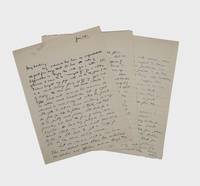
1942376490N.p. 1942. 3pp. on three ruled sheets. Small closed tear to top edge of first page small open tear to left edge of final page; else Fine. 3pp. on three ruled sheets. A charming letter at a vital time in Eisenhower's career: in the midst of planning the attack that would lead to the defeat of Germany here refered to casually as getting "absorbed in work." We're also let in on another side of Eisenhower's responsibilities: entertaining the entertainers. He bears this somewhat wearily but nonetheless we're left with a valuable record of the spirit and dedication of not just the entertainers but all women working on or near the front line. <br /> <br /> "Last eve was an event in our house. There are several movie stars here entertaining the soldiers and officers . . . . Last eve the troupe gave a performance for the officers of AFHQ but I would not go. Afterwards I sent them an invitation . . . to come up for an after performance supper. They did. There were: Kay Francis Martha Ray Carole Landis and Mitzi Mayfair. I was a bit fearful of how movie people would act & what they'd expect--but it all went off perfectly naturally & no embarrassment. . . . They work hard giving from 2 to 3 shows per day 6 days per week. Moreover they reflect an attitude that seems to be characteristic of all women British & American in this region. They want to get close to the front. The women seem to be more casual with respect to danger than do sic the men. These particular ones want to get up as close as possible to do their stuff-as do the Red Cross the WAACs the ATS etc etc. I suppose there are 50-75 American women in this city & every one tells me that their constant cry is 'Let me get up where there is action.' Many of my officers are quite willing to take cushy jobs far from the sound of bombs & bullets. . . . <br /> "No woman can . . . take your place. Don't worry about me . . . . I'm in love with you & with no one else." This last tempted fate written just months before Eisenhower met his long-term mistress Kay Summersby. unknown
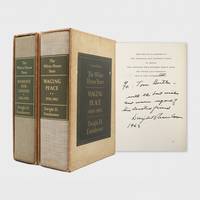
1965376916New York: Doubleday 1965. Limited editions both no. 1231 of 1434 copies signed by the author 1500 the entire edition the first volume inscribed on the colophon. xx 650 pp; xxiv 741 pp. 2 vols. Thick 8vo. Both light tan buckram with Presidential seal stamped in gilt on upper front boards; stamped in olive and gilt on spine; decorative map endpapers; first volume uncut. Fine copies with original acetate jackets in original publisher's slipcases with affixed printed labels; some shelf wear and sunning to slipcases. Illustrated throughout with black-and-white photog. Limited editions both no. 1231 of 1434 copies signed by the author 1500 the entire edition the first volume inscribed on the colophon. xx 650 pp; xxiv 741 pp. 2 vols. Thick 8vo. Eisenhower's two-volume memoir of his time in the White House issued two years apart in 1963 and 1965.<br /> <br /> Both volumes of these limited editions are numbered the same however indicating some forethought on the part of Eisenhower when presenting them to his close friend Thomas B. Butler a Baltimore banking and railroad executive who was a frequent playing partner of Eisenhower's at Augusta National Golf Club where both were long-time members. Each man has a lodge named after them on the Augusta course with Butler Cabin being the site where the winner of each year's Masters Tournament receives his iconic green blazer.<br /> <br /> Eisenhower's formal signature appears on the first blanks of the books in the first volume on a tipped-in leaf and he additionally inscribed Mandate for Change to Butler on the colophon: "For Tom Butler - / with the best wishes and warm regard of his devoted friend / Dwight D. Eisenhower / 1963."<br /> <br /> A compelling narrative by one of the twentieth-century's most significant figures dedicated in turn to one of his closest friends. Doubleday unknown
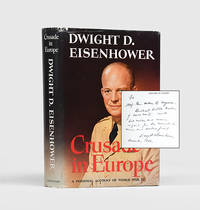
1948193230Garden City NY: Doubleday & Company Inc. 1948. Inscribed to a D-Day commander First edition presentation copy inscribed by the author on the half-title "For Maj. Gen. Willard G. Wyman - Brilliant battle leader of World War II. With best wishes and warm regards from his comrade-in-arms and devoted friend. Dwight D. Eisenhower December 1948". Willard G. Wyman 1898-1969 first met Eisenhower at Fort Lewis in 1941. In Crusade in Europe Eisenhower names him among "an exceptionally keen group of men. whom I tried with some success to keep close to me throughout the ensuing war years" p. 9. Wyman served under Eisenhower in North Africa and played a leading role on D-Day. As assistant commander of the 1st Infantry Division he commanded their D-Day beachhead: his Distinguished Service Cross citation recorded "Brigadier General Wyman came ashore directly behind the leading wave of troops. Due to enemy action many organizational leaders had become casualties. With disregard for his own personal safety Brigadier General Wyman moved up and down the fire-swept beach personally directing the movement of the men and the vehicles which had landed. Under his direction the men were reorganized and successfully assaulted the enemy positions. The gallantry and outstanding leadership displayed by Brigadier General Wyman exemplify the highest traditions of the military forces of the United States". A year later commanding the 71st Infantry Division in which Eisenhower's son John served Wyman led the unit across the Rhine at Oppenheim and into Germany where it linked up with Soviet forces on the Enns River. He later commanded IX Corps in Korea and served as Commander in Chief NATO Land Forces South-East Europe 1952-54 and Sixth Army 1954-55. He retired in 1958 as commander of Continental Army Command with the rank of four-star general. Octavo. With 16 plates 4 double-page maps 38 full-page maps in text. Original brown cloth spine lettered in gilt on black ground facsimile signature in black to front cover map endpapers fore edge untrimmed. With supplied dust jacket. Rubbed and a little shaken; unclipped jacket with slight rubbing and nicking at extremities: a very good copy in very good jacket. hardcover
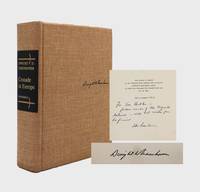
1948376914New York: Doubleday & Company 1948. First edition #1352 of 1426 copies signed by Eisenhower on the facsimile D-Day Order and additionally inscribed on the colophon. Illustrated with six color maps by Rafael Palacios and 38 text maps plus six photographic illustrations selected by Edward Steichen. 559 pp. 1 vols. 4to. Brown buckram; facsimile signature stamped in black on front title on spine; t.e.g. rest of edges uncut; illustrated map endpapers. Original acetate jacket torn at bottom front otherwise fine. Housed in original printed slipcase shelf worn and split at top. First edition #1352 of 1426 copies signed by Eisenhower on the facsimile D-Day Order and additionally inscribed on the colophon. Illustrated with six color maps by Rafael Palacios and 38 text maps plus six photographic illustrations selected by Edward Steichen. 559 pp. 1 vols. 4to. Eisenhower's personal memoir of his service as the Allied Supreme Commander during World War II replete with detailed maps photographs and diagrams which elucidate both his strategies and decision-making across numerous battles including the Normandy invasion. The book was instrumental in propelling him to the presidency four years later. <br /> <br /> Each iteration of this limited edition was signed formally by Eisenhower at the bottom of the facsimile D-Day Order at the front of the text. This copy is additionally inscribed on the facing colophon page though using instead his well-known nickname as the signature: "For Tom Butler - / fellow member of the Augusta National - with best wishes from his friend / Ike Eisenhower."<br /> <br /> Thomas B. Butler a Baltimore banking and railroad executive was a personal friend of Eisenhower as well as a fellow member of the Augusta National Golf Club where he was often the former general's playing partner. Both men have cabins named after them on the Augusta course with Butler's being the site where the winner of each year's Masters Tournament receives his iconic green blazer. Doubleday & Company unknown
194858This is a numbered and signed first edition of which this is number 472 of 1426. It lacks the original acetate jacket and the slipcase. It is now in a red custom made slipcase made by Quality Bindery Inc photo. Bound in heavy duty wheat colored buckram. This copy is signed twice as it is an association copy with an inscription for the commander of the Fitzsimons Army Hospital in Denver when President Eisenhower was a heart patient there in 1955 photo. The book is also signed by Eisenhower on the Facsimile of the D-Day Order of the Day photo. In effect the book was signed in 1948 when Ike was a five star general and in 1955 when he was president and commander-in-chief. The book is in good condition. Its only imperfection is the front hinge which is a bit shaken photo otherwise the hinge is firm to feel. Doubleday & Company, Inc. hardcover
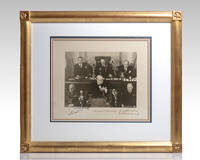
1946149606Colonial Studios 1946. Black and white photograph of Winston Churchill delivering a speech before the General Assembly of the Commonwealth of Virginia on March 8 1946 with General Dwight D. Eisenhower seated to his left. Signed in the lower margin of the photograph "Winston S. Churchill" and "Dwight D. Eisenhower." Additionally signed by Virginia Governor William M. Tuck Lieutenant Governor of Virginia Lewis Preston Collins II and Field Marshal Henry Maitland Wilson. Three days after his famous 'Sinews of Peace Iron Curtain' speech at Westminster College in Fulton Missouri on March 5 1946 Churchill traveled to the Virginia State Capitol in Richmond Virginia where he gave an address to the joint houses of the Virginia General Assembly. Flanked by General Eisenhower and Field Marshal Wilson Churchill built upon his Iron Curtain message emphasizing the importance of post-war unity by drawing historical parallels with past conflicts such as the Revolutionary and Civil Wars. A resounding applause followed the conclusion of his speech: "It is in the years of peace that wars are prevented and that those foundations are laid upon which the noble structures of the future can be built. But peace will not be preserved without the virtues that make victory possible in war. Peace will not be preserved by pious sentiments expressed in terms of platitudes or by official grimaces and diplomatic correctitude however desirable these may be from time to time. It will not be preserved by casting aside in dangerous years the panoply of warlike strength. There must be earnest thought. There must also be faithful perseverance and foresight. Great Heart must have his sword and armor to guard the pilgrims on their way. Above all among the English-speaking peoples there must be the union of hearts based upon conviction and common ideals. That is what I offer. That is what I seek." After a series of boisterous chants Eisenhower also took to the podium and addressed the assembly: "'Of all the things that supported me through three and a half years of warfare on the European continent I know of no other single thing that was of greater moral benefit than the unwavering staunch indomitable courageous support of the Prime Minister of Great Britain. It is my earnest conviction that only history can measure even remotely the true value of the worth of the service he has rendered to all of us. But I am certain that in meetings such as this with the wholehearted welcome he finds in this city from my own countrymen to him he will gain some little measure of understanding in his own time of what we think of him." In near fine condition with lightly trimmed edges and some creasing to the borders. Triple matted and framed. The photograph measures 12 inches by 10 inches. The entire piece measures 20.25 inches by 17.5 inches. An exceptional signed photograph with a highly desirable assemblage of autographs. Winston Churchill’s oratory during the Second World War played a pivotal role in sustaining British morale and fortifying resistance against Nazi Germany. His speeches combined rhetorical mastery with psychological acuity transforming language into a strategic weapon of war. Addressing the nation during its darkest hours—such as after the fall of France in 1940—Churchill’s declarations of defiance “We shall fight on the beaches…†articulated not only military determination but also a collective moral resilience. His use of repetition cadence and vivid imagery appealed to both reason and emotion forging unity across class and political divisions. Beyond mere motivation Churchill’s rhetoric effectively redefined the narrative of the war: from one of imminent defeat to one of enduring struggle for freedom and civilization. By shaping public perception and maintaining confidence in ultimate victory his speeches became integral to Britain’s psychological endurance and international standing influencing Allied cohesion and laying the groundwork for eventual triumph over totalitarianism. Colonial Studios unknown
1948016960Garden City: Doubleday & Company Inc. 1948. First Edition. Hardcover. Slight sunning to the spine about Fine lacking the slipcase. First Edition preceding the trade edition. Illustrated with drawings and photographs. There were 1426 deluxe numbered copies SIGNED by the author on the facsimile page of the D-Day Order to send the troops to storm the beaches of Normandy which begins: "You are about to embark upon the Great Crusade toward which we have striven these many months. The eyes of the world are upon you." Of those 1426 copies the first 25 were bound in full red morocco leather and put aside for Eisenhower's personal use. This is Copy #4 and in addition to having the SIGNED order is INSCRIBED by the President to his brother on the limitation page: "For my brother Edgar/In the hope that herein/he may find some small/thing to compensate him for/all the trouble caused him/by the soldier member of the/family with lasting devotion./Ike." <br/><br/>Edgar N. Eisenhower 19 January 1889 - 12 July 1971 was a lawyer and the older brother of Dwight D. Eisenhower. The two brothers were known as Big Ike Edgar and Little Ike Dwight with Edgar eventually dropping the nickname. While Dwight's golf game would garner a great deal of attention and he became a most important person in the transition of golf from play to a sport Edgar was the much better golfer winning tournaments over a 20 year span. Edgar was known as a shoot-from-the-hip ultraconservative and a vocal critic of his brother the president. Edgar criticized Ike's budgets policies and judicial nominations. When the press asked Ike about the criticism he smiled and responded that Edgar had been "criticizing me since I was 5 years old." Ike's touching inscription in this book in just a few words perfectly captures their relationship. Doubleday & Company, Inc. hardcover
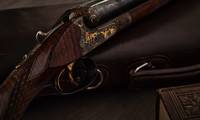
1959208191959. <blockquote><p>Perhaps the most historically important gun to reach the market; Gifts of state are themselves rare as since an Act of Congress in 1978 they have belonged to the nation and not the recipient; The magnificent shotgun another one of which was given to President Eisenhower comes with a copy of the thank you letter from McElroy to Khrushchev</p><p> </p><p>Khrushchev’s visit lessened Cold War tensions and was a major reason the Cold War did not turn hot</p><p> </p><p>""This gun is an embodiment of Nikita Khrushchev's policies in more ways than one: the diplomatic effort to make peace with the West and the domestic reforms aimed to turn the military-industrial second into profitable enterprises operating on open civilian market†says author Aleksei Morozov</p></blockquote><p>https://vimeo.com/1068197728</p><p> </p><p><strong>Provenance</strong></p><p>This gift was given by the craftsmen in Izhevsk to Premier Khrushchev who brought it from Moscow and instructed his foreign policy team to present it to Secretary of Defense Neil McElroy a gift of state meant to symbolize a detente between the two nations. It was retained by McElroy and passed to his son whose heirs sold it directly to us. It has never before been offered for sale and was not known to have survived.</p><p><strong>Rarity</strong></p><p>This is perhaps the most historically significant long gun given its symbolism as a symbolic gift of state between the two dominant 20th powers at a crucial moment in the Cold War ever offered for sale. There are no comparables on the public market. Gifts of state are themselves rare as since an Act of Congress in 1978 they have belonged to the nation and not the recipient</p><p><a href=""https://cdn.raabcollection.com/wp-content/uploads/20231204175833/rifle2.jpg""><img class=""alignnone size-post-window wp-image-20846"" src=""https://cdn.raabcollection.com/wp-content/uploads/20231204175833/rifle2-1600x600.jpg"" alt="""" width=""1600"" height=""600"" /></a></p><p><strong>Historical background</strong></p><p>In September 1959 the Soviet Premier Nikita S. Khrushchev visited the United States for about two weeks. This was the first visit by a Soviet head of state to America and was seen as a momentous occasion absolutely dominating the news at the time. Khrushchev's fundamental purpose in making the trip was to gain a better understanding of what America was and to promote mutual understanding between the Soviet Union and the United States on matters of importance to both. Khrushchev hoped that mutual understanding would eventually lead to peaceful coexistence feeling his visit would be the first step on that road. Dr. Sergei Khrushchev - the son of the late Soviet Premier who made the trip with him and became a U.S. citizen in 1999 - considers this visit to be “the beginning of the mutual interaction of the two worlds.""</p><p>On his trip Khrushchev wanted to talk about politics with President Eisenhower and his senior officials such as Secretary of Defense Neil McElroy: the need for a peace treaty between East Germany and the United States the mutual advantages that would result from the establishment of trade relations between the United States and the Soviet Union and most importantly the necessity of complete and universal disarmament. Even though the U-2 spy-plane incident in May 1960 and Berlin Wall and Cuban Missile Crisis in 1962 were setbacks the ultimate success of Khrushchev's trip the United States in 1959 was increased interaction a lessening of tensions the 1962 Nuclear Test Ban Treaty and a better comprehension of both nations’ core Cold War positions which was a major reason that the Cold War did not turn hot.</p><p>Khrushchev’s hopes to establish a mutual understanding with the United States were embodied not merely by the exchange of views on certain issues so that the two sides understood the position of the other but also understood the reasons each had for their perspectives. In Khrushchev’s mind this mutual understanding also went beyond diplomacy and extended to seeing America's people to letting them see him to becoming familiar with American culture and to experiencing what the United States had to offer. This was the success of the visit which had a significant immediate impact on the Cold War.</p><p><a href=""https://cdn.raabcollection.com/wp-content/uploads/20231204175829/rifle3.jpg""><img class=""alignnone size-post-window wp-image-20847"" src=""https://cdn.raabcollection.com/wp-content/uploads/20231204175829/rifle3-1600x558.jpg"" alt="""" width=""1600"" height=""558"" /></a></p><p>The backdrop for Khrushchev’s visit is essentially a history of the Cold War which often threatened to get hot and lead to a nuclear holocaust. Following World War II the uneasy wartime alliance between the United States and Great Britain on the one hand and the Soviet Union on the other began to unravel. By 1948 the Soviets installed communist governments in the countries of eastern Europe that had been liberated by the Red Army. The Americans and the British feared the permanent Soviet domination of eastern Europe and the threat of Soviet-influenced communist parties coming to power elsewhere. The Soviets on the other hand were determined to maintain control of eastern Europe and intent on spreading communism worldwide. The Cold War had solidified by 1947–48 when U.S. aid provided under the Marshall Plan to Western Europe had brought those countries under American influence. From 1948–53 the Soviets unsuccessfully blockaded the Western-held sectors of West Berlin; the United States and its European allies formed NATO; the Soviets exploded their first atomic warhead thus ending the American monopoly on the atomic bomb; the Chinese communists came to power in mainland China; and the Soviet-supported communist government of North Korea invaded U.S.-supported South Korea in 1950 setting off an indecisive but bloody Korean War that lasted until 1953. Josef Stalin died in 1953 triggering a power struggle in which Khrushchev emerged victorious and by 1956 he had consolidated his authority as First Secretary of the party's Central Committee. He then famously denounced the “excesses†that occurred under Stalin and declared that he sought “peaceful coexistence†with the United States.</p><p>Regarding his trip Khrushchev said he was “curious to have a look at America†and he visited not only Washington D.C. but New York California Pennsylvania Camp David and even a farm in Iowa. The trip took twelve days running from September 15-27 1959. His arrival on the 15th was followed with a motorcade from the airport to downtown Washington. Spectators and several military bands lined the way as Eisenhower Khrushchev and his wife Nina all seated in a convertible waved to the crowds. At the White House they engaged in the first of several meetings both formal and informal. These ran the gamut from frigid sessions at first to - shortly before Khrushchev’s departure - ones that were infused with a spirit of compromise. At a state dinner that first night Eisenhower said “Because of our importance in the world it is vital that we understand each other better.†Khrushchev responded by observing that friendship was necessary “because our two countries are much too strong and we cannot quarrel with each other.â€</p><p>On the 16th in D.C. for a luncheon at the National Press Club Khrushchev declared his ""sincere desire to achieve better relations between our two countries and promote peace all over the world."" On the 18th in a speech to the United Nations General Assembly Khrushchev discussed the damaging effects of the Cold War and the critical role the United Nations must play to achieve peace among the most powerful nations in the world. ""People still live in constant anxiety about peace about their future"" he said ""And how can they not feel this anxiety when now in one part of the world now in another military conflicts flare up and human blood is shed"" He ended his speech with a plea for universal disarmament: ""Let us compete in who builds more homes schools and hospitals for the people; produces more grain milk meat clothing and other consumer goods; and not in who has more hydrogen bombs and rockets. This will be welcomed by all the peoples of the world.""</p><p>Later in the trip in Pittsburgh he told a crowd “I highly value your confidence expressed in the fact that you presented me with a symbolic key of your city. I thank you and assure you that I want to be your friend and will never abuse your trust and with this key I will only open those doors which you allow me to open…†When he left on the 27th he said he has been ""enriched"" by his visit and that his talks with Eisenhower have helped both men “understand each other better.""</p><p><a href=""https://cdn.raabcollection.com/wp-content/uploads/20231204175820/rfile5.jpg""><img class=""alignnone size-post-window wp-image-20849"" src=""https://cdn.raabcollection.com/wp-content/uploads/20231204175820/rfile5-1600x537.jpg"" alt="""" width=""1600"" height=""537"" /></a></p><p>During the trip the Russians presented the Americans with a small number of symbolic gifts - tokens of friendship and good will. Novosti the Russian news agency reported on ""the list of gifts taken by the USSR delegation to America.Along with the traditional names - granular caviar a set of wine and vodka products boxes and nesting dolls - it also included carpets guns sets of LPs books by Mikhail Sholokhov in English and much more."" The gems were the magnificent decorative guns shotguns from the foremost manufacturer in the Soviet Union one presented to the President and one to Secretary of Defense McElroy. An American newspaper reported on October 11 1959 under the headline ""Eisenhower and Khrushchev have successfully negotiated†that: “One of the gifts Khrushchev brought to Eisenhower was a Russian-made double-barreled shotgun. The Soviet prime minister argued that it was superior to the best British shotguns that hunters around the world have long appreciated. The President is a good shooter and each year he finds time to hunt in the fields of Georgia with former Treasury Secretary George M. Humphrey. Half humorously half solemnly Khrushchev said that this is the only weapon that should be left in the world for the pleasure of hunters…those who witnessed it hope that a small platform for mutual understanding has appeared on which to build future negotiations…â€</p><p>Sergei Khrushchev states of his father and Eisenhower that “these two old men without resolving a single specific question made a lot of progress in the most important area the sphere of human understanding of each other. The first glimmers of trust became visible…We had to move away from the image of an enemy. It seems that this first attempt succeeded. Father produced a rather good impression on Americans. He personally believed in the American president’s desire to achieve peace and a good-neighborly relationship. The image of Eisenhower as an evil instigator of war was finally dissipated and what remained was a clever kind somewhat tired person who had seen a great deal in his life.â€</p><p>The guns were the gems of all the gifts. They were a favorite of Khrushchev and he personally selected them as gifts to the two men. In February he had gone to the Izhevsk region of Russia hundreds of miles East of Moscow where they had presented him with the long arms designed by the finest gun designers. The master engraver Avel Lekomtsev ornately carved representative hunting designs. He is considered to be the finest of the period in Russia.</p><p><strong>The artifact</strong></p><p><a href=""https://cdn.raabcollection.com/wp-content/uploads/20231204175815/rifle6.jpg""><img class=""alignnone size-post-window wp-image-20850"" src=""https://cdn.raabcollection.com/wp-content/uploads/20231204175815/rifle6-1600x602.jpg"" alt="""" width=""1600"" height=""602"" /></a></p><p>When the Russians came to US for this important visit they brought to the Secretary of Defense one of these long guns made in Izhevsk by Lekomtsev.</p><p>The metal and wood extensively engraved double barrel hammerless shotgun is in pristine condition. It is a IZH 57 for Izhevsk and the year it was designed.</p><p>The Izhevsk Mechanical Plant which a few years later became one of the most prominent civilian arms producers in the USSR exported shotguns air rifles and pistols under the Baikal brand all over the world. And yet although the maker is better known for mass-made weapons it also turned out a number of one-off samples hand-finished to the best standard — like this Izh-57. The gun is signed by the Master Gunmakers who worked on it a sign of best quality. Those include Master Engraver Avel Lekomtsev one of the best representatives of the Izhevsk Engraving School a group of artisans who blended several decorative to create unique ornamental style and techniques. The gun lists in Russian the maker and engraver: Master Assembler - V. Nesmelov; Stocker - A. Brylov; Engraver - A. Lekomtsev.</p><p>The year the gun itself was created 1959 - the year of the visit is carved into the metal. The gun also lists the bore and choke size - 17/16.5 and 17/16 millimeters - and the gauge - 16. Lekomtzev has engraved a five-pointed star in a shield the mark of Izhevsk Mechanical Plant used in the period. He has also decorated the action with images of the hunt including a gold fox with prey in its teeth scaring away in the thickets two ducks made in gold. The bird in its teeth is made in silver or white gold.</p><p>On the left side of the action a gold-colored pointing dog in the thickets makes a stand above the bird and the dawn in the sky is made using a colored gold method showing the sunrise with a transition from a golden hue below to a more contrasting shade above. The different shades of plumage of the ducks and animals create the impression of a three-dimensional image. The details of the landscapes on both sides of the action are made in silver or white gold.</p><p>Author Aleksei Morozov notes: ""The way Lekomtsev plays with differently colored gold alloys to make the duck stand out on the background of the equally golden fox is a forerunner of the way Leonard Vasev would create perhaps the best internationally known sample of Izhevsk gun school - the Lenin gun made for the 1967 World Expo in Montreal.""</p><p><a href=""https://cdn.raabcollection.com/wp-content/uploads/20231204175810/Gun8.jpg""><img class=""alignnone size-post-window wp-image-20854"" src=""https://cdn.raabcollection.com/wp-content/uploads/20231204175810/Gun8-1600x1067.jpg"" alt="""" width=""1600"" height=""1067"" /></a></p><p>The gun comes with a copy of the letter from McElroy to Khrushchev dated September 18 1959 while Khrushchev was still in America on Secretary of Defense letterhead. It states in part: “I was pleased yesterday to receive two of your representatives who brought with them some attractive gifts as well as a message from you…Of course the shotgun is handsome indeed. It offers evidence of the quality of craftsmanship of which any country could be proud. In thanking you for the shotgun may I fully reciprocate the wish expressed to me by our representatives that the firearms used in the future by our two countries need be no longer than this shotgun for the preservation of world peace and that even the shotgun be used solely for sporting purposes.â€Â McElroy's manuscript papers were donated but the gun was retained.</p><p>The choice of this gun was no triviality. In presenting the gun to McElroy the Soviet emissaries stated it was meant to symbolize Russian hopes that firearms used in the future by our two countries need be no longer than this shotgun for the preservation of world peace and that even the shotgun be used solely for sporting purposes. This token of friendship from the Soviet Union to the United States at a key moment in the Cold War is of enormous historical importance.</p> hardcover