Eisenhower, DavidBiblio.com

468 résultats
1986Q-0002177692HarperCollins Publishers 1986-12-01. Hardcover. New. In shrink wrap. Looks like an interesting title! HarperCollins Publishers hardcover
1998Q-0801856744Johns Hopkins University Press 1998-03-18. Hardcover. New. New. In shrink wrap. Looks like an interesting title! Johns Hopkins University Press hardcover
198685974New York: Random House 1986. First Edition stated presumed first printing. Hardcover. Good/Good. Anita Karl and Jim Kemp Maps. xxvii 1 977 3 pages. Principal Figures. Glossary. Bibliography. Notes. Index. DJ is in a plastic sleeve and has some wear tears and soiling. Some edge soiling. Some endpaper soiling. Inscribed by the author on the fep. Inscription reads To Doug Romagnoli With best wishes for a full life. David Eisenhower October 11 1986. This book focuses on Eisenhower's conduct of the war and provides an extensively documented analysis of the political ramifications of the course of the war and Eisenhower's decisions. Dwight David Eisenhower II born March 31 1948 is an American author public policy fellow professor at the University of Pennsylvania and eponym of the U.S. presidential retreat Camp David. He is the grandson of President Dwight D. Eisenhower and First Lady Mamie Eisenhower and a son-in-law of President Richard Nixon and First Lady Pat Nixon. He was a teaching adjunct and public policy fellow at the Annenberg School for Communication at the University of Pennsylvania author and co-chair of the Foreign Policy Research Institute's History Institute for Teachers. From 2001 to 2003 he was editor of Orbis a quarterly published by the institute. Eisenhower was a finalist for the Pulitzer Prize in history in 1987 for his work Eisenhower At War 1943-1945 about the Allied leadership during World War II. He was the host of a public television series called The Whole Truth with David Eisenhower distributed by American Public Television. Derived from a Kirkus review: The younger Eisenhower has spent some six years on this project covering only a three-year period in Ike's career. Eisenhower: At War is a work of dignified completely researched history. Three decades after Eisenhower's presidency a spate of books is being published on issues of his era or about the man. David's view is that Eisenhower's experiences in WW II were the clay he molded into his overall world view which is ultimately crucial to the understanding of his presidency. Eisenhower saw Russia's isolation as a danger to the postwar world and spent the next 15 years of his public life attempting to defuse the Cold War. When his attempts failed he warned his citizens of the consequences especially as they related to the "military-industrial complex." David Eisenhower's special status in being able to call upon his own father for firsthand information and on his father-in-law Richard Nixon's expertise in foreign matters has helped him to produce a very solid work. It is a secondary source but his interpretations are full of acumen and he doesn't shrink from uncomfortable topics such as Eisenhower's decision to allow Montgomery to go ahead with his Market Garden attack even when Ike knew that it was doomed in order to finally dispose of Monty's challenges to his authority. Nepotism in the pursuit of biography is no vice. Random House hardcover
1258005514.Ghardcover. Good. Access codes and supplements are not guaranteed with used items. May be an ex-library book. hardcover
1258492202.Ghardcover. Good. Access codes and supplements are not guaranteed with used items. May be an ex-library book. hardcover
95836Photograph of the Eisenhower family signed by Dwight D. and Mamie Eisenhower their son and daughter-in-law and only grandchild. Inscribed by Dwight D. Eisenhower "For Ken & Joyce Browne with best wishes Dwight D. Eisenhower" and signed "Mamie Doud Eisenhower." Additionally inscribed by the Eisenhowers' eldest son John and his wife Barbara "To the Brownes from Barbara and John Eisenhower" and signed by their son David Eisenhower. In fine condition. Double matted and framed. The entire piece measures 16 inches by 14.25 inches. Rare and desirable signed by members of three generations of the Eisenhower family. Dwight Eisenhower was an Army general who served as the 34th President of the United States from 1953 until 1961. He was a five-star general in the United States Army during World War II and served as Supreme Commander of the Allied Expeditionary Forces in Europe. He was responsible for planning and supervising the invasion of North Africa in Operation Torch in 1942–43 and the successful invasion of France and Germany in 1944–45 from the Western Front. In 1951 he became the first Supreme Commander of NATO. unknown
1986Sign0068New York: Random House 1986. 1st edition / 1st printing. As New. octavo. hardback with dust jacket xxvii 977pp. b/w plates appends. bibliog. index TO SEE MORE ITEMS FROM THE REX RILEY SIGNED BOOK COLLECTION PLEASE ENTER REX SIGNED INTO THE KEY WORDS FIELD Signed by David Eisenhower on ownerÕs Library Bookplate on the half-title. PHOTO available Random House hardcover
1986725NY: Random House. Very Good in Very Good dust jacket. 1986. Stated First Edition. First Printing. Hard Cover. 0394412370 . Publisher's full black cloth gilt lettering on spine blind-stamped medallion on cover fore-edge deckle. Illustrated with 24 maps several double-page. Includes Index of Principal Figures; Glossary; Bibliography extensive Notes; and Index. . Brief gift inscription on ffep otherwise unmarked tight square and clean. The unclipped dust jacket is very mildly chipped with a very small closed tear at the head of the spine. VERY GOOD/VERY GOOD. . Maps. Thick 8vo 8" to 9" tall. xxvii 977 1 pp . Random House hardcover
199114820NY: Wings Books. Very Good in Very Good dust jacket. 1991. First Edition. 1. Hard Cover. Blue cloth cover gilt lettering on spine glossary notes and extensive index. . Inscription in ink to former owner of fep little wear to head and heel of spine small mark on corner at top of pages hinge starting. The unclipped dust jacket rubbed slight wear to head and heel of spine. VERY GOOD/VERY GOOD. . B&W photgraphs and maps. xxvii 977 pp . Wings Books hardcover
2014x-0739189298Lexington Books 2014. Hardcover. New. 169 pages. 9.50x6.25x1.00 inches. Lexington Books hardcover
2016x-1498505880Lexington Books 2016. Paperback. New. reprint edition. 204 pages. 9.00x6.00x0.75 inches. Lexington Books paperback
A9781536110753Paperback / softback. New. paperback
67-0465Los Angeles: Doris Harris Autographs 1970. Facsimile of ALS by Dwight D. Eisenhower dated August 26 1952 sent to General Zachary Taylor. Reproduced in blue ink as written on Eisenhower's letterhead. One 15 x 10-3/4 inch sheet folded once to make a four-page booklet; black and white photograph of Eisenhower on first page. A vertical crease where this has been folded and some rubbing and inkstain on last page; overall Very Good. From the collection of Frederick Gale Ruffner Jr. 1926-2014 the founder of the Detroit based reference book publisher Gale Research. Los Angeles: Doris Harris Autographs, 1970. unknown
0260897116.Ghardcover. Good. Access codes and supplements are not guaranteed with used items. May be an ex-library book. hardcover
40092showing him seated in the front row of three rows of formally dressed men wearing bow ties at a conference the layers are decorated with flowers and foliage signed by Eisenhower and U Thant and one other unidentified man 6¾" x 4½" in mount 8½" x 7½" no place no date circa unknown
36269on the lower white border showing him seated in a chair that is turned away from the camera but he is looking round to face it with one hand on his knee and the other holding his glasses the border has a printed inscription 'For: The Students of Redrice School Andover England' 14" x 11" Andover no date circa Red Rice House near Andover in Hampshire was used by the military during World War II and was visited by Eisenhower in the run-up to D-Day. After the war it became home to Redrice School and Eisenhower again visited when he was in England for the funeral of Sir Winston Churchill in 1965 presenting the current photograph to the school. unknown
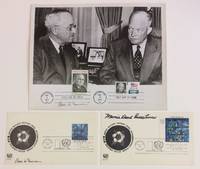
19672833361967. unbound. fine. Interesting group of three signed items by Presidents wives including: Two United Nations issued Marc Chagall Stained Glass Windows First Day Covers postmarked November 17th 1967. Separately signed by Bess M. Truman and Mamie Doud Eisenhower. Also: an original assemblage by noted autograph dealer Seymour Kessler who has used a heavy stock photograph of Presidents Truman and Eisenhower glaring at each other after a misunderstanding; customizing it into a First Day of Issue cachet for both the Truman and Eisenhower stamps released by the Post Office in 1971 and 1973. Item is boldly signed below her husband's portrait stamp by First Lady Bess M. Truman. Photographic Certificate of Authenticity from R and R Auctions Catalog 406 Item 98. Fine condition.<br/> <br/> unknown
COD-04190Golden Press. hardcover. Good. Good condition. Signed by Dolores Hope. With dust jacket with wear. Golden Press hardcover
1974Q-0307487180Golden Press 1974-01-01. Hardcover. New. New. In shrink wrap. Looks like an interesting title! Golden Press hardcover
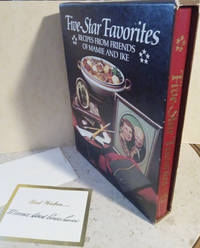
1974050846New York: Golden Press. Fine. 1974. Limited Edition. Hardcover. Large format padded red leather-like binding all edges gilt ribbon bookmark includes the original slipcase "This edition is limited to one thousand copies of which this is number 226" this copy includes the "Best Wishes" card which is signed by Mamie Doud Eisenhower wife of President Dwight Eisenhower the original envelope for the card is also present the book is in excellent condition with one insignificant flaw: a narrow 2-inch long surface-scrape on the blank front end-paper the original illustrated slipcase is in VG condition it has some edge-rubbing but is clean intact and quite presentable overall many friends contributed to this cookbook which also includes a short biography with photos of Mamie & Ike full-page color plates illustrate some of the recipes; 270 pages; Signed by Author . Golden Press hardcover
DADAX0307487180Golden Books 0000-00-00. First Edition. hardcover. New. 0.00x0.00x0.00. Buy with confidence. Excellent Customer Service & Return policy. Golden Books hardcover
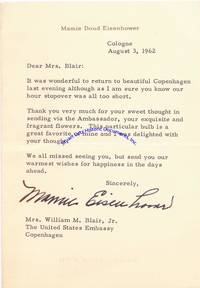
5572Former First Lady Mamie Eisenhower Writes To Ambassador Blairs Wife In Copenhagen unknown
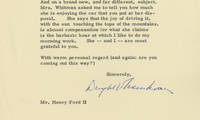
19622622630/01/1962. <blockquote><p>Ford had taken that position as a member of the President's Advisory Committee on Labor-Management Policy</p></blockquote><p> </p><blockquote><p>“I too feel that automation can result in increased productivity if intelligence is applied to the problem and if we encourage the initiative and self-reliance of the American citizen instead as seems to be the case lulling him into letting the central government take over.â€</p></blockquote><p>In the waning days of 1960 President Eisenhower prepared to leave office and hand the presidency to John F. Kennedy. Henry Ford II was a close confidant of Eisenhower’s and during his presidency provided Ike with important assistance. On three occasions Ford lent one of his senior executives Leo Beebe to the U.S. government to supervise the resettlement of refugees and manage similar projects. Beebe became executive vice chairman of Eisenhower’s Committee for Hungarian Refugees in 1956 a need that resulted from the Hungarian Revolution and subsequent flight from the country of many refugees. In addition to his committee work during 1956-1957 while working out of Camp Kilmer in northern New Jersey Beebe oversaw the relocation and resettlement of 35000 Hungarian refugees in the United States eventually finding them permanent residences in this country. In 1959-1960 Beebe organized the U.S. Center for Cuban Refugees in Miami Florida to help with the mass influx of Cuban refugees that fled Castro’s Cuba in 1960 and beyond. Ford backed the refugee aid effort all the way and it was of incalculable importance.</p><p>In 1960 Robert McNamara was President of the Ford Motor Company. Kennedy the President-elect sought to name McNamara Secretary of Defense. Ford agreed to spare McNamara yet another example of his Henry Ford II’s largess.</p><p>The friendship and collaboration of Eisenhower and Ford continued after Ike left office.</p><p>The President's Advisory Committee on Labor-Management Policy which was established by President Kennedy in February 1961 to promote free and responsible collective bargaining industrial peace sound wage and price policies higher standards of living and increased productivity. The Committee also considered policies designed to ensure that American products were competitive in world markets as well as examine the benefits and problems created by automation and other technological advances. Other topics it took on included pensions railroads taxes collective bargaining and economic recovery.</p><p>Henry Ford II president of Ford Motor Company was a member of the committee. The majority report found that automation causes unemployment. Ford dissented saying “Its major premise is the assumption that automation and technological advance are in and of themselves significant causes of unemployment—an assumption that neither history nor an analysis of current unemployment supports…The factual evidence strongly indicates that while automation displaces some individuals from jobs they have held its overall effect is to increase income and expand job opportunities. History teaches us that by and large workers displaced by technological advance have moved rapidly into other employment ultimately to better paying jobs. If…we would help persons displaced by technological advance we must focus our attention not on relief or even training though these properties properly conceived and administered will help - but on creating new jobs for people who seek them and can perform in them.â€</p><p>Eisenhower wrote Ford expressing his agreement with that dissent.</p><p><strong>Typed letter signed</strong> on his letterhead Palm Desert January 30 1962 to Henry Ford II. <em>“Arthur Burns</em> who would later become Chairman of the Federal Reserve <em>sent me a copy of the report of the President's Advisory Committee on Labor-Management Policy After reading it I want to congratulate you on your dissent. I too feel that automation can result in increased productivity if intelligence is applied to the problem and if we encourage the initiative and self-reliance of the American citizen instead as seems to be the case lulling him into letting the central government take over.</em></p><p><em>“And on a brand new and far different subject Mrs. Whitman asked me to tell you how much she is enjoying the car that you put at her disposal. She says that the joy of driving it with the sun touching the tops of the mountains is almost compensation for what she claims is the barbaric hour at which I like to do my morning work. She - and I - are most grateful to you. With warm personal regard and again: are you coming out this wayâ€</em></p><p>A very interesting opinion of Eisenhower expressing that automation is a positive good and helps workers rather than harms them.</p><p><img class=""alignnone wp-image-25018 size-post-window"" src=""https://cdn.raabcollection.com/wp-content/uploads/20231204144051/Folder-site-11-1600x1327.jpg"" alt="""" width=""1600"" height=""1327"" /></p> unknown
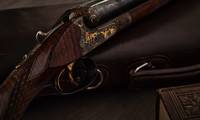
1959208191959. <blockquote><p>Perhaps the most historically important gun to reach the market; Gifts of state are themselves rare as since an Act of Congress in 1978 they have belonged to the nation and not the recipient; The magnificent shotgun another one of which was given to President Eisenhower comes with a copy of the thank you letter from McElroy to Khrushchev</p><p> </p><p>Khrushchev’s visit lessened Cold War tensions and was a major reason the Cold War did not turn hot</p><p> </p><p>""This gun is an embodiment of Nikita Khrushchev's policies in more ways than one: the diplomatic effort to make peace with the West and the domestic reforms aimed to turn the military-industrial second into profitable enterprises operating on open civilian market†says author Aleksei Morozov</p></blockquote><p>https://vimeo.com/1068197728</p><p> </p><p><strong>Provenance</strong></p><p>This gift was given by the craftsmen in Izhevsk to Premier Khrushchev who brought it from Moscow and instructed his foreign policy team to present it to Secretary of Defense Neil McElroy a gift of state meant to symbolize a detente between the two nations. It was retained by McElroy and passed to his son whose heirs sold it directly to us. It has never before been offered for sale and was not known to have survived.</p><p><strong>Rarity</strong></p><p>This is perhaps the most historically significant long gun given its symbolism as a symbolic gift of state between the two dominant 20th powers at a crucial moment in the Cold War ever offered for sale. There are no comparables on the public market. Gifts of state are themselves rare as since an Act of Congress in 1978 they have belonged to the nation and not the recipient</p><p><a href=""https://cdn.raabcollection.com/wp-content/uploads/20231204175833/rifle2.jpg""><img class=""alignnone size-post-window wp-image-20846"" src=""https://cdn.raabcollection.com/wp-content/uploads/20231204175833/rifle2-1600x600.jpg"" alt="""" width=""1600"" height=""600"" /></a></p><p><strong>Historical background</strong></p><p>In September 1959 the Soviet Premier Nikita S. Khrushchev visited the United States for about two weeks. This was the first visit by a Soviet head of state to America and was seen as a momentous occasion absolutely dominating the news at the time. Khrushchev's fundamental purpose in making the trip was to gain a better understanding of what America was and to promote mutual understanding between the Soviet Union and the United States on matters of importance to both. Khrushchev hoped that mutual understanding would eventually lead to peaceful coexistence feeling his visit would be the first step on that road. Dr. Sergei Khrushchev - the son of the late Soviet Premier who made the trip with him and became a U.S. citizen in 1999 - considers this visit to be “the beginning of the mutual interaction of the two worlds.""</p><p>On his trip Khrushchev wanted to talk about politics with President Eisenhower and his senior officials such as Secretary of Defense Neil McElroy: the need for a peace treaty between East Germany and the United States the mutual advantages that would result from the establishment of trade relations between the United States and the Soviet Union and most importantly the necessity of complete and universal disarmament. Even though the U-2 spy-plane incident in May 1960 and Berlin Wall and Cuban Missile Crisis in 1962 were setbacks the ultimate success of Khrushchev's trip the United States in 1959 was increased interaction a lessening of tensions the 1962 Nuclear Test Ban Treaty and a better comprehension of both nations’ core Cold War positions which was a major reason that the Cold War did not turn hot.</p><p>Khrushchev’s hopes to establish a mutual understanding with the United States were embodied not merely by the exchange of views on certain issues so that the two sides understood the position of the other but also understood the reasons each had for their perspectives. In Khrushchev’s mind this mutual understanding also went beyond diplomacy and extended to seeing America's people to letting them see him to becoming familiar with American culture and to experiencing what the United States had to offer. This was the success of the visit which had a significant immediate impact on the Cold War.</p><p><a href=""https://cdn.raabcollection.com/wp-content/uploads/20231204175829/rifle3.jpg""><img class=""alignnone size-post-window wp-image-20847"" src=""https://cdn.raabcollection.com/wp-content/uploads/20231204175829/rifle3-1600x558.jpg"" alt="""" width=""1600"" height=""558"" /></a></p><p>The backdrop for Khrushchev’s visit is essentially a history of the Cold War which often threatened to get hot and lead to a nuclear holocaust. Following World War II the uneasy wartime alliance between the United States and Great Britain on the one hand and the Soviet Union on the other began to unravel. By 1948 the Soviets installed communist governments in the countries of eastern Europe that had been liberated by the Red Army. The Americans and the British feared the permanent Soviet domination of eastern Europe and the threat of Soviet-influenced communist parties coming to power elsewhere. The Soviets on the other hand were determined to maintain control of eastern Europe and intent on spreading communism worldwide. The Cold War had solidified by 1947–48 when U.S. aid provided under the Marshall Plan to Western Europe had brought those countries under American influence. From 1948–53 the Soviets unsuccessfully blockaded the Western-held sectors of West Berlin; the United States and its European allies formed NATO; the Soviets exploded their first atomic warhead thus ending the American monopoly on the atomic bomb; the Chinese communists came to power in mainland China; and the Soviet-supported communist government of North Korea invaded U.S.-supported South Korea in 1950 setting off an indecisive but bloody Korean War that lasted until 1953. Josef Stalin died in 1953 triggering a power struggle in which Khrushchev emerged victorious and by 1956 he had consolidated his authority as First Secretary of the party's Central Committee. He then famously denounced the “excesses†that occurred under Stalin and declared that he sought “peaceful coexistence†with the United States.</p><p>Regarding his trip Khrushchev said he was “curious to have a look at America†and he visited not only Washington D.C. but New York California Pennsylvania Camp David and even a farm in Iowa. The trip took twelve days running from September 15-27 1959. His arrival on the 15th was followed with a motorcade from the airport to downtown Washington. Spectators and several military bands lined the way as Eisenhower Khrushchev and his wife Nina all seated in a convertible waved to the crowds. At the White House they engaged in the first of several meetings both formal and informal. These ran the gamut from frigid sessions at first to - shortly before Khrushchev’s departure - ones that were infused with a spirit of compromise. At a state dinner that first night Eisenhower said “Because of our importance in the world it is vital that we understand each other better.†Khrushchev responded by observing that friendship was necessary “because our two countries are much too strong and we cannot quarrel with each other.â€</p><p>On the 16th in D.C. for a luncheon at the National Press Club Khrushchev declared his ""sincere desire to achieve better relations between our two countries and promote peace all over the world."" On the 18th in a speech to the United Nations General Assembly Khrushchev discussed the damaging effects of the Cold War and the critical role the United Nations must play to achieve peace among the most powerful nations in the world. ""People still live in constant anxiety about peace about their future"" he said ""And how can they not feel this anxiety when now in one part of the world now in another military conflicts flare up and human blood is shed"" He ended his speech with a plea for universal disarmament: ""Let us compete in who builds more homes schools and hospitals for the people; produces more grain milk meat clothing and other consumer goods; and not in who has more hydrogen bombs and rockets. This will be welcomed by all the peoples of the world.""</p><p>Later in the trip in Pittsburgh he told a crowd “I highly value your confidence expressed in the fact that you presented me with a symbolic key of your city. I thank you and assure you that I want to be your friend and will never abuse your trust and with this key I will only open those doors which you allow me to open…†When he left on the 27th he said he has been ""enriched"" by his visit and that his talks with Eisenhower have helped both men “understand each other better.""</p><p><a href=""https://cdn.raabcollection.com/wp-content/uploads/20231204175820/rfile5.jpg""><img class=""alignnone size-post-window wp-image-20849"" src=""https://cdn.raabcollection.com/wp-content/uploads/20231204175820/rfile5-1600x537.jpg"" alt="""" width=""1600"" height=""537"" /></a></p><p>During the trip the Russians presented the Americans with a small number of symbolic gifts - tokens of friendship and good will. Novosti the Russian news agency reported on ""the list of gifts taken by the USSR delegation to America.Along with the traditional names - granular caviar a set of wine and vodka products boxes and nesting dolls - it also included carpets guns sets of LPs books by Mikhail Sholokhov in English and much more."" The gems were the magnificent decorative guns shotguns from the foremost manufacturer in the Soviet Union one presented to the President and one to Secretary of Defense McElroy. An American newspaper reported on October 11 1959 under the headline ""Eisenhower and Khrushchev have successfully negotiated†that: “One of the gifts Khrushchev brought to Eisenhower was a Russian-made double-barreled shotgun. The Soviet prime minister argued that it was superior to the best British shotguns that hunters around the world have long appreciated. The President is a good shooter and each year he finds time to hunt in the fields of Georgia with former Treasury Secretary George M. Humphrey. Half humorously half solemnly Khrushchev said that this is the only weapon that should be left in the world for the pleasure of hunters…those who witnessed it hope that a small platform for mutual understanding has appeared on which to build future negotiations…â€</p><p>Sergei Khrushchev states of his father and Eisenhower that “these two old men without resolving a single specific question made a lot of progress in the most important area the sphere of human understanding of each other. The first glimmers of trust became visible…We had to move away from the image of an enemy. It seems that this first attempt succeeded. Father produced a rather good impression on Americans. He personally believed in the American president’s desire to achieve peace and a good-neighborly relationship. The image of Eisenhower as an evil instigator of war was finally dissipated and what remained was a clever kind somewhat tired person who had seen a great deal in his life.â€</p><p>The guns were the gems of all the gifts. They were a favorite of Khrushchev and he personally selected them as gifts to the two men. In February he had gone to the Izhevsk region of Russia hundreds of miles East of Moscow where they had presented him with the long arms designed by the finest gun designers. The master engraver Avel Lekomtsev ornately carved representative hunting designs. He is considered to be the finest of the period in Russia.</p><p><strong>The artifact</strong></p><p><a href=""https://cdn.raabcollection.com/wp-content/uploads/20231204175815/rifle6.jpg""><img class=""alignnone size-post-window wp-image-20850"" src=""https://cdn.raabcollection.com/wp-content/uploads/20231204175815/rifle6-1600x602.jpg"" alt="""" width=""1600"" height=""602"" /></a></p><p>When the Russians came to US for this important visit they brought to the Secretary of Defense one of these long guns made in Izhevsk by Lekomtsev.</p><p>The metal and wood extensively engraved double barrel hammerless shotgun is in pristine condition. It is a IZH 57 for Izhevsk and the year it was designed.</p><p>The Izhevsk Mechanical Plant which a few years later became one of the most prominent civilian arms producers in the USSR exported shotguns air rifles and pistols under the Baikal brand all over the world. And yet although the maker is better known for mass-made weapons it also turned out a number of one-off samples hand-finished to the best standard — like this Izh-57. The gun is signed by the Master Gunmakers who worked on it a sign of best quality. Those include Master Engraver Avel Lekomtsev one of the best representatives of the Izhevsk Engraving School a group of artisans who blended several decorative to create unique ornamental style and techniques. The gun lists in Russian the maker and engraver: Master Assembler - V. Nesmelov; Stocker - A. Brylov; Engraver - A. Lekomtsev.</p><p>The year the gun itself was created 1959 - the year of the visit is carved into the metal. The gun also lists the bore and choke size - 17/16.5 and 17/16 millimeters - and the gauge - 16. Lekomtzev has engraved a five-pointed star in a shield the mark of Izhevsk Mechanical Plant used in the period. He has also decorated the action with images of the hunt including a gold fox with prey in its teeth scaring away in the thickets two ducks made in gold. The bird in its teeth is made in silver or white gold.</p><p>On the left side of the action a gold-colored pointing dog in the thickets makes a stand above the bird and the dawn in the sky is made using a colored gold method showing the sunrise with a transition from a golden hue below to a more contrasting shade above. The different shades of plumage of the ducks and animals create the impression of a three-dimensional image. The details of the landscapes on both sides of the action are made in silver or white gold.</p><p>Author Aleksei Morozov notes: ""The way Lekomtsev plays with differently colored gold alloys to make the duck stand out on the background of the equally golden fox is a forerunner of the way Leonard Vasev would create perhaps the best internationally known sample of Izhevsk gun school - the Lenin gun made for the 1967 World Expo in Montreal.""</p><p><a href=""https://cdn.raabcollection.com/wp-content/uploads/20231204175810/Gun8.jpg""><img class=""alignnone size-post-window wp-image-20854"" src=""https://cdn.raabcollection.com/wp-content/uploads/20231204175810/Gun8-1600x1067.jpg"" alt="""" width=""1600"" height=""1067"" /></a></p><p>The gun comes with a copy of the letter from McElroy to Khrushchev dated September 18 1959 while Khrushchev was still in America on Secretary of Defense letterhead. It states in part: “I was pleased yesterday to receive two of your representatives who brought with them some attractive gifts as well as a message from you…Of course the shotgun is handsome indeed. It offers evidence of the quality of craftsmanship of which any country could be proud. In thanking you for the shotgun may I fully reciprocate the wish expressed to me by our representatives that the firearms used in the future by our two countries need be no longer than this shotgun for the preservation of world peace and that even the shotgun be used solely for sporting purposes.â€Â McElroy's manuscript papers were donated but the gun was retained.</p><p>The choice of this gun was no triviality. In presenting the gun to McElroy the Soviet emissaries stated it was meant to symbolize Russian hopes that firearms used in the future by our two countries need be no longer than this shotgun for the preservation of world peace and that even the shotgun be used solely for sporting purposes. This token of friendship from the Soviet Union to the United States at a key moment in the Cold War is of enormous historical importance.</p> hardcover
CA13AA-00167Overlook Press. Collectible - Good. Stamford Connecticut : The Overbrook Press 1945. 1st edition. Sm 4to Paperback. 24pp. Good book. Some foxing to pages. world war 1939-1945 speeches Inquire if you need further information. Overlook Press paperback