Bayh, Birch [Eisenhower, Dwight D]Biblio.com
411 résultats
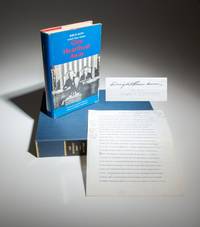
196813766Indianapolis: The Bobbs-Merrill Company Inc 1968. First Edition First Printing. Cloth. Fine/fine. Typed preface by former President Dwight D. Eisenhower for One Heartbeat Away: Presidential Disability and Succession by Senator Birch Bayh. Preface is signed by Eisenhower with handwritten notes by the editor. Includes copy of the book. Octavo ix 3 372pp. Red cloth title stamped on spine. Stated "first printing" on copyright page. This copy is unread. In the publisher's fine dust jacket. Book and documents housed in custom blue cloth clamshell case title in gilt on spine in fine condition. Includes a three-page typed preface by former President Eisenhower stapled at top left corner numerous editorial notes in pencil signed by Eisenhower in black pen on the last page. Provenance: RR Auction of Amherst NH purchased in 2022. ".because this possible peril existed Vice President Nixon and I in consultation with the Attorney General prior to my 1956 operation reduced to memorandum form our understanding as to what would be the Vice President's role in the event of a Presidential disability." - former President Dwight D. Eisenhower. The Twenty-fifth Amendment to the United States Constitution clarifies the presidential line of succession and eliminates ambiguity about the role of the Vice President. As President Eisenhower noted in his preface his signed agreement with Vice President Nixon did not have the legal authority to make Nixon the president if Eisenhower had become incapacitated during his surgeries. The death of President Kennedy brought new focus on the presidential line of succession with legislation for the Twenty-fifth Amendment proposed by Senator Bayh in 1965 and ratified by the states in 1967. The Bobbs-Merrill Company, Inc unknown
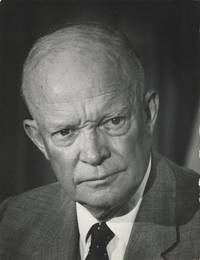
1957162948N.p.: N.p. 1957. Vintage borderless oversize portrait photograph of President Dwight D. Eisenhower 1957. Annotation in manuscript pencil on the verso noting the name of photographer Robert Phillips. <br /> <br /> Noted photojournalist Robert Phillips primarily covered US politics from the mid-1950s to the 1970s. His work is today held by the University of Texas at Austin. <br /> <br /> From the archive of the PIX Agency an American photo house that acted as an intermediary between emigre photographers as well as those still living in Europe and the American magazine and newspaper market between 1935-1969. <br /> <br /> 10.25 x 13.5 inches housed in a 20 x 16 inch 8-ply white mat. Very Good plus. N.p. unknown
1986813823Simon & Schuster. Collectible - Very Good/Very Good. 1986. First Printing. Hard Cover. Signed by Author N421 . Simon & Schuster hardcover
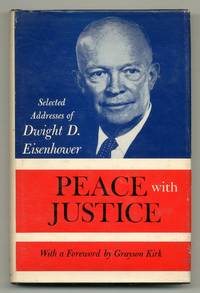
1961556061New York: Columbia University Press 1961. Hardcover. Fine/Near Fine. First edition. Foreword by Grayson Kirk. Corners very slightly bumped else fine in lightly rubbed near fine dust jacket. Columbia University Press hardcover
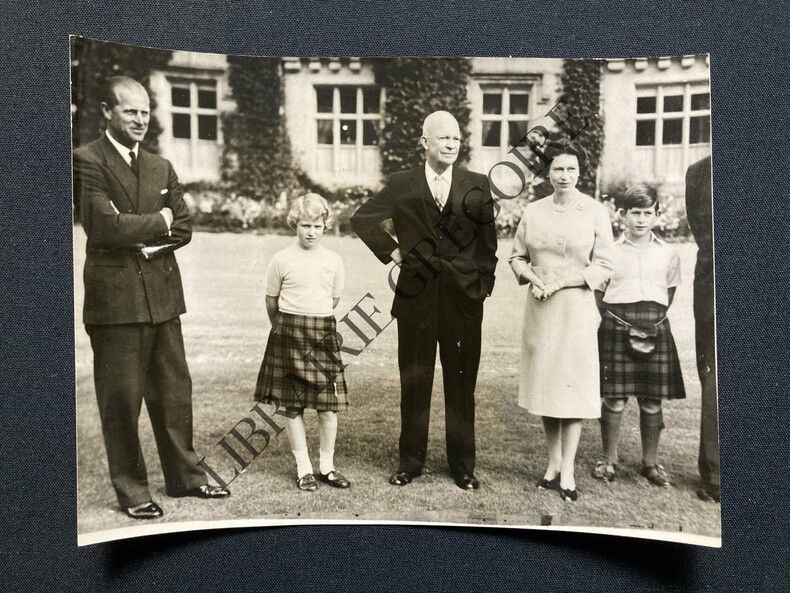
1959ABE-1739142324882TIRAGE ARGENTIQUE NOIR ET BLANC-20,5 CM X 15,5 CM-AU DOS: CACHET AGENCE ASSOCIATED PRESS-LEGENDE SUR PAPIER-(CP8)
1959174141959. Civil Rights Presidents. This 1959 AP Press photo depicts President Eisenhower shaking hands with the wife of civil rights leader George M. Johnson. Original photo dated June 9 1959 with inscription on verso. 9" x 7" inches. Johnson was the newest member of the Civil Rights Commission an organization created in 1957 to study and advocate for social equality for minorities in America. He was an African-American attorney and academic who was appointed to the commission and had an interracial marriage with his wife Evelyn which was quite rare and controversial in that era. Ike and the Johnsons are pictured in the White House and wear wide smiles. This photo has a 2" x 1" inch white-out patch adjacent to George Johnson's face. Has AP caption at right side margin. Overall in very good condition. unknown
1950D7442probably late 1950s. Ephemera. Very Good. Black-and-white photograph silver gelatin print 8x10 inches with thin white border; capturing Eisenhower in a squinty laugh standing amongst 3 other men. It's inscribed on the back "To Mr. Sutnar with a reminder that if you need anything -- I know big people / Lauther Carrer." Two faint pencil marks in the top border; a little faint soiling on the back. <br/><br/> unknown
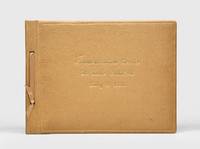
19511604641951. Commemorating the American fallen A compelling album apparently made by the family of a fallen serviceman and therefore unique commemorating Eisenhower's presentation of the Roll of Honor to St Paul's Cathedral. The roll lists the 28000 American soldiers stationed in Britain who gave their lives in the Second World War. The album includes large-format photographs of the military procession to the ceremony; attendees entering the cathedral including Churchill Mountbatten Attlee the Queen Mother and Princess Elizabeth Eisenhower and Curtis LeMay; photographs of the service including the congregation singing hymns and the sermon by the Archbishop of Canterbury; and Eisenhower leaving the Cathedral. The ceremony was held on Independence Day. Eisenhower delivered a message: "Each name inscribed in this book is a story of personal tragedy and a grieving family; a story repeated endlessly in white crosses girdling the globe. The Americans whose names here appear were part of the price that free men have been forced a second time to pay in this century to defend human liberty and rights". The album includes a copy of a page from the roll listing names from Hiltabidle to Hitchings - presumably the album was made by the family of someone listed there. We could trace no other similar album. In 1958 the American Memorial Chapel was completed in a part of the cathedral that a bomb had hit in 1940. The roll now resides there and a page is turned each day to show different names. Landscape quarto album 318 x 419 mm. Four letterpress leaves partly printed in gilt comprising title excerpt from the Archbishop of Canterbury's address Eisenhower's introduction to the Roll of Honour and copy of page from roll all with acetate covers. Tan leatherette front cover lettered in blind "Commemoration Service - St. Paul's Cathedral - July 4. 1951." cord-bound cord recently renewed 33 heavy card leaves with 28 mounted black and white silver gelatin press photographs 203 x 254 cm most captioned by hand. Binding neatly restored and consolidated the photographs in sharp unblemished condition slight discolouration around letterpress leaves. In very good condition. hardcover
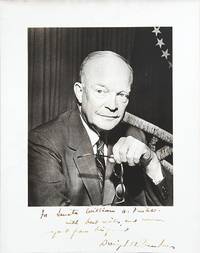
19531581571953. A notable portrait presented to a prominent early supporter Inscribed by the president "For Senator William A. Purtell with best wishes and warm regard from his friend Dwight D. Eisenhower"; an appealing image of a pensive Eisenhower by renowned Capitol Hill photographer George Tames taken in the White House as Eisenhower announced the truce ending the Korean War. Purtell 1897-1978 served as Republican Senator for Connecticut in 1952 and from 1953 to 1959. He was one of the earliest Connecticut Republicans to support Eisenhower's run for the presidency. In turn Purtell's success in the November 1952 Connecticut senatorial election rode on the back of the strong public support for Eisenhower in the simultaneous presidential election; Purtell allied himself closely to Eisenhower's campaign platform. "A strong supporter of President D. Eisenhower's policies Senator Purtell was also a staunch American who liked to say: 'we have the finest country the finest system of society and the finest government in the world'" New York Times obituary 1 June 1978. The photographer George Tames 1919-1994 worked for the New York Times on Capitol Hill and in Washington from 1945 to 1985 taking many shots which became iconic. He took the photograph after Eisenhower's joint radio and television address to the nation announcing the signing of the Korean Armistice 26 July 1953. Interestingly this image would have been familiar to millions of Americans through its use on the 6 cent stamp issued in 1970. Official photograph taken by George Tames 358 x 280 mm copyright notice to verso stating reproduction by the Signal Corps of the US Army. Dark oak frame with conservation acrylic glazing 427 x 351 mm. Slight cockling inscription a little faded but still clearly legible very good. unknown
1950517061950. EISENHOWER Dwight D. INTERNATIONAL NEWS PHOTOGRAPH. Photo taken by Maurice Johnson December 12 1950. Former General Dwight D. Eisenhower is shown on his arrival in Washington for a conference with Admiral Forrest P. Sherman former Cheif of Naval Operations. Black and white photo measuring 7" x 9" attached to paper board along with typed insert describing his affairs. Two small creases to photo at top and bottom corner else fine. unknown books
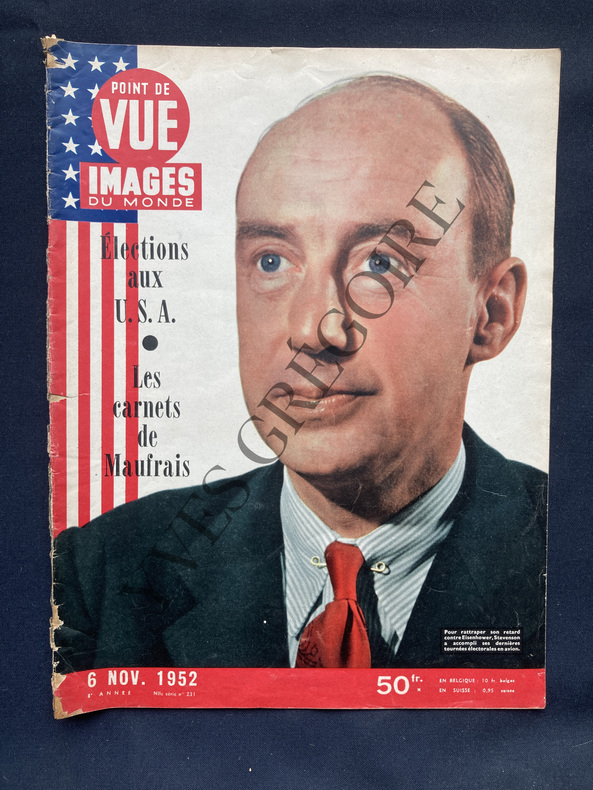
1952ABE-1549284937627EN COUVERTURE "POUR RATTRAPER SON RETARD CONTRE EISENHOWER, STEVENSON A ACCOMPLI SES DERNIERES TOURNEES ELECRORALES EN AVION", GROS PLAN COULEURS-ENTREE EN FONCTIONS: 20 JANVIER 1953, ELECTIONS PRESIDENTIELLES AMERICAINES, 9P, DESSIN DE SENNEP-LE DERNIER ALLIE DE LA MEDECINE: LE FROID, 3P, 4 PHOTOS-LES TRAVAILLEURS DE LA JOIE, REPORTAGE DE JOHN CRAVEN, FORAINS, 8 PAGES, 27 PHOTOS-CHARLOT EN AVION CHARLOT A PARIS POUR LA 4e FOIS, 2P, 12 PHOTOS, REPORTAGE BRODSKY-LA MODE LES JEUNES FILLES, 1P, 4 PHOTOS (BRIGITTE BARDOT, FRANCOISE ARNOUL)-EN 4 DE COUVERTURE "DES MILLIERS DE KILOMETRES, DES CENTAINES DE DISCOURS, BILAN DE LA LUTTE D'EISENHOWER CONTRE STEVENSON", GROS PLAN COULEURS
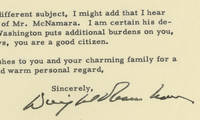
19602101927/12/1960. <p>“I doubt if you realize just how much you have helped me carry on the official work of government…â€</p><p>In the waning days of 1960 Eisenhower prepared to leave office and hand the presidency to John F. Kennedy. Henry Ford II was a close confidant of Eisenhower’s and during his presidency provided Ike with important assistance. So as he said farewell to the presidency Ike wanted to tender to Ford his heart-felt thank you.</p><p>On three occasions Ford lent one of his senior executives Leo Beebe to the U.S. government to supervise the resettlement of refugees and manage similar projects. Beebe became executive vice chairman of Eisenhower’s Committee for Hungarian Refugees in 1956 a need that resulted from the Hungarian Revolution and subsequent flight from the country of many refugees. In addition to his committee work during 1956-1957 while working out of Camp Kilmer in northern New Jersey Beebe oversaw the relocation and resettlement of 35000 Hungarian refugees in the United States eventually finding them permanent residences in this country. In 1959-1960 Beebe organized the U.S. Center for Cuban Refugees in Miami Florida to help with the mass influx of Cuban refugees that fled Castro’s Cuba in 1960 and beyond. Ford backed the refugee aid effort all the way and it was of incalculable importance.</p><p>In 1960 Robert McNamara was President of the Ford Motor Company. Kennedy the President-elect sought to name McNamara Secretary of Defense. Ford agreed to spare McNamara yet another example of his largess.</p><p>Ford Motor Co. required its top executives to use private aircraft for business and personal travel. We see in this letter that he also served Eisenhower by providing private jet transportation to and from meetings.</p><p><strong>Typed letter signed</strong> on White House letterhead Washington December 27 1960 to Henry Ford II. <em>“As the end of my Administration approaches I want once again to express to you and through you to your associates the appreciation I personally feel and which is shared by the members of the White House staff who normally travel with me of the many courtesies that have been extended to us not only during 1960 but through all the years here. I doubt if you realize just how much you have helped me carry on the official work of government by making transportation available to the key personnel who must be with me but are necessarily scattered during any one of the so-called ‘work-vacation’ trips I have taken. I assure you however that without your cooperation it would have been exceedingly difficult for me to carry out my responsibilities and still get some periods of relaxation. I shall be lastingly grateful to you and your officials in the various places we have visited with some regularity and at some length.</em></p><p><em>“On a totally different subject I might add that I hear good reports of Mr. McNamara. I am certain his departure for Washington puts additional burdens on you but as always you are a good citizen.</em></p><p><em>“With best wishes to you and your charming family for a fine 1961 and warm personal regard Sincerely Dwight D. Eisenhower.â€</em></p><p>This letter is the first valedictory of Eisenhower’s we can recall seeing and it remained in the Ford family until 2020. It has never before been offered for sale.</p><p><img class=""alignnone wp-image-25018 size-post-window"" src=""https://cdn.raabcollection.com/wp-content/uploads/20231204144051/Folder-site-11-1600x1327.jpg"" alt="""" width=""1600"" height=""1327"" /></p> unknown
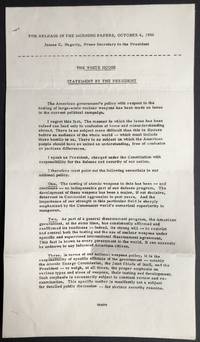
1956H35632Washington DC: The White House 1956. Very good. 14 x 8 inches 3 sheets stapled with Eisenhower's statement on the testing of nuclear arms with a committment to testing them stil further which had bipartisan support along with Eisenhower's reaffirmation that his committment is also to peace and de-escalation of Cold War tensions. We could not locate this on Worldcat. The White House unknown
19581012260023National Archives of the U.S 1958. Hardcover. Like New. 4to. Clean unmarked pages. Good binding and cover. Hardcover. Ships daily. National Archives of the U.S hardcover
195869212Washington DC: U. S. Government Printing Office 1958. Presumed first edition/first printing. Second volume in series. Hardcover. Good. No dust jacket. Cover has some wear and soiling. Corners bumped. xxxiv 1220 pages. Includes index. Frontis. List of items The was published by the Federal Register Division National Archives and Records Service General Services Administration. From Wikipedia: "The Public Papers of the Presidents contain the papers and speeches of the Presidents of the United States that were issued by the Office of the Press Secretary. The series constitutes a special edition of the Federal Register. The Public Papers of the Presidents series was begun in 1957 in response to a recommendation of the National Historical Publications Commission. An extensive compilation of messages and papers of the Presidents covering the period 1789 to 1897 was assembled by James D. Richardson and published under congressional authority between 1896 and 1899. Since then various private compilations have been issued but there was no uniform publication comparable to the Congressional Record or the United States Supreme Court Reports. Many Presidential papers could be found only in the form of mimeographed White House releases or as reported in the press. The Commission therefore recommended the establishment of an official series in which Presidential writings addresses and remarks of a public nature could be made available. The Commission s recommendation was incorporated in regulations of the Administrative Committee of the Federal Register issued under section 6 of the Federal Register Act 44 U.S.C. 1506 which may be found in title 1 part 10 of the Code of Federal Regulations." The Public Papers series is compiled and published by the Office of the Federal Register National Archives and Records Administration. Each volume generally covers a 6-month period of a given administration and presents content in chronological order with headings providing the dates of the documents or events. In instances when the release date differs from the date of the document itself the date of public release is shown in the textnote. Remarks are checked against an audio recording if available or read aloud against official transcripts if no audio source is available and issued documents are checked against the original with exacting attention paid to preserving the integrity of the signed document. Textnotes and cross references are provided by the editors for purposes of identification or clarity usually of notable people referred to by the President or others participating in an event. Speeches are assumed to have been delivered in Washington DC unless otherwise indicated in the item heading. The times noted are assumed to be local times. All materials printed in full text in the book are indexed in the subject and name indexes and listed in the document categories list. With few exceptions deceased people are not indexed by name. The notes are intended for the general reader and specific criteria govern decisions about inclusion in or exclusion from the note with an eye toward keeping references standardized succinct and useful. U. S. Government Printing Office hardcover
19531704250042US Government Printing Office 1/1/1953. Hardcover. Good. 8 volume complete set. 26 cm. Hardcover. Good binding and cover. Some volumes Library of Congress stamps. v. 1 Jan. 20 to Dec. 31 1953.--v. 2 Jan. 1 to Dec. 31 1954.--v. 3 Jan. 1 to Dec 31 1955.--v. 4 Jan. 1 to Dec. 31 1956.--v. 5 Jan. 1 to Dec. 31 1957.--v. 6 Jan. 1 to Dec. 31 1958.--v. 7 Jan. 1 to Dec. 31 1959.--v. 8 Jan. 1 1960 to Jan. 20 1961. This is an oversized or heavy book that requires additional postage for international delivery outside the US. US Government Printing Office hardcover
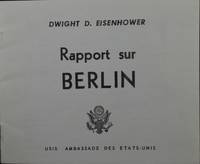
19591394Paris: USIS/Ambassade des États-Unis 1959. First Edition First Printing. Oblong 16mo 6 1/4 x 5 1/4 inches 160 x 130 mm 19 1 pages in stapled white wrappers. Wrappers a bit soiled and showing a little edge wear interior pages clean and bright. A Very Good or better copy. Text of an address by President Dwight Eisenhower on March 16 1959 about the growing crisis in Berlin. French text issued by the U.S. Information Service and the U.S. Embassy in Paris. The Soviets had demanded Western forces pull out of West Berlin a demand rejected by the U.S. Britain and France. In his speech Eisenhower says that the crisis was provoked by the Soviet Union and that the West must confront Soviet imperialism. "We shall continue to exercise our right of peaceful passage to and from West Berlin" he says. "We will not be the first to breach the peace. It is the Soviets who threaten the use of force to interfere with such free passage. We are ready to participate fully in every sincere effort at negotiation that will respect the existing rights of all and their opportunity to live in peace." Page 10 translated from the French. OCLC WorldCat shows three institutional holdings all in France. No other copies in commerce as of July 27 2017. A rare bit of Cold War ephemera. RARE. <br/><br/> USIS/Ambassade des États-Unis unknown
19591394Paris: USIS/Ambassade des États-Unis 1959. First Edition First Printing. Oblong 16mo 6 1/4 x 5 1/4 inches 160 x 130 mm 19 1 pages in stapled white wrappers. Wrappers a bit soiled and showing a little edge wear interior pages clean and bright. A Very Good or better copy. Text of an address by President Dwight Eisenhower on March 16 1959 about the growing crisis in Berlin. French text issued by the U.S. Information Service and the U.S. Embassy in Paris. The Soviets had demanded Western forces pull out of West Berlin a demand rejected by the U.S. Britain and France. In his speech Eisenhower says that the crisis was provoked by the Soviet Union and that the West must confront Soviet imperialism. "We shall continue to exercise our right of peaceful passage to and from West Berlin" he says. "We will not be the first to breach the peace. It is the Soviets who threaten the use of force to interfere with such free passage. We are ready to participate fully in every sincere effort at negotiation that will respect the existing rights of all and their opportunity to live in peace." Page 10 translated from the French. OCLC WorldCat shows three institutional holdings all in France. No other copies in commerce as of July 27 2017. A rare bit of Cold War ephemera. RARE. <br/><br/> USIS/Ambassade des États-Unis unknown books
1973238994Houston Texas: Privately printed 1973. No. 13 of 30 copies. 2 27 pp.; 88 ff. facsimiles of correspondence; 127 pp. transcript of interview. 1 vols. 8vo. Black buckram titled in silver. Bottom corners bumped else fine. No. 13 of 30 copies. 2 27 pp.; 88 ff. facsimiles of correspondence; 127 pp. transcript of interview. 1 vols. 8vo. Eisenhower's National Security Advisor Recalls 'Ike'. "The searing candor which he brought to every issue bespoke his basic honesty."<br/><br/>Memoir of Dillon Anderson's long association with President Dwight D. Eisenhower. Anderson was Eisenhower's Special Assistant for National Security Affairs in 1955-1956 a post created by Eisenhower: "not exactly household words then. In recent years Henry Kissinger has enlarged considerably the scope and visibility of the role."<br/><br/>The memoir is organized in four parts: first the "principal elements" of talks on Eisenhower that Anderson gave in early 1972; second facsimiles of their correspondence from early 1950 through 1969; third a facsimile of Eisenhower's handwritten notes when he articulated the Open Skies Proposal at the Four Power Summit in Geneva 1955; and fourth the transcript of a substantial interview with Anderson conducted by John Luter of the Columbia University Oral History Project.<br/><br/>Inscribed from the author "For Mary and Norris Darrell with appreciation and affection Sincerely Dillon Anderson Sept. 1973". Privately printed unknown books
1946016370His majesty's stationery office. Very Good. Soft cover. 1st Edition. 1946. His majesty's stationery office paperback
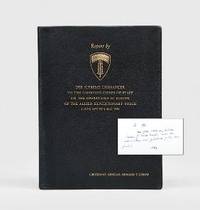
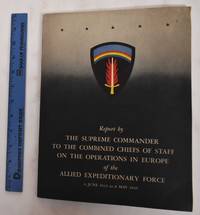
1946190508Washington DC: US Government Printing Office 1946. Presented to his "oldest and best friend" a key commander at D-Day First edition presentation copy specially bound for Leonard T. Gerow and inscribed by Eisenhower on the initial blank "To 'Gee' one of the outstanding battle leaders of World War II with the admiration and gratitude of his old friend Ike". Gerow 1888-1972 was in command of the V Corps at Omaha Beach on D-Day and became the first American general to enter Paris after its liberation in 1944. "Gerow was his oldest and best friend in the theater and V Corps headquarters would provide a haven in moments of anxiety more than once" Eisenhower p. 176. The careers of the two men were closely intertwined. "Eisenhower and Gerow were opposites. Gerow trim and meticulous was a chronic worrier. Eisenhower hale and robust had a gregarious and confident manner. But the two men shared similar thinking and tastes and had similar prewar professional reputations as staff officers. In the summer of 1916 Eisenhower and Gerow had first served together in the 19th Regiment based at San Antonio. In 1926 they had been classmates at the Leavenworth Command and General Staff School. They had formed a two-man study group in Eisenhower's tiny attic" Eisenhower pp. 176-7. It was Gerow that introduced Eisenhower to his future wife Mamie. Gerow originally headed the War Plans Division until the role was reassigned to Eisenhower due to Gerow's failure to foresee Pearl Harbour. Eisenhower was gracious to Gerow acknowledging it was only fortune that led to his taking the position; afterwards Eisenhower's career was to inevitably eclipse that of his old friend but Gerow still rose to a highly respected position eventually leading the Fifteenth and Second Armies. The book prints Eisenhower's official report of his role leading the Allied liberation of western Europe and the defeat of Nazi Germany. Eisenhower had copies bound for presentation to close family and military leaders the Eisenhower library have his brother's copy in the same binding; we could trace no other example on the market. Folio. Original black morocco front cover lettered in gilt silk endpapers. Housed in a custom black cloth solander box. With 11 colour maps of European battle theatres. Spine and front inner hinge neatly repaired light rubbing and wear at extremities. A very good copy. David Eisenhower Eisenhower at War 1986. hardcover
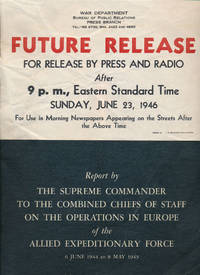
194645447Washington DC: Government Printing Office 1946. Paperback. 4to. Stiff pictorial wrappers. x 123pp. Maps. Very good. Faint wear to outer wrappers only -- tight and internally fine. Handsome first edition of Dwight Eisenhower's 13 July 1945 report. Top half of front wrapper bears an interesting tipped-on "War Department Bureau of Public-Relations" notice titled "FUTURE RELEASE" in large red typeface presenting this report "For Release by Press and Radio After 9 p.m. Eastern Standard Time Sunday June 23 1946 For Use in Morning Newspapers Appearing on the Streets After the Above Time. Government Printing Office paperback
1946027927Washington: United States Printing Office 1946. xi 123p. colored maps original stiff wrappers quarto format. United States Printing Office unknown
1946027927Washington: United States Printing Office 1946. xi 123p. colored maps original stiff wrappers quarto format. United States Printing Office unknown books
1946178710Washington DC: United States Government Printing Office 1946. Softcover. VG- some scuffs on wraps and shelf wear owner's inscription and tear on FFEP otherwise clean and tight. Gray wraps with color illustration. x 123 pages: diagrams maps. Operation Overlord was the codename for the Battle of Normandy the Allied operation that launched the successful invasion of German-occupied Western Europe during World War II. The operation was launched on 6 June 1944 with the Normandy landings. A 1200-plane airborne assault preceded an amphibious assault involving more than 5000 vessels. Nearly 160000 troops crossed the English Channel on 6 June and more than two million Allied troops were in France by the end of August. The Falaise Pocket or Battle of the Falaise Pocket German: Kessel von Falaise; 1221 August 1944 was the decisive engagement of the Battle of Normandy in the Second World War. A pocket was formed around Falaise Calvados in which the German Army Group B with the 7th Army and the Fifth Panzer Army formerly Panzergruppe West were encircled by the Western Allies. The battle is also referred to as the Battle of the Falaise Gap after the corridor which the Germans sought to maintain to allow their escape. The battle resulted in the destruction of most of Army Group B west of the Seine which opened the way to Paris and the Franco-German border for the Allied armies on the Western Front. The Battle of the Bulge also known as the Ardennes Counteroffensive was the last major German offensive campaign on the Western Front during World War II and took place from 16 December 1944 to 25 January 1945. It was launched through the densely forested Ardennes region of Wallonia in eastern Belgium northeast France and Luxembourg towards the end of the war in Europe. The offensive was intended to stop Allied use of the Belgian port of Antwerp and to split the Allied lines allowing the Germans to encircle and destroy four Allied armies and force the Western Allies to negotiate a peace treaty in the Axis powers' favor. United States Government Printing Office unknown books