[RÉSISTANCE]Livre Rare Book
[RÉSISTANCE]Livre Rare Book
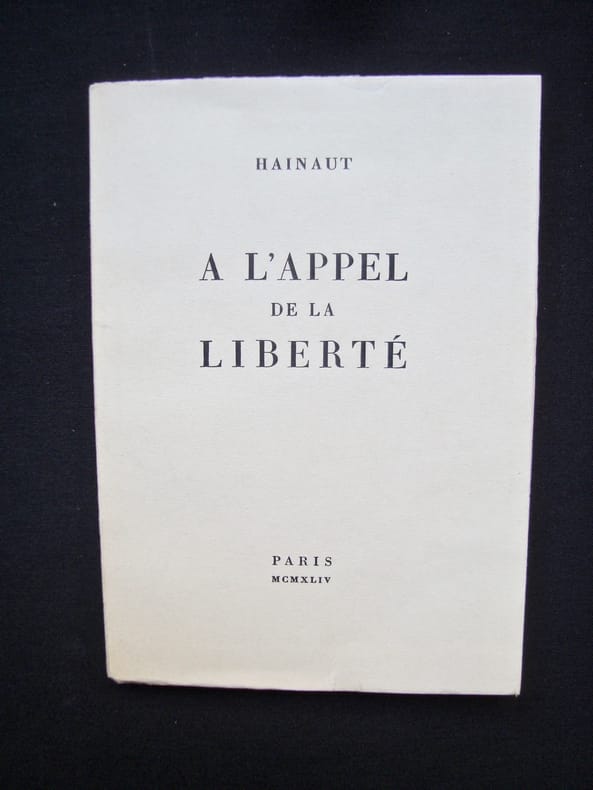
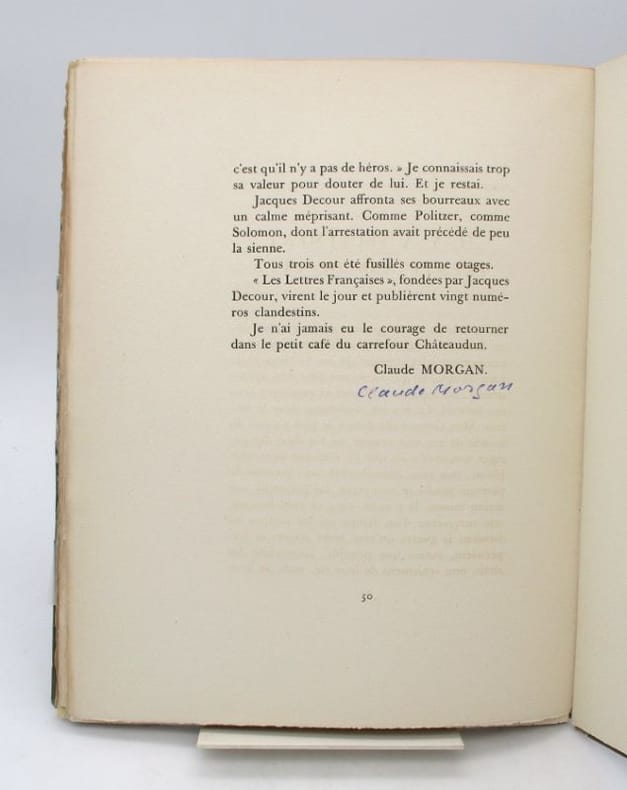
Palmes. Hommage à la Résistance P.T.T.
18053Paris, s.n., 1945. In-4, 62 pp., broché, couverture originale imprimée (légère insolation, décharges).
L'Ancienne Librairie · Paris, France900,00 €
1 821 résultats
194429035Paris, n° 1 et 2, juin et juillet 1944 ; Paris, Éditions de la Jeune Parque, nouvelle série, n° 1 à 6, décembre 1944 - avril 1945. 2 plaquettes (105 x 135 mm) de 16 et 16 p. ; puis 5 vol. (135 x 185 mm) de 82, 87, 83, 85 et 139 p. Brochés. Collection complète de cette importante revue fondée dans la clandestinité par Paul Éluard. Les deux premiers numéros, clandestins, sont particulièrement rares.
242379Lanzac [Lot], mars 1945 in-8, 48 pp., avec des illustrations photographiques de Robert Doisneau dans le texte, 16 pp. de poésies sur papier noisette, broché, sans les couvertures.
194523042Lyon, Editions de la voix du Peuple, (25 janvier) 1945. 1 vol. oblong (210 x 135 mm) non paginé. Broché. 24 pages de musique notée avec chacune une illustration de G. Manillier.
18053Paris, s.n., 1945. In-4, 62 pp., broché, couverture originale imprimée (légère insolation, décharges).
1961008040Paris Galerie Daniel Cordier 1961 In-8 en hauteur Un feuillet plié Edition originale
194525455Paris, Éditions de Minuit, coll. « Témoignages », (12, 15 et 17 septembre) 1945 3 vol. (115 x 165 mm). Brochés, sous couvertures orangé. Première édition publique. Toulon ; Le Crime contre l'esprit ; L'Armistice.
201802811Lyon, Imprimerie Rivet, 1978 ; in-8, 400 pp., broché, couverture illustr. 45 photos et 13 croquis - broché bel état.
1945LFA-126737534Un ouvrage de 157 pages, format 170 x 235 mm, illustré + une carte dépliable, broché couverture couleurs, publié en 1945, Impr. Réunies de Chambéry, bon état, rare
2009LFA-126719108Bulletin de 232 pages, format 165 x 250 mm, illustré, Société d'Etudes des Hautes-Alpes (Gap) fondée en 1881, publié en 2009
1984LFA-126719490LXXXVe année - 3e Trimestre 1984 : 106 pages, format 185 x 230 mm, broché, illustré, bon état
2000LFA-126719593CIe année - 2e Trimestre 2000 : 122 pages, format 185 x 230 mm, broché, illustré, bon état
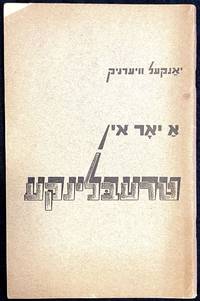
194443339Nyu-York: Farlag 1944. 1st American Edition. Paper Wrappers 8vo 61 pages. Includes illustrations. 22 cm. In Yiddish. Title translates as "A Year in Treblinka." Translation of Rok w Treblince. <br> <br> Jankiel Yankel Yaakov or Jacob Wiernik 1889-1972 was a "Polish-Jewish Holocaust survivor who was an influential figure in the Treblinka extermination camp resistance. He had been forced to work as a Sonderkommando slave worker there where an estimated 700000-900000 people mostly Jews were murdered. After his escape during the uprising of 2 August 1943 Wiernik reached Warsaw and joined the resistance. He also wrote a clandestine account of the camp's operation A Year in Treblinka which was copied and translated for printing in London and the US in English and Yiddish.<br> Following World War II Wiernik testified at Ludwig Fischer's trial in 1947. He left Poland emigrating first to Sweden and then to the new state of Israel. In 1961 he testified at Adolf Eichmann's trial in Jerusalem. He returned to Poland in 1964 to attend the opening of the Treblinka Memorial. Wiernik died in Israel in 1972 at the age of 83.<br> On his arrival at Treblinka aboard the Holocaust train from Warsaw Wiernik was selected to work as a Sonderkommando; otherwise he would have been immediately gassed and killed that day. Wiernik's first job with the Sonderkommando required him to drag corpses from the gas chambers to mass graves. He was traumatized by his experiences and later wrote in his book: 'It often happened that an arm or a leg fell off when we tied straps around them in order to drag the bodies away.'<br> He remembered the horrors of the enormous pyres where '10000 to 12000 corpses were cremated at one time.'<br> He was also encouraged by occasional scenes of brave resistance. In chapter 8 he describes seeing a naked woman escape the clutches of the guards and leap over a three-metre high barbed wire fence unscathed. When accosted by a Ukrainian guard Trawniki on the other side she wrestled his machine gun out of his grasp killed the guard and shot another guard before being killed herself.<br> When the SS recognized that Wiernik was a professional carpenter they put him to work constructing various camp structures including additional gas chambers. Given his skills Wiernik was not subjected to the same treatment as others and no longer had to handle dead bodies. He attributed his survival to being able to build structures needed in the camp. Given the shortage of skilled construction workers accustomed to the killing process Wiernik moved between the two divisions of the camp frequently. As a result he became an important contact between the camp zones when the revolt was being planned.<br> Wiernik escaped Treblinka during the revolt of the prisoners on 'a sizzling hot day' of August 2 1943. A shot fired into the air signaled that the revolt was on. Wiernik wrote that he 'grabbed some guns' and after spotting an opportunity to make a break for the woods an axe. A camp guard in pursuit shot Wiernik with a pistol but the bullet did not penetrate his skin. Wiernik said he turned around and killed his pursuer with the axe. Wiernik continued to Warsaw hiding in a freight train.<br> Wiernik assumed the name of Jan Smarzynski. He made contact with members of the Jewish underground working in the 'Aryan' part of Warsaw. They realized he was a valuable eyewitness of the extermination process in Treblinka. He was persuaded in late 1943 to write A Year in Treblinka in spite of his initial reluctance Wiernik had little education and was not a skilled writer.<br> He took part in the 1944 Warsaw Uprising fighting in the Armia Ludowa. After the end of World War II Wiernik initially remained in Poland in 1947 he testified in the trial of Ludwig Fischer. He emigrated to Sweden and afterwards to the newly founded state of Israel.<br> There in the 1950s Wiernik built a model of the Treblinka camp. It is displayed in the Ghetto Fighters' House museum in Israel. In 1961 Wiernik testified in the Eichmann trial in Israel.<br> Jankiel Wiernik published Rok w Treblince A Year in Treblinka in 1944 as a clandestine booklet. It was printed through the efforts of the Jewish National Committee Zydowski Komitet Narodowy ZKN Bund underground organizations of the remnants of Polish Jews and the Polish Council to Aid Jews Zegota by means of an underground printer organized by Ferdynand Arczynski. The circulation was estimated by Wladyslaw Bartoszewski as 2000 copies. It was sent through Polish underground channels to London and translated into English and Yiddish. It was also printed in the US by American representatives of the General Jewish Workers Union of Poland ie. this copy. The book recounts his experiences in the Treblinka extermination camp between 1942 and 1943" Wikipedia.<br> SUBJECTS: Holocaust Jewish 1939-1945 -- Poland. Jews -- Poland -- Biography. OCLC: 12246244. Some toning touch or corner wear to covers otherwise Very Good Condition. Nice copy of this very important contemporary account of Treblinka. B HOLO2-50-20A-XXLE-IMMBBE@-'gg. Nyu-York: Farlag unknown
1943LFA00bfdUn ouvrage de 292 pages, format 200 x 130 mm, illustré, relié cartonnage, publié en 1943, Librairie Générale (Paris)
2019LFA-126747457Une revue de 98 pages, format 210 x 300 mm, illustrée, brochée couverture couleurs, publiée en 2019, bon état
201902680Epinal, Editions du sapin d'or, 1980 ; in-8, 228 pp., br. Broché état correct bon des usures.
201506658Épinal, Editions du sapind'or, 1982 ; in-8, 228 pp., br. En superbe état broché.
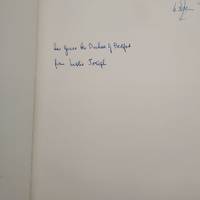
196868144Newport England: The Ceramic Book Company 1968. First edition inscribed association copy. Leather Bound. Very Good . SIGNED by W. D. John and inscribed by Leslie Joseph. 97 pages of text. Quarto 31 cm Elegantly bound by Brian Frost and Company Bath England in brown leather with raised bands a gilt stamped title and floral designs on the spine and double gilt ruled borders on the boards. Turn-ins gilt. With very light wear to the extremities including an almost invisible moisture ring to the front board. The pages are clean and bright. With one hundred and eighty illustrations of which forty are in color. One in an edition limited to 1000 copies.<br /> <br /> Billingsley is considered one of the foremost names in British porcelain. His remarkable ceramic achievements and accomplishments have been recognized and held in high esteem continuously by both aficionados and technical specialists alike since the year 1790 when as a young craftsman at the renowned Derby China Factory he was suddenly called upon to assume the role of head flower painter in completing an important order for the matching of some valuable early Chelsea plates with profuse botanical plant decoration. <br /> <br /> This copy is signed by W. H. John on the front flyleaf. It is also inscribed by Sir Leslie Joseph to the Duchess of Bedford Nicole Russell: "Her Grace the Duchess of Bedford from Leslie Joseph." Nicole Russell 1920-2012 was one of the first female television producers in France working on projects which included "The Adventures of Sherlock Holmes." Also notable is the fact that she had been a courier for the Resistance in Paris during the Second World War. In 2003 Russell spent some time living in Santa Fe New Mexico. According to Anne Constable The Santa Fe New Mexican while living in Santa Fe she Russell wrote to Queen Elizabeth II suggesting that fake fur be substituted for the bear skin used in the hats worn by her guards. Her memoir published in 1975 was titled "Nicole Nobody. The Ceramic Book Company unknown
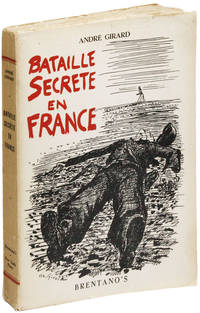
194426125New York: Brentano's 1944. First Edition. Octavo 20cm.; original cream pictorial wrappers printed in red and black depicting a signed illustration by Girard of a fallen soldier; 292pp.; illus. by the author throughout including many full-paged. Spine a bit darkened top textblock edge stained with very shallow bleeding onto leaves. A Very Good and tight copy. Text entirely in French. Extensively illustrated contemporary account of the German occupation in France and the French Resistance. Girard a French painter and poster artist was the founding member of the Resistance organization known as the CARTE network which he ran from Antibes a free zone in France. In 1942 CARTE drew the attention of the British Special Operations Executive which provided the organization with arms radio operators and funds. After traveling to Britain under SOE orders in 1943 Girard was forbidden from returning to France during which time his wife was arrested and incarcerated in the Ravensbruck concentration camp until the end of the war. As a result Girard broke with the SOE and left in self-imposed exile for the United States where he voiced his opposition to the British and the Gaullists. <br /> <br /> TOGETHER WITH:<br /> <br /> Original pencil and ink maquette drawing of a fallen soldier 20x13.5cm. nearly identical to the cover illustration. Additional pencil sketch on verso with variation of the fallen soldier and cover text. Slight rust-staining from previously removed paper clip else Very Good.<br /> <br /> TOGETHER WITH:<br /> <br /> Original pencil and ink illustration 28x21.5cm. signed. Depicts a scrum of bedraggled men and women overseen by four large and sinister German guards either at a train station or a concentration camp though it is unclear. This illustration does not appear in the published work though variations of the guards do make appearances throughout. Tears at hole punches not affecting text some minor staining along top edge else Very Good. Brentano's unknown
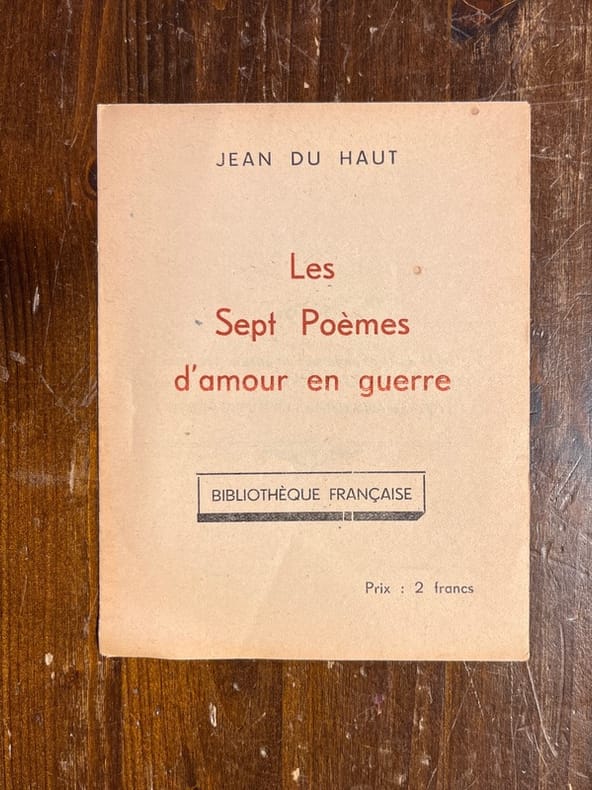
194320803[Saint-Flour], Bibliothèque française, [1943]. Plaquette in-16 de 8 pages. Non coupé.
56902Lingua italiana, Amministrazione provinciale Ferrara, Commissione donne e resistenza, 22 gennaio 1979, 1982, 180 pp., brossura editore, condizioni buone.
Lingua italiana, Amministrazione provinciale Ferrara, Commissione donne e resistenza, 22 gennaio 1979, 1982, 180 pp., brossura editore, condizioni buone.
500371586Harlequin Sans date. Sidonie accablée par les dettes laissées par sa mère voit son vol pour Dublin annulé et doit accepter l'hospitalité du puissant et envoûtant Alexio Christakos. Malgré sa promesse de lui résister elle se retrouve confrontée à un désir irrésistible risquant de se faire piéger par ce séducteur notoire
34903Paris : Editions de Minuit, 30 juillet 1944 - In-16 broché sous couverture imprimée à rabats, 94 pages non coupées - bon état - Edition originale clandestine -
1950boz_004537Agnès HUMBERT. Lettre autographe et lettre dactylographiée signées et datées du 15 octobre 1950 à Paris. Dimensions : 21 x 27 cm. Etat : Bel état de conservation.
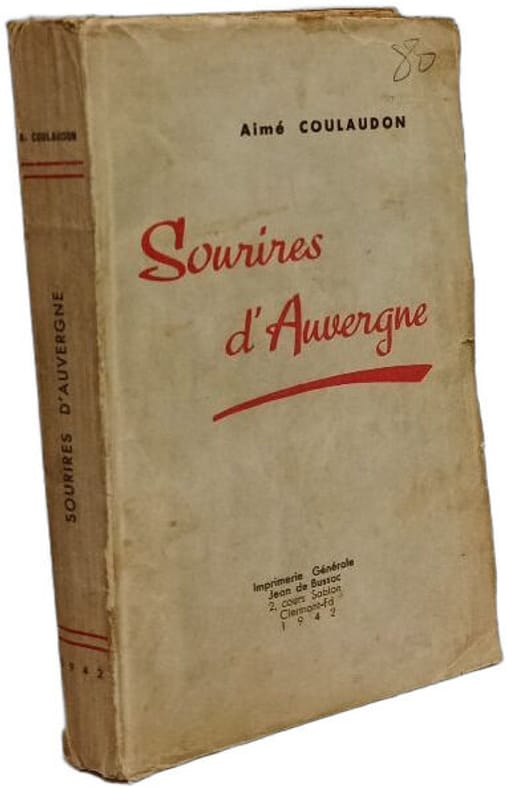
1942100153773Imprimerie Générale Jean de Bussac 1942 in12. 1942. Broché. Cet ouvrage est une réédition numérique d'un livre paru en 1942 désormais indisponible dans son format d'origine. Il s'agit d'un livre d'histoire locale sur l'Auvergne écrit par Aimé Coulaudon avocat député et figure de la résistance