Stil, AndreAntiquariat.de

686 résultats
19491016Paris, La bibliotheque francaise, 1949. 8°. 188 (2) p.; reliure en toile; Ganzleinenband mit aufkaschiertem Orig.-Deckel. - André Stil (1921 in Hergnies - 2004 in Camélas), Schriftsteller und Chefredakteur der L?Humanité. Ab 1944 Mitglied der Kommunistischen Partei Frankreichs und ab 1977 Mitglied der Académie Goncourt. Deckelschild beschädigt und fleckig. pages brunés a cause d'âge; Seiten altersbedingt etwas nachgebräunt; Bibliotheksstempel der "KPÖ" (Kommunistische Partei Österreichs) auf Titelseite und Inhaltsverzeichnis.
1973LFA-126738289Revue trimestrielle de 56 pages, format 155 x 240 mm, illustrée, brochée, bon état
1977LFA-126738305Revue trimestrielle de 80 pages, format 155 x 240 mm, illustrée, brochée, bon état
1977LFA-126738306Revue trimestrielle de 80 pages, format 155 x 240 mm, illustrée, brochée, bon état
1978LFA-126738307Revue trimestrielle de 80 pages, format 155 x 240 mm, illustrée, brochée, bon état
197135814Kümmerle, Göppingen, 1971. 153 Seiten, 8° , 21 x 15 cm, kartoniert
1996LFA-126737498Un ouvrage de 199 pages, format 150 x 220 mm, broché, publié en 1996, Editions Par Exemple, bon état
1944MCAS33S1Paris Les Editions de Minuit 15/05/1944 Petit in-12 broché, couverture crème, 77 pp. Edition originale clandestine.
2000RO80212538Amis du Musée de la Résistance Haute-Vienne. Aout 2000. In-8. Broché. Bon état, Couv. convenable, Dos satisfaisant, Intérieur frais. 86 pages. Quelques photographies en noir et blanc dans et hors texte.. . . . Classification Dewey : 908.4466-Régionalisme : Limousin
194552785Paris Editions de Minuit 1945 1 vol. broché in-16, broché, couverture à rabats, 91 pp. Première édition publique numérotée sur vélin. Bon état.
194552785Paris Editions de Minuit 1945 1 vol. broché in-16, broché, couverture à rabats, 91 pp. Première édition publique numérotée sur vélin. Bon état.
194563627Paris Editions de Minuit 1945 1 vol. broché in-16, broché, couverture à rabats, 91 pp. Première édition publique. Un des 200 exemplaires numérotés sur pur fil. Brunissure à la couverture, sinon bon état.
194563627Paris Editions de Minuit 1945 1 vol. broché in-16, broché, couverture à rabats, 91 pp. Première édition publique. Un des 200 exemplaires numérotés sur pur fil. Brunissure à la couverture, sinon bon état.
1945WOC-1355Paris, Aux Éditions de Minuit, 1945. In-12 (16,5x11,5cm) broché, couverture à rabat. 92pp.
198120048Paris Presses De La cité 1981 In-8 416 pp et deux cahiers photo
197432522Paris Presses de la cité 1974 Cartonnage éditeur sous Jaquette
198132769Paris Presses de la Cité 1981 in-8°
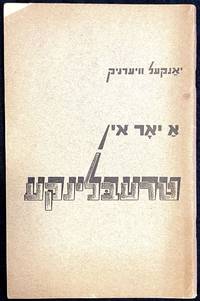
194443339Nyu-York: Farlag 1944. 1st American Edition. Paper Wrappers 8vo 61 pages. Includes illustrations. 22 cm. In Yiddish. Title translates as "A Year in Treblinka." Translation of Rok w Treblince. <br> <br> Jankiel Yankel Yaakov or Jacob Wiernik 1889-1972 was a "Polish-Jewish Holocaust survivor who was an influential figure in the Treblinka extermination camp resistance. He had been forced to work as a Sonderkommando slave worker there where an estimated 700000-900000 people mostly Jews were murdered. After his escape during the uprising of 2 August 1943 Wiernik reached Warsaw and joined the resistance. He also wrote a clandestine account of the camp's operation A Year in Treblinka which was copied and translated for printing in London and the US in English and Yiddish.<br> Following World War II Wiernik testified at Ludwig Fischer's trial in 1947. He left Poland emigrating first to Sweden and then to the new state of Israel. In 1961 he testified at Adolf Eichmann's trial in Jerusalem. He returned to Poland in 1964 to attend the opening of the Treblinka Memorial. Wiernik died in Israel in 1972 at the age of 83.<br> On his arrival at Treblinka aboard the Holocaust train from Warsaw Wiernik was selected to work as a Sonderkommando; otherwise he would have been immediately gassed and killed that day. Wiernik's first job with the Sonderkommando required him to drag corpses from the gas chambers to mass graves. He was traumatized by his experiences and later wrote in his book: 'It often happened that an arm or a leg fell off when we tied straps around them in order to drag the bodies away.'<br> He remembered the horrors of the enormous pyres where '10000 to 12000 corpses were cremated at one time.'<br> He was also encouraged by occasional scenes of brave resistance. In chapter 8 he describes seeing a naked woman escape the clutches of the guards and leap over a three-metre high barbed wire fence unscathed. When accosted by a Ukrainian guard Trawniki on the other side she wrestled his machine gun out of his grasp killed the guard and shot another guard before being killed herself.<br> When the SS recognized that Wiernik was a professional carpenter they put him to work constructing various camp structures including additional gas chambers. Given his skills Wiernik was not subjected to the same treatment as others and no longer had to handle dead bodies. He attributed his survival to being able to build structures needed in the camp. Given the shortage of skilled construction workers accustomed to the killing process Wiernik moved between the two divisions of the camp frequently. As a result he became an important contact between the camp zones when the revolt was being planned.<br> Wiernik escaped Treblinka during the revolt of the prisoners on 'a sizzling hot day' of August 2 1943. A shot fired into the air signaled that the revolt was on. Wiernik wrote that he 'grabbed some guns' and after spotting an opportunity to make a break for the woods an axe. A camp guard in pursuit shot Wiernik with a pistol but the bullet did not penetrate his skin. Wiernik said he turned around and killed his pursuer with the axe. Wiernik continued to Warsaw hiding in a freight train.<br> Wiernik assumed the name of Jan Smarzynski. He made contact with members of the Jewish underground working in the 'Aryan' part of Warsaw. They realized he was a valuable eyewitness of the extermination process in Treblinka. He was persuaded in late 1943 to write A Year in Treblinka in spite of his initial reluctance Wiernik had little education and was not a skilled writer.<br> He took part in the 1944 Warsaw Uprising fighting in the Armia Ludowa. After the end of World War II Wiernik initially remained in Poland in 1947 he testified in the trial of Ludwig Fischer. He emigrated to Sweden and afterwards to the newly founded state of Israel.<br> There in the 1950s Wiernik built a model of the Treblinka camp. It is displayed in the Ghetto Fighters' House museum in Israel. In 1961 Wiernik testified in the Eichmann trial in Israel.<br> Jankiel Wiernik published Rok w Treblince A Year in Treblinka in 1944 as a clandestine booklet. It was printed through the efforts of the Jewish National Committee Zydowski Komitet Narodowy ZKN Bund underground organizations of the remnants of Polish Jews and the Polish Council to Aid Jews Zegota by means of an underground printer organized by Ferdynand Arczynski. The circulation was estimated by Wladyslaw Bartoszewski as 2000 copies. It was sent through Polish underground channels to London and translated into English and Yiddish. It was also printed in the US by American representatives of the General Jewish Workers Union of Poland ie. this copy. The book recounts his experiences in the Treblinka extermination camp between 1942 and 1943" Wikipedia.<br> SUBJECTS: Holocaust Jewish 1939-1945 -- Poland. Jews -- Poland -- Biography. OCLC: 12246244. Some toning touch or corner wear to covers otherwise Very Good Condition. Nice copy of this very important contemporary account of Treblinka. B HOLO2-50-20A-XXLE-IMMBBE@-'gg. Nyu-York: Farlag unknown
1949184357Amiot Dumont Amiot Dumont 1949, In-8 broché de 206 pages. Sous jaquette illustrée. Traduit de l'allemand par René BREIZ. Peu courant. Bon exemplaire
19711241164(Selbstverlag M. Brahms), 1971. 122 Seiten; Illustr.; 22 cm; fadengeh., illustr. Broschur.
19321227551932 Descours et Cabaud, produits métallurgiques, S.A. capital 100 millions, Lyon - 1932 - In-8, cartonnage kaki avec titre en doré sur le 1er plat - 24 pages + 436 planches + LXXV planches
197510640Editions des Dernieres Nouvelles, Strasbourg 1975. 165 Seiten mit zahlreichen Abbildungen auf Tafeln. Kart. Umschlag u. Schnitt gering gebräunt u. fleckig.
1944CCC00229159. edition associaçao de cultura Franco-brasilieira Images françaises, 1944. Couverture souple. État : Très bon. In-8 (18 X 13 cm) imprimé en septembre 1944 sur les presses de Fabral Rio de Janeiro. Envoie de l'auteur à l'ambassadeur. Dédicacé par l'auteur
194560020Paris: Aux Editions de Minuit. 1945. 61S. 12°. OEnglische Broschur.
194650049Brüssel (Bruxelles): La Renaissance du Livre / Paris, Les Editions de Minuit. 1946. 61 S., 1 Bl. 12°. OKarton (Softcover).