(Constantinople) Iranian, MBiblio.com

66 résultats
1897237507Constantinople 1897. 10 x 7-3/4 inches. Mounted. Slightly faded. 10 x 7-3/4 inches. Photo/Wh/2/up unknown
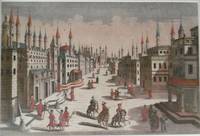
#[35345]Augsburg Georg Balthasar Probst ca. 1770. Contemporary handcoloured perspective view vue d'optique or Guckkastenbild depicting a street scene with the prison in Constantinople. Ca 26 x 39 cm. Optical view inside Istanbul showing the state prison the seven towers to Constantinople. A fine street view with on both sides buildings with slender towers and several local peope and horsemen. - Fine. unknown
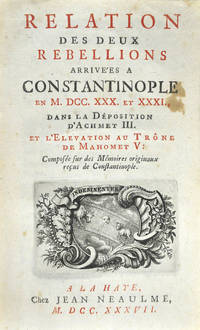
86461The Hague Jean Neaulme 1737. . First edition first issue. Small 8vo iv 164 viiiadspp. title printed in red and black with engraved device small stain to title light waterstain to inner upper margin bound in recent green morocco backed marbled boards spine gilt lettered.<br /> mba004 This account describes the two rebellions which broke out during the unsettled period following the victories of Nadir Kuli Khan of Persia against Turkey during September 1730 and which brought to and end the 'Tulip Period'. On the 20th of that month a minor riot developed into a full scale insurrection and Sultan Ahmet III was forced to abdicate in favour of his nephew Mahmoud I. The janissaries were led by one of their own an Albanian by the name of Patrona Halil and for two months the empire was in the hands of the insurgents. They were eventually overthrown by the Grand Vizier the Mufti and Aga of the Janissaries with the help of the Khan of the Crimea and Patrona and 7000 of his supporters were put to death. The first issue has the title printed in red and black as here.<br /> Atabey 1026; Blackmer 1407. The Hague, Jean Neaulme, 1737. hardcover
0332218546.Gpaperback. Good. Access codes and supplements are not guaranteed with used items. May be an ex-library book. paperback
0332229742.Ghardcover. Good. Access codes and supplements are not guaranteed with used items. May be an ex-library book. hardcover
1391635922.Ghardcover. Good. Access codes and supplements are not guaranteed with used items. May be an ex-library book. hardcover
1391196112.Gpaperback. Good. Access codes and supplements are not guaranteed with used items. May be an ex-library book. paperback
0881410381New. paperback. New. Satisfaction Guaranteed or your money back. paperback
1985Q-0881410381St Vladimirs Seminary Pr 1985-04-01. Paperback. New. In shrink wrap. Looks like an interesting title! St Vladimirs Seminary Pr paperback
260791828. On one side of 31 x 21 cm. A frail survival worn aged and with closed tears with the backing damaged and stained. Text clear and entire in Greek key border. Blind stamp of Cardinal Zurla at bottom left. Signed by 'J. Patr. Constantinop. Vicesgs.' and by the scribe who completed the printed document in manuscript. Somewhat crudely printed with Zurla's arms at the head. Headed: 'D. PLACIDUS ORDINIS S. BENEDICTI / CONGREGATIONIS CAMALDULENSIS / TITULI S. CRUCIS IN JERUSALEM S. R. E. PRESBYTER / CARDINALIS ZURLA / SSmi Domini Nostri PAPAE VICARIUS GENERALIS.’ The manuscript part of the document concerning 'sacred particles from the neck of Saint Theresa the Virgin reads: 'sacras particulas ex ossibus S. Teresiae Virg; quas ex authenticis locis extractas reverenter collo cavimus in thea ex aurichalco argento obducto ovalis figurae unico crystallo munita’. See scan. 1828. unknown
0259510521.Gpaperback. Good. Access codes and supplements are not guaranteed with used items. May be an ex-library book. paperback
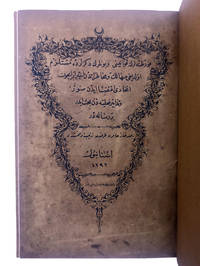
1875055260Constantinople Istanbul: Neologos Litografyasi - Votîra ve Sürekasi Matbaasi. AH 1292 1875. 1st Edition . Leather. Very Good. 8vo - over 7¾ - 9¾" tall. Contemporary 1/4 leather bdg. with marbled boards. Small 4to. 27 x 19 cm. 23 p. 11 p. in Ottoman script Old Turkish with Arabic letters; 12 p. in French with rare 4 folded maps. A very good copy. First and only edition of this extremely rare bilingual book in French and Ottoman Turkish including the first records on the formation and characteristics of storms to explain how storms and hurricanes occurred which route they followed and how they were conveyed to the regions that need to be warned by telegraph for the vessels sailing in the seas by French expert Coumbary who was founded the Rasathâne-i Âmîre i.e. Ottoman Imperial Observatory. Both the original French and Turkish translations of the work were published together in one volume. The work also included four maps which were drawn for this work only. The first map shows the movement of a storm that occurred on March 8 1865 the second one shows the occurrence between the Tropic Cancer and Capricorn whirlwinds storms in the Atlas and Indian oceans the movements in the Bay of Bengal the storms in different directions in the China Sea the Gulfstream Grönland and Azores. The second observatory in the Ottoman era was established for meteorology. Before this center was established beginning from the Reformation 1839 many meteorological observatories were built by foreigners in various cities such as Istanbul Smyrna Trebizond Tekirdag and Merzifon both as private and public establishments. The very first known temperature readings are the meteorological observations made by the Priest Dalmas at the St. Benôit monastery between 1839-1847. Later William Lane an Englishman who came to Istanbul during the Crimean War made observations at the British Cemetery at Haydarpasa. W. Noe director of the Mekteb-i Fünûn-u Sahane made observations at the house in Kalyoncukulluk where he lived until the Beyoglu Fire in 1848; and finally it is known that French engineer Ritter who was invited by the government for waterworks in Kuruçesme 1856-1860 also conducted meteorological observations. Observations on precipitation and humidity conducted between 1875-1892 by an amateur observer on the Thomson Farm in Erenköy are invaluable on the subject of Istanbul's climate. These observations have been published in Budapest in 1928. Excellent observations on heat pressure and humidity made in the summer residence of the Russian ambassador on Büyükada have also been published in Annales St. Petersburg. In 1858 the French government established the first observatory communicating data over the telegraph and in 1863 by compiling meteorological data in France the French National Meteorological Network started operations. In 1868 upon the recommendation of the French government the Rasathane-i Âmire was founded to convey meteorological forecasts to certain centers by telegraph. Instruments were purchased from leading European factories and operations started on top of a hill 74 meters high on Pera. The first director was Mr. Aristide Coumbray who came to Istanbul to renovate the telegraph network. Instruments commissioned from France were set up at Mr. Coumbary's home which stood at the garden of the Swedish Embassy. The observatory was later moved after its offices were prepared. Coumbary represented Turkey in the first international meteorology congress convened in Wien five years later in 1873. Rasathane-i Âmire worked by the same system as the National Meteorology Center in France. In the observation books of 1868 August-November names of affiliated stations are given to us Soulina Köstence Constantia Varna Burgaz Valona Elbasan Durazzo and Beirut. Later stations in Izmir Diyarbakir Baghdad and Fao were also added. The observatory founded by Aristide Coumbary in 1868 in Istanbul operated until the end of the First World War. Özege 5735.; TBTK 7688 10862.; Not in OCLC. <br/> <br/> Neologos Litografyasi - Votîra ve Sürekasi Matbaasi., [AH 1292] hardcover
1913055948Rodosto & Constantinopoli: Manuscript & Typescript 3-9 October 1913. 1913. No Binding. Very Good. 8vo - over 7¾ - 9¾" tall. A one-page typed letter with autograph marginal notes and a two-page manuscript report in black ink. Both are written on bifolia papers with "Renage's Mill" watermark One is "Banknote Paper" the other is "Extra Strong". "Agenzia Consolare d'Italia Rodosto" & "Consolato Generale d'Italia in Constantinopoli" letterheads. 27x21 cm. The letter is in Italian report is in French. 1 p.; 2 p. Signed. Except for the horizontal centre-fold in very clean condition. A letter written by the Italian Consul General in Constantinople to the Italian chargé d'affaires accompanied by a historically significant report from the Consular Agent in Rodosto provides valuable first-hand information about the outbreak of epidemic diseases such as cholera and typhus among humans and anthrax and bubonic plague among animals in the Ottoman Empire in 1913. It also sheds light on the authorities' failure to address these public health crises while offering significant insights into the Muslim immigrants arriving in convoys to the region during the ongoing Balkan Wars. This is an invaluable firsthand account of the Sixth Cholera Pandemic in the Ottoman Empire "a time when the Empire's foundations were shaken by the Balkan War military defeats territorial losses the plight of refugees and immigrants and the dreadful calamity of the cholera epidemic between 1911 and 1913 during which no reliable official records exist regarding the exact number of cholera cases and deaths". Unat. The manuscript report opens by stating the number of direct death cases as rendered in the translation: "I believe it is my duty to inform you that on the 27th a case of cholera followed by death was reported in the town. The day before yesterday there were four other cases two of them fatal; yesterday four new ones two of which were fatal; today another case. So out of ten cases there have been five deaths." The letter goes on: "The other municipality requested a credit of 1000 piastres from Constantinople to take the measures required by the circumstances. Unfortunately no reply has been given and our local officials do not know to which authority they should turn." "Cholera is present in Kirklareli Quarante Églises Baba-Eski Babaeski à Vise Vize à Bounar-Hissar Pinarhisar à Luli Bourgaz Lüleburgaz à Ouzun Keupiru Uzunköprü and aound Krichan Kirikhan. In Tchorlou Çorlu typhus is wreaking havoc and smallpox is present here. Our entire region is devastated by an epizootic outbreak: smallpox and foot-and-mouth disease among the sheep anthrax and bubonic plague among the oxen and buffaloes. Money and serum have been requested from the Ministry of Agriculture but there has been no response. The chief veterinarian I spoke with assured me that it would be impossible to do anything until he has serum to treat the livestock and that if the epidemic disease continues to spread like this the livestock will be completely wiped out in our region." The Royal Consular Agent states that during and after the war between the Turks and Bulgarians also known as the Battle of Kirkkilise which was part of the Balkan Wars Muslim immigrants who continually flocked to Kirklareli and the surrounding areas brought cholera and other epidemic diseases to the region. "Regularly there are convoys of migrants who had left their villages in the surrounding areas of Adrianople Quarante Églises Lüleburgaz etc. before the Turco-Bulgarian War arriving from Anatolia by steamships. They are the ones who brought us cholera and the epidemic disease." He ended his manuscript report by stating there is no way to convince the authorities to have them disembark elsewhere outside the city or to prevent the arrival of these immigrants who are being directed utilizing forced requisitions to areas where cholera is spreading. This report was presented to the Italian chargé d'affaires with this letter additionally as below: "Healt <br/> <br/> Manuscript & Typescript, 3-9 October 1913. unknown
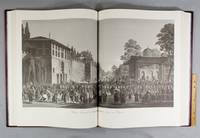
CJW1322Bern: Ertug & Kocabiyuk 2002. No. 46 OF 50 SPECIALLY BOUND COPIES of a total edition of 350. 670 x 508 mm. 26 3/8 x 20". 3 p.l. 10 pp. 63 leaves. <br/> Publisher's scarlet morocco by Buchbinderei Burkhardt AG covers with gilt-rolled border cornerpieces tooled in gilt upper cover with gilt calligraphic Arabic centerpiece lower cover with gilt central heraldic device marbled endleaves all edges gilt. With a portrait frontispiece of Emperor Selim III 48 DOUBLE-PAGE PLATES AND THREE DOUBLE-PAGE MAPS. ◆A virtually as-new copy.<br/> <br/> This is one of the deluxe copies of a modern facsimile of Melling's massive and magnificently illustrated work devoted to 18th century Constantinople a book that provided the earliest interior views and plans of the harems and palaces of Sultan Selim III when it was published in 1819. The illustrations remain the best and certainly most attractive record we have of the city during this era in its history. Our edition was produced from a copy of the elephant folio first printing in the collection of the facsimile's publisher Ahmet Ertug with images faithfully reproduced in their original mammoth size 650 x 970 mm. After his arrival in Constantinople in 1795 architect and painter Antoine Ignace Melling 1763-1831 was appointed imperial architect by Selim III. In the course of his duties he designed and landscaped a seaside palace for Selim's sister Princess Hatice and produced these striking panoramic views of the city and its environs. After completing the palace and a number of other building projects for Selim he returned to Paris and in 1804 issued a prospectus for this work. He established an engraving studio in 1809 to reproduce these drawings and began publishing the completed prints as a series of fascicles that were sent to subscribers. The last one appeared in 1819. The outstanding success of an exhibition of the paintings on which the "Voyage Pittoresque" was based earned Melling the rank of painter to the Empress Josephine. When "Voyage Pittoresque" was originally published booksellers in England sold copies for £84 a huge sum for a book at the time. The original edition in pleasing condition now fetches between $75000 and $100000. Our handsomely bound actual size facsimile offers an attractively priced alternative. Ertug & Kocabiyuk unknown
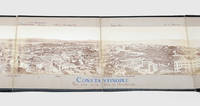
1875170484Constantinople c.1875. A superb photographic panorama A panoramic 360-degree view of the city. Towards the Golden Horn the Topkapi Palace and the city's great mosques can be seen including Hagia Sophia the Blue Mosque the Yeni Mosque and the Süleymaniye. Panoramas of this period usually favour the Galata Tower as a vantage point. The view is unsigned though likely from the studios of Pascal Sébah and Policarpe Joaillier or the Swede Guillaume Berggren. Both are renowned for their handsome panoramas of the city. In 1857 Sébah opened one of the first photographic studios in Constantinople. The business was taken over by his son Jean in 1883 who styled himself J. Pascal Sébah and went on to become a talented photographer in his own right. In 1888 he partnered with Policarpe Joaillier their firm becoming the official photographers of the Sultan. "From the 1870s Sébah and Joaillier were major suppliers of evocative imagery to the increasing number of people who undertook the Victorian Grand Tour" Hannavy p. 1261. Berggren moved to Constantinople in 1866 and opened his studio on Grand Rue de Pera in the early 1870s. His oeuvre included studio work a remarkable series of documentary portraits of working people and the eternalising of the construction of the Anatolian Railway. Oblong quarto concertina 290 x 255 mm. Comprising 8 mounted albumen prints each 165 x 248 mm together approximately 165 x 1984 mm mounts captioned in manuscript red and blue ink. Contemporary dark brown pebbled paper over bevelled boards later blue paper on verso of mounts. Minor loss to corners and edges of boards a few surface scratches; prints yellowed and faded in margins some a little creased at folds: a very good example. John Hannavy ed. Encyclopaedia of Nineteenth-Century Photography Vol. I 2005; Engin Özendes From Sebah & Joaillier to Foto Sabah: Orientalism in Photography 2004. hardcover
182851526Constantinople Matbaa-i Amire 1828 1243 h. Small 4to. 22 x 16 cm. Contemp. full calf. with flap. A tear in the flap. Rebacked. Blindtooling to covers and a medaillon on front and back. Covers a bit rubbed. 34259 pp. A small burnmark in inner margins of the last 8 leaves otherwise internally clean and fine. Printed arabic types in Turkish/ Ottoman Turkish. <br/><br/><em>First edition. Esad Effendi Turkish historian born 1790 dead 1848. The work deals with the armed forces hydrology etc. </em> unknown