Les Barbares Et le CatholicismeBiblio.com

93 résultats
0366856553.Gpaperback. Good. Access codes and supplements are not guaranteed with used items. May be an ex-library book. paperback
500330126Pocket Sans date. Dans ce récit autobiographique Yann Queffélec explore sa relation complexe avec son père l'écrivain Henri Queffélec qu'il décrit comme l'homme de sa vie. L'œuvre dévoile les secrets et les joies d'une enfance difficile mêlant humour et émotion pour brosser le portrait d'un père à la fois aimé redouté et défié
Small chip along top edge of DJ else Fine. ; 1.02 x 9.21 x 6.22 Inches; 304 pages; Why did the Western Roman empire collapse in the fifth century and the Eastern Roman empire survive for another thousand years? The Rome That Did Not Fall examines the two halves of the Roman empire in the fifth century the Latin West and the Greek East. Stephen Williams and Gerard Friell explore how, despite similar military and political turmoils, the western empire all but collapsed and the eastern empire survived and consolidated its power in the face of the invading barbarians, weak and immature emperors and intrigues around the throne. The Rome That Did Not Fall analyzes the remarkable recovery of the eastern empire, comparing the parallel and diverging developments in east and west, and tracing the evolution of new skills and strategies in the east diplomatic, military, political and fiscal. This well-illustrated and well-documented book provides a stimulating exploration of the fifth century Roman empire.
pp. vii, 370 + Photogravure Frontis and full page portraits. Uncut. Pictorial endpapers. Large 8vo. Original full blue cloth binding, gold lettered with some fading. Hardbound. Very good. EUROPE BOX 1
16 pages. Features: Supportive comments inside from cover; Who Provoked the War? - incidents showing the historical progress of events toward the inevitable clash; Has France a Title to Alsace-Lorraine? - extracts of a letter by Thomas Carlyle to the London Times during the Franco-German War; The American Press and the War, by Dr. A.B. Faust; Ernst Haeckel and Rudolph Eucken Rally to the Flag; Supportive letter from William C. Fox, Ex-American Minister to Ecuador; We and the World - poem by Hanns Heinz Ewers; Brief piece about the 'Loquacious" German Ambassador Count Bernstorff; A call for Americans of German and Austro-Hungarian blood to organize; Full-page image depicting Germany as the defender of civilization against the Barbarian Host; News the New York Times would like to suppress; Poem entitled "For All We Have and Are" by Frederick H. Martens; We Poles in Austria, by an Austrian Pole; The German-American and the President's Neutrality Proclamation, by Prof. Julius Goebel; The War Situation - latest news of WWI; and more. Average wear. Binding intact. Unmarked. Cover holding by one staple otherwise a sound copy. Magazine
Wear and creases to cover and spines. Interior pages clean and unmarked. The glue in these perfect bound books are over 50 years old and is likely fragile.
140810475X.Ghardcover. Good. Access codes and supplements are not guaranteed with used items. May be an ex-library book. hardcover
200837533London: Christopher Helm 2008. 1st edition. Hardcover. Fine/Near Fine. 1st edition 2008. A Fine copy in a Near Fine dust jacket. Small 4to. 512 pp. bound in publishers photo illustrated paper covered boards with matching dust jacket. Minor signs of shelf wear only; text appears clean and unmarked. Dust jacket now protected in mylar sleeve. Christopher Helm hardcover
5627041-nnew. unknown
5627041like new. unknown
100148693Garnier Freres Libraires-Editeurs in12. Sans date. Cartonné. Ouvrage historique d'Augustin Thierry publié en 1840 rassemblant six « Nouvelles lettres sur l'histoire de France » parues précédemment. Le livre se compose de deux parties distinctes : une dissertation historique (« Considérations sur l'histoire de France ») et une narration sur l'époque mérovingienne écrite dans un style vivant et presque romancé qui mêle érudition et imagination
Tiny stain to rear board and obverse of DJ else book and DJ are fine/fine. ; 1 x 9.25 x 6.25 Inches; 277 pages; How did the Romans build and maintain one of the most powerful and stable empires in the history of the world? This illuminating book draws on the literature, especially the historiography, composed by the members of the elite who conducted Roman foreign affairs. From this evidence, Susan P. Mattern reevaluates the roots, motivations, and goals of Roman imperial foreign policy especially as that policy related to warfare. In a major reinterpretation of the sources, Rome and the Enemy shows that concepts of national honor, fierce competition for status, and revenge drove Roman foreign policy, and though different from the highly rationalizing strategies often attributed to the Romans, dictated patterns of response that remained consistent over centuries. Mattern reconstructs the world view of the Roman decision-makers, the emperors, and the elite from which they drew their advisers. She discusses Roman conceptions of geography, strategy, economics, and the influence of traditional Roman values on the conduct of military campaigns. She shows that these leaders were more strongly influenced by a traditional, stereotyped perception of the enemy and a drive to avenge insults to their national honor than by concepts of defensible borders. In fact, the desire to enforce an image of Roman power was a major policy goal behind many of their most brutal and aggressive campaigns. Rome and the Enemy provides a fascinating look into the Roman mind in addition to a compelling re-examination of Roman conceptions of warfare and national honor. The resulting picture creates a new understanding of Rome's long mastery of the Mediterranean world.
Former owner's name on ffep. Dustjacket has very minor shelfwear. ; 1 x 9.25 x 6.25 Inches; 277 pages; How did the Romans build and maintain one of the most powerful and stable empires in the history of the world? This illuminating book draws on the literature, especially the historiography, composed by the members of the elite who conducted Roman foreign affairs. From this evidence, Susan P. Mattern reevaluates the roots, motivations, and goals of Roman imperial foreign policy especially as that policy related to warfare. In a major reinterpretation of the sources, Rome and the Enemy shows that concepts of national honor, fierce competition for status, and revenge drove Roman foreign policy, and though different from the highly rationalizing strategies often attributed to the Romans, dictated patterns of response that remained consistent over centuries. Mattern reconstructs the world view of the Roman decision-makers, the emperors, and the elite from which they drew their advisers. She discusses Roman conceptions of geography, strategy, economics, and the influence of traditional Roman values on the conduct of military campaigns. She shows that these leaders were more strongly influenced by a traditional, stereotyped perception of the enemy and a drive to avenge insults to their national honor than by concepts of defensible borders. In fact, the desire to enforce an image of Roman power was a major policy goal behind many of their most brutal and aggressive campaigns. Rome and the Enemy provides a fascinating look into the Roman mind in addition to a compelling re-examination of Roman conceptions of warfare and national honor. The resulting picture creates a new understanding of Rome's long mastery of the Mediterranean world.
21225U.K., Skira, 2008 Hardback, with dusjacket, 279x240mm, 700p, 890 col.ill, 110 bwill, English edition new condition, Art and Exhibition Hall, Bonn Expo: 22/8/08 - 7/12/2008. ISBN 9788861304888.
20192-6139470781LAP Lambert Academic Publishing 2019. Paperback. New. 8.62x5.91x0.39 inches. LAP Lambert Academic Publishing paperback
3659677507.Gpaperback. Good. Access codes and supplements are not guaranteed with used items. May be an ex-library book. paperback
194233386Paris, Alphonse Lemerre, 1942. In-12 broché (19 x 12 cm), 363 pages, ornements en tête de chapitre, culs-de-lampe. Très bon état.
1767002383Genève Par la Compagnie des Libraires 1767
2013100146401BREPOLS 2013 426 pages 3x23x15cm. 2013. Broché. 426 pages. Cet ouvrage collectif dirigé par Michel Tardieu constitue la première étude d'ensemble visant à comprendre le rôle et les mécanismes des 'noms barbares' en tant que pratique magique de nomination. Il analyse ces noms comme des objets magiques complexes faits de jeux de signes et de phonèmes et étudie leur transfert entre panthéons et la fusion des dynasties divines. Un chapitre spécifique par exemple examine les noms magiques d'Aphrodite dans un contexte de recette égyptienne de séduction
32420Turnhout, Brepols, 2011 Hardback, XX 656 p., 152 b/w ill. 35 colour ill., 156 x 234 mm. ISBN 9782503531250.
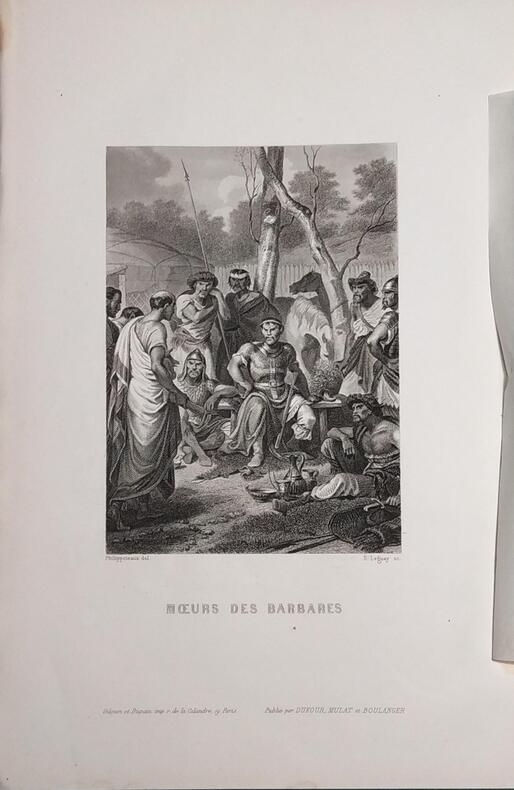
186353886- Gravure 18 x 27 cm.
2025B2512253Ankara: n/a Elif Yayinlari 2025. New. n/a n/a Elif Yayinlari unknown
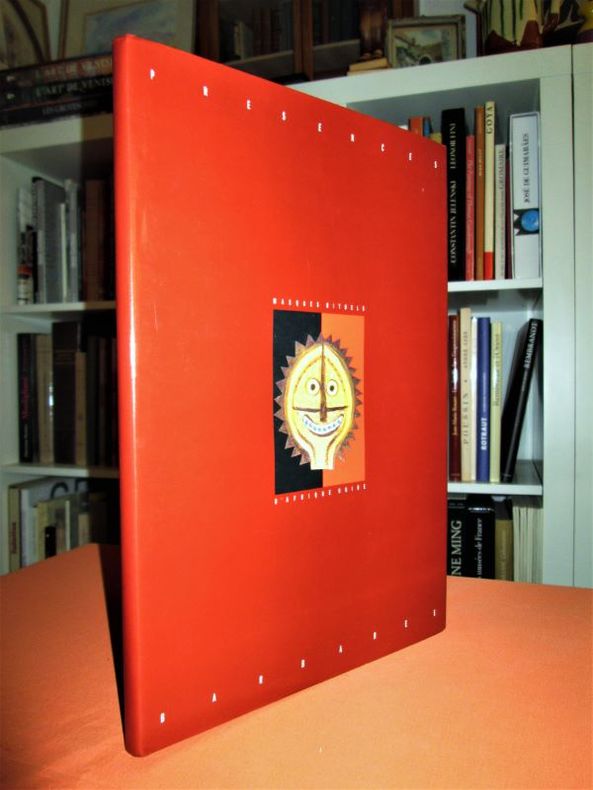
199228712Crehalet Folio Poussielgues, 1992. "Présences barbares - " In-4 relié avec jaquette imprimée en couleurs, format 23 x 34 cm, 44 pages dont 41 planches légendées pour chaque masque. Rééditon d'un ouvrage introuvable.- 650g.L. - Excellent état.
1985ABE-18844762327116 PAGES-EN COUVERTURE CLAUDE LEVI-STRAUSS PAR MORETTI-DOSSIER LEVI-STRAUSS, 51 PAGES-GUITRY, C'EST EXQUIS, PAR ANDRE BERNARD-SACHA GUITRY OU L'IMAGE BLOQUEE, PAR MICHEL TOURNIER, 3P, PHOTO-MISE EN TENEBRES, CRITIQUE PAR VINCENT LANDEL POUR "LES NOCES BARBARES" DE YANN QUEFFELEC, PHOTO-FAULKNER DEBUTANT, 2P PAR ANDRE LE VOT, PHOTO-JEAN GIONO: PAYSAGES IMAGINAIRES, PROPOS RECUEILLIS PAR JEAN CARRIERE, 6P, 3 PHOTOS-LE REGARD D'UNE PHOTOGRAPHE, 1P PAR ALAIN GARRIC, GISELE FREUND, PHOTO-(17CA)
1978LFA-126721790Un ouvrage de 181 pages, format 205 x 280 mm, illustré, relié toile dos simili cuir, publié en 1978, Editions Famot, bon état