7 résultats
1858GITd044Lille Lefort 1858. In-12 broché belle couverture illustrée 142pp. Petite étiquette ancienne de classement sur le dos. Bel exemplaire frais.
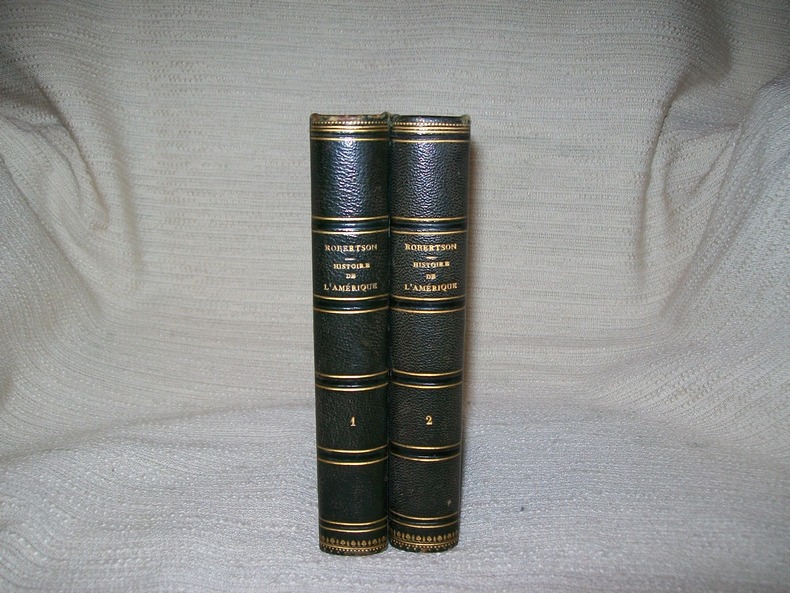
1852GITc766Paris Adolphe Delahays 1852. 2 volumes in-12 515 554pp. Demi chagrin vert, dos lisse orné de filets dorés, chaînette dorée en queue, reliure de l'époque. Cachets de bibliothèque, rousseurs. Exemplaire bien relié.
18873136DBBerlin, Friedländer, 1887. Folio. (4), 29 S. Mit 3 farb. Tafeln. Halbleinenband der Zeit. + Wichtig: Für unsere Kunden in der EU erfolgt der Versand alle 14 Tage verzollt ab Deutschland / Postbank-Konto in Deutschland vorhanden +, 3136D
1850WRCAM40555New York: Casper C. Childs 1850. 35pp. Illus. Dbd. Some light tanning. Small stains to first three leaves. Minor paper loss to top of last page not affecting text. Very good. English translation from the original Spanish of Velasquez' supposed memoir actually a concoction dreamed up to draw attention to the two small mixed-blood children which were hauled about and displayed in America and on the continent. The children described as "Descendants and Specimens of the Sacerdotal Cast of the Ancient Aztecs" were in reality of mixed Indian Spanish and Negro blood and were enslaved near San Miguel. "It is the most circumstantial fiction which the brain of an advertising agent ever conceived" - Field. Sabin records three issues printed this same year; this printing by Childs appears to be the scarcest of the three. SABIN 98812. FIELD 1598. Casper C. Childs unknown books
184024491um 1840. 49,5x39cm Blatt handkoloriert, etwas angerändert, seitlich außerhalb der Darstellung kl. Einrisse,, etwas fleckig
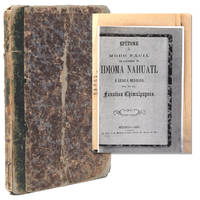
1869332990Mexico: Tip. de la V. de Murguia e hijos 1869. First Edition. 122 of 124pp missing title-page which is replaced by facsimile. 12mo. Quarter green morocco and boards spine partially perished. First Edition. 122 of 124pp missing title-page which is replaced by facsimile. 12mo. Tip. de la V. de Murguia e hijos unknown
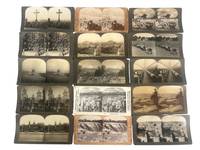
1900221191900. Archive of 15 stereoview photographs of Mexico published by the Keystone View Company around the turn of the twentieth century documenting Mexican urban architecture Indigenous labor archaeological sites and monumental landscapes during a period of modernization and expanding foreign visual interest in the country. Produced for the international stereograph market the images present Mexico through interconnected views of colonial civic grandeur rural labor systems and Indigenous historical sites reflecting contemporary American and European fascination with both modernization and ethnographic spectacle in Latin America. The archive documents visual and commercial systems of early photographic tourism and ethnographic representation through stereographic imagery printed captions and descriptive texts revealing how Mexico was interpreted and circulated to foreign audiences through mass-produced educational photography. At the same time the photographs preserve valuable visual evidence of everyday labor urban space transportation and architecture during the late Porfirian period.<br /> <br /> Archive consists of 15 original stereoview photographs measuring approximately 3.5 x 7 inches primarily silver gelatin prints mounted on curved gray or tan cardstock with printed captions and descriptive text on versos. Subjects include monumental architecture archaeological ruins agricultural labor transportation scenes and volcanic landscapes across Mexico. Several stereographs depict the historic center of Mexico City including views of the Metropolitan Cathedral with its twin bell towers and baroque façade the National Palace and distant perspectives of Chapultepec Castle framed by broad boulevards and landscaped public space. Rural and labor scenes include Indigenous and mestizo workers harvesting maguey plants for pulque production mule teams transporting water and figures posed beside adobe structures in village environments. One stereograph presents the terraces and volcanic slopes of Popocatépetl emphasizing the dramatic topography associated with Mexico's central highlands. Another depicts the pyramid complex at Cholula surmounted by a Catholic church accompanied by printed Keystone commentary interpreting the site as evidence of Christian conquest over Indigenous religion. The versos retain substantial printed explanatory text characteristic of Keystone educational stereographs combining geographic description historical narrative and ethnographic framing for consumers of stereoscopic travel imagery.<br /> <br /> The archive reflects the growing role of stereography in shaping international perceptions of Mexico during the late nineteenth and early twentieth centuries when photographic publishers marketed immersive visual experiences of foreign landscapes and cultures to middle-class audiences in the United States and Europe. Keystone's stereographs frequently combined documentary photography with interpretive narratives emphasizing archaeology modernization colonial history and rural labor contributing to broader visual constructions of Latin America during the Porfirian era. Particularly notable are the images juxtaposing Indigenous life Catholic architecture and pre-Columbian ruins which reveal contemporary tensions between modernization nationalism and colonial historical memory in visual culture. Minor expected wear and occasional toning to mounts; photographs generally sharp and well preserved with captions and versos legible throughout. Overall very good condition. A visually rich archive of early stereographic photography documenting Mexico's landscapes architecture and social life at the turn of the twentieth century. unknown