10 résultats
193662710New York: The Macmillan Company 1936. 8vo. viii 2 217 1 pp. Scarlet-coloured publisher’s cloth gilt lettering front cover & spine w/ d.j. minor chipping head of spine very minor dustsoiling coupe slight nicks still NF/VG copy. First American edition stated of Wells’ work which restates and distills his utopian ideals of a World State governed by an elite committed to scientific development that would serve to forestall the inherent dangers of fascism communism and Nazism with Jewish peoples singled out as a particular case of obstructive nationalism with a refusal to be largely assimilated by the socio-economic cultures in which they lived. The Macmillan Company, hardcover
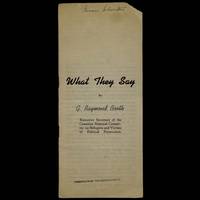
19386981Toronto Ontario Canada: Reprinted from the "American Friend" Canadian National Committee on Refugees and Victims of Political Persecution N.D. Circa 1938-1948. First Edition First Printing. Stapled Wraps. pp. 7. 8vo. measuring 9.5 x 21.5 cm. Plain twice-stapled wrappers with stylized title in black. A remarkable seven-page pamphlet evidently re-printed from "The American Friend" wherein the author offers a strident defence of Jews and those of Jewish extraction in the face of virulent popular and institutional anti-semitism which pervaded Europe and North America amidst the Second World War and the ongoing Holocaust. The author addresses a variety of often contradictory and historic accusations employed against Jews in concerted efforts by anti-semites to prevent their immigration and integration into Western society: "They says Jews are different"; "They say Jews are not ethical"; "They say the Jews are never farmers"; "They say Jews are not patriotic"; "They say the Jews are Communists"; "They say the Jews are anti-social big business people"; "They say the Jews are dirty"; "They say the Jews are noisy"; "They say the Jews never assimilate". Each statement is followed by a firm denouncement by the author who then offers examples for why such stereotypes are patently false misleading and ultimately rooted in historical anti-semitic tropes with no basis in reality. Net period ink name to the upper-right margin of the cover some loss affecting the upper-right corner of pages no loss of text contents otherwise without blemish; very good. Unrecorded in OCLC. Not found in Fisher Peel BAC/LAC UoM Archives & Special Collections et al. Rare indeed. <br/><br/> Reprinted from the "American Friend" | Canadian National Committee on Refugees and Victims of Political Persecution paperback
1965003265<p>Isle of Man: Britons - Times Longman 1965. Good original wraps with the Britons Publishing Company label pasted over original publisher VERY SCARCE Attacks Jews as being in control of Bolshevism etc. First Edition. Original Wraps. Good.</p> Britons - Times Longman paperback
1936304567Dresden: Verlag von M.D. Groh 1936. First edition. Illus. viii 326 2pp. Large 4to. Original cloth some staining to back cover and some residue of internal staining at end. First edition. Illus. viii 326 2pp. Large 4to. <br/><br/> Verlag von M.D. Groh hardcover
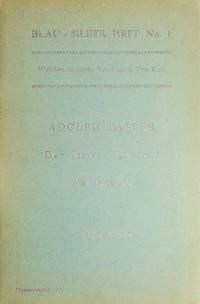
193932824New York: Weltdemokratische Vereinigong 1939. 1 vols. 8vo. Green wrappers some wear. 1 vols. 8vo. Weltdemokratische Vereinigong unknown
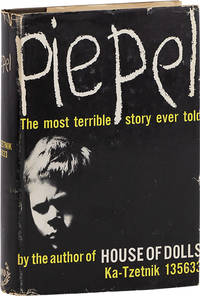
196163055London: Anthony Blond 1961. First Edition. 8vo. 20cm x 14cm. Publisher's dark brown cloth boards. Dustjacket. Titled in gilt to spine a little rubbed and scuffed to extremities with some bumping to spine ends in a strong example of the priceclipped pictorial dustjacket with some fraying to the spine ends cracking and rubbing of the laminate here and there and some inoffensive soiling to the white rear panel. A strong presentable copy. 285pp. Internally clean. A deeply harrowing tale post-Eichmann trial about the horrors visited upon concentration camp inmates by the Nazis from the informed perspective of a survivor. Anthony Blond unknown
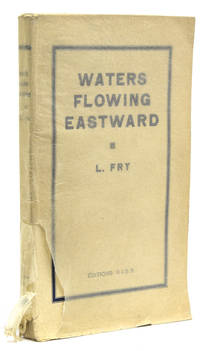
1931264494Paris: Éditions R.I.S.S. 8 Avenue Portalis 1931. First edition with errata pasted to front pastedwown. Illustrated with b/w photos and facsimiles. 226 1 pp. 1 vols. 8vo. Brown printed wrappers. Tear to tail of spine front hinge coming unglued. In glassine wrapper. With contemporary add for The Rebirth of Conservatism by Dorothy Crisp laid in. First edition with errata pasted to front pastedwown. Illustrated with b/w photos and facsimiles. 226 1 pp. 1 vols. 8vo. The first edition of this notorious work of anti-Semitism. Based largely on the Protocols of the Elders of Zion Waters Flowing Eastward warns of a comming Jewish new world order. Éditions R.I.S.S. 8, Avenue Portalis unknown
1941190536Paris: Institut d'Etude des Questions Juives 1941. First edition first printing of the exhibition catalogue for the first and only anti-Semitic exhibition held in German-occupied Paris "France and the Jew" funded by the Nazis. The exhibition was designed to convince the French of the necessity of anti-Semitic law. An estimated 200000 people visited the exhibit which ran from 5 September 1941 to 15 January 1942. Similar to "Der Ewige Jude" The Eternal Jew held in 1937 at the German Museum in Munich this exhibition presented the Jews in a stereotypically racist manner with facial representations corresponding to classic anti-Semitic depictions such as the hooked-nose or dirty hair. On display were photographs and charts intended to show the dominance of Jews in the French media and in the movie industry and the links between Jewry and communism. Quarto. Original pictorial wrappers. With 10 black and white photographic reproductions and exhibition map. Light soiling and toning at extremities. A very good copy. unknown
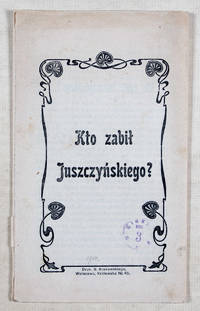
191443558Warsaw: S. Krakowskiego 1914. First edition. Softcover. vg. Octavo. 8pp incl. covers. Original covers with Art Nouveau illustration framing black lettering protected by modern mylar. Extremely scarce Polish anti-Semitic pamphlet related to the 1911 murder of the 13-year-old Ukrainian boy Andrei Yushchinsky and the subsequent trial and political scandal that resulted known as the Beilis trail or the Beilis affair. The case is considered a infamous example of the Blood libel and evidence of rampant anti-Semitism in Russia during the period. The identity of the author is not known but is credited under the likely psuedonym "Alm Fuw" on the last page.<br /> <br /> The pre-trial investigation of the case accusing Menahem Mendel Beilis Beilis Affair of the ritual murder was conducted by the foremost investigator of the Kiev Police Department Nikolay Krasovsky. Beilis a Jewish brick-factory worker was accused of the murder based on the testimony of a lamplighter who claimed he had witnessed Beilis kidnapping of Yushchinsky. Under horrific conditions Beilis spent more than two years in prison awaiting his trial which took place from September 25th through October 28 1913.<br /> <br /> The Russian right-wing press and politicians started a campaign throughout Russia against Jewish communities with accusations of the ritual murder. Despite the investigation by the local police which clearly linked the murder to a criminal gang killing Yushchinsky because he most likely had overheard conversations revealing information relating to crimes the gang committed the investigators in charge were dismissed. Evidence and many other aspects of the trial were manipulated by government officials at the highest level. Archival documents prove that the jury was rigged and monitored and witnesses were bribed or threatened. The trial sparked international criticism both from Jewish and non-Jewish intellectuals among them Maxim Gorky Vladimir Korolenko Alexander Blok and Alexander Kurpin.<br /> <br /> Yushchinsky was abducted on a Saturday morning while Beilis was at work. Ironically the alibi was the result of Beilis' unusual habit of working on the Jewish Sabbath and eventually the lamplighter confessed that he had been confused by the secret police. The prosecution's case was further undermined when it became clear that the body of the boy showed 14 wounds rather than 13 which was deemed to be in accordance with the "Jewish Ritual" a fact the prosecution had spent a great deal of effort to establish. However after several hours of deliberation the jury acquitted Beilis.<br /> <br /> After his acquittal Beilis left Kiev for Palestine and later settled in the United States. There he published his memoir under the title "The Story of My Sufferings" in Yiddish 1925 and a year later in English. Beilis story became the basis for Bernard Malamud's novel "The Fixer" which won the Pulitzer Prize and the National Book Award. <br /> <br /> Text in Polish. <br /> <br /> Very light wear along edges of pamphlet. Contemporary price stamp on cover and year penciled to bottom. Pamphlet in overall very good condition. One one Polish institutional holding worldwide based on OCLC records. S. Krakowskiego unknown
193943670Budapest: Pesti Lloyd-nyomada 1939. First edition. Softcover. vg. Folio. 26pp. published unbound. Original cream stapled wraps with title printed in black to back cover protected by modern mylar. To the Honorable Upper and Lower House of the Parliament. Respectful petition of the representatives of the Hungarian Jewish community concerning "Bill No. 72. regarding the restriction of Jews in public and economic life". <br /> <br /> Official petition of the Hungarian Jews regarding the bill of the Second Anti-Jewish Law No. IV:1939. The Second Anti-Jewish Law was one of a series of anti-Jewish measures passed by the Hungarian Parliament between 1938 and 1941 and the first Hungarian law providing a "racial" definition of the Jewish status according to the Nuremberg Race Law of 1935. Besides of other severe deprivations it sets a ceiling of six percent reduced from twenty of Jews being allowed to work in various financial and commercial professions as well as industrial enterrises employing more than ten persons. It also excluded the Jews from state administrations and jurisdiction prohibited Jews from teaching high school reenacted the Numerus Clausus at universities and partly rescinded their right to vote.<br /> <br /> Bill No. 702 the Second Anti-Jewish Law was drafted by István Antal state secretary of the Ministry of Justice and Pál Teleki Minister of Religion and Education and was presented for debate before Parliament on December 23 1938. The petition aimed to sway Parliament to disapprove the law claiming it being unconstitutional and delinquent in view of legal equality human rights and the Divine Law and furthermore relinquishing social justice and threatening national unity the emancipation granted by the laws of 1849 and 1867 in short it was deemed to be against the national interest of Hungary. The petition was unsuccessful the bill was approved by Parliament and was signed into law on May 5 1939 effecting the Hungarian Jewry severely with more than 90 thousand Jews losing their jobs and thus lowering the living conditions of approximately 220000 people significantly. Braham R.: The Second Anti-Jewish Law in: The Politics of Genocide: Holocaust in Hungary New York Columbia University Press 1981 pp. 147–156. Scarce important historical document with institutional holdings recorded only in Hungary. Text in Hungarian with slight rubbing to covers. Else in very good condition. Pesti Lloyd-nyomada unknown