(RÉSISTANCE). PAUL (Marcel).Livre Rare Book
1 191 résultats
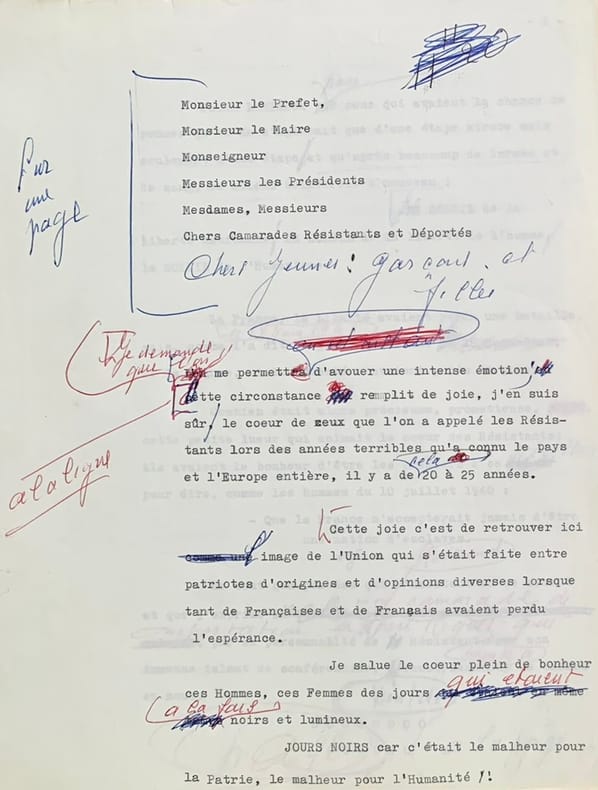
1343LES ENFANTS D'ORADOUR ; L’Enfant de Buchenwald, épreuves manuscrites et tapuscrites corrigées à la main. Texte rédigé par Marcel Paul pour un discours de commémoration du massacre d’Oradour-sur-Glane (par le régiment Der Führer de la division Das Reich). En tout 132 feuillets A4 remplis au recto, divisés en 4 liasses complètes, dont une entièrement manuscrite. Les minutes du drame (le plus grand massacre de civils commis en France par les armées allemandes, perpétré aux dépens de 643 victimes), suivi d’un second récit, celui du sauvetage d’un enfant polonais à Buchenwald, d’abord caché dans une valise perforée, puis dans le magasin d’habillement du camp, protégé par deux prisonniers, torturés plusieurs fois sans passer aux aveux. Extraits : « Oradour-sur-Glane, c’est le crime cerné. L’œuvre de la bestialité si près de nous qu’elle reste d’une acuité bouleversante. (…) Je sais bien, il y a eu des dizaines de milliers de morts à Dachau, à Ravensbrück, à Mauthausen, à Bergen Belsen, des millions de morts dans les chambres à gaz d’Auschwitz et de Majdanek. A Birkenau, les SS prétendaient à l’humanisme en présentant la chambre à gaz comme une salle de douches. Ils poussaient parfois l’hypocrisie jusqu’à remettre une serviette et une savonnette à l’entrée de la chambre à gaz, qu’ils récupéraient dans les tas de cadavres et servaient pour les fournées suivantes. (…) A Oradour, ceux qui n’étaient que blessés ont vu les monstres revenir, s’avancer sur eux, tirer à la mitraillette pour les achever. Ceux qui avaient encore survécu les ont vu apporter la paille, les fagots, les allumer, tout ceci pour des mamans avec leurs enfants dans les bras, pour des fillettes, des garçonnets, pour des bébés. (…) » LA RÉSISTANCE À BUCHENWALD, épreuves manuscrites et tapuscrites corrigées à la main. Texte complet, 166 ff. A4 remplis au recto, divisés en 7 liasses, dont une entièrement manuscrite. Le récit de l’insurrection du camp de Buchenwald le 11 avril 1945, racontée par Marcel Paul, qui en fut l’un des principaux meneurs. Organisation clandestine, fabrication et cache d’une radio de fortune, transmission d’informations par le bouche à oreille, vêtements subtilisés dans les magasins, vivres volés, soins prodigués aux souffrants, sabotage des armes d’infanterie, introduction et cache des fusils, grenades, poignards, manœuvres et préparatifs pour l’insurrection…Quelques extraits : « La magnifique expression ‘l’armée des ombres’ a, je crois, pleinement défini les conditions du combat qui était celui de la Résistance organisée, conduite par les hommes et les femmes des groupes d’action, des maquis, des réseaux, des imprimeurs et des diffuseurs de publications clandestines. Le cadre dantesque du règne de la brute pesait sur l’homme le mieux équilibré. La terreur pouvait, à la longue, lui faire perdre une partie de son sens humain. (…) A Buchenwald, les enquêtes avaient succédé aux enquêtes mais l’action de sabotage était si diluée, si généralisée qu’elle restait insaisissable. (…) Dans les derniers jours, le commandement SS avait tenté l’évacuation du camp. Des colonies de déportés étaient parties sur les routes, escortées par les SS et leurs abominables chiens policiers, dressés à attaquer tout homme en tenue rayée de prisonnier. Les pertes humaines par la faim, par les coups, furent effroyables. Chaque homme qui trébuchait sur la route était abattu, suivant la fameuse méthode nazie de la balle dans la nuque. » (…) Et plus loin, à propos de la libération du camp : « Sans doute, dans la psychologie des brutes, les morts étaient resuscités de leurs cendres. Ces déportés qu’ils assaillaient de leur haine, de leur mépris, de leur bave, autant que de leurs coups, étaient devenus des diables invincibles. A la panique, succédait la débandade. (…) Deux heures plus tard, tout était fini, le camp était libre. Des centaines de SS capturés étaient nos prisonniers, les autres étaient en fuite. » A TREBLINKA, COMME DANS LES AUTRES CAMPS DE LA MORT, LE TUEUR ÉTAIT SS. Texte préparatoire d’un discours rédigé pour une table ronde, organisée par l’U.J.R.E. (Union des Juifs pour la Résistance et l’Entraide), pour répondre à la controverse entrainée en 1966 par la publication du livre de Jean-François Steiner Treblinka (Fayard, 1966). L’ouvrage, présenté comme une œuvre romanesque et écrit par un fils de déporté, avait été préfacé par Simone de Beauvoir et salué à sa sortie par François Mauriac, Philippe Labro, Françoise Giroud et Pierre Vidal-Naquet (qui était revenu plus tard sur ses positions). Plusieurs voix s’étaient élevées (dont celles de Léon Poliakov, Claude Lanzmann, Emmanuel Levinas et Romain Gary) pour dénoncer l’une des thèses du livre, selon laquelle les Juifs, par leur docilité à se faire massacrer, s’étaient rendus complices de leur propre génocide. Dans son discours, conclu par une adresse à Jean-François Steiner, Marcel Paul insiste sur la seule culpabilité des bourreaux nazis dans les atrocités qui avaient été commises à Treblinka, où (selon le mémorial Yad Vashem) plus de 800 000 Juifs ont été assassinés entre 1942 et 1944. Tapuscrit complet, 12 ff. A4 ronéotés remplis au recto et corrigés à la main, précédés de 4 lettres dactylographiées et signées, échangées en mai 1966 entre l’auteur et les organisateurs de la rencontre. Extraits : « Il est difficile, même pour ceux qui ont vécu la tragédie, pour ceux qui sont passés par les mains des tortionnaires hitlériens, de traduire la réalité des camps de la mort avec des mots. Je ne désirais pas, pour ma part, m’essayer à le faire mais il y a un devoir, au nom des morts de Treblinka comme des autres camps, de ne pas tolérer la tentative de réhabilitation des S.S., de réhabilitation du nazisme, car c’est de cela qu’il s’agit en définitive. Il est révoltant de de voir qu’il est affirmé que les victimes auraient non seulement consenti à leur martyrologue, mais qu’elles auraient même été complices de leurs tortionnaires. Les hitlériens eux-mêmes n’avaient jamais osé aller jusque là. Eux tentaient de nier le crime, mais ils ne recherchaient pas de complicité. (…) Voici ce dont ceux des camps auraient été complices : les menaces, les tortures, l’entassement et l’étouffement dans les wagons à bestiaux sous la menace des chiens et des mitraillettes, la mort pour qui tente l’évasion, le lever à quatre heures chaque matin après quelques heures de prétendu repos, à dix dans des étages de boxes de 50 ou 60 cm, corps enchevêtrés, tête-bêche et pieds entremêlés (…) Tapuscrit complet, 12 ff. A4 dactylographiés remplis au recto. Une protestation écrite au nom de la mémoire des Résistants et des victimes du régime nazi, contre l’armement de l’Allemagne, contre la prescription des crimes de guerre allemands, contre les pensions versées par le gouvernement aux criminels reconnus comme tels, « menant des vies confortables, camouflées ou honorées ». Le texte appelle à l’extradition des anciens responsables nazis, à la dissolution de leurs organisations, reconstituées en Allemagne de l’Ouest, et au front « contre les activités fascistes, y compris reconstituées par les groupes de tueurs de l’O.A.S. » APPEL AU REFUS D'ACCORDER À L'ALLEMAGNE LE DROIT À DISPOSER DE L'ARME ATOMIQUE. Extrait : « Deux noms traduisent mieux que des phrases, le langage de la terrible tragédie. Celui d’Auschwitz où 4 500 000 êtres humains, femmes enfants, vieillards, ont été asphyxiés dans les chambres à gaz. Celui de Majdanek, où 4 200 000 êtres humains ont été exterminés dans les mêmes conditions. Si la Résistance et les armées Alliées n’avaient pas triomphé, les pays asservis seraient devenus eux-mêmes des camps de travail pour le grand Reich, c’est-à-dire des camps de la mort par le travail à l’image de Mauthausen, Dachau, du Struthof, de Sachsenhausen, Neuengamme, Buchenwald, de Ravensbrück. (…) Or, le danger persiste ! Depuis 2 ans, l’état-major de la Bundeswehr et le gouvernement de Bonn s’acharnent à obtenir le droit de disposer de l’armement atomique, sous la forme multilatérale ou multinationale pour commencer. Les Résistants, quelles que soient leurs opinions, leurs croyances, doivent déclarer un NON définitif à cette horrifiante prétention et obtenir du pouvoir qu’il s’y oppose résolument. » On joint : Marcel Paul, vie d’un « pitau », par Pierre Durand. Paris, Temps actuels, coll. La Vérité vraie, 1983."
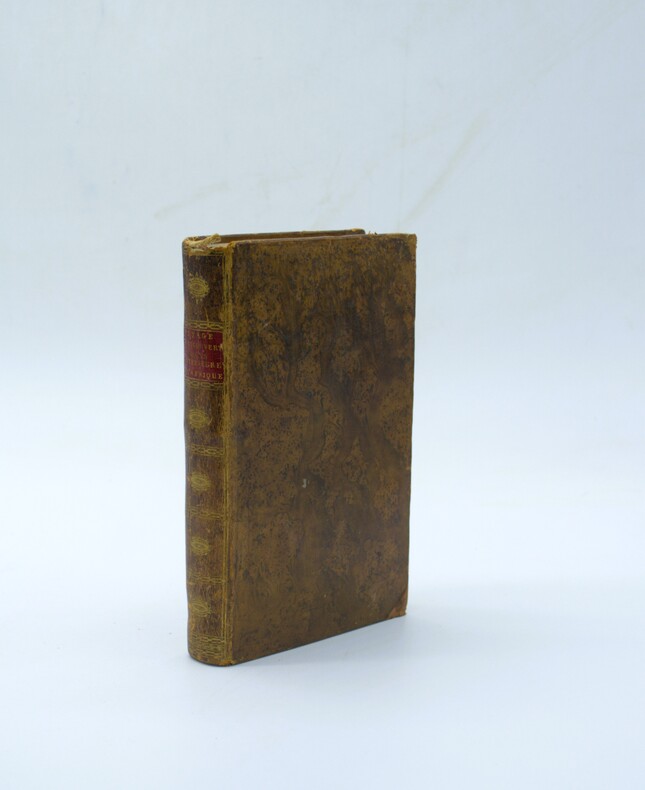
1798PHO-2264Paris, Tavernier, An VI [1798)]. In-8° de [4], 343 pp. 3 cartes dépliantes & Paris, Directeurs de l'Imprimerie du Cercle Social, 1792, l'an premier de la République Française. 171 pp. Basane fauve racinée, dos long orné, p. de t. en maroquin rouge, filet doré sur les coupes, tranches citron (Reliure de l'époque). Annotations anciennes dans les marges. Accident à la coiffe de tête, usure aux coins, frottements au dos.
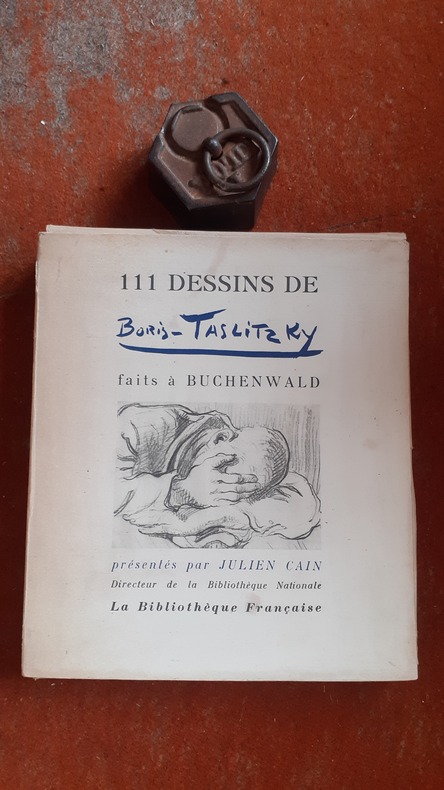
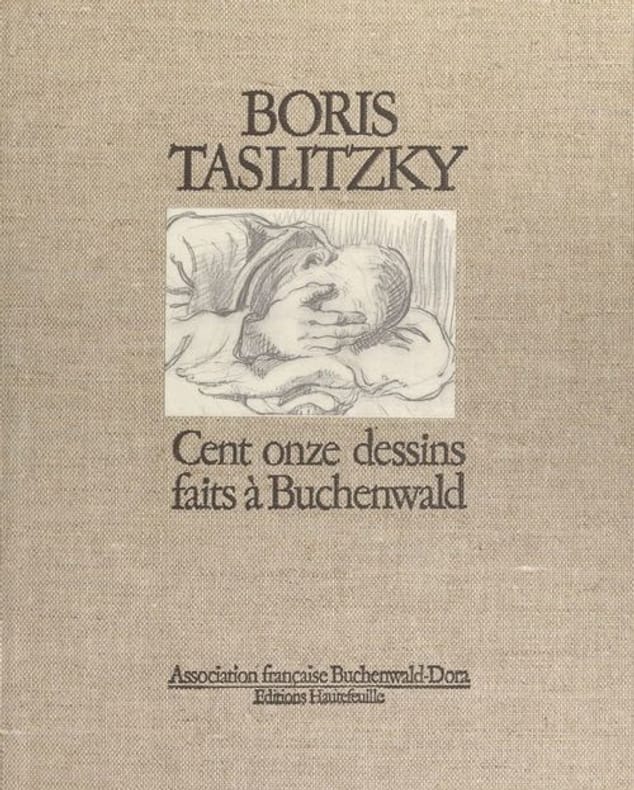
QWA-21448La Bibliothèque Française, 1945,pet. in-4 en feuillets sous chemise cartonnée (21,5 x 24,5),11 p. + 110 fnch , 1ère édition, tirage à 3214 exemplaires numérotés, celui-ci l'un des 510 exemplaires sur vélin pur fil du Marais (après les 104 sur vélin de Rives et avant les 2600 sur papier de châtaignier), préface de Julien Cain, reproduction à pleine page de 100 dessins en n. et b., 6 portraits en n. et b. et 5 aquarelles en couleur ; les titres des dessins sont traduits en langues anglaise et russe ; la plupart des dessins sont des esquisses au crayon ; seule la série de portraits (Julien Cain, Émile Chevalier, Roger Arnoux, Maurice Hewitt, Salme, Madiot), plus travaillée, semble être un travail à l'encre ; bel envoi autographe signé de l'auteur à Marcel Blanc (ancien résistant et déporté, préfet de Corrèze de 1968 à 1971) : "Pour mon camarade L. Blanc parce qu'il a su conserver une attitude impeccable à Buchenwald dans la misère et dans la boue, et avec mon (....) amitié Boris Taslitzky 1946" (on joint une carte de voeux de 1997 adressée au même, signée Boris, l'ouvrage provient de la bibliothèque de M. Blanc), cartonnage passé avec rabats comportant des déchirures réparées, intérieur très propre, exemplaire bien complet, bon état.
Very Good Armenian Original fine red cloth bdg. with decorative gilt on board. Spine is repaired masterfully. Large roy. 8vo. (25 x 18 cm). In Armenian. [24], 429 p., 1 folded Armenian map of Turkey (map size: 24x33 cm), 29 unnumbered full-page b/w plates (one is folded). Armenian Golgotha is a memoir written by Grigoris Balakian about his eyewitness account of the Armenian Events. The memoir was released in two volumes. Volume 1, about his life prior to and during the Armenian Deportation, was released in 1922. Volume 2, about his life as a fugitive after the Deportation, was released in 1959. Originally published in Armenian, the memoir was later published in various languages including an English translation by Peter Balakian, Balakian's great-nephew, with Aris Sevag. Grigoris Balakian [or, Palakean, Palakian, Balakean], was a bishop of the Armenian Apostolic Church, in addition to being a survivor and memoirist of the Armenian Events in the Ottoman Empire. Grigoris Balakian was born in Tokat in the Ottoman Empire and graduated from the Sanasarian College in Erzurum. He had been studying architecture in Germany for two years and got a degree in civil engineering. He became a celibate priest ordained under the monastic name Grigoris Balakian. On 24 April 1915, he was among the group of 250 leading Armenian figures of Constantinople who were arrested and deported. One group was deported to Ayas. Balakian was deported to Çankiri, north-east of Ankara with the rest of the 190 other deportees from the capital. Only 16 of them would survive. He marched with 48 deportees from Çankiri in the direction of Deir Al-Zor in the Syrian desert. On the way, Balakian won the confidence of captain of constabulary Shukri Bey and learned about the Ottoman government's plan to exterminate the whole Armenian population. Balakian was able to flee toward Islahie. He joined a group of workers on the Bagdad-railway where Turkish deserters did forced labor alongside Armenian refugees. While Armenian workers between Marash and Bartche were being slain, Balakian fled to another construction site on the Bagdad railway. He was helped by German engineers and finally succeeded - disguised as Herr Bernstein - in escaping from Constantinople to Paris. At the 1921 trial in Berlin against Soghomon Tehlirian, the murderer of Talât Pasha, Balakian appeared as a witness for the defendant together with Johannes Lepsius. Soghomon Tehlirian was ultimately acquitted. Balakian became prelate of Manchester, London, and finally bishop of Marseille. Two churches were built under his guidance in Marseille and Nice (St. Mary, 1928) as well as a number of chapels and schools. He died in Marseille. Balakian is the granduncle of Anna Balakian, an expert on symbolism and surrealism who chaired New York University's Department of Comparative Literature, and the great-granduncle of Peter Balakian, an Armenian-American writer and winner of the 2016 Pulitzer Prize for Poetry. Balakian's memoirs in Armenian Golgotha are an important eyewitness account of the Armenian Events. He describes his experiences during the deportation. Balakian was one of the few surviving leaders of the Armenian community who gave an account of the deportation. Komitas (Gomitas) Vartapet belonged to the same group of detainees as Balakian. His information about the traumatization of the famous composer and founder of modern Armenian classical music is of eminent importance. OCLC: 1137218025. First Armenian Edition. Rare.
Fine English Paperback. Pbo. Roy. 8vo. (24 x 17 cm). Articles in English, Turkish. 54 issues set. Armenian studies. A quarterly journal of history, politics and international relations.= Ermeni arastirmalari. Üç aylik tarih, politika ve uluslararasi iliskiler dergisi. Mart-Nisan-Mayis 2001 - Ekim-Kasim-Aralik 2016. 1-54. Edited by Ömer Engin Lütem.
18169999259chez Madame Vve Lepetit Paris chez Madame Vve Lepetit 1816, In-8 relié bradel de l'époque, 298 pages. Exemplaire en trés bon état, totalement sans rousseurs. Rare.
Paris chez Madame Vve Lepetit 1816, In-8 relié bradel de l'époque, 298 pages. Exemplaire en trés bon état, totalement sans rousseurs. Rare.
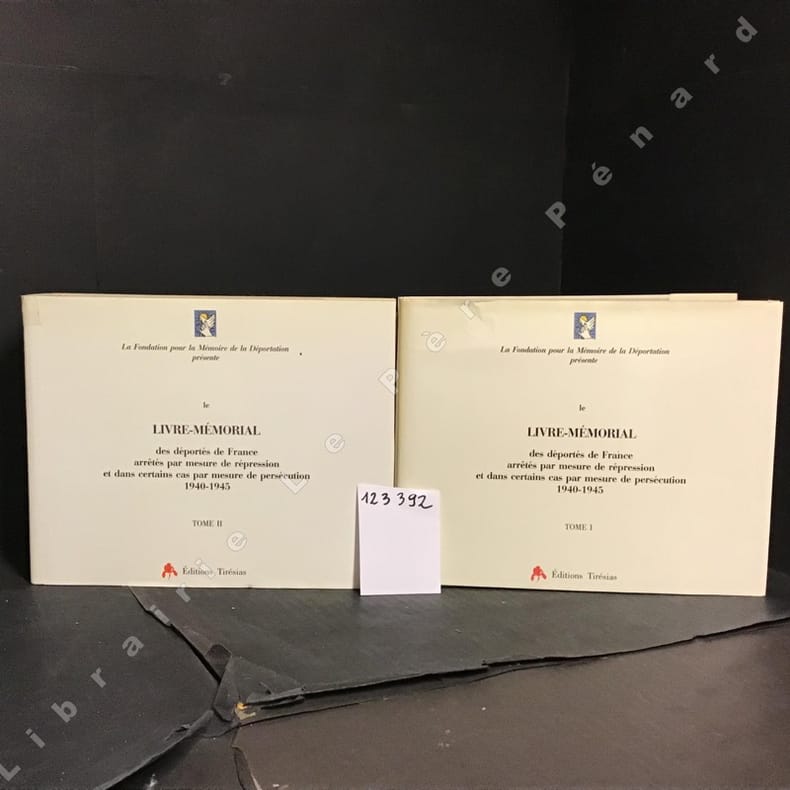
2004808022004 Paris, Editions Tiresias, 2004, 4 très forts volumes grand in 8° oblongs, reliés pleine toile de l'éditeur, jaquettes imprimées, 1446, 1406, 1406 et 1282 pages ; cachets ; quelques traces de surlignement.
41599Paris Guillaume et Cie, Libraires. Salon Littéraire, Palais Royal 1819 in 8 (20x12,5) 1 volume reliure demi basane maroquinée verte à coins de l'époque, dos lisse orné, XII et 329 pages, avec une carte dépliante de l'archipel des Iles Séchelles, et 2 planches dépliantes, papier uniformément jauni. Edition originale. Bon exemplaire
12420P., Maradan, s.d. [circa 1800] ; in-8. 269 pp. - 13 f.n.ch.(tableaux) - 11 pp.(annonce de la publication du Cultivateur anglais, d'Arthur Yung). Basane marbrée, dos lisse orné, pièce de titre en maroquin rouge, tranches rouges. Légers frottements. Bon exemplaire dans une reliure de l'époque.
46405675Manuscrit en 2 parties, la première titrée Souvenirs d'un transporté, fragments. La seconde intitulée Le Camp des transportés.Donat Lucien Pelletier-Didon ou Pellotier de Lorgues est né à Lorgues (Var) en 1817. Il fut arrêté le 3 juillet 1848 pour ses activités révolutionnaires durant les journées de Juin et condamné sans jugement à la transportation. Les archives du Service historique de la Défense [dossiers personnels: 4785 Cote: 6 J 64] indiquent qu'il était à l'époque artiste homme de lettres et qu'il résidait à Paris. Il fut interné sur les pontons de La Didon (Brest), de la Belle Poule (Brest) et la Guerrière (Brest), puis détenu à Belle-Île à partir du 20 février 1849. Transporté en Algérie à Lambessa, sa peine fut commuée en 1853, il quitte Lambessa pour Constantine en juillet 1853. La première partie en 13 pp. contient le récit de sa condamnation et sa captivité à Brest sur le ponton de la Guerrière puis la transportation des prisonniers à Belle-Île à bord de l'Armodée et du Gomer. La seconde partie (pp. 14 à 29) décrit la vie dans le camp des transportés de Belle-Île.
19481cb12in12 reliure toilée chocolat moderne. Plat papier contrecollé sur la reliure dos muet 189 pp Papier jauni
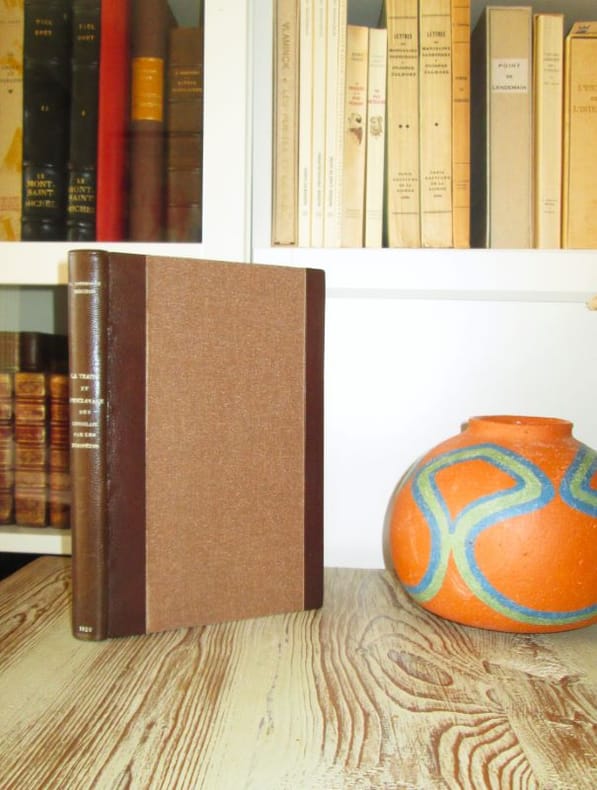
192932291Wetteren : impr. de J. de Meester et fils, 1929. Petit in-4 relié (25,3 x 17 cm), reliure demi-maroquin à bandes, titre doré sur le dos, couverture conservée, XVI-308 pages. Préface de M. Engels. Orné de 37 illustrations hors texte. Importante "Bibliographie générale de la Traité et de l'Esclavage" (38 pages) et index (18 pages).- 900g.- Petit ex-libris de la Fondation Ardouvin.- Exemplaire bien frais et très relié, très bel exemplaire peu courant.
20041233922004 Editions Tirésias, Paris - 2004 - 4 volumes petits in-8 à l'italienne, cartonnages toilés gris avec titre en doré sur le premier plat, sous jaquette - 1446 + 1406 + 1406 + 1282 pages
179920013Londres 1799 in-8 demi- percale 2 textes d'Auteurs différents reliés en un volume, reliure demi-percale bordeaux (half hard-back percale) in-octavo (14 x 21,6 cm), reliure tardive 19ème, dos long (spine without raised band), décoré or, titre frappé or, pièce de titre sur fond noir avec double filets or, fleuron central (floweret) or double filets or en pied avec date frappée or, papier peigné rouge et or aux plats, (label of title with gilt line) sur fond havane, papier marbré aux plats (cover with marbled paper), toutes tranches non rognées, orné d'un portrait de Barthelemy gravé sur bois en noir en frontispice + une vignette représentant "deux colonnes tronquées et mutilées en mémoire de Barthelemy et Carnot " gravée sur bois en noir en bas de la page de titre (avec l'explication page 223), 223 pages, sans lieu 1799 sans nom d'éditeur pour les MEMOIRES HISTORIQUES ET DIPLOMATIQUES DE BARTHELEMY (Edition Originale) + sans illustrations (no illustration), IV + 186 pages, seconde Edition, Londres, 1799 sans nom d'éditeur pour le JOURNAL DE L'ADJUDANT-GENERAL RAMEL,
32 pages. Features: Coming Home - A Poem; Removing the Smoke Screen From America's Warships; Use Your Hands to Save Your Head; Churches are Building Skyscrapers from Coast to Coast - article with photos of Broadway Temple in New York, Mizpah Temple in Syracuse, and Baptist Temple in Rochester, NY; The Conquest of the MIddle Ages; The Lustrous Lenglen - French tennis pro Suzanne Lenglen - article with illustration; News out of Washington; Henry Ford's Page - He argues the Marines should be used to root out those Americans who visit Central and South America only to bind their nations with loans, exploit them in commerce and mislead them in industry; Editorials - Will Rogers is recommended as Sec. of State for Pan-American Affairs, Criticism of Charlie Chaplin, poor Army grub leads to many desertions, the Civil Liberties Union, led by Ernst Freund, opposes the Alien Deportation Bill; When France got Back Her Favorite Daughter, Alsace the Lovely - photo-illustrated article of the beautiful region; Strange Men Who Could Not Keep Straight (part 2) - Charlie of the Quantrelle Gang; The Balloon That Never Returned - a mystery story of the Arctic; One-page illustrated ad for the Venice Company of Venice, Florida; Alfred Brunson was Wisconsin's First Methodist Circuit Rider; Chats with Office Callers; Q & A; I Read in the Papers - college news in France, Montreal rabbi Rev. Isaac de la Penhe claims ownership of Labrador, Robby Burns' advice to his brother; News Bits. Average wear. Nibbling along top of coverfold. Unmarked. Page 9 loose but present. A worthy vintage copy. Book
1992LR60-R50Peu courant ensemble du témoignage sur la déportation de l'abbé Joseph de la Martinière. Il a été arrêté à Gien le 12 mai 1942 sur dénonciation et interné à la prison d’Orléans, puis au secret à Fresnes. Il est ensuite déporté par le convoi du 10 juillet 1942[en Allemagne, en application du décret et de la procédure Nacht und Nebel visant les détenus « coupables » d’être hostiles envers le Reich, « jugés » en Allemagne par des tribunaux spéciaux de sorte que leur famille et les autorités de leur pays soient tenues dans une complète ignorance du sort qui leur est réservé, vivants ou morts (d’où l’expression « Nuit et brouillard » choisie par Hitler en personne). (Source : Wikipedia) Ces 5 volumes correspondent à l'édition de 1992 Publié directement par Joseph de La Martinière à Lignières-de-Touraine, puis diffusé par B. Le Fournier. Brochés, couvertures illustrée, dos toilés par un adhésif, pages imprimées sur le recto uniquement, quelques illustrations, 97 p. , 102 p. 105 p. ,110 p. et 147 p.
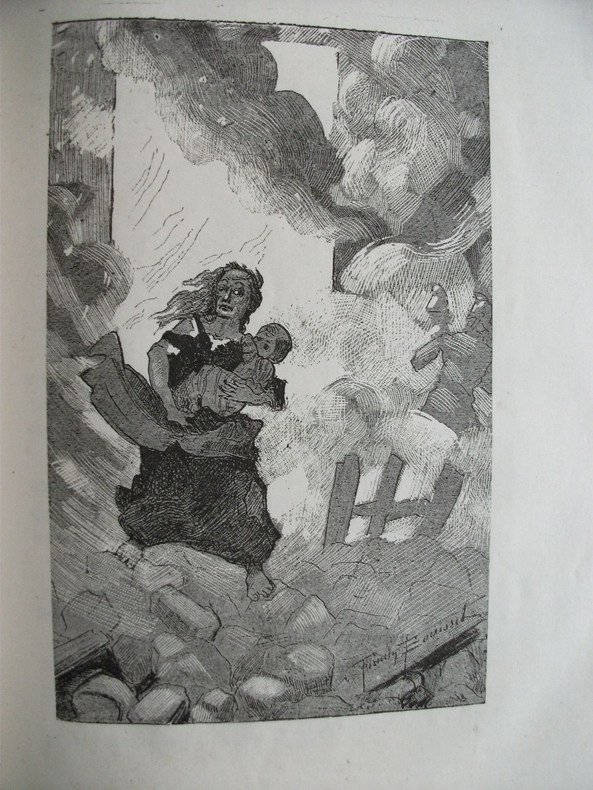
140Contes et légendes par L.M (institutrice)un volume in 8 pleine toile,titre doré en long au dos, Ville de Paris doré sur le premier plat,filets à froid en encadrement. Titre, 68 pages,un feuillet de table des matières,deux illustrations hors texte de Firmin BOUISSET,Keva & Cie 1886.mention de deuxième édition. (La neige, la vieille chéchette,Robin des bois ...)
ORD-9823Tome 2°. Paris. Beauvais. 1872. A la suite: Derniers télégrammes de l'Empire. Documents inédits. Paris. Beauvais. 1871. In-8 (160 x 247mm) dos lisse veau fauve, filets or, plats et gardes marbrés, 3ff.n.ch., 228 pages et 2ff.n.ch., 35 pages (Derniers télégrammes de l'Empire). Qq. rousseurs pâles sinon bon exemplaire.
Very Good Armenian Original half bound leather bdg. Large demy8vo. (22 x 15,5 cm). In Armenian. 675 p. Prior to Soviet rule, the Dashnaksutiun had governed the First Republic of Armenia. The Socialist Soviet Republic of Armenia was founded in 1920. Diaspora Armenians were divided about this: supporters of the nationalist Dashnaksutiun did not support the Soviet state, while supporters of the Armenian General Benevolent Union (AGBU) were more positive about the newly founded Soviet state. From 1828 with the Treaty of Turkmenchay to the October Revolution in 1917, Eastern Armenia had been part of the Russian Empire and partly confined to the borders of the Erivan Governorate. After the October Revolution, Bolshevik leader Vladimir Lenin's government announced that minorities in the empire could pursue a course of self-determination. Following the collapse of the empire, in May 1918 Armenia, and its neighbors Azerbaijan and Georgia, declared their independence from Russian rule and each established their respective republics. After the near-annihilation of the Armenians during the Armenian Genocide and the subsequent Turkish-Armenian War, the historic Armenian area in the Ottoman Empire was overrun with despair and devastation. A number of Armenians joined the advancing 11th Soviet Red Army. Afterward, Turkey and the newly proclaimed Soviet republics in the Caucasus negotiated the Treaty of Kars, in which Turkey resigned from its claims to Batumi to Georgia in exchange for the Kars territory, corresponding to the modern-day Turkish provinces of Kars, Igdir, and Ardahan. The medieval Armenian capital of Ani, as well as the cultural icon of the Armenian people Mount Ararat, were located in the ceded area. Additionally, Joseph Stalin, then acting Commissar for Nationalities, granted the areas of Nakhchivan and Nagorno-Karabakh (both of which were promised to Armenia by the Bolsheviks in 1920) to Azerbaijan. From 12 March 1922 to 5 December 1936, Armenia was a part of the Transcaucasian SFSR (TSFSR) together with the Georgian SSR and the Azerbaijan SSR. The policies of the first Soviet Armenian government, the Revolutionary Committee (Revkom), headed by young, inexperienced, and militant communists such as Sarkis Kasyan and Avis Nurijanyan, were implemented in a highhanded manner and did not take into consideration the poor conditions of the republic and the general weariness of the people after years of conflict and civil strife. Such was the degree and scale of the requisitioning and terror imposed by the local Cheka that in February 1921 the Armenians, led by former leaders of the republic, rose up in revolt and briefly unseated the communists in Yerevan. The Red Army, which was campaigning in Georgia at the time, returned to suppress the revolt and drove its leaders out of Armenia. Convinced that these heavy-handed tactics were the source of the alienation of the native population to Soviet rule, in 1921 Moscow appointed an experienced administrator, Alexander Miasnikian, to carry out a more moderate policy and one better attuned to Armenian sensibilities. With the introduction of the New Economic Policy (NEP), Armenians began to enjoy a period of relative stability. Life under the Soviet rule proved to be a soothing balm in contrast to the turbulent final years of the Ottoman Empire. The Armenians received medicine, food, as well as other provisions from the central government and extensive literacy reforms were carried [.] Only one copy is located in OCLC: 782028953 (National Library of Israel - Jewish National Library).
1978126958Versailles, Éditions Hautefeuille pour L'Association française Buchenwald-Dora, 1978, gr. in-4°, (4)-3-9-111-(4) pp, avant-propos de Marcel Paul, préface de Julien Cain, 111 dessins légendés dont 98 au crayon noir de scènes au camps de concentration, 8 portraits d'amis de camps en noir et 5 dessins de scènes au camps en couleurs, liste des dessins in fine, en feuilles, sous coffret pleine toile écrue de l'éditeur titré en noir avec un dessin de l'auteur contrecollé au 1er plat, fermé par trois rubans, très bon état. Tirage à 1000 exemplaires numérotés sur vélin pur chiffon des Papeteries Arjomari, tous signés par l'artiste, celui-ci le n° 0724
Very Good Turkish, Ottoman (1500-1928) Contemporary cloth bdg. with Ottoman gilt on the spine made in the Ottoman period. Original pictorial cover saved inside. Roy. 8vo. (23 x 16 cm). In Ottoman script. 256 p., b/w ills. An illustrated rare book on Misak Torlakian case in 1921. Misak Torlakian, (1889-1968), was the assassin of Behbud Khan Javanshir, Internal Affairs Minister of Azerbaijan, in 1921. Torlakian was admitted "guilty but not responsible" due to his mental condition by the British military tribunal in November 1921. Torlakian was born in 1889 in Trebizond, Ottoman Empire. Joining the Armenian Revolutionary Federation (ARF) at the age of 18, Torlakian, tasked to obtain military intelligence during World War, by then a member of a Russian Army scout unit, provided valuable information about Turkish army dispositions. was sent by the ARF to execute Behbud Khan Javanshir Azad Khanoglu, (Azerbaijani politician, diplomat, Minister of Internal Affairs of Azerbaijan Democratic Republic (ADR) and Deputy Minister of Trade and Industry), (1877-1921). Torlakian murdered Javanshir in October 1921, the British tribunal issued a guilty verdict but ruled that he was not responsible for his actions due to his epilepsy. Torlokyan left for Greece, where he was released and left for the United States. Behbud Khan Javanshir was assassinated outside the Pera Palace Hotel in Istanbul on July 18, 1921. This rare book includes several unnumbered b/w plates like a plan of the route of Behbud Khan Jawanshir from Municipality building in Tepebasi to Pera Palas Hotel, shortly before his assassination, his portrait, Torlakian's photo with his friend and others. Bookseller stamp on colophon. Slightly chipped on two pages' margins. Colophon date 1922 [1328 AH] Özege 21155.; TBTK 1149.; First Edition.
Very Good French Paperback. Demy 8vo. (21 x 14 cm). In French. 2 volumes set: (207, 22 p.; 75 p.). Commission mixte pour l'Echange des Populations Greccques et Turques. Actes, decisions, sentences arbitrales relatifs a l'Echange de Populations Grecques et Turques. 2 volumes set. Tome I. / Tome II: Annexe: Rapport final de la commission mixte. Contents: Actes signes a Lausanne (1923).; Cnvention concernant l'Echange des Populations Grecues et Turques et protocole signes le 30 Janvier 1923, le gouvernement de la Grande Assemblee NAtionale de Turque et le gouvernement Hellenique.; Protocole by Ismet, Dr. Riza Nour, Hassan.; Accord Greco-Turc relatif a la Restitution des Internes Civils et a l'Echange des Prisonniers de Guerre signe le 20 Janvier 1923.; Declaration relative aux proprietes musulmanes en Grece signee le 24 Juillet 1923. Recueil...; Accord d'Athenes.; Liste d'immeubles mentionnee a l'Art. 8 de l'accord sur les Biens signe a Athenes le 1er decembre 1926) appartenant a des ressortissants hellenes etablis a Smyrne, Mersine et Pendik et se trouvant en possession de leurs proprietaires.; et alli.; Recueil des decisions prises par la Commission Mixte depuis le 19 mars 1932 jusqu'au 9 decembre 1933, date de la signature de la derniere Convention d'Ankara.; Rapport final.
1904STXG0060Stuttgart, F. Lehmann 1904. 8°. IV, 133(3) S. Grüne OBrosch. mit aufwendig eingerahmtem Deckeltitel in Rot- u. Goldpräg. Rücken mit Lichtspuren; alte Signatur auf Hinterdeckel; insgesamt schönes u. sauberes Ex. Meyer zu Hoberge S. 21ff. - Erste Ausgabe. Pamphlet des deutschen Oberlandesgerichtsrates Casimir Wagner, in dem er die Strafverschickung von Kriminellen propagiert. W. zählte zu den überzeugtesten Verfechtern der Deportation und erwog auch die Zwangsverschickung politischer Gegner. "..Haß und Furcht gegenüber verschiedenen sozial und politisch unerwünschten Gruppierungen dominieren das Werk. Sie alle wollte W. am liebsten ad hoc deportieren lassen." (Meyer zu Hoberge). Aus kolonialpolitischen Gründen schienen ihm die deutschen Pazifikinseln als künftige Strafkolonien am geeignetsten.