188 résultats
10095Antwerpen1985 t/m 1992 diverse formaten geniet of gebrocheerd gelezen staat naam vorige eigenaar - unknown
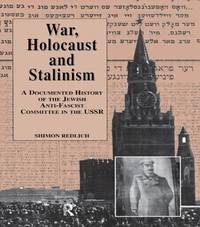
199525360Luxembourg: Harwood Academic Publishers 1995. hardcover illustrated boards. minor bits of superficial wear to exterior around spine. no other flaws or wear. clean. no markings. no bumps tears. strong binding.; english text.; author's signed gift inscription to front free endpaper.; xxix-504pp. 12 b/w illustrations and over 180 documents. exhaustive reference. First Edition. Hardcover. Near Fine/No Jacket as Issued. 8vo - over 7¾" - 9¾" tall. Harwood Academic Publishers Hardcover
1945296615L. B. Fischer 1945. First Edition. Hardcover. Near Fine. Small 8vo in red cloth spine title in black. Binding tight and square corners and spine ends very mildly pushed but absolutely not rubbed. The dustjacket is not price-clipped virtually no rubbing to the corners and spine ends. L. B. Fischer hardcover
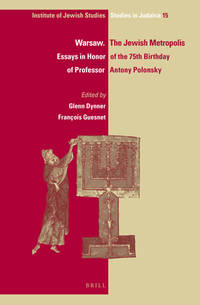
201522545Leiden/Boston: Brill 2015. soft cover. no flaws or wear. clean. no markings. no bumps tears creases. tight binding.; english text.; xiv-624pp. 15 maps illustrations. color frontispiece. 25 essays and texts by various contributors on aspects of the jewish community of warsaw. prof. polonsky wrote and taught extensively on polish-jewish history including the many volumes of polin. a true scholar's scholar. First Softcover Edition. Soft Cover. Fine. 8vo - over 7¾" - 9¾" tall. Festschrift. Brill Paperback
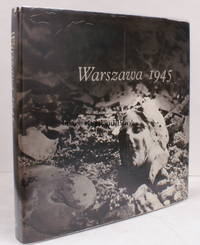
198521346Panstwowe Wydawnictwo Naukowe Warsaw 1985. 4to. First Edition with very numerous full-page photographs throughout; oatmeal Holland backstrip lettered in black black endpapers a near fine copy in unclipped dustwrapper the latter very lightly chafed at extremities. Comprehensive photographic survey with over 240 contemporary images of WWII destruction. Very scarce especially in this condition. Panstwowe Wydawnictwo Naukowe, Warsaw, unknown
0773442464.Ghardcover. Good. Access codes and supplements are not guaranteed with used items. May be an ex-library book. hardcover
1995094743United Kingdom: Edwin Mellen Pr. 461 pages. Cloth at head of spine has a minor slit approx. 1cm. Clean hardback. No dust jacket. What Have We Learned: Telling the Story and Teaching the Lessons of the Holocaust Papers of the 20th Anniversary Scholars' Conference . Good. Hardcover. 1995. Edwin Mellen Pr hardcover
0815635532.Ghardcover. Good. Access codes and supplements are not guaranteed with used items. May be an ex-library book. hardcover
1964335850New York: Hawthorn Books Inc. 1964. First Edition. Hardcover. Very Good/No Jacket. No DJ tan cloth boards with minor stain to dront cover. Otherwise book is like new. Hawthorn Books Inc. hardcover
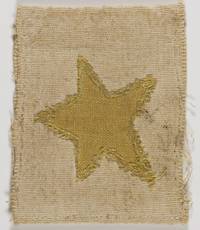
194353630Tunisia 1943. Nearly Fine. Five-pointed yellow cloth star sewn onto plain beige cloth 7.3 by 9 cm. Yellow dye somewhat faded else in fine state of preservation.<br /> <br /> Specimen of the yellow star imposed on the Jewish population of Tunisia in March 1943 as a mark of the slave laboror. Tunisia was the only Islamic country to come under Nazi rule at first indirectly through the Vichy regime in France between 1940 and its liberation by Allied forces on May 7 1943. In response to the Allied invasion of Algeria and Morocco German and Italian forces invaded Tunisia on November 9 1942. By the end of November the Germans took the first anti-Jewish move by arresting four of the community leaders including Moïse Borgel the president of the Jewish congregation. "In addition to the governor-general's sympathetic attitude -- and in some degree to the pro-Jewish attitude of Bey Sidi Mohammed al-Mounsaf -- the Italians also in practice interfered with the application of the anti-Jewish laws" E.H. The dignitaries were released after a week following the intervention of the mayor of Tunis and the Italian consul. Because of objections by the Italians the edict to wear the star does not appear to have been generally enforced with rigor and was only formally imposed in two cities Sfax and Tunis. While 5000 Jews had originally been put on forced labor in thirty locations and camps along the front line "at the time of the collapse and surrenter in early May 1943 only sixteen hundred Jews were employed on forced labor" E.H. Given the relatively small labor force and the lack of zeal in imposing the anti-Jewish ordinances it is clear why so few of these yellow badges have survived. References: I. Gutman ed. Encyclopedia of the Holocaust vol. 4 pp. 1521-23. unknown
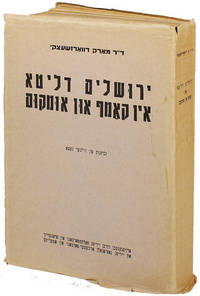
194816623Paris: L'Union Populaire Juive en France 1948. First Edition. Octavo. Printed paper wrappers; 515pp; illus some folding; facs. Includes bibliography. Text entirely in Yiddish. Text slightly tanned but a tight clean copy overall VG or better in the original wrappers. First-hand account of atrocities in the Vilnius ghetto by a survivor; extensively documented including facsimiles of original documents and photographic evidence of Nazi atrocities. Uncommon especially in this state of preservation. L'Union Populaire Juive en France unknown
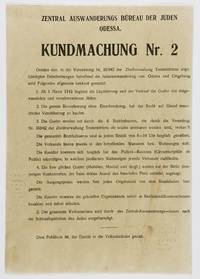
194251752Odessa: Zentral Auswanderungs Büreau 1942. Original document. Loose leaf. Very good condition. Quarto. Original loose leaf with black lettering. Announcement based on ordinance no. 35/942 of the civil government of Transnistria relating to the emigration of Jews in Odessa and surrounding areas. <br /> <br /> The text printed biligually in German and Ukrainian is organized into five statements. The annoucement concerns the liquidation and sale of goods of emigrated or vanished Jews beginning on March 1 1942 with the whole population without limitations given the right to buy these items based on oral agreements. Furthermore the announcement regulates details and procedures of the sale and at the end announces that after the sale proceeds will by handed to the Jews by the Central Emigration Office.<br /> <br /> "The rapid development of Odessa began after the Russian conquest 1789. Its Jewish population also grew quickly and in the late nineteenth and early twentieth centuries it was the most important Jewish literary community after Warsaw. In 1926 there were 153194 Jews in Odessa 36.4 percent of the total population and by 1939 their numbers reached 180000." Encyclopedia of the Holocaust Vol. 3 page 1080.<br /> <br /> When Romanians and Germans laid siege to the city on August 5 1941 many Jews in Odessa managed to leave and eighty to ninety thousand Jews remained in the city. Odessa fell on October 16 and the German Einsatzkommando 11b and the Romanian intelligence service immediately slaughtered over eight thousand residents mainly Jews and Odessa was established as the capital of the Transnistria region. On October 22 the Romanian military headquarters were blown up killing sixty-six officers and the military governor. In reprisal the Romanian ruler Ion Antonescu ordered devastating retaliation including the arrest of one member of each Jewish family. By October 1941 some 40000 Jews were assembled in the ghetto of the nearby city of Slobodka and their valuables confiscated. Deportations of some 20000 Jews began in January of 1942. When Odessa was liberated on April 10 1944 authorities reported that about 99000 Jews had been killed. Odessa again became an important Jewish center with 102000 Jews living there according to a 1959 census.<br /> <br /> Considering the context of "Kundmachung Nr. 2 the Odessa massacre of October 22-24 1941 and the murder of Jews living between the rivers Dniester and Bug during the Romanian and German occupation this succinct notice including its misspellings and mistakes in the German language is a chilling mirror image of the attitude shown by the occupying powers towards the Jews. Approximately 30000 Jews were killed in Odessa and more than 100000 in Transnistria. <br /> <br /> The text is printed in German on one side and Ukrainian on the verso. Minor wear and smudging. Protected in modern mylar. Zentral Auswanderungs Büreau unknown
M8-QO57-8QXBNew. unknown