Ofer, DaliaBiblio.com
188 résultats
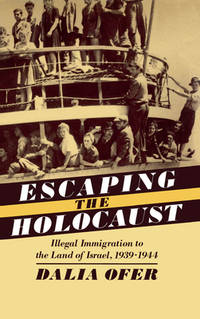
1990017866New York & London: Oxford University Press 1990. Fine condition in a Near Fine dust jacket. NO chips. NO tears. NO fading. Bright shiny clean square and tight. Sharp corners. NOT a library discard. NO owner's name or bookplate. NO remainder mark. Fresh and crisp -- probably never read. NO underlining. NO highlighting. NO margin notes. 1990 First printing with complete number row 135798642 on the copyright page. Photo illustrated. List of chapter notes. Bibliography. Index. Bound in the original pale yellow boards with a maroon spine stamped in shiny gold. From the dust jacket: "Illegal Jewish immigration to Palestine prior to the founding of the State of Israel forms one of the most fascinating chapters in the history of Zionism and modern Jewish history. Bringing Jews from Europe to Palestine by land and by sea in defiance of restrictive British immigration policies was partly an undertaking of national rescue and partly a calculated strategy of political brinksmanship. In ESCAPE FROM THE HOLOCAUST sic Dalia Ofer examines various rescue and illegal immigration efforts organized by the Palestinian Jewish community in both the beginning and latter phases of the war. Making exhaustive use of archival sources Ofer provides invaluable insight into the struggles of the immigrants the activists and supporters of the movement the logistical obstacles and the political forces working to halt or exploit the flow of refugees." . First Printing of the First Edition. Hardcover. Fine condition/Near Fine dust jacket. 8vo. xiii 408pp. Oxford University Press Hardcover
1998BN151634Österreichische Lagergemeinschaft Mauthausen o.J 1998. 1998. Erinnern. Remembering. Souvenir. Ricordare. Mauthausen. - "Signiertes Exemplar" von der Autorin Cathrine Stukhard <br/><br/>Erinnern. Remembering. Souvenir. Ricordare. Mauthausen. - "Signiertes Exemplar" von der Autorin Cathrine Stukhard Holocaust - Mauthausen - Bandion Wolfgang J. Cathrine Stukhard und Stephan Hilge Österreichische Lagergemeinschaft Mauthausen, o.J unknown
200585458Washington DC: United States Holocaust Memorial Museum 2005. Presumed First Edition First printing. Wraps. Very good. Format is approximately 8.5 inches by 8.5 inches. 4 iv 80 pages. Illustrations. Cover has minor wear sticker residue and soiling. Letter from the Director Sara J. Bloomfield. Introduction by Margaret Peterson. Sections by Erika Eckstut Frank Ephraim Manya Friedman Fritz Glucksetin Nesse Godin Pete Philipps Charlene Schiff Flora Singer Esther Starobin and Rabbi Joseph Weiner. Illustrations. Some of the contents are identified as works of fiction--the others are nonfiction. This is one of the publications that marked the 10th anniversary of the Holocaust Museum which was dedicated in 1993. The Museum offers its survivor volunteers the Memory Project writing workshop as a means of recounting their experiences whether in biographical accounts or in fictional form. These workshops have met the needs of many survivors who wanted to tell their story but who had not previously had the right place or time to do so. The United States Holocaust Memorial Museum USHMM is the United States' official memorial to the Holocaust. Adjacent to the National Mall in Washington D.C. the USHMM provides for the documentation study and interpretation of Holocaust history. It is dedicated to helping leaders and citizens of the world confront hatred prevent genocide promote human dignity and strengthen democracy. Since its dedication on April 22 1993 the museum has had nearly 40 million visitors including more than 10 million school children 99 heads of state and more than 3500 foreign officials from over 211 countries and territories. The museum's visitors came from all over the world and less than 10 percent of the museum's visitors are Jewish. Its website had 25 million visits in 2008 from an average of 100 countries daily. Thirty-five percent of these visits were from outside the United States. The USHMM's collections contain more than 12750 artifacts 49 million pages of archival documents 85000 historical photographs a list of over 200000 registered survivors and their families 1000 hours of archival footage 93000 library items and 9000 oral history testimonies. It also has teacher fellows in every state in the United States and since 1994 almost 400 university fellows from 26 countries. Researchers at the United States Holocaust Memorial Museum have documented 42500 ghettos and concentration camps created by the Nazis throughout German-controlled areas of Europe from 1933 to 1945. Though the museum is located geographically in the same cluster as the Smithsonian museums the United States Holocaust Memorial Museum is an independent entity with its own governance structure. However the museum and the Smithsonian regularly participate in joint projects. United States Holocaust Memorial Museum paperback
194829513New York; YKUF 1948. Paperback. Original Wrappers. 12mo. 79 pages. 17 cm. Undated edition. In Yiddish. <br> Includes introduction by Miriam Novitch as well as "Vi Yitshak Katsnelson hat geshribn zayne klog-lider" also by Miriam Novitsh on pages 15-16.<br> “Song of the Murdered Jewish People" by Itzhak Katzenelson 1885–1944 a Hebrew and Yiddish poet. â€Katzenelson’s world fell apart when in August 1942 his wife Hanna and two younger sons Ben-Tsiyon and Binyamin were deported to Treblinka. From then on his literary creativity was piercingly shaped by lamentations over the loss of his family. Nonetheless with his oldest son Tsevi he found the strength to join the Jewish Fighting Organization and took part in the first uprising of January 1943. <br> After the ghetto was destroyed in April and May 1943 he escaped to the Aryan section of Warsaw and obtained a Honduran identity document. Nevertheless he was sent to a German detention camp for foreign subjects in Vittel France. He was imprisoned there until April 1944 and devoted most of his time to writing. <br> Two important works were produced during that period: Pinkas Vitel The Vittel Diary a Hebrew composition that uses the language of an incensed diarist and reconstructs the days of terror in Warsaw during the mass deportations; and Dos lid fun oysgehargetn yidishn folk The Poem about the Murdered Jewish People a pathos-filled Yiddish poem that laments the destruction of the Jewish people and of the poet himself who has been become bitterly angry with humankind and God. These two works are among the boldest and most lofty literary expressions to emerge from the Holocaust.…<br> All of Katzenelson’s works from his Vittel period were either buried in hiding places or were given to people he trusted; consequently they were saved and published shortly after the end of the war. <br> In the middle of April 1944 Katzenelson and his son Tsevi were sent to the Drancy transit camp and from there one month later to Auschwitz where they were murdered. In 1950 the Ghetto Fighters kibbutz built a museum and an institute for research about the Holocaust that bear Yitshak Katzenelson’s name†YIVO Encyclopedia. <br> Subjects: Holocaust Jewish 1939-1945 -- Poetry. OCLC: 12260367. <br> Half Dollar size chip to cover no text loss institutional stamp on title page taped spine otherwise Good Condition. BK5 B HOLO2-97-33-XX-ELABCC. New York; YKUF paperback
196343253New York: YKUF 1963. Paperback. Original Wrappers. 12mo. 79 pages. 17 cm. In Yiddish. <br> <br> Includes introduction by Miriam Novitch as well as "Vi Yitshak Katsnelson hat geshribn zayne klog-lider" also by Miriam Novitsh on pages 15-16.<br> <br> “Song of the Murdered Jewish People" by Itzhak Katzenelson 1885–1944 a leading Hebrew and Yiddish poet. <br> <br> â€Katzenelson’s world fell apart when in August 1942 his wife Hanna and two younger sons Ben-Tsiyon and Binyamin were deported to Treblinka. From then on his literary creativity was piercingly shaped by lamentations over the loss of his family. Nonetheless with his oldest son Tsevi he found the strength to join the Jewish Fighting Organization and took part in the first uprising of January 1943. <br> <br> After the ghetto was destroyed in April and May 1943 he escaped to the Aryan section of Warsaw and obtained a Honduran identity document. Nevertheless he was sent to a German detention camp for foreign subjects in Vittel France. He was imprisoned there until April 1944 and devoted most of his time to writing. <br> Two important works were produced during that period: Pinkas Vitel The Vittel Diary a Hebrew composition that uses the language of an incensed diarist and reconstructs the days of terror in Warsaw during the mass deportations; and Dos lid fun oysgehargetn yidishn folk The Poem about the Murdered Jewish People a pathos-filled Yiddish poem that laments the destruction of the Jewish people and of the poet himself who has been become bitterly angry with humankind and God. These two works are among the boldest and most lofty literary expressions to emerge from the Holocaust.…<br> All of Katzenelson’s works from his Vittel period were either buried in hiding places or were given to people he trusted; consequently they were saved and published shortly after the end of the war. <br> <br> In the middle of April 1944 Katzenelson and his son Tsevi were sent to the Drancy transit camp and from there one month later to Auschwitz where they were murdered. In 1950 the Ghetto Fighters kibbutz built a museum and an institute for research about the Holocaust that bear Yitshak Katzenelson’s name†YIVO Encyclopedia. <br> <br> Subjects: Holocaust Jewish 1939-1945 -- Poetry. OCLC: 28824340. <br> <br> Some stains on covers Good Condition. B HOLO2-97-33A-XX-ELABCC. New York: YKUF paperback
198775666New York: Beate Klarsfeld Foundation 1987-. First edition. Five large octavo volumes. 22 493 `; 4 364; 4 467 plus some facsimile illustrations; 4 643 1; 4 561 1 pp/ Pubisher's yellow wrappers lettered in black and each front with an illustration of the Jews of the Grodno Ghetto. Unfortunately a couple of volumes have some tide marks but not horrifiically so. Part 3 has taken the brunt of it. Still an invaluable source record of a great sin of mankind.Comprosed of; v. 1. A. Accounts by Jewish survivors residing in the West. B. Accounts recorded in Poland and the Soviet Union. -- v. 2. Accounts by German witnesses or perpetrators of the final solution. -- v. 3. A. German justice seeking the truth. B. Documents. -- v. 4. Grodno in the Bialystok trial 1966-1967. -- v. 5. The Grodno trial in Cologne 1968. Jewish community in pre-war Grodno includes "Lista Platnikow Skladki Gmninnej Gminy Wyznaniowej Zydowskiej w Grodnie na rok 1937" v. 5 p. 1-97 in the section headed "Jewish Community in Pre-War Grodno"; German documents in Grodno archives: Testimonies concerning Grodno gathered by Jewish underground and recovered after the war; Testimonies gathered in years 1944-1946.; Testimonies gathered in Israel around 1957 in archives of Yad Vashem.From 1939 to 1941 the Soviet Union occupied Grodno. During this time some 4000–5000 Jewish refugees arrived from German-occupied lands to the west. About half of these refugees were later deported into the interior of the USSR. On 13 July 1941 after taking over the city the Germans executed 100 Jews among the intelligentsia and in November of that year they created two ghettos one in the city’s center—to house 15000 Jews designated as “productiveâ€â€”and the other in its suburb of S obodka to house 10000 “unproductive†Jews. The liquidation of the ghettos began in November 1942. The Germans deported Grodno’s Jews to Auschwitz—some via a transit camp in nearby Kelbasin where many died as a result of disease and inhumane conditions—and to Treblinka. On 12 March 1943 the approximately 1000 Jews remaining in the city were deported to the Bia ystok ghetto. When the Red Army entered Grodno on 14 July 1944 only about 250 Jews remained. Beate Klarsfeld Foundation unknown
2009BN152272Yad Vashem Pubns 2009. 2009. Dividing Hearts: The Removal of Jewish Children from Gentile Families in Poland in the Immediate Post Holocaust Years <br/><br/>Dividing Hearts: The Removal of Jewish Children from Gentile Families in Poland in the Immediate Post Holocaust Years Polen / Judaica / Israel / Holocaust / Antisemitismus - Nachmany Gafny Emunah Yad Vashem Pubns unknown
0923J679669Very Good. Subtitle is "A Series of Lectures Presented at Northwestern University by Elie Wiesel and 3 others. Nortwestern 1977. Hardcover with excellent paper. 63 pages. Very nice plus. hardcover
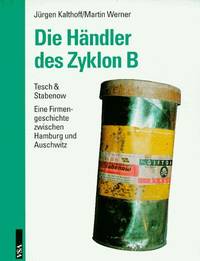
1998013349Hamburg: VSA-Verlag 1998 254 pages. Photographs documents images map tables diagrams. German language / Deutsche Sprache / Duitstalig. 1ste / 1st. Soft Cover. Good / Goed. A4. Paperback. VSA-Verlag paperback
1959300403Prague: Statni Zidovske Museum 1959. Hardcover. Very Good. Translation of the title: Children's Drawings at the Stop for Death: Terezin 1942-1944. Reissued in 1964 in English as I Never Saw a Butterfly: Children's Drawings and Poems from Terezin Concentration Camp 1942-1944. 4to in buckram spine title in black front board device in black and gilt red ribbon marker bound in. Binding tight and square very modest shelf wear. The dustjacket is rubbed at the corners chipped at the spine ends closed tears and creases at the bottom of both panels. Statni Zidovske Museum hardcover
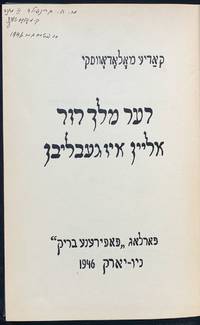
194643238New York: Papirene Brik 1946. First edition. Original boards. 8vo 156 pages 24 cm. In Yiddish. Title appears in English as “Only King David Remained.â€<br> <br> Inscribed by Molodowsky on title page in year of publication<br> <br> Early post-war book of poems by Kadya Mololdowsky that is composed of poems about the Holocaust and that “draw upon traditional Jewish literary responses to catastrophe.†Contains some of Molodowsky’s most well regarded poems.<br> <br> Kadya Molodowsky was a major figure in the Yiddish literary scene in Warsaw from the 1920s through 1935 and in New York from 1935 until her death in 1975. A teacher in the Yiddish schools in Warsaw as a young woman she was best known for her children's poems.<br> <br> In the United States she wrote for the Yiddish press and founded and edited a journal Sviva Surroundings which she published for three decades. Living in Israel 1948-52 she founded and edited a journal Heym. She published six major books of poems 1927-1965 novels short stories plays and essays. Recurrent themes in her work include the lives of Jewish women and girls Jewish tradition in the face of modernity Israel and the Holocaust.<br> <br> SUBJECTS: Yiddish poetry. David King of Israel -- Poetry. David King of Israel. Poetry. OCLC: 19314664.<br> <br> Clean copy with book stamp from “Emil Gorovets’s Library.†Very Good Condition. An attractive inscribed work by a leading female Yiddish writer. YID-48-47-LEXCCM!-’gg. New York: Papirene Brik unknown
1985219453Shazar Library Institute of Contemporary Jewry Vidal Sassoon International Center for the Study of Antisemitism Hebrew University of Jerusalem January 1985. Paper Back. Very Good. clean unmarked copy Shazar Library, Institute of Contemporary Jewry, Vidal Sassoon International Center for the Study of Antisemitism, Hebrew Univer unknown
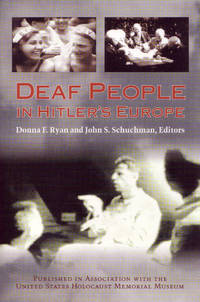
20021-1563681323Gallaudet Univ Pr 2002. Paperback. New. 233 pages. 8.75x6.00x0.75 inches. Gallaudet Univ Pr paperback
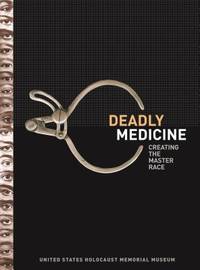
272511UNITED STATES HOLOCAUST MEMORIAL MUSEUM. Hardcover. GOOD. 0 9780807829165 C2004 VERY GOOD TALL HARDBACK IN FAIR / GOOD DUST JACKET SOME WEAR BUMPED CORNERS CLEAN CONTENTS DJ SHOWS RAGGED TEAR IN SPINE UNITED STATES HOLOCAUST MEMORIAL MUSEUM hardcover
199414486Washington DC: U.S. Holocaust Memorial Mus 1994. good. Quarto 448 wraps illus. map chronology glossary covers soiled & edges worn small tears at bottom of spine rear cover creased. Chronology and historical documents of Holocaust events which occurred during 1944. U.S. Holocaust Memorial Mus paperback
20182-1695143868Independently published 2018. Paperback. New. 146 pages. 11.00x8.50x0.35 inches. Independently published paperback
1962017845New York / Jerusalem: Yad Washem Martyrs' and Heroes' Memorial Authority / YIVO Institute for Jewish Research 1962. Very Good condition. NOT a library discard. NO underlining. NO highlighting. NO margin notes. Text is in Hebrew Yiddish and English. Foreword translated from the Hebrew by Jacob Robinson. ON THE BIBLIOGRAPHY OF THE JEWISH CATASTROPHE translated from the Yiddish by Leibush Lehrer. Introduction translated from the Yiddish by Joseph Gar. Joint Documentary Projects Bibliographical Series No. 3. Bound in the original gilt-stamped black cloth. 7.75" wide by 10.75" tall 19.5 cm x 27.5 cm. First Edition in English. Hardcover. Very Good condition/No jacket. xxxi 330pp. Yad Washem Martyrs' and Heroes' Memorial Authority / YIVO Institute for Jewish Research Hardcover
1998biblio925<p>512 pages. Translated from German by Mary Harber</p> Rubin Mass Ltd. hardcover
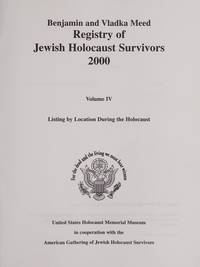
2000222089United States Holocaust Memori January 2000. Paper Back. Very Good. Four volumes 4to in printed wraps. Very Good to Near Fine: all bindings tight and square no creases at the gutters very light rubbing at some corners and spine ends. A rather heavy set; please request shipping quote before ordering. United States Holocaust Memori unknown
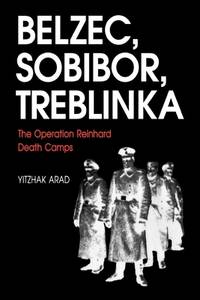
1999006540Bloomington Indiana U.S.A.: Indiana Univ Pr 1999. 437pp/illus. An authentic gripping definitive account of the least known Nazi death camps. Many photos maps letters includes lists of deportations. Clean. First Edition. Trade Paperback. Fine/No Jacket - Wraps. 8vo - over 7¾" - 9¾" tall. Indiana Univ Pr paperback
194434835Tel Aviv: Haaretz Printing House 1944. First Edition with annotations in Hebrew. Illustrated with 17 full-page Zinco engravings created by Zincographies Ltd. Oblong folio 34 x 25 cm publisher's original linen backed boards the upper cover printed in Hebrew. 4 text and 17 plates pp. A very good copy well preserved with minor evidence of age or use. RARE EARLY ILLUSTRATED WORK ON THE HORRORS OF THE HOLOCAUST. The evocative illustrations include Jews being rounded up for transport to the camps a depiction of the "death wagons" used for transport the rebellion in the ghetto partisans Treblinka the "monster" Nazi the Underground resistence and more. The album of illustrations was prepared and published during the most intense years of the Holocaust.<br> Lea Grundig 1906 – 1977 was a German painter and graphic artist. In the mid-1930s her work reflected themes of the new Nazi age with her cycles "Harzburger Front" "Unterm Hakenkreuz" 1936 "Der Jude ist schuld!" 1935–38 "Krieg droht!"1935–37 "Im Tal des Todes" 1942/43 and "Ghetto".<br> In 1935 a ban was imposed on exhibits of her work and in May 1936 she was arrested. Later in 1936 she traveled to Switzerland but she then returned to her home city and it was in Dresden that in May 1938 she was again arrested. In March 1939 she was found guilty of "Preparing to commit High Treason" »Vorbereitung zum Hochverrat« as a result of her Communist activities and/or her Jewish provenance and was sentenced to four months imprisonment. She served her sentence which in the event lasted till November/December 1939 in a prison in Dresden. However on her release she was granted an emigration permit. She emigrated to Bratislava then the capital of the still notionally independent Slovak Republic Slovakia. In 1940 she reached a refugee camp in Slovakia from where she moved as an exile to Palestine. Here she survived in a British internment camp at Atlit till 1942. On release she remained till the end of 1948 in Palestine living successively in Haifa and Tel Aviv. She was again able to show her work legally: exhibitions of her work took place not just in Palestine where she was living but also in the USA France South Africa and Great Britain. Haaretz Printing House hardcover
1967029284New York: The Dial Press 1967. Appears never read. Near Fine condition in a bright and shiny Very Good dust jacket. NOT price clipped $5.95. The jacket is lightly rubbed/frayed at the edges with a small mark where a price sticker was removed. Sharp corners. Square and tight. NO owner's name or bookplate. NOT a library discard. NOT a remainder. Pages are fresh crisp clean and unmarked -- apparently unread. NO foxing. Translated by Jacob Guralsky. With black & white illustrations by S. Brodsky. First published censored in 1966 in a Soviet periodical. This is the first printing of the first edition in English. Bound in the original black cloth stamped in bright red on the spine. From the dust jacket: "In the vast literature of World War II no story is more tragic more awesome than the two-year occupation of the Russian city of Kiev by Nazi troops. Here is the first extensive account. of that terrible period of time from 1941 to 1943 in which the Germans systematically murdered some 200000 people beginning with the barbaric massacre of 50000 Russian Jews at the ravine on the outskirts of the city known as Babi Yar. Using. the reseach of many years -- interviews newspaper clippings posters diaries -- the author reveals to us the awful trauma of foreign invasion the destruction of life and property the thunderous entry of German troops. the sickening mass annihilation of Kiev's Jewish population.". First printing so stated. Hardcover. Near Fine condition/Very Good dust jacket. Illus. by NOT a library discard. 8vo. xvi 399pp. Great Packaging Fast Shipping. The Dial Press Hardcover
196625349New York: Praeger 1966. cloth hardcover in dust jacket. old dust-spotting dulling to top-edge.trace of old dampstain to bottom corner. minor wear to some dj edges and small punch-hole to flap price. book has been cleaned. no text marking. no bumps.strong binding. gate-fold photograph of birkenau in winter intact.bears the signature of ruth mitchell and a phrase for every right there is an obligation. May have belonged to US journalist taken prisoner in serbia by the ss also sister of general billy mitchell. ; english text. 433pp. section of photos of the defendants camp maps. english translation of lengthy german account of the 1963 trial in frankfort of 22 former ss staff of auschwitz-birkenau concentration/extermination camp. these individuals appear in countless memoirs written by survivors in dozens of languages. the testimony of witnesses in this trial constitutes a history of the most notorious place in human history. very little on the postwar trials of holocaust perpetrators has been translated into english. particularly of the trials which took place after nuremberg. introduction by hannah arendt. long out of print. First American Edition. Hardcover. Good/Very Good Minus. 8vo - over 7¾" - 9¾" tall. Praeger Hardcover
2000222607Auschwitz-Birkenau State Museum 2000. Hardcover. Very Good. Five volumes 8vo in red boards titles in black and silver. Ex-library with spine stickers card pockets etc. The bindings are tight and square there is very little rubbing to the boards and the text blocks are unmarked. Please request a shipping quote before ordering. Auschwitz-Birkenau State Museum hardcover
200121710NY/London: Herodias 2001. hardcover in dust jacket. no flaws - clean unmarked tightly bound.; gift inscription by anne dutlinger to famed graphic designer milton glaser on verso of ffep.; xix-204pp. illustrated throughout in color b/w. contains seven essays and assorted other writings from various contributors. comprehensive overview of the theresienstadt ghetto serves as foundation from which to focus upon the teaching of art and music to the children imprisoned there. Signed by Editor/Co-Author. First Edition. Hard Cover. Fine/Fine. Oblong 8vo. Exhibition Catalogue. Herodias Hardcover