929 résultats
200612396, Edition de la découverte , 1984 ; in-8, 147 pp., broché, couverture illustr.
196631813London: Leslie Frewin 1966. First Edition. First Impression. Octavo 21.5cm; black paper-covered boards with titles stamped in gilt on spine; dustjacket; 240pp; illus. Lower corners gently tapped though still sharp else Near Fine in a Near Fine dustjacket unclipped with light wear to extremities tiny tears along lower edge some some mild bubbling beneath the laminate. Account of the October 1964 election in Smethwick UK by Griffiths who won the seat as Smethwick MP in the 1964 general election against Labour Party candidate Patrick Gordon Walker. Smethwick's deep divisions racial and anti-immigrant issues drew comparisons to Little Rock and Selma at the time. Leslie Frewin unknown
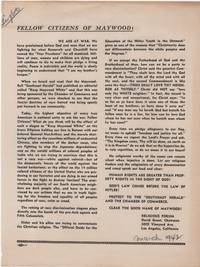
1942206856Los Angeles: Religious Forum of Maywood 1942. Light fading around edges. Broadside 8 1/2 x 11 in. printed on one side of white paper. Broadside leaflet from Chairman David Grant of the Religious Forum calling for religious Christian citizens of Maywood to stand against the Axis Powers and denouncing racial discrimination at home. Religious Forum of Maywood unknown
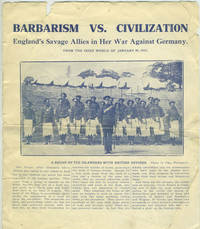
191526775New York 1915. Irish propaganda targeting the British during W.W.I. from the Irish World of January 30 1915. During W.W.I the struggle for Irish independence was suspended with the Nationalist forces splitting over support of the war. This handbill appears to be an effort to incite hatred of the British with racist descriptions of Fijian soldiers "the cannibals we may say" who fought for the British. There is a clear preference for Germany - "And these are the savages the cannibals we may say whom Britain is bringing over to fight the most enlightened nation of Melancthon and SchlegeL of Kant. of Mozart and Beethoven and Wagner of Goethe and Heine." <br /> <br /> The text characterized the Fijians as cannibals "dark copper colored have black eyes and bushy hair worn in the form of a mop" short stature protruding stomachs legs bowed and feet flat and usually nude. The photograph shows the Fijian soldiers standing at attention behind a British Officer photo by Paul Thompson. <br /> <br /> The text of the handbill is extracted from The Irish World and American Industrial Liberator published in New York between 1878-1951. Hand bill 9 x 7 3/4" printed in blue on cream paper verso blank. Creased with marginal tears and small margin loss. <br /> <br /> Unrecorded on OCLC although there is a W.W.I poster with the title "Civilization Vs. Barbarism" 1914 but associated with Red Cross Week. OCLC: 894257435. unknown
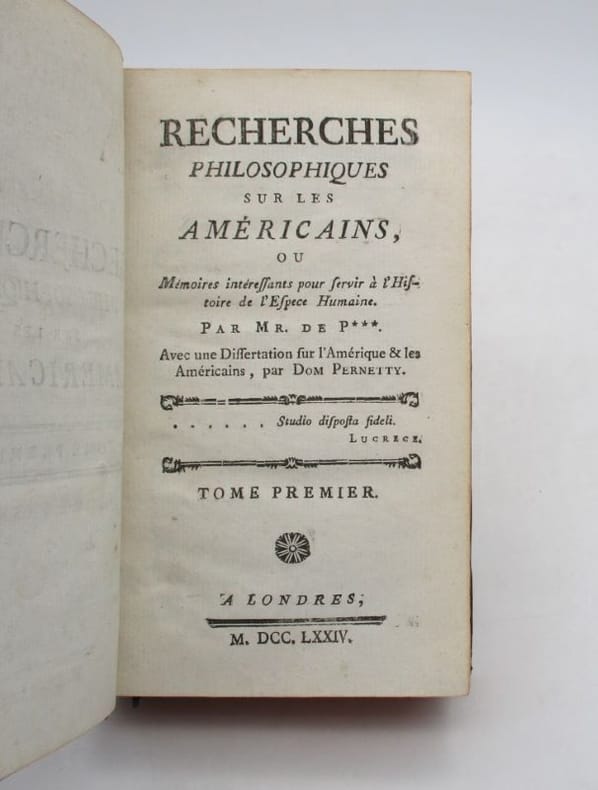
20966Londres, s.n., 1774. In-12, XIV-406 pp., basane marbrée havane, double filet doré en encadrement sur les plats, dos long orné de caissons dorés, pièce de titre blonde, pièce de tomaison noire (quelques petites épidermures).
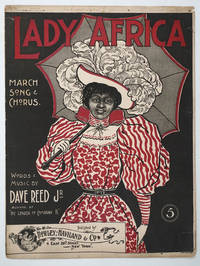
189728219New York: Howley Haviland & Co. 1897. Ephemera. Otherwise very good condition. Sheet music with a striking color cover image of an African American woman with parasol red and white dress with puff sleeves and hat decorated with feathers. Lyrics describe her as the "Queen of color'd high society" and uses stereotypical references and politically incorrect language. 10 1/8 x 14 1/8" 6pp pages detached but complete top and right edges slt ruffled. Cover art by Syd Davies. Howley, Haviland & Co. unknown
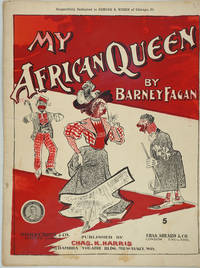
189728240Wisconsin: Chas. K. Harris 1897. Ephemera. Otherwise very good condition. Sheet music with a red black and white illustrated cover image of a woman and two men in fancy dress. The woman with red and white dress and hat decorated with feathers. Lyrics use stereotypical references and politically incorrect language. 10 1/4 x 14" 8pp cover detached spine edge slt ruffled. Chas. K. Harris unknown
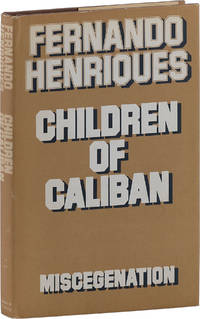
197464110London: Secker and Warburg 1974. First Edition. First impression. Octavo. Cloth hardcover; dustjacket; xii196pp; illus. Neat ownership stamp to front free endpaper and title page else tight clean and unmarked. In the original dustwrapper price-clipped else Fine. <br /> <br /> The Jamaican anthropologist's final published work a pioneering study of attitudes towards race-mixing in the West Indies Latin America and the United States. Henriques 1916-1976 was a major theorist of class color and sexuality best-known for his massive three-volume survey Prostitution and Society 1962-68. He was Director of the Centre for Multi Racial Studies from 1964 to 1974. Secker and Warburg unknown
8vo; First Edition. Original Printed Green Cloth. 12mo. 235 pages. 19 cm. These articles appeared from May 22 to October 2, 1920in Ford's paper, "The Dearborn Independent." "Why discuss the Jewish Question? Because it is here, and because its emergence into American thought should contribute to its solution, and not to a continuance of those bad conditions which surround the Question in other countries." Chapters: 1. The Jew in Character and Business 2. Germany's Reaction Against the Jew 3. Jewish History in the United States 4. The Jewish QuestionFact or Fancy? 5. Anti-SemitismWill It Appear in the U.S.? 6. Jewish Question Breaks Into the Magazines 7. Arthur Brisbane Leaps to the Help of Jewry 8. Does a Definite Jewish World Program Exist? 9. The Historic Basis of Jewish Imperialism 10. An Introduction to the "Jewish Protocols" 11. "Jewish" Estimate of Gentile Human Nature 12. "Jewish Protocols" Claim Partial Fulfillment 13. "Jewish" Plan to Split Society by "Ideas" 14. Did the Jews Foresee the World War? 15. Is the Jewish "Kahal" the Modern "Soviet"? 16. How the "Jewish Question" Touches the Farm 17. Does Jewish Power Control the World Press? 18. Does This Explain Jewish Political Power? 19. The All-Jewish Mark on "Red Russia" 20. Jewish Testimony in Favor of Bolshevism. Original single volume as originally issued; later joined by vols 2,3 & 4. Henry Ford, a noted anti-semite, had a close association with Dearborn, MI. Ford did not write the articles. He expressed his opinions verbally to his executive secretary, Ernest Liebold, and to William J. Cameron. Cameron had the main responsibility for expanding these opinions into article form. Liebold was responsible for collecting more material to support the articles. The Dearborn Independent, also known as The Ford International Weekly, was a weekly newspaper established in 1901, and published by Henry Ford from 1919 through 1927. The paper reached a circulation of 900,000 by 1925, second only to the New York Daily News, largely due to a quota system for promotion imposed on Ford dealers. Lawsuits regarding antisemitic material published in the paper caused Ford to close it, and the last issue was published in December 1927. The publication's title was derived from the Detroit suburb of Dearborn, Michigan. Derived largely from information found posted on line: Convinced that "bankers" and "the Jews" were responsible for a whole range of things he didn't like, from the world war to short skirts to jazz music, Henry Ford used his newspaper, the Dearborn Independent, to carry on an active anti-Semitic campaign. Between 1920 and 1922 a series of articles denounced all things Jewish. While officially apologizing for the articles in 1927, Ford's anti-Jewish sentiments ran deep. In January 1919, Henry Ford began publication of the Dearborn Independent, a small community weekly he had purchased the previous year. Carrying the subtitle, The Chronicler of the Neglected Truth, the paper primarily served as a forum for Henry Ford's views. Each issue of the Independent carried "Mr. Ford's Own Page," an editorial expressing his opinions, written by William J. Cameron. The Ford Motor Company pressured car dealers to buy multiple subscriptions and hand out copies to customers. The newspaper was popular, and circulation reached 900,000 in 1926. The Dearborn Independent would, most likely, have remained a sidebar in Ford's biography were it not for a controversial series that began on May 22, 1920 and lasted for several years. Appearing on the front page every week, "The International Jew: The World's Problem" examined a purported conspiracy launched by Jewish groups to achieve world domination. The basis for the articles was a notorious forgery, The Protocols of the Elders of Zion, an anti-Semitic hoax, first published in Russia in 1903. Many have accused Ford's personal secretary, Ernest Liebold, of being the source of the campaign, and Liebold's anti-Semitic views are well documented. William Cameron, editor of the Independent, was an enthusiastic supporter of the publication of the anti-Semitic diatribes. However, Ford's own attitudes towards Jews were the major reason for the publication of "The International Jew." His anti-Semitic beliefs formed along several strands from his upbringing, attitudes, and personal beliefs. A common stereotype at the time led some people to assume that Jews controlled the international banking system; that belief may have fed his anti-Jewish feelings. The publication of "The International Jew" caused an uproar. In some quarters, such as anti-immigrant and nativist groups, the series confirmed their own beliefs. Others were appalled by the series, published demands for a retraction, removed the paper from public libraries, and promoted a boycott of Ford automobiles. Some Ford dealers refused to carry the paper. Responding to this pressure, Ford halted publication of the anti-Jewish series in January 1922, only to start it up again less than a year later. Previous owner's name, pocket on rear blank endpaper, no other markings, an excellent copy Very Good Condition. (HOLO2-63-21D)
8vo; First Edition. Original Printed Green Cloth. 12mo. 235 pages. 19 cm. These articles appeared from May 22 to October 2, 1920in Ford's paper, "The Dearborn Independent." "Why discuss the Jewish Question? Because it is here, and because its emergence into American thought should contribute to its solution, and not to a continuance of those bad conditions which surround the Question in other countries." Chapters: 1. The Jew in Character and Business 2. Germany's Reaction Against the Jew 3. Jewish History in the United States 4. The Jewish QuestionFact or Fancy? 5. Anti-SemitismWill It Appear in the U.S.? 6. Jewish Question Breaks Into the Magazines 7. Arthur Brisbane Leaps to the Help of Jewry 8. Does a Definite Jewish World Program Exist? 9. The Historic Basis of Jewish Imperialism 10. An Introduction to the "Jewish Protocols" 11. "Jewish" Estimate of Gentile Human Nature 12. "Jewish Protocols" Claim Partial Fulfillment 13. "Jewish" Plan to Split Society by "Ideas" 14. Did the Jews Foresee the World War? 15. Is the Jewish "Kahal" the Modern "Soviet"? 16. How the "Jewish Question" Touches the Farm 17. Does Jewish Power Control the World Press? 18. Does This Explain Jewish Political Power? 19. The All-Jewish Mark on "Red Russia" 20. Jewish Testimony in Favor of Bolshevism. Original single volume as originally issued; later joined by vols 2,3 & 4. Henry Ford, a noted anti-semite, had a close association with Dearborn, MI. Ford did not write the articles. He expressed his opinions verbally to his executive secretary, Ernest Liebold, and to William J. Cameron. Cameron had the main responsibility for expanding these opinions into article form. Liebold was responsible for collecting more material to support the articles. The Dearborn Independent, also known as The Ford International Weekly, was a weekly newspaper established in 1901, and published by Henry Ford from 1919 through 1927. The paper reached a circulation of 900,000 by 1925, second only to the New York Daily News, largely due to a quota system for promotion imposed on Ford dealers. Lawsuits regarding antisemitic material published in the paper caused Ford to close it, and the last issue was published in December 1927. The publication's title was derived from the Detroit suburb of Dearborn, Michigan. Derived largely from information found posted on line: Convinced that "bankers" and "the Jews" were responsible for a whole range of things he didn't like, from the world war to short skirts to jazz music, Henry Ford used his newspaper, the Dearborn Independent, to carry on an active anti-Semitic campaign. Between 1920 and 1922 a series of articles denounced all things Jewish. While officially apologizing for the articles in 1927, Ford's anti-Jewish sentiments ran deep. In January 1919, Henry Ford began publication of the Dearborn Independent, a small community weekly he had purchased the previous year. Carrying the subtitle, The Chronicler of the Neglected Truth, the paper primarily served as a forum for Henry Ford's views. Each issue of the Independent carried "Mr. Ford's Own Page," an editorial expressing his opinions, written by William J. Cameron. The Ford Motor Company pressured car dealers to buy multiple subscriptions and hand out copies to customers. The newspaper was popular, and circulation reached 900,000 in 1926. The Dearborn Independent would, most likely, have remained a sidebar in Ford's biography were it not for a controversial series that began on May 22, 1920 and lasted for several years. Appearing on the front page every week, "The International Jew: The World's Problem" examined a purported conspiracy launched by Jewish groups to achieve world domination. The basis for the articles was a notorious forgery, The Protocols of the Elders of Zion, an anti-Semitic hoax, first published in Russia in 1903. Many have accused Ford's personal secretary, Ernest Liebold, of being the source of the campaign, and Liebold's anti-Semitic views are well documented. William Cameron, editor of the Independent, was an enthusiastic supporter of the publication of the anti-Semitic diatribes. However, Ford's own attitudes towards Jews were the major reason for the publication of "The International Jew." His anti-Semitic beliefs formed along several strands from his upbringing, attitudes, and personal beliefs. A common stereotype at the time led some people to assume that Jews controlled the international banking system; that belief may have fed his anti-Jewish feelings. The publication of "The International Jew" caused an uproar. In some quarters, such as anti-immigrant and nativist groups, the series confirmed their own beliefs. Others were appalled by the series, published demands for a retraction, removed the paper from public libraries, and promoted a boycott of Ford automobiles. Some Ford dealers refused to carry the paper. Responding to this pressure, Ford halted publication of the anti-Jewish series in January 1922, only to start it up again less than a year later. Previous owner's name, pocket on rear blank endpaper, no other markings, an excellent copy Very Good Condition. (HOLO2-63-21E)
8vo; First Edition. Original Paper Wrappers. 12mo. 235 pages. 19 cm. These articles appeared from May 22 to October 2, 1920in Ford's paper, "The Dearborn Independent." "Why discuss the Jewish Question? Because it is here, and because its emergence into American thought should contribute to its solution, and not to a continuance of those bad conditions which surround the Question in other countries." Chapters: 1. The Jew in Character and Business 2. Germany's Reaction Against the Jew 3. Jewish History in the United States 4. The Jewish QuestionFact or Fancy? 5. Anti-SemitismWill It Appear in the U.S.? 6. Jewish Question Breaks Into the Magazines 7. Arthur Brisbane Leaps to the Help of Jewry 8. Does a Definite Jewish World Program Exist? 9. The Historic Basis of Jewish Imperialism 10. An Introduction to the "Jewish Protocols" 11. "Jewish" Estimate of Gentile Human Nature 12. "Jewish Protocols" Claim Partial Fulfillment 13. "Jewish" Plan to Split Society by "Ideas" 14. Did the Jews Foresee the World War? 15. Is the Jewish "Kahal" the Modern "Soviet"? 16. How the "Jewish Question" Touches the Farm 17. Does Jewish Power Control the World Press? 18. Does This Explain Jewish Political Power? 19. The All-Jewish Mark on "Red Russia" 20. Jewish Testimony in Favor of Bolshevism. Original single volume as originally issued; later joined by vols 2,3 & 4. Henry Ford, a noted anti-semite, had a close association with Dearborn, MI. Ford did not write the articles. He expressed his opinions verbally to his executive secretary, Ernest Liebold, and to William J. Cameron. Cameron had the main responsibility for expanding these opinions into article form. Liebold was responsible for collecting more material to support the articles. The Dearborn Independent, also known as The Ford International Weekly, was a weekly newspaper established in 1901, and published by Henry Ford from 1919 through 1927. The paper reached a circulation of 900,000 by 1925, second only to the New York Daily News, largely due to a quota system for promotion imposed on Ford dealers. Lawsuits regarding antisemitic material published in the paper caused Ford to close it, and the last issue was published in December 1927. The publication's title was derived from the Detroit suburb of Dearborn, Michigan. Derived largely from information found posted on line: Convinced that "bankers" and "the Jews" were responsible for a whole range of things he didn't like, from the world war to short skirts to jazz music, Henry Ford used his newspaper, the Dearborn Independent, to carry on an active anti-Semitic campaign. Between 1920 and 1922 a series of articles denounced all things Jewish. While officially apologizing for the articles in 1927, Ford's anti-Jewish sentiments ran deep. In January 1919, Henry Ford began publication of the Dearborn Independent, a small community weekly he had purchased the previous year. Carrying the subtitle, The Chronicler of the Neglected Truth, the paper primarily served as a forum for Henry Ford's views. Each issue of the Independent carried "Mr. Ford's Own Page," an editorial expressing his opinions, written by William J. Cameron. The Ford Motor Company pressured car dealers to buy multiple subscriptions and hand out copies to customers. The newspaper was popular, and circulation reached 900,000 in 1926. The Dearborn Independent would, most likely, have remained a sidebar in Ford's biography were it not for a controversial series that began on May 22, 1920 and lasted for several years. Appearing on the front page every week, "The International Jew: The World's Problem" examined a purported conspiracy launched by Jewish groups to achieve world domination. The basis for the articles was a notorious forgery, The Protocols of the Elders of Zion, an anti-Semitic hoax, first published in Russia in 1903. Many have accused Ford's personal secretary, Ernest Liebold, of being the source of the campaign, and Liebold's anti-Semitic views are well documented. William Cameron, editor of the Independent, was an enthusiastic supporter of the publication of the anti-Semitic diatribes. However, Ford's own attitudes towards Jews were the major reason for the publication of "The International Jew." His anti-Semitic beliefs formed along several strands from his upbringing, attitudes, and personal beliefs. A common stereotype at the time led some people to assume that Jews controlled the international banking system; that belief may have fed his anti-Jewish feelings. The publication of "The International Jew" caused an uproar. In some quarters, such as anti-immigrant and nativist groups, the series confirmed their own beliefs. Others were appalled by the series, published demands for a retraction, removed the paper from public libraries, and promoted a boycott of Ford automobiles. Some Ford dealers refused to carry the paper. Responding to this pressure, Ford halted publication of the anti-Jewish series in January 1922, only to start it up again less than a year later. Touch of wear at foot and crown of spine, little bit of residue on front cover, Very Good Condition. (HOLO2-63-21)
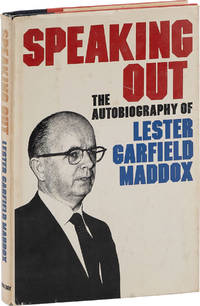
197580686Garden City NY: Doubleday & Company Inc 1975. First Edition. First Printing. Octavo 21.5cm; red paper-covered boards and navy blue cloth backstrip with titles stamped in white on spine; dustjacket; viii1831pp; illus. Inscribed by the author on the front endpaper to author and Georgia Democrat Robert M. Willingham: "Best wishes to Robert M. Willingham - Lester Maddox." Light wear to crown faint foxing to upper edge of textblock; Near Fine. Dustjacket is unclipped priced $6.95 gently spine-sunned showing modest shelfwear some dustiness and a few tiny nicks and tears; Very Good. Memoir by the racist former governor of Georgia 1967-71 a staunch segregationist who famously said he would rather close his family restaurants rather than serve African American customers - even after the passage of the Civil Rights Act. Doubleday & Company, Inc unknown
ORD-16672Paris. Hachette. Sans date. Vers 1900. In-4 (234 x 306mm) dos chagrin vert à 5 nerfs, titre dorée, Plats peignés bordés d'un filet or, gardes marbrées, tête dorée, 2ff., IV, 391, (1) pages, 12 planches hors texte en couleurs et très nombreuses photogravures dans le texte. Dos de reliure uniformément bruni, minimes défauts, bel exemplaire.
19911Paris, chez Ladvocat, 1824. In-12, 172 pp., demi-basane havane, dos long orné de frises dorées, tranches jaunes mouchetées de rouge (épidermures et petits manques, petites rousseurs).
198713972Paris, Esprit, 1987 1 volume 15,3 x 23,9cm Broché sous couverture au 1er plat orné d'une petite vignette. 128p. Bon état.
Au sommaire, dossier "Dérives françaises", en 3 parties: "Epuisement d'un modèle républicain" par Pierre GREMION ("L'Echec des élites modernisatrices"), Hervé VIEILLARD-BARON (sur les H.L.M. et la ségrégation géographique), Louis GRUEL ("Narcisse en haillons", sociologie du sous-prolétaire); "Contrer l'inégalité" par Jacques DONZELOT ("Nouveaux mécanismes" de solidarité sociale), François DUBET (sur S.O.S.-Racisme), Paul THIBAUD ("Les chemins de la solidarité", historique de la perception politique de la pauvreté); "Déclin de la culture et rhétorique du déclin" par Olivier MONGIN et Dominiqur BOURG; suivi de divers, dont textes de Claude IMBERT sur "Les années parisiennes de Walter Benjamin" et de Jean-Pierre SIMEON sur "L'Heure de s'enivrer" de Hubert Reeves, et critiques d'ouvrages. Français
197314001Paris, Esprit, 1973 1 volume 14 x 22,5cm Broché. Paginé de [737] à 927, 12 pages gris bleu. Bon état sauf dos et marges du 1er plat légèrement jaunis.
Au sommaire; "La loi sur l'avortement [réflexions de Jean BENJAMIN, "L'avortement et la responsabilité des médecins"] - Lip: échec et réussite [article de Daniel MOTHE] - Les immigrés et le racisme [articles de François DENANTES, "Un problème mal posé: l'immigration" et de J.-P. MOUVAUX, "Les étrangers chez nous"] - En France. Mounier et Maritain [article de Gérard LUROL] - Pouvoir et société dans le Tiers-monde - Nasser et les Egyptiens [article de Mahmoud HUSSEIN] - Bourguiba et la Tunisie" (textes de Tewfiq EL HAKIM, "La conscience retrouvée" et de Salem KHALSI); suivi de divers. Français
199513904Paris. Presses de la Fondation nationale des sciences politiques, 1995 1 volume 17 x 24cm Broché. 231p. Bon état.
Au sommaire: "Totalitarisme" par Krzysztof POMIAN, "L'espace totalitaire d'Adolf Hitler" par Didier MUSIEDLAK, "L'embellie parisienne à la Belle Époque: l'invention d'un modèle de consommation" par François CARON, "Urbanisation et exclusions dans le passé parisien (1850-1950)" par Alain FAURE, "Juifs français et allemands dans la grande guerre" par Philippe-Efraïm LANDAU, "Racisme et discrimination dans la politique française de l'immigration: 1938-1945/1974-1995" par Patrick WEIL, "Face à l'immigration: mixophobie, xénophobie ou sélection. Un débat français dans l'entre-deux-guerres" par Pierre-Andre TAGUIEFF, "Voyage à l'intérieur d'X-Crise" par Olivier DARD, "L'alliance démocratique de 1933 à 1937 ou l'anachronisme en politique" par Francois AUDIGIER, "Les journalistes dans l'entre-deux-guerres - Une identité en crise" par Christian DELPORTE, "Des chrétiens français face à la guerre du Vietnam (1966)" par Sabine ROUSSEAU; et divers. Français
191563112New York: Grosset & Dunlap ca. 1915. 8vo. 8 374 pp. Photo frontisp. 7 photo illust. Red cloth white lettering minor shelfwear faint tidemark wicked into fore-edges of plates at the very fore-edge w/ d.j. cover art with KKK rider on horseback next to heroine minor chipping head & foot of spine minor closed tears edgewear still G/VG- copy. First Photoplay edition of the notorious movie starring Lilian Gish Henry B. Walthall Mae Marsh Miriam Cooper Ralph Lewis George Siemann and others which steeped in the Confederacy’s Lost Cause mythos which had heavily influenced the misguided Dunning School’s interpretation of Reconstruction and significantly influenced Dixon and Woodrow Wilson. Directed by D.W. Griffith the movie was very successful but the racist overtones and blatant support of the Ku Klux Klan triggered widespread protests and it was banned in several cities. Very much like 21st-Century media Birth of a Nation’s portrayal of African-Americans created a justification for prejudice and discrimination which undermined Civil Rights for decades and reactivated the largely quiescent Ku Klux Klan movement and was the first film ever screened at the White House for President Wilson. See: Petaja Photoplay Edition p. 53; The Influence of “The Birth of a Nation†Facing History & Ourselves March 14 2016. Grosset & Dunlap, hardcover
19331821<p>15 cm. 4ii vii11-621-36331-1653xii2pp. Most pages double-column with either side-by-side or facing English and Chinese text. Brown cloth stamped in gilt and white. Shelfworn with white almost entirely missing from spine characters; small stain to rear board.</p><p>An English conversation guide for Chinese speakers that covers the subject in three separately paginated parts -- Vocabulary Dialogues and Useful Sentences -- plus an Appendix. Numerous examples are provided throughout although often of such a specific nature that it is hard to imagine such a conversation taking place e.g. when the reader is provided with dialogue about the benefits of swimming in sea water versus river water or how to report to the police being robbed by four men with guns one of whom has a "double thumb" .</p><p>Interestingly all of the examples appear to take place in China and at times offer a sharp cultural critique of English-speaking foreigners. This is particularly true in a section in Dialogues on "Protests" in which a sample Chinese person defends himself against rudeness and racist comments by foreigners in different situations such as being mistreated by a clerk in a store when being involved in a traffic accident that was the foreigner's fault and on a tram car "The occasions of provocation are numerous and only a few are referred to here". An Editor's Note follows this section noting that while "it does a man good to get a genuine complaint out of his chest rather than to harbour it there" readers should always take the moral high ground: "the spirit underlying the protest should never be one of racial prejudice. A protest should be made with the best of intentions for the sake of the benefit of the offender as well as the scandalised onlookers. The protester should not fall into a passion for after all to err is human" p. 140-41.</p><p>Surprisingly not found in OCLC.</p> The World Book Co., Ltd. hardcover
1962834081962 Montréal, Les Editions de l'Homme, 1962, in 8° broché, 124 pages ; couverture illustrée.
199720339Société Nouvelle Adam Biro/Ministère de a Culture Délégation aux Arts Plastiques (FIACRE) 1997 In-folio, broché couv. illustrée rempliée, photographies et illustrations pleines pages en noir et en couleurs, 96 pp. Avec une page en encart photographique pré-découpé montrant Alain Gesgon, collectionneur.
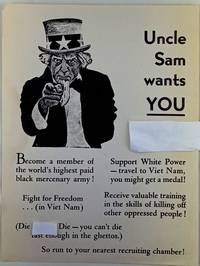
021310No Place: No publisher. Unbound. Good. No publisher place or date. Perhaps circa 1966-68. 8 ½ by 11 inches. Thin paper stock. Black and white printing. A handbill using racist epithets to highlight institutional racism in the military and the US stating among other things "Support White Power-travel to Viet Nam you might get a medal!"; "Receive valuable training in the skills of killing off other oppressed people!"; and "-you can't die fast enough in the ghettos." This imagery has also appeared in a 9x12 inch color format substituting the word "needs" for "wants." The Civil Rights Archive has a circa 1966 photo of Kwame Ture Stokely Carmichael handing out this style leaflet. GOOD condition. Moderate toning. Some creasing along the edges and corners. Faint dampstain at the center left edge. No publisher unknown