86 résultats
171255796London: Printed for John Nicholson at the Queen’s-Arms in Little-Britain and Sold by John Morphew 1712. Five vols. 8vo. 6 viii of x 5 80 288; 24 92 156 80 100; 24 215 1 6 204 4; 32 185 5 72 8; 16 166 18 131 11 pp. With 205 of 206 copper-engraved plates 2 folding. Uniformly bound in contemporary tight-back English paneled calf raised bands on spines minor rubbing shelfwear remnants of spine labels very minor chipping heads of Vols. I & II still a VG clean set from the noted library of Charles Hope 1681-1742 first Earl of Hopetoun noted bibliophile whose collection included the Gutenberg Bible now at Cambridge University Library each volume w/ his bookplate on the front pastedown. First edition in English of this collection of works containing significant contributions from the translator Desaguliers and others with the volumes encompassing the Elements of Euclid sections on trigonometry calculating tables geometry geodesy military architecture and fortification perspective geography and sundials as well as sections on hydrostatics and mechanics. Ozanam 1640-1718 was a French mathematician mathematics teacher and a prolific textbook writer whose works proved engaging and popular and was especially well received in England. Printed for John Nicholson at the Queen’s-Arms in Little-Britain, and Sold by John Morphew, hardcover
17234650Claude Jombert 13 x 20,5 Paris 1723 Quatre volumes in-8, reliure plein veau raciné de l'époque, dos à cinq nerfs orné de fleurons dorés et de petits fers, pièces de titre et de tomaison dorées, tranches rouges. Nouvelle édition revue, corrigée, augmentée. Vol. 1: Problèmes d'arithmétique, problèmes de géométrie, problèmes de musique, problèmes d'optique, (20)-460-(20) pp. 32 pl. Vol. 2: Problèmes de gnomonique, problèmes de cosmographie, problèmes de mécanique, (6)-462-(14) pp. 55 pl., dont nombreuses dépliantes. Vol. 3: Problèmes de pyrotechnie, problème de physique, traité des horloges élémentaires, (2)-482-(14) pp. 33 pl. Vol. 4: Des phosphores naturels, des phosphores artificiels, des phosphores et des lampes perpétuelles, tours de gibecière, (8)-446-(6) pp. 15 pl. L'ouvrage d'Ozanam (1640-1718) s'inscrit dans un genre éditorial qui s'est largement développé au XVIIe siècle, celui des "Récréations mathématiques", qui associent la science mathématique, le jeu, les tours et les expériences de physique. (cf. les travaux de Gilles Chabaud). La première édition du livre d'Ozanam, plus réduite, date de 1694. Les travaux d'Ozanam ont fait date, car l'ouvrage est à la fois rigoureux et récréatif. Réédité à de nombreuses reprises à l'identique dans son format de quatre volumes, il deviendra la référence du genre tout au long du XVIIIe siècle. Ozanam sera élu membre de l'Académie des Sciences en 1707. Petite étiquette de bibliothèque sur la page de titre, coins émoussés, coiffe inférieure abîmée et petits manques en queue et au plat inférieur du tome 3, bon intérieur, texte et planches sans rousseurs. Bon exemplaire. A noter ex-libris manuscrit de l'époque "Jarossay notaire" [nom de famille de l'ouest...patronyme également d'une dynastie d'horlogers à la fin du XVIIIe siècle...) (EvC146) PHOTOS NUMERIQUES DISPONIBLES PAR EMAIL SUR SIMPLE DEMANDE-DIGITAL PHOTOGRAPS MAY BE AVAILABLE ON REQUEST Livre
174115729Paris, Jombert, 1741. 4 vol in-8 de (16)-460-(20) pp. 32 pl. ; (4)-462-(14) pp. 56 pl. ; (2)-482-(12) pp. 31 pl. ; (8)-446-(6) pp. 17 pl., veau marbré, dos orné à nerfs, pièces de titre et de tomaison en maroquin rouge et brun (reliure de l'époque).
175071788À Paris, chez Jacques Rollin, 1750, in-8, 4 volumes, Veau marbré de l'époque, dos à nerfs et fleuronnés, pièces de titre rouges, tomaisons vertes, tranches rouges, 136 planches gravées sur cuivre, certaines dépliantes, représentant différentes expériences, la plupart avec les instruments et appareils pour les réaliser. Nouvelle édition des célèbres Récréations. Ce grand classique, toujours très recherché, du mathématicien Ozanam (1640-1717), a paru à l'origine en 1692. Il contient le Traité des horloges, qui est une traduction de l'ouvrage de Domenico Martinelli : Horologii elementari publié à Venise en 1669. "Cet ouvrage curieux, beaucoup plus ample que ceux qui avaient déjà paru sous le même titre, contient la solution d'une foule de problèmes d'arithmétique, de géométrie, d'optique, de gnomonique, de mécanique, de pyrotechnique, etc." (Quérard). "Il contient la solution d'une quantité de problèmes mathématiques, tours de gobelets, de cartes et d'escamotage, tous décrits avec les perfectionnements désirables pour l'époque" (Ruegg). Une bonne partie du premier volume est consacrée à la théorie des nombres qu'Ozanam connaissait parfaitement. Bel exemplaire. Ruegg, Bibliographie de la prestidigitation française, p. 71-72. Couverture rigide
17650000545Paris: Jombert 1765. Contemporary calf. Good . Two parts: Manuscript and Complete printed text for Ozanam's Trigonometrie. 8vo. 18.4 X 11.4cm. Contemporary mottled calf; raised bands; gilt floral designs in panels; leather label with gilt title; breaks along spine for both boards affecting lower cord of rear board; corners rubbed with minor loss; covers with gilt filigree border; all edges of text block gilt. Book housed in quarter leather clamshell box. Collation: Manuscript- 220pp. 3 folded plates and 1 tipped in note in printed text at p. 68. Manuscript note on verso of pl. 4; Text- xvi 128 384 pp. 6 copper engraved plates. The unlabeled pages contain the Tables des sinus 182pp and Tables des lograrithmes 102 pp. This is a unique and rare 18th century complementary manuscript bound in front of printed text for Ozanam's treatise on rectilinear and spherical trigonometry with accompanying tables for sines tangents and secants. The manuscript contains detailed information arithmetic trigonometry and geometry with theorems corollaries and problems with reference to Euclid Archimedes and Metius. There is also tables that can be used with sun dials. Information for construction of sun dial is also provided. The mathematic sections of the manuscript provide the reader with detailed information for measuring angles and surfaces in great detail. These are complemented by numerous drawings many colored and tables. <br/><br/>Ozanam was a French mathematician whose trigonometric and logarithmic tables first published in 1670 were more accurate than any previously published. The later edition here attests to the popularity and value of Ozanam's work. Jombert unknown books
1712RRW1591London:: John Nicholson and Sold by John Morphew 1712. Vols. IV-V: Oxford: Printed by L. Lichfield for John Nicholson. . . and Sold by John Morphew 1712. 1712. 5 volumes complete. 8vo. 6 x 4 1-80 1-288; 241-92 1-156 1-72 8; 16 1-215 1 1-131 1 10; 32 1-185 7 14 1-204 8; 16 1-166 18 292 pp. "Nearly 200" engraved plates extensive tables subscriber's list. Original blind-stamped speckled calf modern maroon leather gilt-stamped spine labels; joints cracked volume 1 corner bumped. Ownership gilt-stamps at foot of spine: "FFF" with a floating leg and spur above. Very good. First English edition. Ozanam was a self-taught French mathematician better known for his writing than for any major discoveries though he did effect significant improvements on existing logarithmic tables. Nearly the entire first volume is devoted to Euclid's Elements. The work also contains: trigonometry calculating tables geometry geodesy fortification mechanics simple & compound engines statics hydrostatics perspective geography and dialing. The English edition of the Cursus Mathematicus also contains contributions from the English mathematician J. T. Desaguliers: "In 1712 Desaguliers was also working on Ozanam's Cursus mathematicus. This was a complete course in mathematics in five-volumes originally in French and which was 'done into English . . . by several hands' for John Nicholson and again printed by L. Lichfield and sold by John Morphew. Volumes 4 and 5 which treated respectively 'Mechanicks and Perspective' and 'Geography and Dialling' were specifically said to be translated and 'amended in several places by J. T. Desaguliers.' . . . During his last years in Oxford Desaguliers was clearly busy not only translating many hundreds of pages of Ozanam's works but also amending and even correcting the French mathematician's works. In the eighteenth century a translator had perhaps more freedom than would be condone today to put his individual mark on the translated text." – Audrey T. Carpenter John Theophilus Desaguliers pp. 114-115. Volumes: I. Contains a short Treatise of Algebra and the Elements of Euclid; II. Arithmetic and Trigonometry with correct Tables of Logarithms Sines and Tangents; III. Geometry and Fortification; IV. Mechanics and Perspective; V. Geography and Dialling. John Nicholson, and Sold by John Morphew, 1712. [Vols. IV-V]: Oxford: Printed by L. Lichfield for John Nicholson. . ., and Sold hardcover books
17650000635Paris: Author & Jombert 1765. Contemporary mottled calf. Good . Two parts: Manuscript and Complete printed text for Ozanam's Trigonometrie. 8vo. 18.4 X 11.4cm. Contemporary mottled calf; raised bands; gilt floral designs in panels; leather label with gilt title; breaks along spine for both boards affecting lower cord of rear board; corners rubbed with minor loss; covers with gilt filigree border; all edges of text block gilt. Book housed in quarter leather clamshell box. Collation: Manuscript- 220pp. 3 folded plates and 1 tipped in note in printed text at p. 68. Manuscript note on verso of pl. 4; Text- xvi 128 384 pp. 6 copper engraved plates. The unlabeled pages contain the Tables des sinus 182pp and Tables des lograrithmes 102 pp. This is a unique and rare 18th century complementary manuscript bound in front of printed text for Ozanam's treatise on rectilinear and spherical trigonometry with accompanying tables for sines tangents and secants. The manuscript contains detailed information arithmetic trigonometry and geometry with theorems corollaries and problems with reference to Euclid Archimedes and Metius. There are also tables that can be used with sundials. Information for construction of sundial is also provided. The mathematic sections of the manuscript provide the reader with detailed information for measuring angles and surfaces. This information is complemented by numerous colored drawings and tables. <br/><br/>Ozanam was a French mathematician who's trigonometric and logarithmic tables first published in 1670 were more accurate than any previously published. The later edition here attests to the popularity and value of Ozanam's work. Author & Jombert unknown books
1712317879London 1712. First edition in English. 205 engraved plates. 6 x 288; 24 92 156 284; 16 215 1 blank 14 204 8; 30 185 7 72 8; 16 166 18 131 11pp. half-title in volume 1. 5 vols. 8vo. Contemporary half vellum from scraps with marbled paper panels on boards. Bookplate of George Craster. First edition in English. 205 engraved plates. 6 x 288; 24 92 156 284; 16 215 1 blank 14 204 8; 30 185 7 72 8; 16 166 18 131 11pp. half-title in volume 1. 5 vols. 8vo. Ozanam's Cours de mathematiques first published in 1693 contains sections on algebra and Euclid's Elements arithmetic trigonometry geometry fortification mechanics perspective geography and dialling. <br /> <br /> John Theophilus Desaguliers whose name is mentioned on the title-pages of volumes 4 and 5 published his translation of Ozanam's treatise on fortification separately in 1711 the treatise here forms the second part of volume 3 with its original title-page.<br /> <br /> In a curious vernacular binding in half vellum and marbled sides visibly pieced together from smaller fragments of skin. unknown
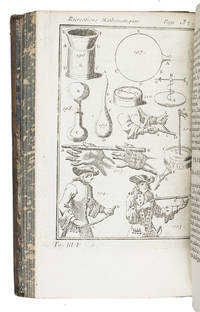
175018749Paris 1750. 8vo. Jacques Rollin Contemporary mottled calf spine gilt in compartments with two red morocco labels lettered in gold blue marbled edges. With 136 engraved plates 9 folding 127 full-page numerous woodcut diagrams and printed tables in the text. 4 volumes. 16 460 20; 4 462 14; 2 482 12; 8 446 5 pp. Enlarged edition of a famous compendium of popular science complete with all 136 engraved plates. The work discusses a wide variety of subjects as it presents both serious scientific problems and experiments as well as descriptions of conjuring tricks fireworks and games. The problems and their solutions are arranged according to subject: arithmetical geometrical gnomonical optical mechanical pyrotechnical and physical. The optical problems were based on the author's own teachings of perspective and include working with mirrors anamorphosis and a camera obscura. All problems and experiments described are clearly and fully depicted on the numerous engraved plates.For his Recreations Jacques Ozanam 1640-1717 used everything known at the time in the field of popular science and made use of the works of Claude Gaspard Bachet de Mérizac Claude Mydorge Jean Leurechon and Daniel Schwenter. The added treatise on clocks which can be found in the third volume was based upon Domenico Martinelli's Horlogi elementari 1669 with popular observations by Ozanam added. However Ozanam not only recreated other scientist's experiments but also presented his own including a first idea of a movie made by quickly projecting magic lantern slides of the same figure in slightly different poses creating the illusion of a person walking. His work became very popular and was used at schools and at home to teach youth all aspects of mathematical sciences. The first edition was published in 1694; this is the final edition in the original form as the work was almost entirely rewritten by Jean-Étienne Montucla 1725-1799 shortly after. The present edition was significantly enlarged compared to the first edition with extra information and 52 additional plates.Ozanam came from a Jewish family that had converted to Catholicism. He taught mathematics in Lyon before going to Paris where his teaching brought him a substantial income. Ozanam cannot be regarded as a first-rate mathematician but he had a flair for writing and during his career he wrote a number of books some of which were very popular passing through many editions. His contributions consisted of popular treatises and reference works on 'useful and practical mathematics' and this extremely popular work on mathematical recreations which had by far the more lasting impact. Ozanam's Récréations may be regarded as the forerunner of modern books on mathematical recreations.With a paper shelfmark label mounted on the front pastedown of each volume "j3459/ 223". The edges and corners of the boards of all volumes are somewhat scuffed. Internally clean with only minor foxing on some of the leaves plates 19-21 in volume 1 are bound in the wrong order. Otherwise in very good condition.l Caillet 8242 mentions only 132 plates; Sotheran 12888; Poggendorff II col. 342; cf. DSB IX p. 263-265. hardcover
174193006Paris, C.A. Jombert, 1741, in-8, 4 vol, Basane maroquinée verte, roulette sur les plats, dos à nerfs très orné, titre dorés, doublure et garde de papier à damiers dorés. Reliure de l'époque, Avec un traité des horloges élémentaires. Nouvelle édition illustrée de 136 pl. dépliantes h.t. gravées sur cuivre représentant différentes expériences, certaines avec les instruments et appareils pour les réaliser. Cette nouvelle édition est considérablement augmentée depuis la première parue en 1694 (2 volumes et 84 planches). Ce grand classique est toujours très recherché. Une bonne partie du premier volume est consacrée à la théorie des nombres qu'Ozanam connaissait parfaitement. Le traité des horloges est une traduction de celui de l'italien Domenico Martinelli "Horologi elementari", publié à Venise en 1669. T.I: [8] ff+ 460 pp+ [10] ff, avec 32 pl. (la pl. 26 est un fac-simile ancien.) T. II: [2] ff+ 462 pp. + [7] ff. avec 56 pl. (il y a 2 pl. 14, la pl. 23 du cadran universel est un fac-simile ancien.) T. III: [1] f. + 482 + [6] ff. avec 31 planches (il y a 2 pl. chif. 7). T. IV : [4] ff, + 446 pp. + [3] ff. avec 17 pl. Étiquette ex-libris, aux contreplats : Ce livre appartient à M. Touvenot de Sabloniere, conseiller du Roi, Rapporteur & Certificateur des Criées au Châtelet de Paris. (Les étiquettes sont partiellement recouvertes de papier rose ou grattées pour 2 volumes, mais bien lisible au T. IV.) Dos uniformément passés, quelques accrocs aux coins, petite épidermure au dos du T. 2. et sur un plat du T. 3, tache sombre au plat supérieur du Tome 4. Mais très bel exemplaire, richement relié à l'époque. Couverture rigide