PROUDHON, JP J PBiblio.com
970 résultats
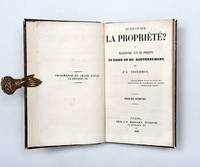
1840051<b>4 works in 1 volume Octavo. Contemporary quarter calf over marbled paper boards with decorative gilt motif on the spine & marbled endpapers. Half-titles present. a few minor interior blemishes but contents generally clean. A very good copy. Second edition of the French anarchist philosopher's notorious thesis together with the first editions of his two succeeding works the "deuxième" and "troisième" memoirs. Qu'est-ce que la propriété was first published in 1840 and shocked its readership with its famous assertion that "all property is theft" which remains widely cited among radical circles to this day. Proudhon himself referred to Qu'est-ce que la propriété as a "diabolical work which frightens even me" Correspondence I p. 296 and he was called to defend himself against insurrection charges at his local court immediately after its publication. The distinguished economist Blanqui 1805-1881 was appointed by the Minister of Justice to read Proudhon's inflammatory treatise and his review of it was partially reproduced by Le Moniteur on 7 September. Although he opposed the views that Proudhon adopted Blanqui's judgement was ultimately favorable because he believed Proudhon to be a philosopher and inquirer rather than a serious revolutionary. Blanqui's verdict helped to lessen the insurrection charges brought against Proudhon and it was only because of his support that Proudhon was permitted to keep his stipend. The second work in this volume is Proudhon's grateful response to Blanqui's review where he reacts to some of the reviewer's objections and offers some moderate revisions to his first work. Both works are scarce both institutionally and in commerce especially so bound together. Lastly the uncommon Explications Au Ministere Public 1842 is also bound in. Housed in a custom oatmeal colored cloth slipcase with chemise and leather label.</b> Librairie de Prévot hardcover
1840161495Paris: J.-F. Brocard 1840. A "diabolical work which frightens even me" Proudhon First edition one of 500 copies and correspondingly scarce in commerce of the French anarchist philosopher's notorious thesis which caused a scandal by equating all property with theft. In the wake of the social turmoil caused by the economic decline in France in 1839-40 and the July Monarchy's lapse into a "religion of property" Pierre-Joseph Proudhon 1809-1865 argued that - unlike freedom and equality - the right to property was not a natural right. Yet he also opposed collective ownership "as he was persuaded that only a society without government is able to establish social harmony. The First International was indeed destroyed in the great fight between those who supported a libertarian socialism of the kind Proudhon had advocated and those who followed the authoritarian pattern devised by Karl Marx. Kropotkin and Herzen were all his confessed disciples. Even Tolstoy sought him and borrowed the title and much of the theoretical background of his masterpiece War and Peace from Proudhon's book La guerre et la paix One can place Proudhon among the great socialist thinkers of the nineteenth century" Simons pp. 301-2. Proudhon himself referred to Qu'est-ce que la propriété as a "diabolical work which frightens even me" Correspondance I p. 296 and he was called to defend himself against insurrection charges at his local court immediately after its publication. Qu'est-ce que la propriété was followed in 1841 by his "Lettre à M. Blanqui sur la propriété Deuxieme mémoire" and "Avertissement aux propriétaires ou Lettre à M. Considérant sur une defénse de la propriété" often referred to as the "troisiéme mémoire". Duodecimo 168 x 105 mm. Binder's stamp Ateliers Laurenchet to front pastedown. Recent quarter calf marbled paper boards to style spine lettered gilt vellum tips sprinkled edges. Short marginal tear just entering text to page 93 repaired without loss pale marginal dampmark to head and foot final gathering with short marginal tear occasional light spotting withal a very good copy of a fragile publication. Not in Mattioli or Sraffa. See Correspondance de P.-J. Proudhon 1960-74; William Bradford Simons Private and Civil Law in the Russian Federation 2009. hardcover
1017825084.Ghardcover. Good. Access codes and supplements are not guaranteed with used items. May be an ex-library book. hardcover
1015697399.Ghardcover. Good. Access codes and supplements are not guaranteed with used items. May be an ex-library book. hardcover
101804311X.Ghardcover. Good. Access codes and supplements are not guaranteed with used items. May be an ex-library book. hardcover
1276294093.Gpaperback. Good. Access codes and supplements are not guaranteed with used items. May be an ex-library book. paperback
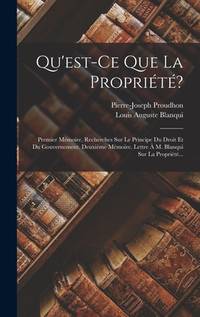
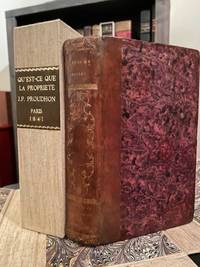
1841129328Paris: Librairie de Prévot 1841. All property is theft Second edition of the French anarchist philosopher's notorious thesis together with the first editions of his two succeeding works the "deuxième" and "troisième" memoirs. Qu'est-ce que la propriété was first published in 1840 and shocked its readership with its famous assertion that "all property is theft" which remains widely cited among radical circles to this day. Proudhon himself referred to Qu'est-ce que la propriété as a "diabolical work which frightens even me" Correspondance I p. 296 and he was called to defend himself against insurrection charges at his local court immediately after its publication. The distinguished economist Blanqui 1805-1881 was appointed by the Minister of Justice to read Proudhon's inflammatory treatise and his review of it was partially reproduced by Le Moniteur on 7 September. Although he opposed the views that Proudhon adopted Blanqui's judgement was ultimately favourable because he believed Proudhon to be a philosopher and inquirer rather than a serious revolutionary. Blanqui's verdict helped to lessen the insurrection charges brought against Proudhon and it was only because of his support that Proudhon was permitted to keep his stipend. The second work in this volume is Proudhon's grateful response to Blanqui's review where he reacts to some of the reviewer's objections and offers some moderate revisions to his first work. In the third work written in response to Victor Considérant's "Défense du Fourierisme" Proudhon warns property owners that the workers' revolution would soon come. Proudhon's pronouncement led to his home and printing office being raided and many copies of the book were seized. All three of the works are scarce both institutionally and in commerce and it is highly unusual to find all three bound together. Three works bound in a single vol. duodecimo 176 x 109 mm. Contemporary half calf rebacked red morocco label erroneous date of 1641 at base of spine marbled sides and endpapers. Half-titles present. Tips repaired with green calf a few minor interior blemishes but contents generally clean very light damp stain to last few leaves some pages short and opened a little crudely. A very good copy. unknown
1849EOU'EPRO55Paris: Garnier Frères 1849-48. 1849. 2 Volumes in 1. 18mo. pp. xvi 252 2; 155. with half-title. contemporary quarter roan extremities worn some foxing & browning throughout more pronounced in second part. Fourth and Second Edition respectively originally published in 1840 and 1841. Proudhon's most famous work "La propriété c'est le vol!" declared by Marx to be "the first decisive vigorous and scientific examination of property." cfGoldsmiths' 32492-93. cfKress C.5620-21. Coquelin & Guillaumin II pp. 478-79. Paris: Garnier Frères, 1849-48. unknown
1848R320040469GARNIER FRERES. 1848. In-12. Broché. Etat passable, Couv. défraîchie, Dos abîmé, Intérieur acceptable. 155 pages - Dos quais-manquant.. . . . Classification Dewey : 320-Science politique
500224719Le monde /flammarion Sans date.
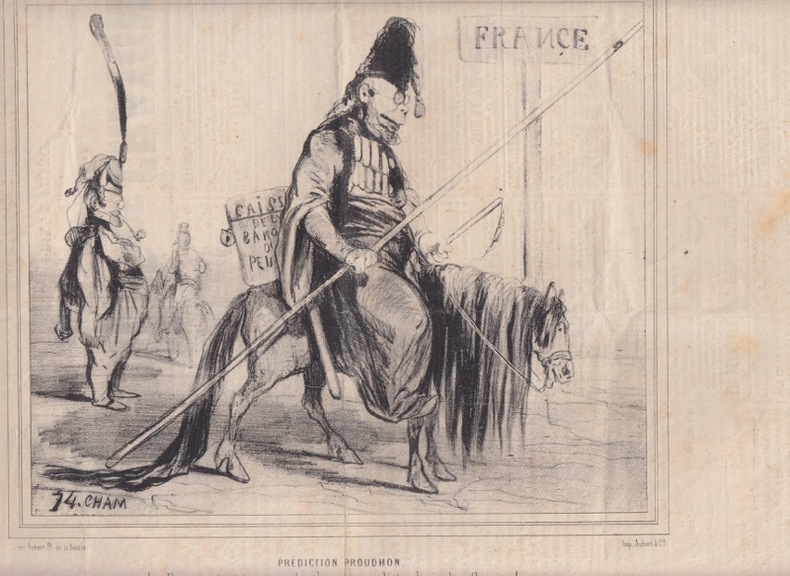
1849256561849 Le Charivari, 1849 - Croquades politiques (Titre de l'ensemble) 1 feuillet-4p. ; illustration page 3.- Lithographie - Œuvre; Hauteur: 27.5cmx Largeur: 35.8cm
1994Q-0521405564Cambridge University Press 1994-02-25. Paperback. New. In shrink wrap. Looks like an interesting title! Cambridge University Press paperback
12637Paris, NRF GALLIMARD - Leurs Figures, 1948. In-8 broché, 528 pp. - Actualité et permanence de Proudhon - Enfance et jeunesse (1809-1843) - Proudhon commis batelier à Lyon( 1843-1847). - Famille et république - Banque du peuple et projet d'exposition perpétuelle (31 janvier 1849-Décembre 1955). - De la révolution-nécessité à la justuce (juillet 1851-1854) - Conscience et liberté (Décembre 1855-Juillet 1858). - En exil : la guerrre et la pax (18 juillet 1858-17 septembre 1962) - Séparation (17 septembre 1862-octobre 1864) - Georges Sorel.
Paris, N.R.F., " Leurs Figures ", 1948. Fort in-8, broché, portrait sur la couverture, 528 pp. Bel exemplaire.
194894749Paris, Gallimard 1948. 1948. 528 S. Orig.-Karton.
In 8° pp. 109, br. edit.
12117P. Havard. 1855. Petit in 12 broché. 92p. 1 portrait gravé en front. 1 lettre fac-simile dépliante. Couv. un peu défraichie.
15680Paris, Sequana, 1944. Coll. "Hier et Demain", No 9. In-8 broché, 187 p. Bon état.
1927232900Vanguard Press 1927. Book. Good. Hardcover. No dust jacket possibly as issued. Red lettering and artwork on grey boards. Book and pages have just minor wear. Text free of markings. Very scarce title. Shipped within 24 hours from the beautiful Baltimore inner harbor area. First class service; accurate descriptions. Most items packed in boxes not envelopes. Vanguard Press Hardcover
1025928806.Ghardcover. Good. Access codes and supplements are not guaranteed with used items. May be an ex-library book. hardcover
192046110Bln., Paul Cassirer, 1920. OKart. (etwas geknickt, angestaubt und kleine Eckfehlstelle). 130 SS., 1 Bl.
1952228518Le club français du livre 1952 308 pages in8. 1952. Relié. 308 pages.
185214441852 GIRAUD-DAGNEAU 1852- IN12 br. couv.défraichies-dos factice-234p.-texte frais.
6603Paris, Etienne Chiron, 1920. Coll. des "Amis de Proudhon", "Bibliothèque de Philosophie moderne". In-8 broché rouge et blanc, non coupé, 255 p. Préface de C. Bouglé. Bon état. ... Le Mouvement ouvrier - La Philosophie du travail et l'école - Marxisme et Proudhinisme - Le Fédéralisme Proudhon.
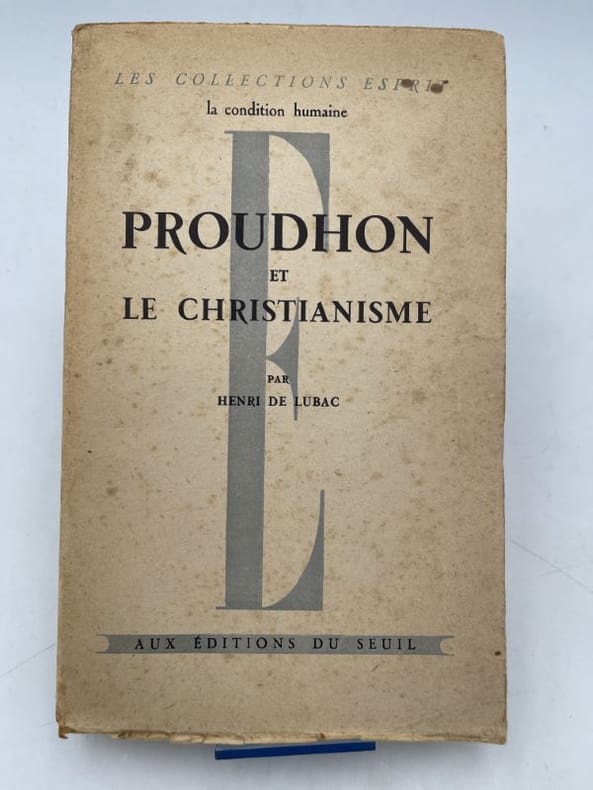
1945174896Editions du Seuil Editions du Seuil, 1945. Grand In-8 broché de 315 pages. Rousseurs en couverture et papier jauni. Non coupé.