Pierre-Joseph ProudhonBiblio.com
970 résultats
026532887X.Ghardcover. Good. Access codes and supplements are not guaranteed with used items. May be an ex-library book. hardcover
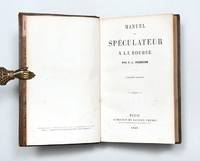
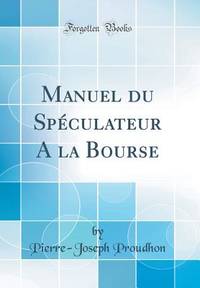
1857143950Paris: Librairie de Garnier Frères 1857. Fifth edition first 1854 of the most curious of Proudhon's works an account of the contemporary financial world commissioned by Garnier Brothers. "It was called The Stock exchange speculator's annual and consisted of a mass of statistical information collected with the assistance of George Duchêne on all the leading companies whose shares were offered for sale at the Bourse garnished with an introduction notes and 'final considerations' from Proudhon's own hand. Any genuine speculator who went to the Manual for a hot tip would be disappointed for not only did the authors condemn speculation itself but Proudhon also indulged in a lengthy analysis of the growth of the feudal structure in industry which was driving apart the bourgeois and the working class and acting inevitably to the detriment of the latter" Woodcock Pierre-Joseph Proudhon p. 191. Octavo 176 x 108 mm. Contemporary marbled sheep red morocco label smooth spine blocked in gilt covers bordered in gilt marbled endpapers. Early Rio de Janeiro bookseller's ticket to front pastedown. Light foxing to contents binding in very fresh condition; an excellent copy. unknown
0274001187.Ghardcover. Good. Access codes and supplements are not guaranteed with used items. May be an ex-library book. hardcover
1273405358.Gpaperback. Good. Access codes and supplements are not guaranteed with used items. May be an ex-library book. paperback
2012585787.Gpaperback. Good. Access codes and supplements are not guaranteed with used items. May be an ex-library book. paperback
1016683839.Ghardcover. Good. Access codes and supplements are not guaranteed with used items. May be an ex-library book. hardcover
1508716099.Gpaperback. Good. Access codes and supplements are not guaranteed with used items. May be an ex-library book. paperback
1857R200029450GARNIER FRERES. 1857. In-12. Broché. Etat d'usage, Plats abîmés, Dos abîmé, Quelques rousseurs. 511 pages + 12 pages. Quelques pages et cahiers désolidarisés.. . . . Classification Dewey : 0-GENERALITES
94961857 . Garnier , In 12 relié 1/2 veau bleu .Dos à nerfs orné de caissons dorés .XII,499 pp.(Coiffe sup.élimée,qq.pâles rouss.)
1837103387Paris, Adolphe Delahays, 1837, in-8, VI-344 pp, Broché, couverture originale imprimée, Nouvelle édition, augmentée d'une édition originale de l'Essai de grammaire générale par P. J. Proudhon, son premier texte publié en collaboration avec l'imprimeur Lambert avec lequel il était associé. ?Cet exemplaire a une couverture datée de 1856 avec le nom de l'éditeur Delahays mais sa page de titre est datée de 1837 chez Lambert. Couverture défraîchie, rousseurs. Couverture rigide
1869041498Madrid: Imprenta a cargo de J. E. Morete 1869. No consta edición. Tapa blanda. Good. X 347 pp. 155 x 215 cm. Libro en buen estado aunque falto de lomo y cubiertas deslucidas. Imprenta a cargo de J. E. Morete unknown
197616AzParis Larousse 1976 15,5x22 127 pages - broché - bon etat - Decembre 1976
197616AzParis Larousse 1976 15,5x22 127 pages - broché - bon etat - Decembre 1976
185168629Paris Prison de Sainte-Pélagie Paris 1851. Fine. ""I still appear to many people as only the pure and simple negation of what is."" Paris Prison de Sainte-Pélagie Paris 12 Novembre 1851 13 x 20.50 cm une feuille Autograph letter signed on four pages dated 12 November 1851. 124 lines in black ink. This letter is presented in a chemise and slipcase with paper boards decorated with abstract motifs green morocco spine green suede doublure slipcase with morocco spine and matching paper boards signed by Thomas Boichot. Unpublished autograph letter on progress signed by Pierre-Joseph-Marie Proudhon major figure in French social thought and the father of anarchy. The philosopher imprisoned since 1849 develops his socialist convictions in a virulent and combative style condemning the absolutisms of his time. Extraordinary declaration of philosophical political and social faith from a marginal thinker who influenced Karl Marx Emile Durkheim and Benjamin Tucker. This unpublished and densely written letter is a passionate reflection close to an essay entitled De lidée de progrès written around ten days later that Proudhon published with another De la Certitude et de son criterium in the work Philosophie du progrès. This set of texts was composed only two weeks before the coup of Louis-Napoléon Bonaparte which he immediately opposed. Once released from prison in 1852 Proudhon published the two letters at Lebègue in Brussels in order to escape censorship which had prohibited the sale of the booklet on French territory. Already having been detained for two years in the jails of the future French emperor Proudhon writes to Romain-Cornut from Sainte-Pélagie prison. Journalist Romain-Cornut had just finished a series of articles on Auguste Comtes positivism Études critiques sur le socialisme October-November 1851. This letter must be viewed as an admirable four-page plea or more a confession of his socialist vision of progress a social positivism which is based on the reconsideration of the ancient order: we withdraw in the face of an intellectual negation which is the sine qua non condition of further progress. During the course of the letter he establishes a balance between his polemical soul and his desire for legitimacy striving to be no longer viewed as a mere agitator but as a true philosopher. We are indeed reminded of his famous saying Property is theft! his sympathy for the 1848 uprisings as well as his acerbic pamphlets in Le Peuple that consecrated his radical reputation: I have been until this day so foolishly judged even by the socialists . Because I led the criticism of the old principles as far as it could go . I still appear to many people as only the pure and simple negation of what is. Proudhon however maintains his intention to leave the shields of criticism leaving the argument of circumstance for the moment in my new studies and thus implies the writing of a new deeper work published under the title La Philosophie du progrès 1853 dedicated to the same Romain-Cornut. Proudhon an anarchist in favour of the abolition of the State and the government violently criticizes the system which is by definition anti-progressive: Yet it is unquestionable from this progressive point of view that our society as a whole monarchists democrats Catholics philosophers is still absolutist: what everyone wants is a charter a constitution a system a fixed and definitive legislation finally. In addition to political systems Proudhon picks up this same idealism in the philosophical thinking of his elders and does not refrain from giving a violent condemnation: Like Pascal like the Germans we want the absolute! . Spinoza Malebranche Leibnitz etc. all of whom operating on the categories of substance causality eternity unity plurality etc. have arrived at politically and intellectually immobile systems at the absolute. He noted the harmful effects of the political regimes and of the ph hardcover
41101P., Grasset, 1929, in 12 broché, 363 pages.
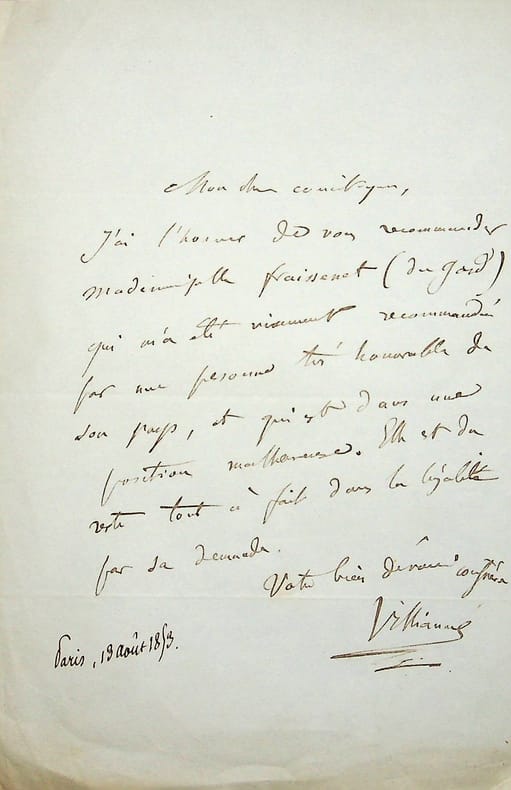
020819Nicolas Villiaumé (1818-1877), écrivain, historien, économiste, révolutionnaire en 1848, proche de Proudhon. L.A.S., Paris, 13 août 1853, 1p in-8. « Mon cher concitoyen, J'ai l'honneur de vous recommander mademoiselle Fraissenet (du Gard) qui m'a été vivement recommandée par une personne très honorable de son pays, et qui est dans une position malheureuse. Elle est du reste tout à fait dans la légalité de sa demande. Votre bien dévoué confrère. Villiaume ». Rare. [513]
8414Bernard Grasset Paris 1946
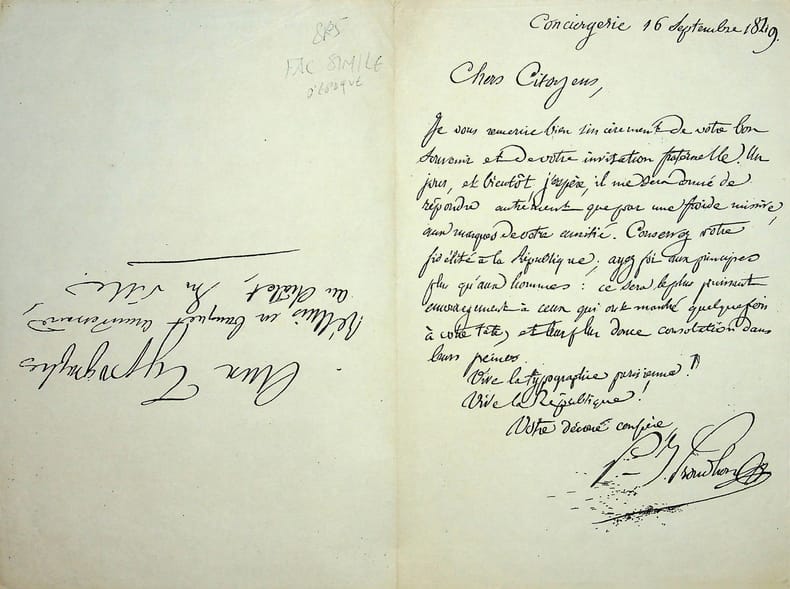
017053Pierre-Joseph Proudhon (1809-1865), philosophe, polémiste, anarchiste révolutionnaire. L.A.S. [fac-simile d'époque], Conciergerie, 16 septembre 1849, 1p in-8. Belle lettre adressée aux typographes présents au banquet typographique du 16 septembre 1849. Ce document, fac-simile strictement d'époque, est le court texte qu'il leur adresse et qui fut distribué lors de ce diner. Proudhon était absent puisqu'il était en prison. Un exemplaire, présenté comme autographe, est présent au catalogue de Ricardo Hereria (n°3800) avec cette remarque : « Curieuse épître où il les remercie de leur invitation, les engage à conserver leur fidélité à la République et à avoir foi aux principes plus qu'aux hommes. Il termine par ces mots : « Vive la typographie parisienne ! Vive la république ». ». Rare curiosité. [398]
1946ROD0116476BERNARD GRASSET. 1946. In-12. Broché. Etat d'usage, Couv. convenable, Dos frotté, Non coupé. 289 pages. Frontispice en noir et blanc. Quelques planches en noir et blanc.. . . . Classification Dewey : 846-Lettres, correspondance littéraire
1929R240142791BERNARD GRASSET. 1929. In-12. Broché. Bon état, Couv. convenable, Dos satisfaisant, Intérieur frais. 363 pages.. . . . Classification Dewey : 846-Lettres, correspondance littéraire
1950ZNC-583Paris, Grasset, 1950, in-12°, 315 pages, broché, couverture illustrée.
8550Paris, Grasset, 1946. In-12, broché.
192949351929 Paris, Grasset- collection "les écrits", 1929, volume in-12 broché, 363 pages, portrait en frontispice, illustrations hors texte, exemplaire du service de presse, très bon état
230667Paris, Bernard Grasset, 1946 in-12, 289 pp., un f. n. ch., avec 3 planches hors texte, dont un portrait-frontispice, et 2 ff. de fac-similés hors texte, broché.
1274794919.Gpaperback. Good. Access codes and supplements are not guaranteed with used items. May be an ex-library book. paperback