Livre Rare Book
49 résultats
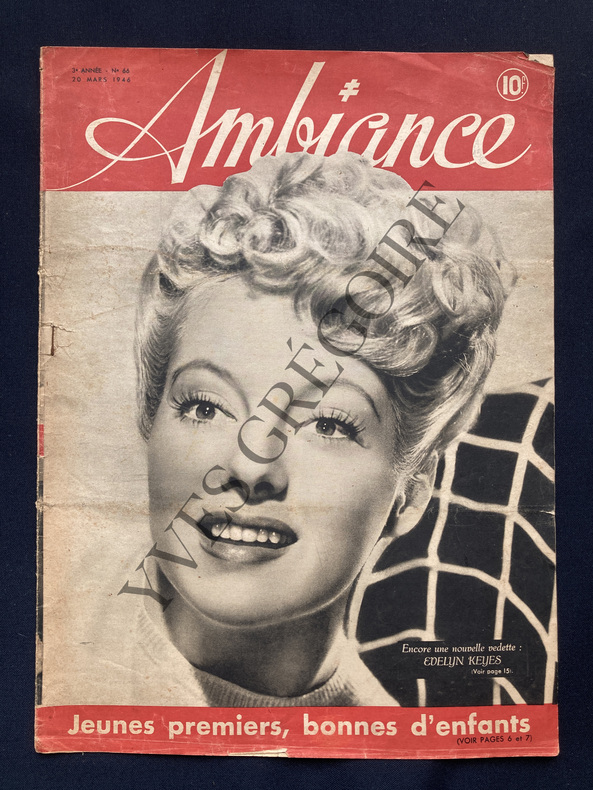
1946ABE-7004546873FORMAT IN 3-16 PAGES-EN COUVERTURE "ENCORE UNE NOUVELLE VEDETTE: EVELYN KEYES"/GROS PLAN NOIR ET BLANC-UNE JOURNEE AVEC LOUIS NOGUERES PRESIDENT DE LA HAUTE COUR/1P/7 PHOTOS-CES CAMERAS ENREGISTRERONT L'ESSAI ATOMIQUE DE BIKINI/2 PHOTOS-CINEMA "FESTINS D'HIER ET RESTRICTIONS ACTUELLES" LA VIE PRIVEE DE HENRI VIII/CHARLES LAUGHTON/3 PHOTOS-JEUNES PREMIERS.BONNES D'ENFANTS!./2P/FRANCOIS PERIER ET SES 3 ENFANTS/1 PHOTO-JEAN DESAILLY/PHOTO-LES PLUS BEAUX DIAMANTS DU MONDE PASSENT ENTRE LEURS MAINS/2P/9 PHOTOS-"27 CRIMES DIT L'ACCUSATION! NON: 63 AFFIRME PETIOT!/1P/7 PHOTOS-ET DURANT 6 JOURS/VEL D'HIV/1P/4 PHOTOS-TELECOMMUNICATION/NOUVELLE INEDITE DE GEORGES MAREY/DESSIN DE NITRO (PJ16)
29784showing Anne Boleyn Jane Seymour and Catherine Howard all head and shoulders full face 4" x 2¼" no place no date unknown
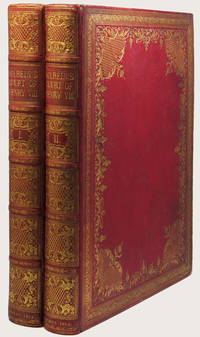
181234168London: Published by John Chamberlaine the Keeper of the King's Drawings and Medals. Printed by William Bulmer and Co. Shakespeare Printing Office 1812. 2 volumes. First Edition of the century First Issue the second edition overall. A RARE EXAMPLE WITH THE PLATES BOTH IN COLOURED AND UNCOLOURED STATE THUS WITH DOUBLE THE NUMBER OF PLATES NORMALLY ENCOUNTERED. With 84 hand-coloured plates and 84 plates uncoloured all separately printed on India paper and tipped onto full-page leaves each facing the other the plates with protective leaf separating the two each image with two variations mezzotint portraits of Holbein and his wife a total of 168 illustrations on full-page plates four plates dated from the first printing in 1792 the other 164 dated 1812 as with the publishing date. The plates are printed on a variety of papers slightly different from one another--grey buff white lavender and pink. Folio 34.5 x 2 beautifully bound in full red morocco gilt extra the spines with gilt tooled raised bands separating the compartments which are elaborately gilt decorated within triple gilt filleted frames gilt stippling to the borders of the frames lettered in gilt in one compartment the covers beautifully gilt decorated in all-over designs the borders with gilt stippled lines enclosing three gilt filleted borders surrounding an elaborate gilt inner border of floral tooling bordered again by a stippled and multi-filleted gilt frame the whole surrounding elaborate and large gilt tooled decorations at the inner corners and along the rules the edges gilt ruled the turnovers gilt rolled marbled endleaves all edges gilt very elaborate and beautifully preserved binding work. unpaginated. Fine copies beautifully preserved very light wear or age evidence to the bindings which remain strong the pages and plates all in good order some very occasional light foxing to the papers as is typical the colours remain vibrant and as printed the giltwork on the bindings is in very pleasing condition a very handsome set indeed. FIRST EDITION AND AN UNUSUALLY SPECIAL COPY BOUND IN FULL RED MOROCCO GILT EXTRA WITH THE PLATES PRINTED ON INDIA PAPER IN BOTH COLOURS AND BLACK AND WHITE A COPY WITH DOUBLE THE NUMBER OF PLATES USUALLY ENCOUNTERED. Hans Holbein the Younger; c. 1497 – between 7 October and 29 November 1543 was a German-Swiss painter and printmaker who worked in a Northern Renaissance style and is considered one of the greatest portraitists of the 16th century. He also produced religious art satire and Reformation propaganda and he made a significant contribution to the history of book design. He is called "the Younger" to distinguish him from his father Hans Holbein the Elder an accomplished painter of the Late Gothic school.<br> Holbein was born in Augsburg but worked mainly in Basel as a young artist. At first he painted murals and religious works and designed stained glass windows and illustrations for books from the printer Johann Froben. He also painted an occasional portrait making his international mark with portraits of humanist Desiderius Erasmus of Rotterdam.<br> Holbein travelled to England in 1526 in search of work with a recommendation from Erasmus. He was welcomed into the humanist circle of Thomas More where he quickly built a high reputation. He returned to Basel for four years then resumed his career in England in 1532 under the patronage of Anne Boleyn and Thomas Cromwell. By 1535 he was King's Painter to Henry VIII. In this role he produced portraits and festive decorations as well as designs for jewellery plate and other precious objects. His portraits of the royal family and nobles are a record of the court in the years when Henry was asserting his supremacy over the Church of England.<br> Holbein's art has sometimes been called realist since he drew and painted with a rare precision. His portraits were renowned in their time for their likeness and it is through his eyes that many famous figures of his day are pictured today such as Erasmus and More. He was never content with outward appearance however; he embedded layers of symbolism allusion and paradox in his art to the lasting fascination of scholars. In the view of art historian Ellis Waterhouse his portraiture "remains unsurpassed for sureness and economy of statement penetration into character and a combined richness and purity of style."<br> For Holbein "everything began with a drawing". A gifted draughtsman he was heir to a German tradition of line drawing and precise preparatory design. Holbein's chalk and ink portraits demonstrate his mastery of outline. He always made preparatory portraits of his sitters though many drawings survive for which no painted version is known suggesting that some were drawn for their own sake.<br> Ellis Waterhouse wrote that "modern" painting in England may be said to have begun with Holbein. That later artists were aware of his work is evident in their own sometimes explicitly. Hans Eworth for example painted two full-length copies in the 1560s of Holbein's Henry VIII derived from the Whitehall pattern and included a Holbein in the background of his Mary Neville Lady Dacre. The influence of Holbein's "monumentality and attention to texture" has been detected in Eworths' work. According to art historian Erna Auerbach: "Holbein's influence on the style of English portraiture was undoubtedly immense. Thanks to his genius a portrait type was created which both served the requirements of the sitter and raised portraiture in England to a European level. It became the prototype of the English Court portrait of the Renaissance period".<br> Holbein worked for Thomas Cromwell as he masterminded Henry VIII's reformation. Cromwell commissioned Holbein to produce reformist and royalist images including anti-clerical woodcuts and the title page to Myles Coverdale's English translation of the Bible. Henry VIII had embarked on a grandiose programme of artistic patronage. His efforts to glorify his new status as Supreme Head of the Church culminated in the building of Nonsuch Palace which started in 1538. By 1536 Holbein was employed as the King's Painter on an annual salary of 30 pounds—though he was never the highest-paid artist on the royal payroll. see C. Müller et al.<br> This striving for perfection is very evident in his portrait drawings where he searches with his brush for just the right line for the sitter's profile. The critical faculty in making this choice and his perception of its potency in communicating decisively the sitter's character is a true measure of Holbein's supreme greatness as a portrait painter. Nobody has ever surpassed the revealing profile and stance in his portraits: through their telling use Holbein still conveys across the centuries the character and likeness of his sitters with unrivalled mastery. see J. Rowlands Hans Holbein the Younger 1985 Published by John Chamberlaine, the Keeper of the King's Drawings and Medals. Printed by William Bulmer and Co., Shakespeare Pri hardcover
8vo., First Edition thus, with frontispiece and 32 pages of coloured plates; pictorial boards, black cloth back lettered in yellow, a fine copy in publisher's board slip-case.
Paris, L Maison 1847. 2 volumes in 8 reliés demi chagrin vert, dos à faux nerfs dorés, titres et tomaisons dorés. Avec le portrait de Henri VIII d'après Holbein en frontispice, une antienne en musique, à quatre voix, par Henri VIII, et plusieurs fac-similé. Petites rousseurs éparses. XX + 563 pages et 567 pages. Bien relié
A book on the early map of Great Britain and Ireland forming part of the collection assembled by the antiquary and administrator Sir Robert Cotton. 158 pages. With Notes. In slip-case. Slipcase has some light wear.
333 p. + Full Page Plates. 8vo. 220mm. Original full cloth binding. Original dust jacket, soiled. Third Impression. Hardbound. Very good. Scarce with the dust jacket. BIO BX 2
2009LFA-126733949Un ouvrage de 463 pages, format 140 x 225 mm, illustré, broché couverture couleurs, publié en 2009, Payot, bon état
Payot 1981, fort In-8 broché, 525 pages. Bon état
1981150820Payot Payot 1981, fort In-8 broché, 525 pages. Bon état
1835170241Crapelet 1835. Hardcover. Fair Condition. Illustrator: . No date mid-19th century. Chipped at the top of the spine; rubbing to the leather spine; cracking front hinge. The pages have some discoloring; some foxed; but a good copy of an old book. French text. Color frontispiece of both Henri VIII and Anne Boleyn. Illustrator: . Quantity Available: 1. Category: Antiquarian & Rare; Inventory No: 170241. . Crapelet hardcover
47626Publié par lImprimerie de Crapelet, Paris ,sd , in-8 de XIV + 228 pages ,portrait ,relié demi-chagrin à nerfs ,Etat correct ,1 feuillet détaché .(4 photos du livre sur mon site https://www.vieuxlivre.fr) .Les frais de port pour la France sont offerts à partir de 25 euros d'achat (Mondial relay ). (colissimo suivi +6,90 ).
18353317G.-A Crapelet 19 x 29 Paris 1835 Volume in-8°, reliure demi veau d'époque, pièces de titres de cuir rouge et vert, grandes marges, XIV-228 p. Seconde édition, conforme à la première de 1826. Edition en anglais et en français de 17 lettres, précédée d 'une notice sur Anne Boleyn, première femme du roi Henri VIII, et d'un précis historique du divorce de Henri VIII ; en appendice, documents sur Anne Boleyn, ses lettres au cardinal Wolsey et à Henri VIII son époux qui la fit exécuter, et son histoire en vers par un contemporain. Mors fendus sur 15 cm, nombreuses rousseurs sur les pages de titres et aux marges des pages.(ALB17) Livre
18353317G.-A Crapelet 19 x 29 Paris 1835 Volume in-8°, reliure demi veau d'époque, pièces de titres de cuir rouge et vert, grandes marges, XIV-228 p. Seconde édition, conforme à la première de 1826. Edition en anglais et en français de 17 lettres, précédée d 'une notice sur Anne Boleyn, première femme du roi Henri VIII, et d'un précis historique du divorce de Henri VIII ; en appendice, documents sur Anne Boleyn, ses lettres au cardinal Wolsey et à Henri VIII son époux qui la fit exécuter, et son histoire en vers par un contemporain. Mors fendus sur 15 cm, nombreuses rousseurs sur les pages de titres et aux marges des pages.(ALB17) Livre
1527960293.Ghardcover. Good. Access codes and supplements are not guaranteed with used items. May be an ex-library book. hardcover
3402034573.Gperfect. Good. Access codes and supplements are not guaranteed with used items. May be an ex-library book. unknown
1331723701.Gpaperback. Good. Access codes and supplements are not guaranteed with used items. May be an ex-library book. paperback
0331184214.Ghardcover. Good. Access codes and supplements are not guaranteed with used items. May be an ex-library book. hardcover
152168857London: Richard Pynson 1521. Full Description:<br> <br> HENRY VIII King of England. Assertio Septem Sacramentorum Aduersus Martin. Lutheru. Aedita ab Invictissimo Angliae et Franciae Rege et do. Hyberniae Henrico Eius Nominis Octavo. London: Richard Pynson 1521.<br> <br> First edition. Small quarto 8 1/4 x 6 1/8 inches; 210 x 155 mm. 80 leaves. With the final two blank leaves. Final leaf of text is errata and colophon. Large woodcut initials. Title-page within a allegorical woodcut boarder signed HH for Hans Holbein. "The woodcut border on the title-page which depicts the story of C. Mucius Scaevola and King Porsenna McKerrow & Ferguson 8 was adapted from a design by Hans Holbein for the De immortalitate animae by Aeneas Gazaeus printed by Froben in Basel in 1516." Sotheby's.<br> <br> Probably remboitage binding of 17th-century vellum rebacked. The arms of Pope Urban VIII in gilt as central devices on front and back board. Boards double ruled in gilt and with gilt bees as corner devices. All edges gilt. Leaves very clean. Binding with staining and repairs to corners. Old ink manuscript on front board. Final blank leaf professionally repaired. Overall a very good copy.<br> <br> It was perhaps as early as 1516 that Cardinal Wolsey anxious to distract him from more worldly preoccupations first encouraged Henry VIlI to embark on a serious rejoinder to Luther 49. In so doing Wolsey wrought his own downfall and this was perhaps the least of the consequences of 'The Assertion of the Seven Sacraments' one of the most fateful books in the history of western civilisation. Despite his unfeigned zeal to extirpate heresy it was not until Henry began to take a serious interest in foreign affairs that he realised the practical value which such a work might have if dedicated to the Pope. It is difficult to estimate the spiritual influence of the papacy at a time when the vast majority of Christendom saw It as a not specially powerful temporal state; but it was none the less felt. How much Henry's anxiety to complete the book between May and July 1521 was activated real if romantic desire to become the champion of the papacy it is hard to say. This point of view may be supported by Henry's statement to a startled and incredulous Thomas More 47 that 'from that See we received our crown imperial. More could see the dangers of so firm commitment to the temporal if not to the spiritual power of the papacy and his misgivings were soon to be justified a hundredfold. Henry gained the recognition he sought from Leo X the title of Fidei Defensor. But had he not made so absolute an admission of papal authority it is unlikely that he would have felt so personally slighted by the Pope's refusal to give him his way in his 'great matter' the divorce from Catherine of Aragon; unlikely that he would have turned with such vehemence on almost all the advisers. More among them who had made his reign so successful hitherto; unlikely that he would have claimed the royal supremacy in the Church; unlikely- but there speculation must stop. Suffice it to say that the publication of the Assertio must be considered to mark a critical moment in the history of the English Reformation." PMM 50.<br> <br> ESTC S123359. PMM 50. STC 13078.<br> <br> HBS 68857.<br> <br> $27500. Richard Pynson unknown
1385704403.Ghardcover. Good. Access codes and supplements are not guaranteed with used items. May be an ex-library book. hardcover
196619765Ridgewood N. J: Gregg Press. 1966. hard cover. Very Good/No jacket. Ridgewood N.J: Gregg Press. 1966 Reprint of 1521 edition. 188pp. Harbound. In addition to treatise by Henry VIII contains ten Latin verses by J. Clerk orator; Pope Leo's letter to Henry the 8th in which he give to Henry 98 the title of Fidei Defensor; oration by J. Clerk when he presented the book to the Pope; followed by the Pope's answer to Clark's oration. Ridgewood, N. J: Gregg Press. hardcover
1908K305932New York: Benziger Brothers 1908. re-edited. Nice copy. octavo. orig. cloth 479pp. bibliog. index Book plate on front paste down front hinge tender o/w nice clean copy Benziger Brothers hardcover
2952916241.Gpaperback. Good. Access codes and supplements are not guaranteed with used items. May be an ex-library book. paperback
152807405X.Ghardcover. Good. Access codes and supplements are not guaranteed with used items. May be an ex-library book. hardcover
1874037213.Gpaperback. Good. Access codes and supplements are not guaranteed with used items. May be an ex-library book. paperback