People's Prohibition MovementBiblio.com
39 résultats
139645120X.Gpaperback. Good. Access codes and supplements are not guaranteed with used items. May be an ex-library book. paperback
1396451382.Ghardcover. Good. Access codes and supplements are not guaranteed with used items. May be an ex-library book. hardcover
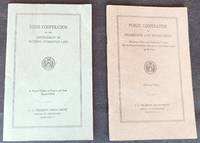
1930023675Washington D.C.: : U.S. Treasury Department Bureau of Prohibition 1930. First Edition First Printing . Soft cover. Near Fine. Initiated with the passage of the 1919 Volstead Act & enforced by the 18th Amendment in 1920 prohibition became the law of the land in the United States for over a decade. However public support of & compliance with the act were severely waning by the end of the 1920s. These booklets were two in a series of monographs issued by the Bureau of Prohibition within the U.S. Treasury Dept in 1930 an attempt to rally the citizenry & convince all those who "have at heart the interest of home family & community" the practical value of supporting the government in its efforts to ban the manufacture transport use & sale of alcoholic beverages. "Public Cooperation" focuses on the role of property owners & the railroad industry along with that of civil leaders insurance companies business owners & others. State Cooperation in the Enforcement of National Prohibition Laws." 70 pages 2-staple binding. Light khaki green wrappers lettered & ruled in black to front. Compares state & national prohibition efforts with lengthy sections on New England Pennsylvania & New York state & city with a review of relevant legislation & court cases. Public Cooperation in Prohibition Law Enforcement: Business Civic and Industrial Groups Aid in Promoting Better Observance and Enforcement of the Law.'' 64 pages 2-staple binding. Light blue wrappers lettered & ruled in black to front. Describes the involvement of the railroads realtors & property owners the chemical manufacturing industry civic leaders business owners & citizens. Despite actually having an impact & reducing American drinking the rise in organized crime linked to Prohibition led to its ultimate repeal nationally with the passage of the 21st amendment in 1933. Our photos depict the Exact book you will receive never "stock" images of books we don't actually have! Same Day Shipping on all orders received by 2 pm Weekdays Pacific time; later orders Weekends & holidays ship very next business day. <br/> <br/> : U.S. Treasury Department Bureau of Prohibition paperback
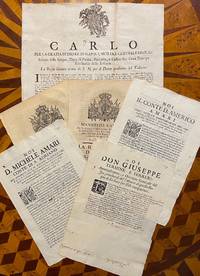
17641067Sicily Naples and Turin 1764. Very good. Together 6 items: 1 broadside 46 x 34.5 cm 5 bandi folio sheets each folded once various sizes various wear some signatures clipped others supplied in manuscript assorted manuscript annotations extracted from bindings. Small but very interesting collection of Bandi on the prohibition of tobacco all scarce none are found in OCLC / FirstSearch. As there was no centralized government in Italy the restrictions on Tobacco was a quagmire of regional taxation restriction and monopolization as is attested by the bandi in the present collection. Increasing tobacco consumption in the Italian penensula merited the establishment of fiscal laws by various States. The present items illustrate the expansion of tobacco culture and the disjointed governmental responses from Sicily Naples and Turin:<br /> <br /> 1. Broadside: Carlo . La Regia Giunta eretta da S.M. per il Dritto proibitivo del Tabacco 3 May 1758.<br /> 2. Noi il Conte d' Americo Amari . del gius proibitivo del Tabacco 23 January 1746 2 pp.<br /> 3. Noi d' Michele Amari conte de S. Adriano . del Jus prohibendi del Tabacco 23 January 1740 2 pp.<br /> 4. Noi Don Giuseppe Termine e Ferreri . del Jus prohibendi del Tabacco 30 November 1733 1 p. <br /> 5. Manifesto Camerale per la vendita. de distribuzione del Tabacco nel Luogo di Refrancore 14 May 1762 3 pp. with Tariffs. <br /> 6. 5. Manifesto Camerale che ristabilisce la vendita e distribuzione del Tabacco nel Luogo di Rochetta Belbo 13 February 1764 3 pp. with Tariffs. unknown
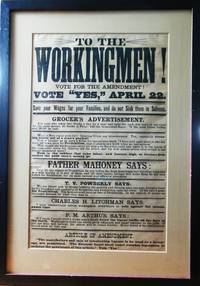
1918723Westerville OH: The American Issue Publishing Co. 1918. Very good. Vintage broadside. Image:12.75 x 20 in.; framed: 19 x 26 in. Custom dark brown wood frame matted under UV museum glass. Not examined outside of frame. Very good or better. <br /> <br /> Westerville Ohio was known as the "Dry Capital of the World" and home of the Anti-Saloon League -- the driving force behind the Prohibition movement in the United States. Some historians consider the league - founded in Oberlin Ohio in 1893 but based in Westerville from 1909 to 1973 - to be the first successful single-issue advocacy group a type of lobbying group common in the modern political landscape. This particular broadside from the prolific group admonishes men to "Save your wages for your families and do not sink them in saloons." There are quotes from Father Mahoney who testifies "Only let the claims of Prohibition be put before the Irish Americans and other Catholics in a way worthy of it and of them and all their tender feelings will make them be not only voters for Prohibition but its most earnest and effective guardians." There are further testimonies from anti-saloon advocates from the Knights of Labor and an author who wrote several books regarding the evils of drink. The American Issue Publishing Co. unknown
0260923249.Ghardcover. Good. Access codes and supplements are not guaranteed with used items. May be an ex-library book. hardcover
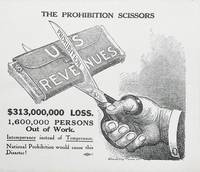
1916190622Newark New Jersey: Bowers 1916. A handbill opposing the introduction of prohibition illustrating it as greatly cutting American revenues leading to "$313000000 loss. 1600000 persons out of work" and therefore "intemperance instead of temperance" - "national prohibition would cause this disaster". Newspapers reported the design placed on billboards and arriving in the mail in early 1916. 178 x 211 mm. Very light central crease and spot at head else in fine condition. hardcover
193064180Boston MA: Little Brown and Co. 1930. 8vo. xii 173 1 pp. Frontisp. numerous plates. Illustrated mustard-coloured publisher’s cloth wine glass illustration front cover w/ d.j. Art Deco cover art by Herold of drunken revelers minor shelfwear darkening to spine still NF/NF copy from the library of Eleanore Weinstock. First edition of this nicely illustrated and fascinating satirical examination of Prohibition Speakeasies Alcohol and the possible futures at the end of the Roaring 20’s as Americans invented a myriad of ways to keep drinking and socialize. Seldes has managed to inventively interweave a myriad of cocktail recipes into his observations along with a legion of cautionary and humorous tales. Little, Brown, and Co., hardcover
191056456Westerville OH: The Anti-Saloon League of America 1910. 8vo. 256 pp. Numerous maps tables charts. Green ribbed publisher’s cloth gilt lettering stamped on front cover & spine very slight bumping to couple corners still a VG tight bright copy w/ long ALS on ffep. from Frank Richard Margetts fl. 1880-1910 a Spokane WA attorney and stalwart supporter of Prohibition and was the Washington District Superintendent who spearheaded the 1909 legislation to allow local Washington jurisdictions to enact their own temperance legislation. First edition of this polemic and fact book issued by the leading organization pushing Prohibision in the Progressive Era drawing heavy support from Protestant congrations throughout the country and by 1905 largely overshadowed the Woman’s Christian Temperance Union. Margetts writes in the presentation letter on the ffep. that “When a thousand years hence this book and its accompanying literature is brought forth . . . it treats of a gigantic curse which has long since been completely obliterated by an enlightened humanity through progress. . . .†After 1928 with the failures of Prohibition exposed through bootlegging and organized crime severely curtailed government tax revenue and failure to disassociate from the Ku Klux Klan the League would lose their power after the election of President Roosevelt. The Anti-Saloon League of America, hardcover
19462110502150415208Mainichishinbunsha 1946. Soft Cover. Fine. Volume: 1 Mainichishinbunsha paperback
1930022635Washington DC: U.S. Treasury Department/Bureau of Prohibition 1930. 1st Edition . Hardcover. Very Good/No Jacket. 8vo - over 7¾ - 9¾" tall. VG/none used caramel colored cloth binding with black text on spine and upper iii-xxi 233pp although there is a blank page of lined paper bound in-between each numbered page. Interior clean no marks except the name stamp of the former owner on the top of the ffep binding tight. Slight shelf rubbing to exterior corners are not worn. This is not a reprinted item. <br/> <br/> U.S. Treasury Department/Bureau of Prohibition hardcover
1920LIST120American 1920. Gelatin silver photograph 5 ½ x 3 ½ inches on Cyko stock photo paper. Very Good. A scarce photograph of a bootlegging operation c. early 1920s. The photograph is printed on Cyko stock which was used through the early 1920s. Few images of bootleggers have survived. The six men in the picture look quite serious in their work and it’s difficult to imagine why they allowed a picture to be taken. A very good example with good contrast well preserved. unknown
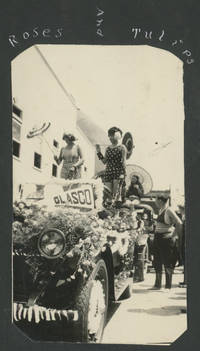
1920List1317Southern California 1920. Limp leatherette album oblong 4to measuring 10 x 7 inches with seventy photographs most measuring 4 x 2 ½ inches. Wear to binding photographs with excellent contrast very good to near fine overall. Near Fine. An energetic album of photographs belonging to one Eddie Jones a fun-loving banjo player from Santa Ana mostly composed of photographs of musicians performing at small parties and functions during the prohibition era. Jones was apparently quite active on the local scene and the album is mostly made up of candid photographs of musicians all captioned some humorously. Many of the photographs show small bands playing guitars many of them playing with slides likely due to the popularity of Hawaiian music at the time. Also included are many photographs of parades in and around Los Angeles as well as photographs of the 1925 Santa Barbara Earthquake showing damaged buildings. Two photographs feature a glass of rye others show agricultural scenes. Newspaper clippings in the back center on the Santa Ana and it’s possible that Jones - who was the common name mentioned in these clippings - was also a farmer from the Santa Ana area when he wasn’t playing music. One photograph shows San Diego a couple show a bullfight in Tijuana. Overall an evocative and well preserved piece of California Prohibition-era history. unknown
0266579876.Ghardcover. Good. Access codes and supplements are not guaranteed with used items. May be an ex-library book. hardcover
0259952737.Gpaperback. Good. Access codes and supplements are not guaranteed with used items. May be an ex-library book. paperback
1933157897Cincinnati: Romach and Groene 1933. Vintage photograph of the first legal whiskey produced in Ohio during prohibition at the Carthage Distilling Company in Cincinnati with contemporary annotations of location dates and personnel and a "Rombach and Groene Commercial Photographers Cincinnati Ohio" stamp on the verso. <br /> <br /> A fascinating prohibition artifact depicting fifteen men and one woman standing in a warehouse before a stack of three whiskey barrels the topmost barrel prominently marked "1" less than two months before the passage of the 21st Amendment December 5 1933 repealing prohibition. On the verso in a contemporary hand is written: "First Barrel Whiskey produced in the State of Ohio since the 18th amendment became effective / manufactured and produced at the Carthage Distilling Corpn. plant Cincinnati Ohio / mashed under date Oct. 20th 1933 / drawn and entered under date Oct. 23rd 1933."<br /> <br /> Cincinnati Ohio second only to Louisville Kentucky in the production of bourbon prior to the end of prohibition was best known during prohibition as the headquarters for the "King of Bootleggers" George Remus. Cincinnati was located within a 300 mile radius of 80 percent of all of America's bonded whiskeys making it an ideal location for a massive bootlegging enterprise as well as for the headquarters to the Schenley Distillery one of only six distilleries nationwide with a license to sell medicinal spirits during prohibition. An October 26 1933 article from the Cincinnati Enquirer entitled "Big Blending Plant Planned For Reading; First Legal Whisky In Ohio Is Produced" confirms the annotations on the photograph "Simultaneously with the actual production of medicinal whisky at its plant in Carthage-said to be the first legal whisky turned out in Ohio since prohibition-it became known yesterday that the National Distillers Products Corporation New York largest distiller in the country will locate one of its major blending and bottling plants in the immediate vicinity of Cincinnati." The article continues "The Carthage Distillery on Anthony Wayne Avenue Carthage is the only distillery now operating in the state of Ohio." In 1933 the Carthage Distilling Company was acquired by the National Distillers Products Corporation and in 1987 was bought by Jim Beam.<br /> <br /> Established in 1883 Cincinnati photographers Rombach and Groene specialized in commercial and landscape photography. In 2001 the Cincinnati Museum Center acquired the Rombach and Groene Collection a collection of over 6500 glass and film negatives and a hundred prints dating from 1870 to 1970. The company closed in 1973.<br /> <br /> 10 x 8 inches. Very Good with some modest creasing four small bruises and a small repair to the surface of the image to the center right. Romach and Groene unknown
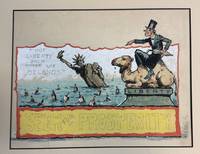
193341184n.p. 1933. 8" x 12". Original color painting on Abacco illustration board matted and framed behind glass. Vibrant colors with some pencil sketch lines showing through. Unsigned and uninitialed. Corners chipped a closed crack in lower left corner. On verso of board is the name of the type of board and available dimensions "Paints Brush and Color Corporation" with distributors listed as E.H. & A.C. Friedrichs Co. of New York The Hirshberg Company of Baltimore and Henry M. Taws of Philadelphia. Very Good. <br /> <br /> Ours is the only copy located after diligent investigation. The camel which Thomas Nast chose as the symbol of the Prohibition Party has replaced the Statue of Liberty on the pedestal. Camels don't drink very often; when they do they only drink water. <br /> This item was likely painted between 1931 and 1933. The official Beer for Prosperity Campaign was organized May 1931 in New York City. Edward H. Schulze was director of the organization and announced that he would support all political candidates in favor of legalizing beer. The slogan spread over the next year and a half. Posters for this campaign in 1932 advertised that legalizing beer would bring two trillion dollars in new revenue in four years because "millions of dollars made from bootleg Beer now finances all kinds of crimes kidnappings etc." Another campaign poster advertised purchases of "Beer for Prosperity" Stamps to "Help Elect to Congress Men Who Will Vote 'Yes.'" Beer for Prosperity Campaign. n.d. In John J. Raskob papers. Manuscripts and Archives Hagley Museum and Library #m473_20100624_005; "Beer For Prosperity Campaign Inc. Will Back Pierce's Congressional Candidacy" The Rutland Daily Herald 23 August 1932 p.7. <br /> We do not know who painted this imaginative item. E.H. & A.C. Friedrichs Company was founded in 1868 and is still in business today under the modern name of Fredrix. The Hirshberg Company originated in 1845 as Hirshberg Hollander & Company and remained in business under a few different Hirshberg names until approximately the early 1960s. Henry B. Taws opened in Philadelphia around 1897 and remained in business until at least 1931. unknown
20149462650438T.M.C. Asser Press 2014. New/New. <p><strong>Author:</strong> Organisation for the Prohibition of Chemical Weapons</p><p><strong>Publisher:</strong> T.M.C. Asser Press</p><p><strong>ISBN:</strong> 9789462650435</p><p><strong>Release Date:</strong> 2014</p><p><strong>Languages:</strong> English</p><p><strong>Binding:</strong> Hardcover</p><p><strong>Number Of Pages:</strong> 805</p> T.M.C. Asser Press hardcover
SONG9462650438T.M.C. Asser Press 2014-12-18. 3rd ed. 2015. hardcover. Used: Good. 6.80x1.90x9.60. Buy with confidence. Excellent Customer Service & Return policy. T.M.C. Asser Press hardcover
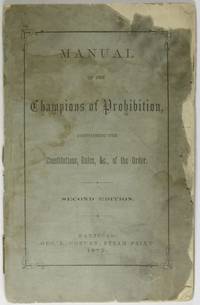
18720000895Hartford Conn.: Geo. L. Coburn Steam Print. 1872. 24 33 pages. Original printed wraps. 17 x 11 cm. Chipping to wraps title and corners of a few other leaves not affecting text and a number of short marginal tears. Spine has mostly perished but gatherings are held by the original stitching. Wraps heavily stained not affecting legibility. Light marginal damp stains throughout; marginal soiling in a few places. A poor but complete copy. SECOND EDITION so stated on the front wrap expanded. The first edition of the previous year contained only the first part of this work the 24-page manual. The second edition includes a new section "Ritual" the second grouping of 33 pages. It contains a diagram of a lodge room and descriptions of ceremonies for opening meetings initiations recognizing visitors installing officers and instituting new lodges. At the end is a cipher being a number code for the alphabet and the common vocabulary used by the organization. In addition to the contents alluded to in the title the manual includes the lyrics to seven odes. Several ads are printed with the text all promoting Thomas H.L. Tallcott's diverse professional and business interests in Glastonbury and Hartford. One ad announces his services as a notary and justice of the peace and another his land surveying firm. He also advertises patent medicines Dickinson's Alternative Balsam and Discutient Ointment and a washing machine the Niagra Washer both of which he distributed. At the end of the manual is an ad for the New England Female Medical College Boston and the free dispensary offered by Dr. Samuel Gregory. Thomas Hyde Lord Tallcott 1829-1907 of Glastonbury was active in the temperance movement in Connecticut from his early adulthood belonged to several national prohibition organizations and was one of the founders of the Prohibition Party in Connecticut 1869. He was also an attorney justice of the peace Congregationalist minister and a prominent figure in the Templars. In 1849 he presented a petition to the Connecticut senate to prohibit alcohol. He was a leader in the Hartford County Temperance Society at least as early as 1852 when he issued a circular for the organization. In 1867 and 1868 he went to the Carolinas to organize lodges for the Templars. He established over a dozen lodges most of which were for African Americans. He founded the Champions of Prohibition in 1870 and served as the first president and secretary of the organization. Ref. Austin "Prohibition Leaders of America" 1895 p. 35. Obituary Hartford "Daily Courant" Sept. 30 1907 p. 2. Fahey "Temperance & Racism" pp. 61-62. Rare. OCLC locates only the Virginia Tech copy of this second edition; not in NUC. Of the first edition OCLC finds only two copies NYP and Harvard; NUC adds the LC copy. Geo. L. Coburn Steam Print. paperback
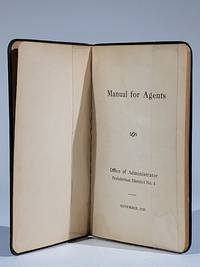
1925965Pittsburgh: Office of Administrator Prohibition District No. 4 1925. Cloth over flexible boards. Sixteenmo. ii 53 pages. Near fine. Bound in black cloth over flexible boards with no exterior titles. A few faint spots to lower board. Binding sound. A rare manual issued by Prohibition District No. 4 Pittsburgh as a pocket guide to help its Revenue and Prohibition agents build strong cases as they enforced the Volstead Act in the field. The contents are distilled ha from Treasury Department Regulations 12 and 60 and aimed at avoiding procedural mistakes during investigations sting operations and arrests. Think Eliot Ness making sure his "i"s are dotted and "t"s are crossed so the bootleggers don't walk on a technicality. Office of Administrator, Prohibition District No. 4 unknown
188656938Olympia W.T.: Thomas H. Cavanaugh Public Printer 1886. 8vo. 555 5 xxvii 1 xv 1 ix 1 pp. Contemporary full calf red black & gilt morocco spine labels minor uniform toning some edgewear minor bumping to corners still VG copy from the library of Bates & Burnett law firm with William Charles Bates 1885-1973 and Milton L. Burnett 1887-1972 who operated for decades in Vancouver WA from before World War I and moved their firm into the Charles Brown historic house in 1945 beginning a local trend of using older homes for professional buildings and George W. Yocum 1827-1890 longtime Portland attorney. First edition of this rare Washington Territory lawbook including the January 29 1886 Alien Land Ownership law which was the only anti-Chinese measure to pass the legislature as well as two laws related to Prohibition advocated by newly empowered women’s suffrage voters. The Alien Land laws emerged out of the anti-Chinese riots in Tacoma WA in November 1885 when labor organizations such as the Knights of Labor with the aid of the Pierce County Sheriff succeeded in forcing all of the Chinese residents out of town as well as torching their homes. Building on the 1882 Federal Chinese Exclusion Acts the Territorial Legislature specifically excluded any “Alien†who were “incapable of becoming citizens of the United States†could neither own land or convey title of properties to heirs. Unfortunately for the Chinese in Seattle this failed to placate socialist firebrands suffragettes & Knights of Labor advocates Laura Hall Peters and Mary Kenworthy or the equally charismatic Knights of Labor organizer Daniel Cronin. In February 1886 hundreds of working-class white men and women on the pretense of enforcing local health regulations condemned buildings in Seattle’s Chinatown and herded over 350 Chinese residents down to the Seattle docks and demanded they ship out. About 200 Chinese embarked for San Francisco and another had to wait six days for another ship setting off a riot and declaration by Washington Territory Governor Squire and President Grover Cleveland. The “Local Option†law passed by the Territorial Legislature in 1886 garnered huge opposition from saloon owners and cases brought resulted in the 1888 ruling against “Local Option†by the Territorial Supreme Court returning the power back to city councils and county commissioners. See: John Putnam Racism and Temperance: The Politics of Class and Gender in Late 19th-Century Seattle The Pacific Northwest Quarterly Vol. 95 No. 2 Spring 2004 pp. 70-81; Mark Lazarus III An Historical Analysis of Alien Land Law: Washington Territory & State 1853-1889 University of Puget Sound Law Review Vol. XII 1989 pp. 197-246. Thomas H. Cavanaugh, Public Printer, unknown
19942080302106800030Japan National Assembly Against Atomic and Hydrogen Bombs 1994. Soft Cover. Fine. Size: New book 246 pages Number of books: 1 Japan National Assembly Against Atomic and Hydrogen Bombs paperback
19942090202120402037Japan National Congress Against Atomic and Hydrogen Bombs 1994. Soft Cover. Fine. Number of books: 1 Japan National Congress Against Atomic and Hydrogen Bombs paperback
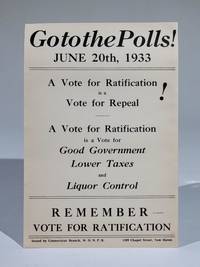
19331172New Haven: Connecticut Branch W. O. N. P. R. 1933. Broadside. 7" x 10 1/4. Single sheet printed on one side. Slight age toning. Fine condition. This is an original handbill from a major women's group soliciting votes to repeal Prohibition in 1933.<br /> <br /> Women's organizations--particularly the Women's Christian Temperance Union--are strongly associated with passage of the 18th Amendment to the U. S. Constitution and the national ban on alcoholic beverages it brought in 1919. The major role women played in getting Prohibition repealed is not as widely recognized however.<br /> <br /> This handbill was issued by the Connecticut Branch of the Women's Organization for National Prohibition Reform W.O.N.P.R. The W.O.N.P.R. was organized in 1929 by women who could no longer ignore the destructive if unintended consequences of Prohibition. <br /> <br /> Here voters are asked to vote for ratification of the 21st Amendment reminding them that "A Vote for Ratification is a Vote for Repeal!" and "A Vote for Ratification is a Vote for Good Government Lower Taxes and Liquor Control." <br /> <br /> The efforts of the W.O.N.P.R. and other repeal groups were successful and Prohibition was repealed with the ratification of the 21st Amendment in December of 1933.<br /> <br /> A tangible piece of Prohibition and women's history. Connecticut Branch, W. O. N. P. R. unknown