Wesley JohnABAA
57 résultats
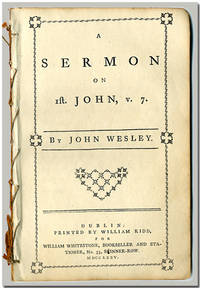
1775WRCLIT66505Dublin: Printed by William Kidd for William Whitestone 1775. 67-311pp. Small octavo. Extracted from nonce pamphlet volume. Typographic decorative title border. Early ink name on half-title half-title neatly detached faint tanning and occasional minor spots but a very good copy printed on unusually heavy paper. First Dublin edition. A Limerick edition is tentatively dated the same year and the first London edition followed in 1776. Wesley's prefatory "Advertisement" is dated at Cork 8 May 1775 and refers to requests that the sermon be rendered in print before he left that city requests that he was unable to fulfill due to circumstance. Scarce: ESTC locates 7 copies 3 of them in North America and OCLC does not expand that count. ESTC T45856. BAKER 306. Printed by William Kidd, for William Whitestone unknown books
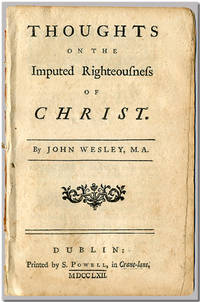
1762WRCLIT66501Dublin: Printed by S. Powell 1762. 111pp. 12mo. Extracted from nonce pamphlet volume. Slight tanning but a very good copy. First edition published in the same year as the London edition which is denoted the "Second Edition." An uncommon edition: ESTC locates four copies in North America and six in the British Isles 3 of them at Manchester. OCLC only adds a handful of additional possibilities. NCBEL cites only this edition. ESTC T16613. BAKER 211. NCBEL II:1632. Printed by S. Powell unknown books
174714807Bristol: A & G. Way prs. 1747. 12mo 17.2 cm 6.75". 8 92 pp. <br><br>Second edition of John Wesley's rendition of the life of the legendarily pious theologian Thomas Halyburton sometimes given as Haliburton son of a Scots nonconformist minister. Halyburton's writings all published posthumously were promoted by Wesley who provided the introduction for this volume and some editing of Halyburton's autobiography. <br>Â Â Â Â <br>Â Â Â Â ESTC N9604. Period-style calf by Grace Bindings signed in blind at inner area of lower rear turn-in framed and panelled in blind rolls with blind-stamped corner fleurons spine with gilt-stamped leather title and author labels and with gilt-stamped floral decorations. Pages age-toned and paper embrittled with a very few small edge nicks; title-page with a short tear from lower margin into lower inner corner not touching text.<br>Â Â Â Â Clean interesting. A & G. Way, prs. hardcover books
1797055132London: G. Whitfield 1797. New Edition . Hardcover. Very Good Plus. 8vo. LONDON : 1797. New Edition. First published in 1780. A nice early edition; eighteenth century editions are hard-to-find. Hardback. Original calf-leather; gilt decoration to full spine not lettered; neatly professionally restored with original spine laid-down to matching calf; hidden. Original end-papers. Tight bright and clean. Minor wear only. Neat owner name; Edith Forest 1798. No internal markings. Tight bright and clean. Nice and attractive copy. VERY GOOD INDEED. 522 xvii pages. Indexes. Referenced by: English Short Title Catalog T124130. 8vo. Will be well-packed for posting/shipping. Rosley Books for Antiquarian books CHS Cumberland Everyman GKC Inklings Keswick Literature MacDonald Rarities Theology and History. . SCARCE. <br/> <br/> G. Whitfield hardcover
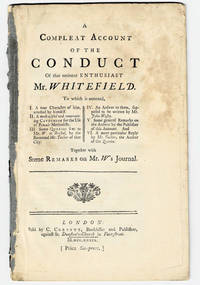
173998089London: Sold by C. Corbett Bookseller and Publisher against St. Dunstan's-Church in Fleet-Street 1739. 1739. Good. - Octavo 8-1/2 inches high by 5-1/2 inches wide. Printed self-wrappers with "Price Six-pence" in square brackets at the foot of the title page. Remnants of later plain green wraps are present along the spine. The front edges of the cover page and last page are slightly chipped. 2 & 38 deckle-edged pages decorated with a title device a formal head & tail piece and woodcut initial. There is scattered dampstaining particularly to the first and last pages. Good. <p>First and only edition. RARE.<p>The significance of a large part of the content of this pamphlet is described in a scholarly article by the American theologian and leading authority on John Wesley Dr. Randy L. Maddox. His article John Wesleys Earliest Published Defense of the Emerging Revival in Bristol 2014 can be found at The Divinity Archive a project of The Duke Divinity School Library.<p>Part 1 "A Compleat Account of the Conduct &tc. of that Eminent Enthusiast Mr. Whitefield &tc." pages 1-16 is a scathing denunciation of Whitefield and John Wesley pieced together by the publisher Charles Corbett. Corbett who was responsible for other anti-Methodist tracts cites an account in the high church Anglican-supported Weekly Miscellany as his source. Corbett mocks Whitefield: "There is something so extravagantly ridiculous in the Behavior of this young Man it is very difficult for a person of any Humour to keep his Countenance.". He later goes on to include Wesley in his insults: "I defy all Mankind to justify such Conduct upon any Principles whatsoever; and Mr. John Wesley is less justifiable or rather more guilty than Mr. Whitefield because he is a Man of more Learning better Judgement and a cooler Head.". Following this Corbett publishes "A Copy of a private Conversation of Mr. Whitefield's taken down in Writing after his leaving the Room and brought to him by the Rev. Mr. Tucker Minister of All-Saints in Bristol and at his Request sign'd by Mr. Whitefield himself." It is the text of a conversation Whitefield had on March 30 1739 in which he attributes his understanding of "true Christianity" to a book by Henry Scougal "The Life of God in the Soul of Man". The text was originally published by Josiah Tucker in a broadsheet dated "Bristol March 30 1739".<p>Part II "A Method of Confession drawn up for the Use of the Women Methodists. Taken from the Original." pages 18-20. Among the questions proposed are the following: "Are you in Love / Do you take more Pleasure in any Body than in God / Whom do you love just now better than any other Person in the World / Is not the Person an Idol Does he not especially in Publick Prayer steal in between God and your Soul / Does any Court you / Is there any one whom you suspect to have any such Design / Is there anyone who shews you more Respect than to other Women / Are not you pleased with That / How do you like him / How do you feel yourself when he comes when he stays when he goes away The last ten Questions may be ask'd as often as Occasion offers." Josiah Tucker described this as "shocking scheme for confessing the women". Dr. Maddox makes a cogent argument in his essay that while differing from Wesley's original December 1738 "Rules of the Band Societies" the author of the rules published here may have been Wesley not Whitefield.<p>Part III "Queries to Mr. Whitefield" pages 20-22 were written by Josiah Tucker and appeared around mid-april 1739. According to Dr. Maddox the queries were "highlighting his discomfort with Whitefields emphasis on extraordinary operations of the Spirit". Part IV "An Answer to the Queries sent to Mr. Whitefield from the Rev. Mr. Tucker Minister of All-Saints Bristol; in a Letter to the Querist" 22-25 is attributed to John Wesley by both the publisher Charles Corbett and Dr. Maddox in his essay. The tone of the reply is quite disdainful. The writer opens: "Had not the Bristol Queries been said to be written by the Rev. Mr. Tucker I should have imagin'd they come from one who had no manner of Notion of Divine Revelation; but as you are a Reverend Minister I must suppose you to be a Christian though you have given great room to think that you believe nothing of the Operations of the Holy Spirit by owning that you do not perceive them in yourself and are hitherto unacquainted with any extraordinary and supernatural Light". He concludes: "If I have mistaken you please to let me know it and tell me both what you mean by the Expressions in which you oppose Mr. W's Notions of supernatural Light and Assistance and what your own Notions are of these Things."<p>Part V of the pamphlet pages 26-31 is Corbett's response to the "Answer to the Queries" followed by his negative assessment of Whitefield. "This Answer is a sophistical Evasion and a false Charge upon the Querist. It turns all upon the Ambiguity of the Words extraordinary and supernatural and feeling or experiencing. Neither the Querist nor any other sober Christian denies the Operation of the Spirit upon our Minds and Hearts; and as this Influence is added to the natural Powers of the Soul it may be called extraordinary or supernatural." Corbett's argument is followed by his contemptuous remarks regarding Whitefield. "Mr. W. in the Character signed by himself has thoroughly satisfied the World of his great natural Abilities and the following Extracts from his last Journal are as strong a Proof of his supernatural Powers and Endowments. Tho' in many of them his Humility be so extraordinary as to put him upon a level with the Prophets and Apostles only yet in others he seems to put himself upon a Foot with Jesus Christ: and the Carnal Letter-learned Established Clergy are rank'd with the false Prophets whom he very candidly threatens with Damnation for opposing him." These statements are followed by nearly three pages of extracts from Whitefield's journal.<p>Part VI is Josiah Tucker's reply to Wesley's answer pages 31-38. It is headed: "The following Reply of Mr. Tucker's not coming to hand 'till all the preceding Part of this Pamphlet was printed off and being willing to make this Collection as complete as I could I have here inserted it". Tucker's reply is dated "OxonJune 14 1739" and includes numerous footnotes by the author. It is especially interesting in that it includes Tucker's attack on the Catechism for female Methodists. He is responding to "Rev. Mr. Hutchins" i.e.John Hutchings b. 1716 who worked closely with Whitefield in Bristol in 1739. "Agreeable to this his Friend and Assistant at Bristol the Rev.Mr. Hutchins put out some Remarks on my Queries wherein with the usual Christian Spirit and Meekness of the Sect he affirms That I had cast a slur upon my gown . . . That I ought to quit the Ministry -- And that I got it by downright Falsehood and Equivocation..His next Attack is on my Phrase and Diction: Here he says I ought not to have asked After what Manner they come into the Mind but after what Manner we are enabled to discern believe and embrace them.But before I take my leave of him I would desire him to consider that if I really was a Deist as he represents me I should not have been such a strenuous Opposer of Mr. Whitefield: No The Deists seem strongly inclin'd to favour his Cause and foment the Division. They in particular are highly delighted with his Shocking scheme for confessing the Women; the graver Part with the Abuse and miserable Perversion of Scripture Sentences and the more dissolute with his indecent and loose Interrogations. This is a Scheme so evidently calculated to promote Vice and Lewdness that many People still persist in thinking 'tis only a waggish Sneer put upon him. But the Gentleman need not be told the contrary; as he appears to be Mr. Whitefields Friend he must know that 'tis a genuine and real Piece approved and recommended by the Heads of the Sect and actually put in Practice both in London and Bristol. Since therefore he has taken upon him to vindicate Mr. Whitefields Principles and Conduct he is hereby called upon publickly to defend it." London: Sold by C. Corbett, Bookseller and Publisher, against St. Dunstan's-Church in Fleet-Street, 1739. paperback
1765mon0000946063William Pine 1765. Hardcover. Very Good. in x in x in. William Pine 1765 first edition by John Wesley English cleric theologian and evangelist who was a leader of a revival movement within the Church of England known as Methodism. Leather binding firm with minor wear and bumping to the spine and boards. Pages clean and bright no markings with the exception of a monogram ""M.M."" inscribed by a previous owner on the end paper of the fore board. Overall a very good and rare examplar for its age. William Pine hardcover
17741283611774. First Edition. BENEZET Anthony WESLEY John. Thoughts upon Slavery. IN: A Collection of Religious Tracts. London Printed: Re-Printed in Philadelphia: Joseph Cruckshank 1774. Small octavo early full brown sheep. Housed in a custom chemise and clamshell box. $12000.First American edition preceded only by the same year's much shorter English edition of Wesley's influential and controversial early attack on slavery and the slave trade the first to contain abolitionist Anthony Benezet's expansive notes and afterword not in the English edition bound with a separate title page with four other works in publisher Joseph Crukshank's A Collection of Religous Tracts.Wesley a ""founder of Methodism was noted not only for outstanding powers of leadership but also for practical holiness social concern and immense courage"" Oxford Dictionary of World Religions 1037. He formulated a doctrine of perfection that led to the ""creation of the largest new family of churches to be thrown up by the revival in Britain and in the rest of the English-speaking world"" ODNB. While he was a colleague of leading abolitionists William Wilberforce and Anthony Benezet in Thoughts upon Slavery ""the ethical core of the argument is Wesley's own"" Field John Wesley as a Public Theologian 4. He first witnessed the horrors of slavery as a missionary in Georgia and South Carolina. ""By the time he published his Thoughts upon Slavery he clearly opposed the cruelties and violations of the slave trade It is striking that in this attack on slavery Wesley explicitly does not use the Bible as the basis for his position. Instead he argues that slavery cannot be reconciled with justice and mercy and derives his understanding of justice from natural law Jennings reports that Wesley went even further in moving from protest to transformation"" Sample Future of John Wesley's Theology 58-9. Wesley's work also stands out in that he was a political conservative who rejected democracy and ""strongly criticized mass action here however he legitimated slave resistance and rebellion as an expression of natural liberty in contradiction of biblical injunctions to slaves"" Field 6.This pivotal edition was issued at the urging of Benezet after reading the same year's much shorter English edition. He was especially moved by Wesley's ""exhortation to the ship captains merchants and planters involved in slaving urging them to 'give liberty to whom liberty is due that is to every child of man to every partaker of human nature.'"" Benezet quickly ""arranged with Philadelphia printer Joseph Cruikshank to reprint Wesley's pamphlet but not before he added five expansive footnotes and a lengthy afterword the general tenor of these additions was to clarify and amplify points Wesley had made"" Crosby ed. Complete Antislavery Writings of Anthony Benezet 197. In England ""the public response to Wesley's Thoughts upon Slavery would soon be so great that 229000 people signed petitions against the slave trade to be presented to Parliament"" Jackson Let This Voice Be Heard 126. Yet ""Wesley's attack on the profitable slave trade was risky his opinions were an affront to those who considered the Africans their inferiors. For the latter group Wesley had further unsettling words: 'The inhabitants of Africa are not inferior to the inhabitants of Europe; to some of them they are greatly superior'"" Yrigoyen John Wesley. ""Wesley's contribution to the struggle against slavery did not end with the publication of Thoughts upon Slavery Symbolically the last letter he wrote before his death was to Wilberforce supporting him in his struggle to have the slave trade abolished"" Field 6. Preceded by the same year's 53-page English edition published without Benezet's lengthy notes and afterword. Thoughts Upon Slavery was both published separately and included as ""the second title in: Benezet Anthony. The Potent Enemies of America Laid Open Philadelphia: Joseph Crukshank 1774 Evans 13146 and as part of some copies of: A Collection of Religious Tracts as here Philadelphia: Joseph Crukshank 1773-1778 Evans 13145"" ESTC W28091. The other titles in this collection each with a separate title page pagination and Crukshank's imprint are: The Plain Path to Christian Perfection by Johannes Tauler translated by Anthony Benezet; The Dreadful Visitation in a Short Account of the Progress of the Effects of the Plague 1774 an abridged version of Defoe's Journal of the Plague Year; Benezet's The Mighty Destroyer Displayed the mistaken Use as well as Abuse of Distilled Spiritous Liquors 1774 and Stephen Crisp's Sermons or Declarations 1773. Sabin 4671 102699. Evans 13145 13762. Hildeburn 3134. Early owner signature. Small early ink notation to the title page: ""Collected by Anthony Benezet.""Minor marginal dampstaining to last leaves of final title Sermons or Declarations; expected age-wear to early sheep binding. Very scarce. unknown