352 résultats
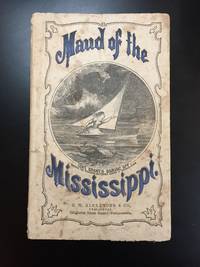
18642790Philadelphia: C.W. Alexander & Co 1864. First Edition. Original pictorial wrappers printed in blue and black 9.25 x 5.75 inches i-iv 21-30 31-32 39-52 53-54 61-74 75-76 85-100 pages i.e. 64 pages as published. Full-page woodcut illustrations included in the pagination. Copyright date on the title page of 1863; the dated preliminary text dated January 15 1864. Somewhat worn some staining and light foxing especially toward the rear; a good sound copy. Fact or fiction the present account celebrates the covert role of women as gatherers of military intelligence during the Civil War. The spectacular illustrated cover is given a full-page reproduction by Alice Fahs' in her "The Imagined Civil War: Popular Literature of the North and South 1861-1865" p. 243. The text is accompanied by a number of naive woodcuts and presents the account of "Maud Melville" the non-de-guerre of "Pauline D'Estraye" who is herself a fictional character invented by "Wesley Bradshaw" pseudonym of Charles Wesley Alexander. The layers of literary deceipt are appropriate for a spy-thriller such as this.<br/><br/>"There is little evidence that the author's Civil War characters were based on real people. However at the beginning of 'Pauline of the Potomac' 1862 Bradshaw hinted at the fact asserting that in the tale he had merged stories from real wartime incidents. Some believe that the character of Pauline D'Estraye was Pauline Cushman 1835-1893 actress and Union spy who was born in New Orleans to a Spanish political refugee and a Frenchwoman. At age 18 she went to New York to earn her living and was recruited there by the manager of the New Orleans Varieties for his show. She and her husband another performer toured throughout the country. When the Civil War erupted he enlisted in the Union army as a musician; she continued to perform until commissioned as a secret agent by the federal government in 1863 with instructions to penetrate as far south as possible. Apprehended by Confederate forces near Tullahoma Tennessee she was tried and sentenced to hang in June 1863. Fortunately for her she was left behind when the advancing army of General William S. Rosecrans forced the Confederates to retreat. Although her usefulness as a spy came to an end she returned to the stage lecturing throughout the North in a federal uniform to great acclaim. Cushman's glamorous but slightly shady profession in addition to her feats of espionage was ideal material for the dime novels of the day. "Maud of the Mississippi" is one of several such novels that appeared during the war years. The heroine Maud Melville gathers intelligence for General Grant as she performs as an actress in towns along the lower Mississippi River. <br/><br/>¶ Fact or fiction Gen. Grant's woman spy Maud Melville was a coquettish young woman with nerves of steel and a genius for military strategy. She is sent by Grant into Vicksburg as a spy; her efforts help the Union army capture the city. Hints that she has captured the affections of General Pemberton are offset by her evident piety; Maud meets with such success that the present account concludes with the promise "Her daring exploits during General Grant's subsequent campaign and her final discovery and capture by the rebels in Georgia which are far more exciting than her previous adventures will be published immediately in a second volume of the same style and price as this book."<br/><br/>Scarce: we have located only one copy in on the market since 2008 namely in M & S Rare Books Catalogue Eighty Four item 16 - this copy<br/><br/>REFERENCES: Women in the American Civil War ed. Lisa Tendrich Frank vol. I p. 99. Thomas Ruys Smith River of Dreams: Imagining the Mississippi before Mark Twain p. 188. C.W. Alexander & Co unknown books
2002RKUERAI00MWLorraine 2002. Very Good. . Raising LaVaughn. Clark Cari; Clark Wesley; Bagley Illustrator Pat. Salt Lake City: Lorraine 2002. 83pp. Illustrated. 8vo. Paperback. Signed by author. Book condition: Very good with very light rubbing to edges faint soiling to front cover and a shallow scratch in rear cover. Contains seven blank pages for notes. Signed by Bagley on half title. Lorraine paperback books