56 résultats
1800B000NMQAOAMethodist Book Room 1800's. Hardcover. Good. Good Hardcover. Edges are rubbed. Contains some underlining. Front endpage loose but binding is tight. Methodist Book Room hardcover
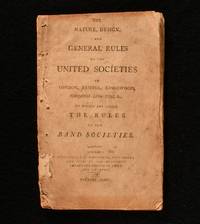
1796716P28London: G. Whitfield 1796. Disbound. Good. 6.5" by 4". None. A very scarce copy of John Wesley's rules for Methodist societies. A very scarce work.ESTC citation number N3911.A rare set of rules for John Wesley's Methodist societies. Wesley's societies were Methodist churches where people could visit and be guided in their prayers and lives.The societies were founded by John Wesley in 1739 and became the dominant form of the independent Methodist movement. Wesley was the leader of a revival movement in the Church of England which was known as Methodism.This rule book is intended for the societies in London Bristol Kingswood and Newcastle-Upon-Tyne and more.The rules for band societies is included in this work. The bands were what the Fetter Lane Society were divided into. Disbound. The external leaves are a little age-toned with loss to the tail of the front wrap and to the gutter of the wraps. Long spilt along the backstrip may tear. Light spots to the outer wraps. Internally disbound. Pages are lightly age-toned and some spots. Small puncture marks to the gutters of leaves. Light edgewear to all leaves. Page 8 and 11/12 are a little closely cropped to the head affecting the pagination only. Good G. Whitfield unknown
17741283611774. First Edition. BENEZET Anthony WESLEY John. Thoughts upon Slavery. IN: A Collection of Religious Tracts. London Printed: Re-Printed in Philadelphia: Joseph Cruckshank 1774. Small octavo early full brown sheep. Housed in a custom chemise and clamshell box. $12000.First American edition preceded only by the same year's much shorter English edition of Wesley's influential and controversial early attack on slavery and the slave trade the first to contain abolitionist Anthony Benezet's expansive notes and afterword not in the English edition bound with a separate title page with four other works in publisher Joseph Crukshank's A Collection of Religous Tracts.Wesley a ""founder of Methodism was noted not only for outstanding powers of leadership but also for practical holiness social concern and immense courage"" Oxford Dictionary of World Religions 1037. He formulated a doctrine of perfection that led to the ""creation of the largest new family of churches to be thrown up by the revival in Britain and in the rest of the English-speaking world"" ODNB. While he was a colleague of leading abolitionists William Wilberforce and Anthony Benezet in Thoughts upon Slavery ""the ethical core of the argument is Wesley's own"" Field John Wesley as a Public Theologian 4. He first witnessed the horrors of slavery as a missionary in Georgia and South Carolina. ""By the time he published his Thoughts upon Slavery he clearly opposed the cruelties and violations of the slave trade It is striking that in this attack on slavery Wesley explicitly does not use the Bible as the basis for his position. Instead he argues that slavery cannot be reconciled with justice and mercy and derives his understanding of justice from natural law Jennings reports that Wesley went even further in moving from protest to transformation"" Sample Future of John Wesley's Theology 58-9. Wesley's work also stands out in that he was a political conservative who rejected democracy and ""strongly criticized mass action here however he legitimated slave resistance and rebellion as an expression of natural liberty in contradiction of biblical injunctions to slaves"" Field 6.This pivotal edition was issued at the urging of Benezet after reading the same year's much shorter English edition. He was especially moved by Wesley's ""exhortation to the ship captains merchants and planters involved in slaving urging them to 'give liberty to whom liberty is due that is to every child of man to every partaker of human nature.'"" Benezet quickly ""arranged with Philadelphia printer Joseph Cruikshank to reprint Wesley's pamphlet but not before he added five expansive footnotes and a lengthy afterword the general tenor of these additions was to clarify and amplify points Wesley had made"" Crosby ed. Complete Antislavery Writings of Anthony Benezet 197. In England ""the public response to Wesley's Thoughts upon Slavery would soon be so great that 229000 people signed petitions against the slave trade to be presented to Parliament"" Jackson Let This Voice Be Heard 126. Yet ""Wesley's attack on the profitable slave trade was risky his opinions were an affront to those who considered the Africans their inferiors. For the latter group Wesley had further unsettling words: 'The inhabitants of Africa are not inferior to the inhabitants of Europe; to some of them they are greatly superior'"" Yrigoyen John Wesley. ""Wesley's contribution to the struggle against slavery did not end with the publication of Thoughts upon Slavery Symbolically the last letter he wrote before his death was to Wilberforce supporting him in his struggle to have the slave trade abolished"" Field 6. Preceded by the same year's 53-page English edition published without Benezet's lengthy notes and afterword. Thoughts Upon Slavery was both published separately and included as ""the second title in: Benezet Anthony. The Potent Enemies of America Laid Open Philadelphia: Joseph Crukshank 1774 Evans 13146 and as part of some copies of: A Collection of Religious Tracts as here Philadelphia: Joseph Crukshank 1773-1778 Evans 13145"" ESTC W28091. The other titles in this collection each with a separate title page pagination and Crukshank's imprint are: The Plain Path to Christian Perfection by Johannes Tauler translated by Anthony Benezet; The Dreadful Visitation in a Short Account of the Progress of the Effects of the Plague 1774 an abridged version of Defoe's Journal of the Plague Year; Benezet's The Mighty Destroyer Displayed the mistaken Use as well as Abuse of Distilled Spiritous Liquors 1774 and Stephen Crisp's Sermons or Declarations 1773. Sabin 4671 102699. Evans 13145 13762. Hildeburn 3134. Early owner signature. Small early ink notation to the title page: ""Collected by Anthony Benezet.""Minor marginal dampstaining to last leaves of final title Sermons or Declarations; expected age-wear to early sheep binding. Very scarce. unknown