FRANCESCA IZZOMareMagnum

2 442 résultats
CAROCCI 2009 ALLO STATO DI NUOVO La teoria gramsciana della democrazia trae origine dalla crisi novecentesca dello Stato-nazione che, per Gramsci, è il soggetto costitutivo del mondo moderno. La democrazia è una possibilità iscritta nella morfologia del "moderno" che si rivela aperto a forme della soggettività non del tutto prevedibili e mai definitive. La risposta di Gramsci alla crisi della sovranità statale è la democrazia cosmopolitica: una prospettiva che oltrepassa l’identificazione di politica e Stato e apre la via a nuove forme di sovranità. La lettura filosofica dei Quaderni del carcere proposta nel volume ha radici lontane: nasce dalla esigenza di reagire alle “grandi narrazioni" incentrate sulla "crisi della ragione" impostesi negli ultimi decenni. La democrazia oltre lo Stato si prospetta come forse l’unica alternativa efficace alla presunta equazione di modernità e nichilismo, alla riduzione della filosofia alla teologia, alla regressione della politica alla pura potenza, alla inevitabilità della guerra. Introduzione 1. I Marx di Gramsci La critica al socialismo positivista/Contro il protezionismo/La guerra e il nazionalismo/La rivoluzione russa/Lenin contro Bordiga/I Quaderni del carcere/Marx filosofo della prassi/La traducibilità dei linguaggi/Egemonia e rivoluzione passiva 2. Filosofia della prassi e concezione della modernità 3. Teoria del soggetto storico 4. Machiavelli filosofo della prassi Politica e storia. Machiavelli e Cesare/Machiavelli scienziato o uomo appassionato e politico in atto?/Gli interlocutori del Principe: il tiranno o il popolo? 5. Dalla territorialità all’industrialismo: la democrazia oltre lo Stato nei Quaderni del carcere 6. Nazione e cosmopolitismo nei Quaderni del carcere 7. Tre Convegni gramsciani 8. Lo storicismo e la riforma intellettuale e morale. Il Gramsci a due facce di Luporini 9. «I due mondi». Tatiana Schucht, Antonio Gramsci e Piero Sraffa sulla questione ebraica Indice dei nomi
74711Darmstadt : Theiss [2016]. 607 Seiten : Illustrationen ; 24 cm Pappe 0
Gutes Exemplar; Einband gering berieben; Seiten minimal nachgedunkelt; Bleistift-Anstreichungen; Beilage: kl. Zeitungsausschnitt (aus der Zeit). - INHALT: Vorwort H. Wagenführ ----- I Die Philosophie des Faschismus ----- Grundgedanken: Der Faschismus als Philosophie ----- Die geistige Haltung ----- Die bejahende Auffassung des Lebens als Kampf ----- Die ethische Auffassung ----- Die religiöse Einstellung ----- Die ethische und realistische Auffassung ----- Antiindividualismus und Freiheit ----- Gegen den Sozialismus und für den körperschaftlichen Gedanken ----- Demokratie und Nation ----- Begriff des Staates ----- Der ethische Staat ----- Wesen des Staates ----- Führertum ----- II Die politischen und gesellschaftlichen Grundlehren des Faschismus ----- Ursprung der Lehren ----- Entfaltung ----- Gegen Pazifismus: Kampf und Leben sollen sein ----- Über Bevölkerungspolitik und den "Nächsten" ----- Gegen materialistische Geschichtsauffassung und Klassenkampf ----- Gegen die demokratischen Hirngespinste ----- Die Unwahrheiten der Demokratie ----- Gegen die liberalen Lehren ----- Der Faschismus wendet sich nicht rückwärts ----- Wesen und Aufgabe des Staates ----- Die Einheit des Staates und die Widersprüche des Kapitalismus ----- Der faschistische Staat und die Religion ----- Herrschaft und Manneszucht ----- III Aus Reden und Manifesten.
194376019C. H. Beck'sche Verlagsbuchhendlung 1943. paperback. good condition with moderate wear and a bit of spine darkening C. H. Beck'sche Verlagsbuchhendlung paperback
1927284560Berlin, Propyläen, 1927. Mit zahlreichen Schwarz-Weiß Abbildungen auf Tafeln und im Text sowie Abbildungen nach Schwarz-Weiß--Fotografien. Originalbroschur mit Deckelillustration. gr.8°.
192969447ABBerlin, Brunnen-Verlag, 1929. 8°. 110 S., 1 Titelportrait. Original-Karton (OEngl.Broschur) und OUmschlag mit Portraitphoto von Mussolini.
1929102041-1Berlin, Brunnen ( 1929). 110 S. Mit 1 Portr. Original-Leinenband
19794759Das Beste, Stuttgart, Zürich, Wien, 1979. 408 S., 8°gr., m. zahlr sw Fotos u. Tabellen, Anhang: Der Krieg in Zahlen, OPpbd., Einband berieben, innen gut
1953291519Stuttgart, Scherz & Goverts, 1953. 424 Seiten. Originalleinen. 22 cm
199736519Göttingen Steidl, 1997. Broschiert
351616 pages in8 - bon état -
IL SAGGIATORE 1967 256 PP. FONDO DI MAGAZZINO: LIEVI SEGNI DEL TEMPO, VOLUME PERFETTO E INTONSO.
Mm 155x225 Collana "Storica Rizzoli" - Prima edizione a cura di Giordano Bruno Guerri. Volume in copertina con sovraccoperta, 581 pagine con alcune tavole in nero fuori testo. Esemplare in ottime condizioni. SPEDIZIONE IN 24 ORE DALLA CONFERMA DELL'ORDINE.
2 voll. In 8o, pp. (XXVIII) 382; 326, br. con sovracc. Premessa di Ugo d' Andrea. Note a cura di Renzo Trionfera. Seconda edizione dello stesso anno della prima. Vol. I: 1939-1940; vol. II: 1941-1943. Come nuovi. Ottimo (4170/CIANO - BIOGRAFIE - FASCISMO - MUSSOLINI)
Firenze, Bemporad, 1927, 8vo brossura (a fogli chiusi) in 8vo brossura, pp. XI-72 (Garibaldi evocato da Oriani, Fiume e D'Annunzio, Dalmazia, Legione di Ronchi, ecc. (Quaderni Fascisti')
200412805München/Wien, Hanser, 2004. 8°, 375 Seiten. mit mehreren Abbildungen und Photos. Orig.Pappband mit silbergeprägtem Rückenschild und OSU.
21289aafRom, C. Colombo, 1927, gr. in-8°, 238 S., broschiert.
194426121Ohne Ort, ohne verlag, ca. 1944. Großes 8°. 1 Blatt.
Mm 160x225 Brossura editoriale di 114 pagine ancora intonse. Ossidazioni a margine della copertina e ai tagli, occasionalmente anche alle carte, ma nel complesso copia in buon ordine con legature ben salde.
Mm 135x210 Collana "Storia e società" - Volume cartonato con legatura editoriale in tela grigia, sovraccoperta originale, VIII-504 pagine. Dorso della sovraccoperta lievemente brunito, peraltro ottima copia, probabilmente mai letta. SPEDIZIONE IN 24 ORE DALLA CONFERMA DELL'ORDINE.
LEGATURA IN BROSSURA EDITORIALE CON ILLUSTRAZIONE numero pagine: 61 formato: 17.6X12.4 stato conservazione: ABBASTANZA BUONO, LIEVI TRACCE D'USO ALLA COPERTINA
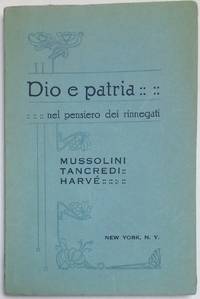
1924256441New York: Il Martello 1924. 133p. paperback very good top of pages unopened a lovely example. "Il Martello" The Hammer was a weekly anti-fascist publication edited by Carlo Tresca. A collection of early texts on religion and nationalism by three former leftists who had become prominent fascists illustrating their complete betrayal of their prior beliefs. The text of Mussolini's section is from a debate held in 1904; it notes that this book was published 20 years later hence the estimated date of 1924. Il Martello unknown
1924259036New York: Il Martello 1924. 133p. paperback wraps worn with a few small stains staples rusted else very good second edition. "Il Martello" The Hammer was a weekly anti-fascist publication edited by Carlo Tresca. A collection of early texts on religion and nationalism by three former leftists who had become prominent fascists illustrating their complete betrayal of their prior beliefs. The text of Mussolini's section is from a debate held in 1904; it notes that this book was published 20 years later hence the estimated date of 1924. Il Martello unknown
1924260016New York: Il Martello 1924. 133p. paperback wraps somewhat worn with a small adhesion and some toning; second edition. "Il Martello" The Hammer was a weekly anti-fascist publication edited by Carlo Tresca. A collection of early texts on religion and nationalism by three former leftists who had become prominent fascists illustrating their complete betrayal of their prior beliefs. The text of Mussolini's section is from a debate held in 1904; it notes that this book was published 20 years later hence the estimated date of 1924. Il Martello unknown
1924260016New York: Il Martello 1924. 133p. paperback wraps somewhat worn with a small adhesion and some toning; second edition. "Il Martello" The Hammer was a weekly anti-fascist publication edited by Carlo Tresca. A collection of early texts on religion and nationalism by three former leftists who had become prominent fascists illustrating their complete betrayal of their prior beliefs. The text of Mussolini's section is from a debate held in 1904; it notes that this book was published 20 years later hence the estimated date of 1924. Il Martello unknown books