Louis Nicholas VauquelinBiblio.com
48 résultats
0266819583.Ghardcover. Good. Access codes and supplements are not guaranteed with used items. May be an ex-library book. hardcover
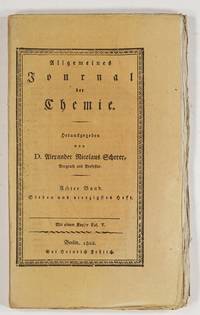
1802309601802. Allg. Journ. Chemie 8/47. - Berlin Heinrich Frölich 1802 8° pp.459-576 orig. Broschur; unbeschnittenes Exemplar in der sehr seltenen orig. Broschur. unknown
0331900114.Ghardcover. Good. Access codes and supplements are not guaranteed with used items. May be an ex-library book. hardcover
2010DADAX6131548285Omniscriptum 2010-11-11. paperback. New. 5.91x0.40x8.66. Buy with confidence. Excellent Customer Service & Return policy. Omniscriptum paperback
77467Paris J. L. Boilly 1820. Engraved broadsheet 36.3 x 27.3 cm. = A rarely-seen portrait of the French chemist and pharmacist Louis Nicolas Vauquelin FRS 1763-1829. He was the discoverer of two elements: chromium and beryllium. The artist Julien-Léopold Boilly 1796-1874 was noted for his album of lithographs Iconographie de l'Institut royal de France ou collection des portraits des Membres composant les quatre académies depuis 1814 jusqu'en 1825 1820-1825. His portraits are much less stiff and formal than many by his contemporaries. Signed by the artist in the lower left margin of the portrait and dated 1820. The caption states the date of his birth and the year 1795 in which Vauquelin was elected as a member of the Institut. Uncut. With in the lower right corner a small oval blindstamp 'Galerie Vivienne Bénard'. Scattered mild foxing; a damp-stain in the top-left corner some soling denting and marginal fraying as well as a short tear in the top edge; otherwise good. unknown
6131548285.Gpaperback. Good. Access codes and supplements are not guaranteed with used items. May be an ex-library book. paperback
1725BOOKS083340ITours: Vauquer & Lheritier. Very good copy. 1725. 1st. hardcover. Tall 8vo 39 pp. Pamphlet bound into simple red cloth covers. One folding table withing the text appears to be trimmed on the right edge and two engraved folding plates following the text. The list in the text calls for a third plate which if produced is missing. . Vauquer & Lheritier hardcover
36158Librairie de Maison In-12 xii-623pp. demi-basane époque exemplaire avec rousseurs unknown
2008SONG047051647XWiley 2008-01-08. 1. hardcover. Used: Good. 6.83x0.69x9.80. Buy with confidence. Excellent Customer Service & Return policy. Wiley hardcover
2008DADAX047051647XWiley 2008-01-08. 1. hardcover. New. 6.83x0.69x9.80. Buy with confidence. Excellent Customer Service & Return policy. Wiley hardcover
047051647XNew. Brand new and still unused unknown
180342886Paris Baudouin AN XI 1803. 4to. Without wrappers. Uncut. Extracted from "Mémoires de L'Institut National des Sciences et Arts" Tome Quatrieme. Pp. 363-466. A few minor brownspots on the first leaves otherwise fine and clean unopened. <br/><br/><em>First printing of this importent paper in the history of chemistry in which the authors gave the first satisfactory account of of urea which they named."Hundreds of concretions from various parts of human and animal bodies were analyzed by Fourcroy and Vauquelin. Most were urinary calculi which independently of Wollaston they classified according to chemical composition from 1798 onwards.They confirmed the frequent presence of uric acid and phiosphate of lime discovered in calculi by Scheele and Georg Pearson respectively and also found urate of ammonia the double phosphate of magnesia and ammonia and occasionally other compounds.In an attempt to find why urinary calculi were formed Fourcroy and Vauquelin investigated urine and in 1799 they gave in the paper offered the first satisfactory account of ures which hey named.they isolated it by recrystallization from alcohol and in 1808 achieved a purer state by adding alkali to the crystalline nitrate that they had discovered."DSB V p. 92-93. </em> unknown
180643597Paris Bernard 1806. Without wrappers. In: "Annales de Chimie ou Recueil de Mémoires.Par MM. Guyton Monge et. al." Tome 57 Issue Cahier 1. Halftitle to vol. 57. Pp. 5-112. Vaugelin & Robiquet's paper: pp. 88-93. A few scattered brownspots. <br/><br/><em>First appearance of this founding paper in which the authors announced their isolation of the first amino acid the fundamental bricks of protein from asparagus. </em> unknown
3506Paris: Auguste Aubry 1854. FIRST COMPLETE EDITION of the works of this Renaissance French poet. 2 leaves; XVI 156 pp plus an engraved portrait of the author. One of 274 numbered copies printed on fine Dutch laid paper. Large 8vo. Finely bound in 19th-century three-quarters morocco and marbled boards. Spine gilt. Top edge gilt other edges uncut. FINE AND BRIGHT. <br/><br/> Paris: Auguste Aubry, 1854 hardcover
180342885Paris Baudouin AN XI 1803. 4to. Without wrappers. Uncut. Extracted from "Mémoires de L'Institut National des Sciences et Arts" Tome Quatrieme. Pp. 21-112. Fine and clean unopened. <br/><br/><em>First printing of one of Biot's earliest work and one of his major mathematical paper. Biot is well known for his discoveries in connection with polarized light.An importent chemical paper in organic chemistry accompanies Biot's paper: Fourcroy et Vauquelin"Mémoire Sur l'analyse des calculs urinaires humains et sur les divers matériaux qui les forment". Pp. 112-150. </em> unknown
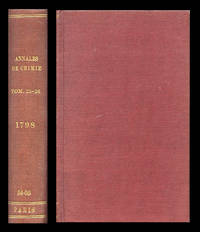
1798799Paris: Chez Fuchs et Guillaume 1798. 1st Edition. FIRST EDITION OF TWO PAPERS BY VAUQUELIN REPORTING THE DISCOVERY OF BERYLIUM. <br /> <br /> Louis Nicolas Vauquelin 16 May 1763 - 14 November 1829 was a French pharmacist and chemist who reports in this paper his discovery of a new ‘earth' obtained by pulverizing gemstone emerald before melting with three times its mass of potassium hydroxide" Walsh Beryllium Chemistry 7. In beryl beryllium aluminum silicate he found an earth oxide that superficially resembled alumina aluminum oxide but was insoluble in alkali and did not form alum. At the suggestion of the editors of Annales de Chimie Vauquelin named it glucina from the sweetness of its sulfate but when first isolated in 1828 by Friedrich Wohler and independently Antoine Bussy it was renamed beryllium DSB Vol. 13 p. 597. <br /> <br /> Though both Beryl and emerald were known as early as 77 A. D. they were not thought to be identical in any way. In 1797 the French mineralogist René Just Haüy noticed that the crystallographic structure of the two minerals seemed similar. Haüy urged Vauquelin to fully determine the chemical composition of each. <br /> <br /> As to the import and uses of Beryllium the national laboratory at Los Alamos states: "Beryllium is used as an alloying agent in producing beryllium copper which is extensively used for springs electrical contacts spot-welding electrodes and non-sparking tools. It is applied as a structural material for high-speed aircraft missiles spacecraft and communication satellites. Other uses include windshield frame brake discs support beams and other structural components of the space shuttle. Beryllium is used in nuclear reactors as a reflector or moderator for it has a low thermal neutron absorption cross section. It is used in gyroscopes computer parts and instruments where lightness stiffness and dimensional stability are required. The oxide has a very high melting point and is also used in nuclear work and ceramic applications" Periodic Table of Elements LANL Los Alamos National Laboratory Portal. <br /> <br /> ALSO INCLUDED: Martin Heinrich Klaproth report on the discovery of tellurium. Additionally Klaproth discovered or co-discovered zirconium 1789 titanium 1792 strontium 1793 chromium 1797 mellitic acid 1799 and cerium 1803 DSB Vol. 7 p. 394. CONDITION & DETAILS: Paris: Chez Fuchs et Guillaume. 8vo. 8.25 x 5.5 inches 206 x 137mm. Volume 25: 335 pages 1 plate. Volume 26: 340 pages 1 plate. Ex-libris with NO spine markings and very minimal interior markings small stamp on title page and blank front flyleaf. Tightly and very solidly bound in maroon cloth with a gilt-lettered spine; minor scuffing to the edge tips. Very slight toning to the preliminaries otherwise bright and very clean throughout. Very good condition. Chez Fuchs et Guillaume hardcover
1798315431798. Crells Chem. Annalen 1798/10-12. - Helmstädt bey C.G.Fleckeisen 1799 Kl.8° pp.267-516 Broschur. Beryllerde 1798 durch Vauquelin im Beryll entdeckt. Das freie Metall erhielten Wöhler und Buss 1828. unknown
1799309841799. Allg. Journ. Chemie 3/1314. - Leipzig Breitkopf & Härtel 1799 8° 264 pp. 2 orig. Broschur; unbeschnittenes Exemplar in den sehr seltenen orig. Broschuren. unknown
46011Paris Rue et Hotel Serpente 1791. 8vo. Contemporary half calf. Gilt spine. In: "Annales de Chimie: ou Recueil de Mémoires Concernant la Chimie et les Arts qui en Dépendent. Par MM. de Morveau Lavoisier Monge Berthollet De Fourcroy le Baron de Dietrich Hassenfratz & Adet." Tome Huitieme. 2336 pp. The entire volume offered. The paper: pp. 230-308. A few scattered brownspots. Small stamps on verso of titlepage. <br/><br/><em>First appearance of the paper in which the authors records a series of experiments on the combustion of hydrogen the aim of which was to confirm Lavoisier's large scale experiments on the synthesis of water. They finally proved that water only contains hydrogen and oxygen and found the approximate ratio of their weights."In May 1790 Séguin read to the Académie des Sciences the report on the larg-scale synthesis of water carried out in Fourcroy’s laboratory by himself Fourcroy and Vauquelin. The purpose of this experiment was to establish finally that water is composed only of hydrogen and oxygen and that the weight of water is fully accounted for by the weights of the two gases. They also sought to determine accurately the combining ratio of the components of water an especially important constant in oxygen chemistry. They found that the ratio hydrogen: oxygen is 2.052:1 by volume and 14.338:85.662 by weight. The discrepancies from the true figure probably arose from the difficulties of weighing the gases."DSB.Apart from other importent chemical papers by Fourcroy Seguin Klaproth etc. the volume contains Joseph Black's famous letter to Lavoisier where Black gives up his phlogistic theory and accepts the new chemistry lead by Lavoisier. "Copie d'une Lettre de M. Joseph Black a M. Lavoisier" pp. 225-229. </em> unknown
2026x-3032153670Springer Nature Switzerland Ag 2026. Paperback. New. 553 pages. 6.10x1.18x9.25 inches. Springer Nature Switzerland Ag paperback
179843088Paris Fuchs et Guillaume An VIe. 1798. Contemp. hcalf. Spine gilt. Very slightly rubbed. Small stamps on verso of titlepage. In: "Annales de Chimie ou Recueil de Mémoires concernant la Chemie" Tome 26. - 340 pp. a. 1 engraved plate.the entire volume offered. Vauquelin's papers: pp. 155-169 pp. 170-177 a. pp. 259-265. Some brownspots to the first and last leaves otherwise fine and clean. <br/><br/><em>First printing of the papers in which Vauquelin describes and announces his discovery of Beryllium."The discovery of beryllium resulted from the Abbé Haüy's observation of the close similarity and probable identity of beryl and the emerald. At his suggestion Vauquelin made some very careful chemical analyses of these two minerals and found in 1798 that they are indeed identical and that they contain a new earth which he named glucina but which is now known as beryllia. The metal was isolated thirty years later by Wöhler and Bussy independently.At the suggestion of the editors of the "Annales de Chemie." he called the new earth 'glucina' meaning sweet." Weeks in "Discovery of the Elements" p. 153-54. - Parkinson "Breakthrough" 1798 C.The volume contains other importent papers in the history of chemistry Hassenfratz "De l'Areométrie" "Suite." 2 Paprs. Berthollet Chaptal Guyton Fourcroy Priestly first app. in French etc. </em> unknown
179843089Paris Fuchs et Guillaume An VIe. 1798. Contemp. hcalf. Spine gilt. Very slightly rubbed. Small stamps on verso of titlepage. In: "Annales de Chimie ou Recueil de Mémoires concernant la Chemie" Tome 25. - 3353 pp. 2 engraved folded plates and 1 folded table.the entire volume offered. Vauquelin's papers: pp. 21-32 a. pp. 194-204. Some brownspots to the first and last leaves otherwise fine and clean. <br/><br/><em>First printing of the papers in which Vauquelin describes and announces his discovery of Chromium. The first paper was simultaneously printed in Mem.de l'Institut. Because of its many coloured compounds Fourcroy and Haüy suggested the name 'chromium' for the new metal. Greek chroma-colour.In 1797 Vauquelin began his own studies of Siberian red lead. He was convinced that the mineral contained a new element. None of the elements then known could account for his results. He reported "a new metal possessing properties entirely unlike those of any other metal." A year later Vauquelin was able to isolate a small sample of the metal itself. He heated charcoal nearly pure carbon with a compound of chromium chromium trioxide Cr 2 O 3 . When the reaction was complete he found tiny metallic needles of chromium metal. DSB XIII p. 597 - Parkinson "Breakthrough" 1798 C.The volume contains other importent papers in the history of chemistry Guyton "Examen de quelques propriétés du Platine" a. "Examen de quelques critiques de la nomenclature de chimistes francais" Chaptal "Observations sur la fabrication de l'acétite de cuivre verd-de-gris etc. </em> unknown
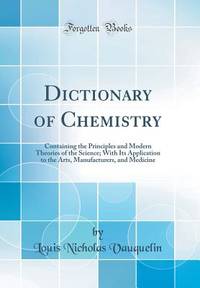
1830875261830. VAUQUELIN Louis Nicolas & Mrs. Almira H. Lincoln trans. DICTIONARY OF CHEMISTRY CONTAINING THE PRINCIPLES AND MODERN THEORIES WITH ITS APPLICATIONS TO THE ARTS MANUFACTURES AND MEDICINE. For the use of Seminaries of Learning and Private Students. Translated from Le Dictionnaire de chimie approuve par Vauquelin . With Additions and Notes by Mrs. Almira H. Lincoln . New York: G. & C. & H. Carvill 1830. First edition. Engraved frontispiece xxviii 29-531 pp. Errata list printed on verso of p. 531. 19 x 12 cm. 7 1/2 by 4 5/8 in. 12mo. contemporary binding: dun paper boards/brown linen spine with remnants of a printed paper label edges untrimmed. Early possibly contemporary ink ownership on ffep. and again on p. xix and book label of Samuel A. D. Sheppard the first president of the Massachusetts Pharmaceutical Association 1882 on front pastedown. Ex library having only two ink stamps on the front pastedown over the book label and again on title-page and a shelf label on spine. Binding is spotted worn at spine and along edges but sound. Pastedowns are heavily foxed. Text leaves are lightly foxed. Like her older sister Emma Hart Willard Almira Hart Lincoln Phelps American 1793-1884 was a pioneering teacher. She helped to broaden the education of American women with her popularization of the sciences as fit subjects for girls and was the author of a series of popular textbooks that were used in both boys and girls schools. In her preface to this book pp. vii-x written while she was vice principal at the Troy Female Seminary she explains a bit more about her role as translator and editor of this dictionary: "The compilers of the original work are MM. Brismontier Le Coq and Boisduval . their work having been submitted to the great chemist Vauquelin appeared under the sanction of his illustrious name. The translator has made additions from Ure Webster Green Journal of science Silliman's chemistry and some of the latest French writers." DAB 7; NAW 3; Amer. Women Writers abr.ed. 2; Siegel & Finley Women in the Scientific Search p. 141. Scarce. unknown